An episode from the period of Col Bashir Husain Zaidi as VC, AMU
Syed Ali Nadeem Rezavi
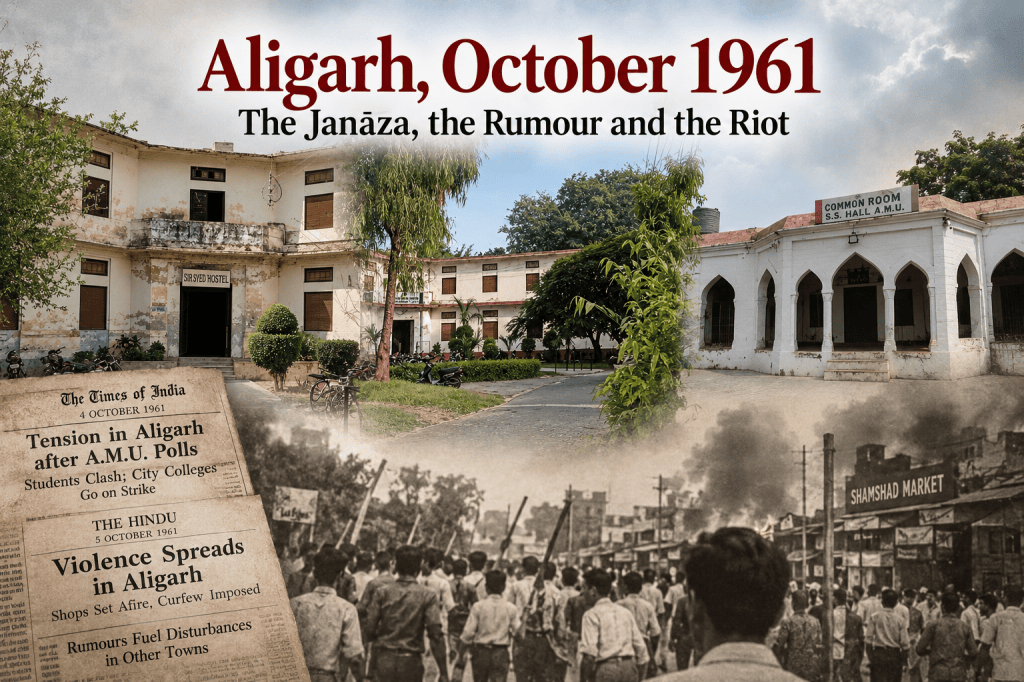
The communal disturbances that began in Aligarh in October 1961 occupy a curious place in the history of Aligarh Muslim University. They are remembered within the University, but usually in fragments. One recollection concerns a Students’ Union election; another, the old Aligarh custom of taking out the janāza, or mock funeral, of defeated candidates; another remembers the rumour that a Hindu student had been killed inside the University; and yet another recalls the attack from the city, the burning of shops around Shamshad Market and the fear that spread through the campus. Once the contemporary evidence is brought together, however, these fragments form a remarkably coherent and rather disturbing story.
The election and its communalisation
The events began with the elections to the Aligarh Muslim University Students’ Union (AMUSU) held on 1 October 1961. They need to be placed within the political atmosphere of Aligarh at the time. The University had 4,530 students, of whom the official administrative account listed 3,001 as Muslims, including overseas students. About 3,000 votes were cast. Hindu students had regularly participated in Union politics and non-Muslim candidates had been elected in previous years. Indeed, Bruce Graham notes that non-Muslims had secured representation in every Students’ Union election since 1951. What distinguished 1961 was the extent to which electoral alignments hardened along religious lines.
Initially eighteen Hindu candidates filed nominations for thirteen positions. Five subsequently withdrew, leaving what amounted to a Hindu slate, with one candidate for each position. The official account interpreted this as an attempt to consolidate Hindu votes, and this in turn provoked a counter-mobilisation among Muslim students. Badur-ul-Islam, a student of Ziauddin Hostel of Muhsinul Mulk Hall, was reported to have argued that Hindu voters were being organised communally and that divided Muslim votes could consequently allow Hindu candidates to capture the principal Union offices. Meetings were held in Ziauddin and Saifi hostels, Morrison Court and S.S. Hall to consolidate Muslim votes.
Communal appeals were therefore being made on both sides, and the official account records allegations that supporters of the Hindu candidates were soliciting Hindu votes on religious grounds. On the Muslim side, supporters associated with the Muslim right and Jamaat-e-Islami circulated equally inflammatory claims that, if Hindu candidates captured the Union, a temple might be constructed opposite the University mosque, Hindi would replace Urdu in Union proceedings and functions might begin with recitations from the Ramayana rather than the Qur’an. A campaign rickshaw was heard urging students to vote for supporters of Urdu lest the janāza of Urdu itself be taken out.
The precise slogan remembered in later accounts as “Hindus are in danger at AMU” requires some caution, because the exact wording has not so far been located in the contemporary official papers. There is, however, independent evidence that Hindu students were being asked to vote communally on the argument that Hindu students were being suppressed or disadvantaged within AMU. A later account explicitly describes the campaign in these terms. The underlying communal appeal is therefore documented, even if the exact phrase should not yet be placed within quotation marks without locating the original election leaflet or contemporary newspaper report.
The result was extraordinary. All thirteen positions went to Muslim candidates. According to the official reconstruction, approximately 2,700 of the 3,000 voters may have voted predominantly along communal lines, with only about 300 cross-community votes. Whatever the precision of that estimate, the outcome was striking because it was reportedly the first Union election in roughly a decade in which no Hindu candidate had succeeded. The results were declared at about 1.20 a.m. on 2 October, and it was at this point that an old Aligarh student custom acquired an entirely new significance.
The janāza and the clash
For years students had celebrated electoral victories by taking out mock janāzas or effigies of defeated candidates. Former AMU student leader Joginder Singh Bindra later recalled the practice quite matter-of-factly: supporters of the victorious group would carry the symbolic funeral of those who had lost, while defeated candidates sometimes absented themselves from campus to escape the humiliation. It was student rough humour, objectionable perhaps, but not inherently communal; by 1961, however, the context had changed. Vice-Chancellor Colonel Syed Bashir Husain Zaidi maintained that the practice had actually been prohibited two or three years earlier. The practice however continued, howsoever illegally, until at least 1980’s.
Nevertheless, at about 2.30 a.m., effigies representing defeated candidates were taken from V.M. Hall towards S.S. Hall, passing through Shamshad Market. Among those represented was a Hindu woman candidate, recorded in the administrative papers as Renuka “Bahjaj”, almost certainly Bajaj. There was also an attempt to include Iqbal Singh, who protested that he had withdrawn and had merely supported B. K. Sinha, the Hindu presidential candidate. Insulting slogans were reportedly raised against some defeated candidates.
Here the janāza ceased to be merely a piece of student theatre. Iqbal Singh and his associates confronted Badur-ul-Islam, and a scuffle followed. Several students sustained minor injuries. Thereafter matters became more serious inside Ziauddin Hostel. According to the district administration’s investigation, some Muslim students assaulted Hindu students, including several who had been sleeping and who had apparently played no part in the original confrontation. Windows were smashed and the bedding of one student was reportedly burnt. Five Hindu and three Muslim students were admitted to the University hospital, while others received treatment for lesser injuries. The official medical examination subsequently recorded numerous abrasions and contusions, although no student had been killed. This last fact is crucial: no Hindu student had been killed in AMU.
The rumour and the campus counter-rumour
Yet during 2 October the story spreading through Aligarh was increasingly that Hindu students had been murdered inside the Muslim University. The district authorities were already aware of the danger. Hindu students approached the District Magistrate displaying their injuries, and some left their hostels because they were frightened. At one point thirty or forty Hindu AMU students gathered at the District Magistrate’s residence and expressed fear that they would be attacked if they returned. Police and magistrates inspected the hostels and found Hindu students still residing there. At least two anxious Hindu students were actually taken by police to the University hospital so that they could see with their own eyes that the supposedly dead students were alive and could then convey this information to others.
At the same time, another account circulated within the campus. Even as reports of the period recorded that Hindu boys in Ziauddin Hostel had been beaten, it was rumoured among students and AMU fraternity, that Ziauddin, Saifi and other hostels had been attacked by students from D.S. College and Jana Sangh volunteers. According to this version, the attackers were sheltered in the house of a certain Dr Bhatnagar located near the Ziauddin Hostel, and emerged suddenly in an attempt to assault the hostels. They were said to have been repelled by residents of Muhsinul Mulk Hall, commonly referred to as M.M. Hall. This is what we heard when Bhatnagar’s house was allotted to my father a few years later. This account should be treated as a campus rumour or oral recollection unless corroborating contemporary evidence is found. It is nevertheless important because it shows that the University was not receiving the crisis in only one narrative. Outside the campus, the dominant rumour concerned the alleged “killing” of Hindu students inside AMU; within the campus, students also believed that organised Hindu groups from the city had attempted to attack Muslim hostels. The authorities also contacted local journalists Babu Lal Agrawal and Madan Lal Hiteshi, and explained that the incident had been a student clash and asked them not to exaggerate its communal dimensions, which they were doing quite liberally. Yet the rumour outran the official correction.
The Vice-Chancellor and the University’s response
At the centre of the University’s response to the crisis stood its Vice-Chancellor, Colonel Syed Bashir Husain Zaidi, who had headed Aligarh Muslim University since October 1956. Zaidi’s role during the disturbances is particularly significant because the contemporary administrative record shows him attempting to prevent the original student clash from becoming a Hindu-Muslim confrontation. When a group of frightened Hindu students gathered at the District Magistrate’s residence, expressing apprehension about returning to their hostels, Zaidi went there personally, assured them of their safety and even offered to take them to his residence and provide them food. University and district officials subsequently inspected the hostels, while arrangements were made to protect students who wished to remain or leave.
Zaidi also maintained that the old practice of taking out mock janāzas of defeated Students’ Union candidates had already been prohibited some years earlier, an important detail because it suggests that the procession which helped precipitate the crisis was neither an officially tolerated University ceremony nor something encouraged by his administration. Nehru’s later assessment is worth recalling in this context. Writing in August 1962, towards the end of Zaidi’s tenure, he observed that “Colonel Zaidi has done good work at Aligarh”, while also noting the difficulties created for him by ‘inadequate cooperation within the University’s own governing structure’. The evidence surrounding October 1961 thus presents Zaidi not as a passive spectator to the crisis, but as a Vice-Chancellor attempting, under exceptionally difficult circumstances, to contain a campus dispute before rumour and organised mobilisation carried it far beyond the boundaries of the University.
From campus fear to city mobilisation
By the evening of 2 October approximately 500 students had gathered near Gandhi Eye Hospital, some carrying sticks and announcing their intention of marching upon the University. They were persuaded to disperse, and police patrols were organised during the night while Section 144 was prepared for enforcement. The administration knew that the situation could explode the following morning. The connection with organised politics also becomes visible in the official papers. The district report stated that Atma Deo Sharma, a municipal commissioner described there as a well-known RSS and Bharatiya Jana Sangh worker and student activist, together with Jyoti Prasad Rastogi, secretary of the city Jana Sangh, had taken an interest in organising strikes in the city colleges. On the morning of 3 October strikes were organised in H.B. Barah Saini College, D.A.V. College and D.S. College.
Bruce Graham’s later reconstruction, drawing upon Jana Sangh history, gives the scale of the mobilisation. Dramatised accounts of what had occurred inside AMU were carried into the city’s colleges, and on 3 October a procession estimated at 7,000 to 8,000 people, predominantly students, attempted to march upon the University. Police stopped the main body near the Kathpula railway bridge. Jawaharlal Nehru’s own reconstruction, written privately to Uttar Pradesh Chief Minister C. B. Gupta on 10 October after interviewing a number of people, is particularly revealing. Nehru believed communal tendencies had developed among sections of both communities. He specifically mentioned Jamaat-e-Islami influence among some Muslim students and RSS, Jana Sangh and Vidyarthi Sangh influence among Hindu students, including students of the city colleges. But regarding the immediate mobilisation against AMU, he was unequivocal: the crowd came towards the University because of the false story that one or two Hindu students had been killed there. Nehru was astonished that the rumour had not been effectively contradicted before it produced its consequences.
Some members of the crowd managed to cross the railway line and enter the Civil Lines and University area. The district report places their number at roughly 150 to 200. They first set fire to Muslim stalls near Tasveer Mahal cinema, then damaged the University cricket pavilion and proceeded towards Shamshad Market, where Muslim-owned shops were burnt and damaged. AMU students now came out in large numbers. Some were armed with lathis. A Hindu cyclist was assaulted before magistrates intervened. Muslim students and some Muslim shopkeepers retaliated in Shamshad Market, setting fire to two Hindu shops and ransacking several others. What had begun as an assault moving towards the University had therefore turned into reciprocal street violence around its perimeter.
Chronology and responsibility
It is important to retain this chronology, because to say merely that “Hindu and Muslim students rioted” obscures how the violence developed. There had indeed been an intra-University confrontation on 2 October in which Hindu students were assaulted. That incident was real and should not be minimised. But campus recollections also preserve a counter-narrative of attempted attacks on Muslim hostels by students from D.S. College and Jana Sangh volunteers, allegedly sheltered by Dr Bhatnagar and repelled by M.M. Hall residents. Whether or not that account can be independently verified, its circulation demonstrates how rapidly competing stories of attack and self-defence were forming on both sides. Nobody was killed in the University.
The transformation occurred when the real assault was converted through rumour into a story of Hindu students having been murdered, while the campus itself circulated a parallel story of organised Hindu attacks on Muslim hostels. These narratives were carried into a pre-existing network of mobilisation in the city colleges. A large crowd then attempted to march upon AMU. Only after parts of that mobilisation penetrated the Civil Lines, attacked Muslims and burnt Muslim shops did large groups from the University emerge and retaliate.
Nor did the killings occur within the University. Violence spread through Aligarh city, with stabbings and shootings and the notorious violence at Manik Chowk. The official tally by 11 October stood at thirteen dead, twelve Muslims and one Hindu, although even the Hindu death was that of a Delhi mechanic whose connection with the communal disturbances was uncertain. Fifty of the sixty-one officially recorded injured were Muslims. Later scholarly accounts give slightly different totals, and Paul Brass has questioned the completeness of official casualty figures. The imbalance in the officially recorded victims is nevertheless unmistakable.
This is one reason why the description of the episode simply as an “AMU communal riot” is historically misleading. The initial campus clash certainly involved communal mobilisation on both sides, and Muslim students committed serious assaults in Ziauddin Hostel. At the same time, campus memory preserves allegations of an attempted attack by city-based Hindu students and Jana Sangh volunteers on Muslim hostels. But the larger violence in Aligarh city quickly became disproportionately directed against Muslims.
Nehru himself made precisely this distinction. He considered what happened inside the University regrettable but comparatively limited. What happened subsequently outside AMU, and particularly in other towns of Uttar Pradesh, alarmed him much more. In his private letter to C. B. Gupta, he wrote that Muslims in these other places appeared principally as victims. He considered two possible mechanisms: Hindu students leaving Aligarh may have carried exaggerated stories to their home towns, or organisations such as the RSS and Jana Sangh may have exploited the situation through existing networks, or both processes may have operated simultaneously. He believed that a hard core of communal activists had taken the lead.
The wider violence in Uttar Pradesh
The disturbances indeed travelled remarkably quickly. Meerut was one of the most serious centres. Paul Brass’s detailed study of the Meerut violence traces its immediate connection back to the Aligarh episode. Iqbal Singh, one of the principal participants in the Ziauddin Hostel confrontation, had connections with Meerut, and intelligence reaching Nehru suggested that his father was a police officer there. Nehru cautioned that he had not independently verified this information, which is an important qualification. Brass’s subsequent research similarly found accounts connecting Iqbal Singh with the mobilisation in Meerut.
Violence also broke out in Chandausi, Hapur and elsewhere. Speaking on 13 October, Nehru himself listed Aligarh, Meerut, Chandausi, Hapur and other places and remarked that one reassuring feature was that the wider masses had generally not become involved. Contemporary reporting cited in the Selected Works of Jawaharlal Nehru recorded seven deaths in Chandausi and Meerut in the immediate aftermath of the Aligarh disturbances. A Reuters report published by Le Monde on 10 October put the combined toll in Aligarh, Chandausi and Meerut at at least twenty-nine dead and about one hundred injured by that stage.
Chandausi provides another revealing example. Muslim merchants subsequently met Nehru and described extensive looting of their businesses. They told him that shops had been specially stocked for Dussehra and that the destruction had wiped out their working capital. One merchant reported losing three members of his family. They also alleged that students of the local D.A.V. College had repeatedly taken the lead during communal disturbances in Chandausi. Nehru transmitted their representation to C. B. Gupta.
The central government was sufficiently disturbed for Nehru to press for a formal inquiry. Writing to Home Minister Lal Bahadur Shastri on 18 October, he argued that although the disturbances in Meerut, Chandausi and Hapur might be investigated separately, the incidents in Aligarh city could not meaningfully be separated from those within AMU because the two were “intimately connected”. He suggested that the inquiry encompass both the University and the city, and there is another aspect of the story which deserves emphasis.
Contemporary sources do not support a simple picture of Hindu students inside AMU facing an undifferentiated hostile Muslim institution. About 150 Hindu students reportedly remained in the University throughout the crisis. University officials and the district administration inspected their hostels; escorts were subsequently provided to those wishing to leave. Nor had Hindu participation in AMUSU politics been exceptional before 1961. Former students remembered an earlier campus in which Sikh and Hindu candidates could and did win Union positions. The very abnormality of the 1961 result, when no Hindu candidate AM won, was one reason it attracted so much attention.
What October 1961 reveals
What October 1961 therefore reveals is not an ancient or inevitable Hindu-Muslim confrontation. It shows something historically more interesting and more disturbing: the manufacture of a communal riot out of a limited student conflict. There were genuine grievances. The election itself had been communalised. Hindu students had organised electorally along communal lines; Muslim students responded with their own communal consolidation. Some Muslim students assaulted Hindu students in Ziauddin Hostel, including students who apparently had nothing to do with the initial quarrel. None of this should be concealed.
But neither should the next stage be collapsed into the first. Nobody had been murdered in the University, yet Aligarh city was told that Hindu students had been killed. Within the campus, meanwhile, students circulated a different account: that D.S. College students and Jana Sangh volunteers, allegedly sheltered by a teacher, had attempted sudden attacks on Ziauddin, Saifi and other hostels and had been repelled by residents of M.M. Hall. Whether this account can be confirmed from contemporary records or not, but it belongs to the history of how the crisis was experienced and remembered inside AMU.
A traditional, if foolish, student ritual involving the symbolic janāza of defeated candidates became detached from its older campus meaning and could now be represented outside as evidence of something much more sinister. Injured students, frightened students, political activists, city colleges, rumours and existing organisational networks supplied the channels through which the story travelled. The result was that within little more than twenty-four hours thousands were marching towards the University.
Shamshad Market became one of the first physical meeting points between rumour and violence. Muslim stalls and shops were attacked and burnt, and retaliatory attacks followed. Violence moved into Aligarh city, and within days the reverberations were being felt in Meerut, Chandausi, Hapur and elsewhere.
Nehru appears to have understood the wider danger. His correspondence in the weeks following the disturbances repeatedly returned to the organisational infrastructure behind communal mobilisation. He did not absolve communal Muslim organisations within AMU. On the contrary, he criticised Jamaat-e-Islami influence sharply. But he was equally concerned by the role of the RSS, Jana Sangh and allied student networks outside the University. More significantly, after examining reports from the different towns, he distinguished the original campus conflict from the subsequent pattern of violence in which Muslims elsewhere were overwhelmingly the victims.
The episode therefore needs to be restored to the history of AMU with considerable care. It was neither simply an “attack on Hindus in AMU” nor simply an “RSS attack on AMU”. Both formulations flatten a complicated sequence of events. The documentary record permits a more precise reconstruction. A communally polarised Students’ Union election was followed by a provocative revival of the traditional janāza ritual. A confrontation followed, and Hindu students were assaulted in Ziauddin Hostel and an alleged attempt to attack Muslim hostels by D.S. College students and Jana Sangh volunteers took place.
The real assault in Ziauddin Hostel was then magnified into the false report that Hindu students had been murdered. Students and political activists in Aligarh city mobilised around the rumour. Thousands attempted to march upon the University. Muslim shops were attacked and burnt. University students retaliated. The conflict spread into the city, where the overwhelming majority of the recorded dead were Muslim, and subsequently into several other towns of western Uttar Pradesh. The distance between the original event and the stories that produced the larger violence is perhaps the most important historical lesson of October 1961. A quarrel had occurred. Students had been beaten. Competing rumours of attack and counter-attack then transformed the campus conflict into a city-wide communal crisis. But no Hindu student had been killed in Aligarh Muslim University. A rumour said otherwise, and a large part of western Uttar Pradesh briefly burned.
*
Note on Principal sources for further investigation
The most important primary body of material is the Home Ministry and Uttar Pradesh Government documentation reproduced or summarised in the Selected Works of Jawaharlal Nehru, Second Series, especially Volumes 71 and 72. Particularly valuable are Nehru’s letter to C. B. Gupta of 10 October 1961; the detailed administrative report, “Communal Conflict in Aligarh”, dated 17 October; Nehru’s correspondence with Lal Bahadur Shastri concerning an inquiry; the Central Intelligence material forwarded on 20 October; and his subsequent correspondence concerning Meerut and Chandausi. Nehru’s August 1962 assessment of Colonel Zaidi, including the observation that “Colonel Zaidi has done good work at Aligarh” and his remarks on the difficulties created by inadequate cooperation within the University’s governing structure, is also relevant. Contemporary parliamentary discussion should be read alongside Lok Sabha Starred Question No. 184, “Disturbances in Aligarh Muslim University”, answered on 23 November 1961. Contemporary newspaper coverage includes The Hindu, especially 7 and 8 October 1961, The Times of India reports for the first half of October, and Reuters reports reproduced internationally.
For later historical reconstruction, particularly important are Paul R. Brass’s early study Factional Politics in an Indian State: The Congress Party in Uttar Pradesh and his later work on communal violence in Aligarh and Meerut; Bruce Desmond Graham, Hindu Nationalism and Indian Politics: The Origins and Development of the Bharatiya Jana Sangh; Christophe Jaffrelot’s work on Hindu nationalism; and later studies of communal violence in Aligarh which use the 1961 disturbances as an important episode in the changing relationship between the University and the city.


