Syed Ali Nadeem Rezavi
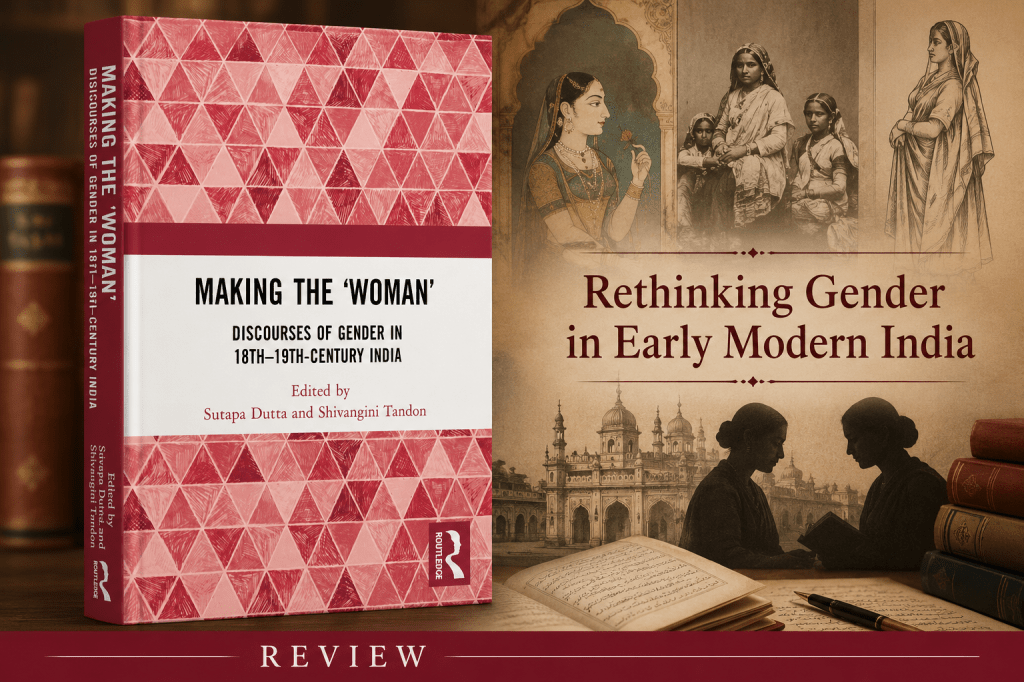
The historiography of women and gender in South Asia has undergone profound transformations over the past four decades. Early scholarship sought primarily to recover women who had been marginalized or overlooked in conventional historical narratives. More recent work has shifted towards interrogating the very categories through which femininity, masculinity and sexuality have been historically imagined. Making the ‘Woman’: Discourses of Gender in 18th–19th-Century India, edited by Sutapa Dutta and Shivangini Tandon, belongs firmly to this latter tradition. Rather than merely asking how women participated in history, the volume asks how the category of “woman” itself was historically produced through competing political, literary, social and cultural discourses. It is an ambitious undertaking that opens several important avenues of inquiry, even if it does not always fully realize all of its theoretical promises.
The editors provide an extensive introduction that serves as the intellectual backbone of the collection. Drawing upon contemporary feminist theorists including Judith Butler, Natalie Stoljar, Nancy Chodorow and Sally Haslanger, they reject essentialist understandings of womanhood and instead argue that “woman” is a historically contingent category shaped by intersecting structures of caste, class, religion, language, region and political authority. Their objective is not simply to write women back into history but to investigate the historical processes through which particular notions of femininity came to acquire legitimacy and normative force. This is an important and welcome intervention, particularly in the context of eighteenth and nineteenth century India, where discussions of gender have often remained confined within the familiar framework of colonial social reform and its nationalist responses. However, it is worth noting that the editors have not contributed individual essays to the collection themselves, confining their scholarly engagement to the introductory framework. While this is not unusual in edited volumes, the absence of their own case studies means that readers must look to the contributors for the empirical instantiation of the theoretical perspectives laid out in the introduction.
One of the major strengths of the volume is its chronological perspective. The editors resist the temptation to treat colonialism as the sole catalyst for changes in gender relations. Instead, they argue compellingly that many of these transformations had their origins in the late Mughal and regional polities of the eighteenth century. This longer historical perspective enables the contributors to situate colonial modernity within earlier processes of political, cultural and intellectual change. Such an approach represents a useful corrective to narratives that privilege colonial intervention at the expense of indigenous historical developments and pre-colonial trajectories of transformation.
The volume is organized into four thematic sections dealing with the public and private worlds, normative constructions of gender, marginalised identities and narratives of femininity. The range of subjects is impressive. Essays discuss Kashmiri hafizas, the Awadhi zenana, Mughal masculinity, Dalit counter-histories, tribal identities, goddess iconography, tawa’ifs, eunuchs, Tamil literary traditions, Bengali ritual songs and Assamese women’s writing. Collectively, these chapters demonstrate the extraordinary diversity of gendered experiences across the subcontinent and successfully undermine any notion of a singular or universal Indian womanhood. This diversity is not merely additive but fundamentally challenges the conceptual frameworks through which South Asian gender history has often been narrated.
Several contributions are particularly noteworthy. Tara Sami Dutt’s study of Wajid Ali Shah’s Ishqnama effectively challenges the long-standing assumption that the zenana was merely a secluded domestic space, demonstrating instead its political and cultural significance within the Awadhi court as a site of artistic patronage, intellectual exchange and political negotiation. Riya Gupta’s examination of the Mirzanama offers a valuable contribution to the growing scholarship on masculinity by showing that elite Mughal masculinity was itself a carefully cultivated social performance rooted in prescribed conduct manuals rather than a natural or stable identity. Lubna Irfan’s chapter on eunuchs similarly stands out for bringing architectural and spatial history into conversation with gender studies, thereby broadening the evidentiary base beyond textual sources and illuminating how built environments both reflected and constituted gendered hierarchies. These essays exemplify the interdisciplinary possibilities that the volume seeks to promote and suggest productive directions for future research.
Another commendable feature is the geographical breadth of the collection. Too often studies of gender in colonial India gravitate towards Bengal, with occasional forays into Maharashtra or the Punjab. Here, the inclusion of material from Kashmir, Awadh, Delhi, western India, Assam and Tamil Nadu significantly broadens the discussion and reminds readers that gender was negotiated differently across regional contexts, each with its own literary traditions, political structures and social formations. The volume also makes effective use of diverse source materials including paintings, literary texts, songs, manuscripts, colonial records and visual culture. Such methodological plurality enriches the historical narrative and reflects the increasingly interdisciplinary nature of gender studies, though it also raises questions about how these different genres of sources relate to one another.
Farhat Hasan’s foreword deserves particular mention. It is much more than a conventional prefatory note. By situating the volume within wider debates on early modern South Asian modernity, multilingual literary cultures, household politics and the relationship between textuality and gender, the foreword provides an elegant historiographical framework that complements and occasionally even extends the arguments developed in the chapters themselves. Hasan’s insistence on the need to historicise gender categories without assuming their universality sets the tone for the collection and offers a concise statement of the volume’s intellectual commitments.
Yet the collection is not without its limitations. The first concerns the relationship between theory and practice. The introduction presents a sophisticated theoretical critique of essentialist notions of womanhood and promises a sustained interrogation of the category of gender itself. However, not all the subsequent chapters engage with these conceptual concerns to the same degree. While some contributors critically interrogate categories such as gender, agency and identity, others employ these terms rather conventionally without fully exploring their historical contingency. Consequently, there is occasionally a discernible gap between the theoretical ambitions announced in the introduction and the empirical analyses offered by individual essays. A more sustained dialogue between conceptual frameworks and case studies would have strengthened the collection’s overall coherence.
The quality of the contributions is also uneven. Some chapters make substantial historiographical interventions and engage critically with both primary sources and existing scholarship, advancing novel arguments that reshape our understanding of specific contexts. Others remain closer to descriptive case studies that, while informative, do not fully exploit their analytical potential. This unevenness is perhaps inevitable in any edited collection, yet the volume sometimes resembles conference proceedings rather than a sustained collective intellectual project. Greater editorial cross-referencing between chapters, or a concluding essay drawing together their wider implications and identifying shared themes, would have enhanced the coherence of the collection and helped readers navigate its diverse offerings.
A more substantive criticism concerns the nature of the archive upon which the volume rests. Although the editors repeatedly emphasise recovering women’s agency and exploring marginalised voices, much of the evidence is drawn from elite literary, artistic and courtly sources. Consequently, the women who emerge most vividly are dancers, courtesans, royal women, literary figures and members of educated elites. The experiences of peasant women, artisans, labouring women and those inhabiting more ordinary social worlds remain largely absent from the analysis. This undoubtedly reflects the limitations of surviving sources and the archival biases that privilege elite and textual materials, but the implications of these archival silences could have been explored more explicitly. A more sustained reflection on what cannot be known, and on the methodological strategies available for approaching subaltern gendered experiences, would have added depth to the volume’s critical project.
Closely related to this is the volume’s overwhelming emphasis on discourse and representation. Most contributors are concerned with how women were imagined, depicted and represented across various textual and visual genres rather than how they actually negotiated economic, legal or institutional structures in their daily lives. Questions of property, inheritance, labour, taxation, commercial activity, education and legal rights receive comparatively limited attention. Yet these were precisely the arenas in which gender relations were materially constituted and contested. A closer engagement with social and economic history would have provided a stronger balance between representation and lived experience, and would have grounded the discursive analysis in the material conditions that shaped women’s lives.
From the perspective of Mughal historiography, another omission is noteworthy. The collection convincingly argues that domestic spaces were deeply political and that the boundaries between public and private were porous and contested. However, relatively little attention is devoted to the institutional dimensions of gender within the machinery of the Mughal state and its successor polities. Recent scholarship has increasingly demonstrated the importance of women, eunuchs and members of the imperial household in diplomacy, patronage, commerce and administration. These broader political implications remain only partially explored here. As a result, the discussion occasionally risks replacing one binary, namely public versus private, with another that continues to privilege representation over institutional practice.
The treatment of colonial modernity also offers less that is genuinely new than the discussions of the eighteenth century. The volume revisits familiar debates concerning social reform, domesticity and nationalist constructions of womanhood that have already been extensively analysed by scholars such as Lata Mani, Tanika Sarkar, Mrinalini Sinha and Partha Chatterjee. While these discussions are competently synthesised and provide useful overviews, the collection’s most original contributions lie elsewhere, particularly in its exploration of the late Mughal and regional worlds where different configurations of gender were in play. A sharper focus on these less familiar terrains would have distinguished the volume more clearly from existing scholarship.
This points to a broader chronological limitation. Although Farhat Hasan’s foreword invokes the sixteenth and seventeenth centuries, situating the volume within a longer history of early modern gender relations, the essays themselves confine their analysis to the eighteenth and nineteenth centuries. The classical Mughal centuries, the period of Akbar, Jahangir and Shah Jahan, remain largely unexamined here. This chronological boundary is not a flaw in itself, as the volume is explicitly framed around the later period. Yet the foreword’s invocation of an earlier era creates certain expectations that the essays do not fulfil. The reader is left with a sense that the history of gender in the Mughal world is only partially told, and that a companion volume addressing the sixteenth and seventeenth centuries would be a necessary complement to this collection. The present volume thus opens a door but leaves the earlier period, with its own distinctive configurations of gender, power and cultural production, awaiting a similarly sustained treatment.
Despite these reservations, Making the ‘Woman’ remains a valuable contribution to the expanding literature on gender in South Asian history. Its greatest achievement lies in demonstrating that gender identities in eighteenth and nineteenth century India cannot be understood through static categories or simple binaries. Instead, they were continually negotiated across multiple linguistic, political, cultural and regional contexts, shaped by both pre-colonial trajectories and colonial interventions. The volume successfully broadens both the geographical and methodological horizons of gender history and encourages historians to move beyond narrowly colonial or nationalist frameworks in their analyses.
The collection also raises important questions that future scholarship might address more fully. How did gender intersect with caste in the production of social identities beyond the elite spheres represented here? What were the economic dimensions of gender that shaped women’s lives in more ordinary circumstances? How did regional literary traditions produce different gender norms and subjectivities? And how did women themselves respond to, appropriate or resist the various discourses that sought to define them? The volume opens these questions without fully answering them, which is perhaps a measure of its generative potential rather than a failing. Moreover, the chronological gap between the foreword’s framing and the essays’ focus invites further inquiry into the classical Mughal centuries, suggesting an agenda for future research that the volume implicitly establishes.
Ultimately, this is a stimulating and thought-provoking collection. It is stronger in posing questions than in providing definitive answers, and stronger in cultural analysis than in social or institutional history. Nevertheless, these are limitations of emphasis rather than of scholarship. The editors have assembled an impressive group of contributors who collectively challenge readers to rethink familiar assumptions about women, gender and power in South Asian history. The volume will be read with profit by historians of early modern and colonial India, as well as by scholars of gender studies, literary history and cultural history. It deserves a place in the continuing conversation on how gender was imagined, contested and lived in the complex world of eighteenth and nineteenth century India, while also pointing towards the need for a complementary study that would extend this analysis back into the classical Mughal centuries.


