Syed Ali Nadeem Rezavi
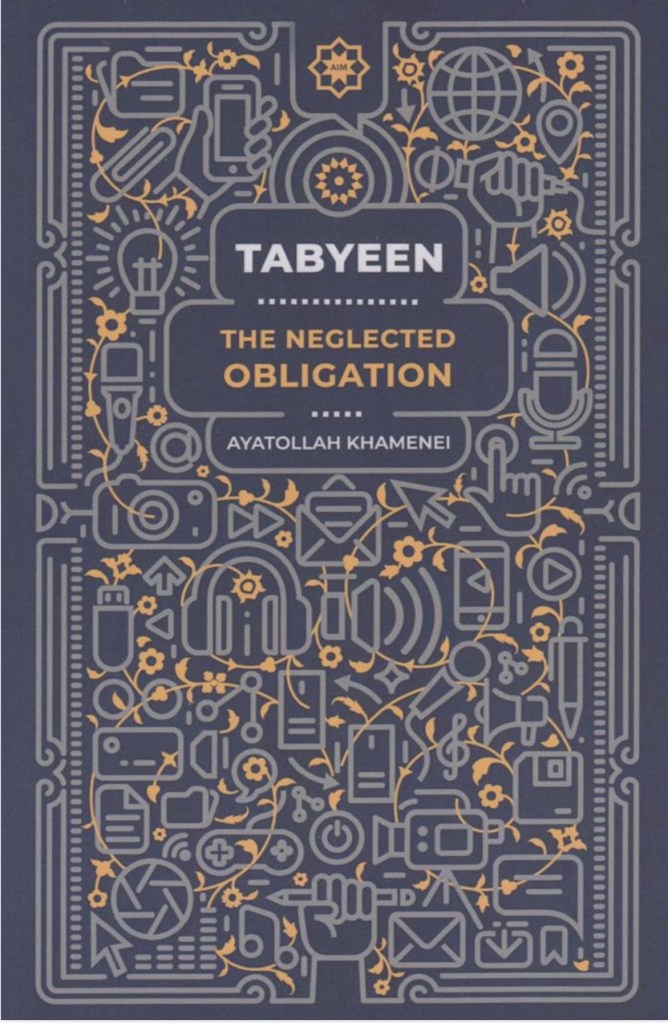
Few concepts have assumed greater prominence in the contemporary discourse of the Islamic Republic of Iran than Jihād al-Tabyīn (‘the Struggle for Clarification’), and few books attempt to present this concept as systematically as Tabyeen: The Neglected Obligation. Published by the Ahlulbayt Islamic Mission (AIM), this substantial volume gathers speeches delivered by Ayatollah Sayyid Ali Khamenei over several decades and organises them into a coherent thematic exposition. Rather than being an original treatise, it is an editorial reconstruction of Khamenei’s thought on one of the defining concepts of his intellectual and political project.
The editors have arranged the material into five broad sections covering the conceptual foundations of tabyeen, its practical requirements, methods of implementation, areas requiring clarification, and the responsibilities of various sections of society. The organisation succeeds remarkably well in transforming scattered speeches into what almost reads as a unified philosophical work. Detailed references to the original speeches further enhance its scholarly value as a documentary source.
The central thesis of the volume is straightforward but far-reaching. Khamenei argues that clarifying truth has itself become one of the highest forms of jihad. The struggle is no longer confined to military confrontation but encompasses education, scholarship, journalism, media, cyberspace and public discourse. The principal battlefield of the twenty-first century is the arena of ideas and narratives. Scholars, students, writers, teachers and ordinary believers all become participants in this intellectual jihad.
One of the book’s strengths is its insistence that jihad should not be narrowly understood as armed conflict. Khamenei repeatedly defines jihad as sustained, purposeful struggle against obstacles, whether intellectual, political, educational or cultural. This wider understanding has deep roots in Islamic thought and allows the concept to be relocated within the domains of scholarship, research and public communication.
To appreciate the full weight of Khamenei’s argument, one must first understand how Shi’i tradition conceptualises jihad. In classical Shi’i jurisprudence, jihad is typically divided into two categories: the ‘greater jihad‘ (al-jihād al-akbar), which denotes the inner struggle against one’s own baser desires and spiritual shortcomings, and the ‘lesser jihad‘ (al-jihād al-asghar), which refers to external armed struggle in defence of the faith. This distinction, rooted in a famous saying attributed to the Prophet Muhammad, has long given Shi’i thought a rich vocabulary for discussing moral and spiritual endeavour alongside military defence. However, Shi’i scholars have also historically recognised a third category: the jihad of the tongue and the pen (jihād al-lisān wa al-qalam), which encompasses the duty to speak truth, refute falsehood and disseminate religious knowledge. It is this latter tradition that Khamenei revives and expands, elevating intellectual and communicative struggle to a status comparable with, and in the contemporary context even surpassing, physical combat. By anchoring his doctrine in this established jurisprudential framework, Khamenei presents tabyeen not as an innovation but as the recovery of a neglected obligation whose time has now come.
Equally noteworthy is the ethical framework within which this struggle is situated. Throughout the opening chapters Khamenei insists that clarification must not descend into slander, rumour, deception or abusive polemics. Rather, it should proceed through reasoned argument, ethical conduct and intellectual honesty. These passages represent some of the strongest sections of the book and distinguish tabyeen, at least in principle, from mere political propaganda.
The work also demonstrates how deeply Shi’i historical memory informs Khamenei’s political theology. Karbala occupies a central place in his conception of clarification. Sayyida Zaynab’s speeches in Kufa and Damascus are presented as the paradigmatic example of preserving truth through testimony after military defeat. Likewise, Imam ‘Ali’s teachings on truthfulness and moral steadfastness are repeatedly invoked to provide scriptural and ethical legitimacy to the concept of Jihād al-Tabyīn.
Yet the real significance of this volume becomes apparent only when it is situated within the broader tradition of modern Shi’i political thought.
Although Khamenei presents tabyeen as an essential Islamic obligation, the underlying idea is by no means entirely new. The duty to explain truth (tablīgh), remove misunderstanding and defend religion has long occupied an important place in Shi’i scholarship. What distinguishes Khamenei is the unprecedented scope he gives to the concept by making it the central organising principle of political communication in the age of mass media and cyberspace.
The intellectual lineage begins most obviously with Imam Khomeini. Indeed, the editors themselves open the volume with an extended selection from Khomeini’s speeches emphasising the responsibility of scholars and preachers to awaken society and defend Islam through explanation. Khamenei’s work therefore represents continuity rather than rupture. Yet there is also an important evolution. Khomeini generally discussed propagation in the context of revolutionary mobilisation, whereas Khamenei transforms it into a comprehensive doctrine governing media, education, universities and digital communication. The battlefield shifts from revolution itself to the contest over public consciousness. To fully grasp the evolution from Khomeini to Khamenei, one must consider how Khomeini’s concept of clarification was inextricably tied to his doctrine of Wilāyat al-Faqīh (Guardianship of the Jurist). In his seminal essays and lectures collected in Wilāyat al-Faqīh: Islamic Government, Khomeini argued that religious scholars bear not only the authority but the sacred duty to guide the political community in the absence of the Imams. Within this framework, propagation (tablīgh) served primarily as an instrument of revolutionary awakening and institutional consolidation. Khomeini’s speeches during the 1970s and early 1980s were characteristically urgent and mobilising, calling upon clerics, students and the broader public to expose the tyranny of the Pahlavi regime and rally behind the nascent Islamic state. His famous lectures in Najaf and Paris were exercises in clarification aimed at transforming passive believers into active revolutionaries. Yet for Khomeini, the ultimate objective remained the establishment and preservation of the Islamic polity itself; explanation was the means, not the end. Khamenei, by contrast, operates in a very different context. Having inherited a fully established Islamic Republic, he confronts not the challenge of building a state but of sustaining its legitimacy across generations in an environment saturated with competing narratives and digital misinformation. Consequently, Khamenei’s deployment of tabyeen is more systemic, more institutionally embedded and more defensive in character. Whereas Khomeini used clarification to dismantle an old order, Khamenei uses it to fortify a new one, embedding the duty of explanation within the very fabric of governance, education and media policy. This shift reflects not a departure from Khomeini’s vision but its adaptation to the demands of longevity, as the revolutionary movement transforms into a permanent civilisation project requiring constant intellectual renewal.
The comparison with Ayatollah Muhammad Baqir al-Sadr is equally illuminating. Like Khamenei, al-Sadr regarded intellectual struggle as indispensable for preserving Islamic civilisation against competing ideologies. His Falsafatunā and Iqtisādunā were themselves exercises in explaining Islam rationally before an educated audience. Yet al-Sadr’s engagement remained primarily philosophical. He debated Marxism and capitalism through systematic reasoning. Khamenei, by contrast, is less concerned with constructing philosophical systems than with countering what he regards as organised campaigns of misinformation. His principal adversary is not philosophical materialism but media distortion.
A similar distinction emerges when one compares this work with the writings of Murtaza Mutahhari. Mutahhari consistently argued that misconceptions about Islam should be removed through reasoned explanation and that every generation requires a fresh intellectual presentation of religion. In many respects Khamenei follows this educational impulse. Nevertheless, Mutahhari’s concern remained principally pedagogical and philosophical. In Tabyeen, clarification becomes inseparable from preserving the political order established by the Islamic Revolution. The educational project is thus incorporated into a theory of governance.
Perhaps the greatest contrast is provided by Allama Muhammad Husayn Tabataba’i. His monumental al-Mīzān fi Tafsīr al-Qur’ān is itself an exercise in clarification, but one grounded in Qur’anic hermeneutics, philosophical reflection and rational inquiry. Khamenei shares Tabataba’i’s confidence that truth must be explained rather than imposed. Yet whereas Tabataba’i asks how revelation should be interpreted, Khamenei asks how truth should be defended amidst global information warfare. Hermeneutics yields to communication strategy.
The most significant divergence within contemporary Shi’ism appears in comparison with Grand Ayatollah Ali al-Sistani. Both scholars regard clarification as a religious responsibility, but they locate its institutional expression very differently. Sistani’s Najaf tradition generally favours moral authority exercised from a distance from state power, intervening directly only during exceptional crises. Khamenei, writing from within the doctrine of Wilāyat al-Faqīh, frequently identifies the defence of the Islamic Republic with the defence of Islam itself. This distinction reflects the continuing divergence between the Najaf and Qom schools of political thought.
Historical comparison with Ayatollah Muhammad Husayn Naini is equally revealing. In Tanbīh al-Ummah wa Tanzīh al-Millah, Naini viewed public explanation as a means of exposing tyranny and limiting arbitrary authority through constitutional government. Khamenei similarly opposes falsehood but directs his attention primarily towards foreign intervention, sanctions, media campaigns and ideological infiltration. Whereas Naini feared despotism from within, Khamenei emphasises manipulation from without.
The comparison with Ali Shariati reveals another important dimension. Both thinkers stress intellectual awakening, youth mobilisation and resistance to cultural domination. Yet Shariati frequently challenged established religious institutions themselves, whereas Khamenei speaks from within the clerical establishment. Shariati’s primary concern was stagnation within Muslim society; Khamenei’s is distortion imposed through hostile narratives.
Ali Shariati’s understanding of jihad departed significantly from both traditional jurisprudence and the clerical establishment of his time. For Shariati, jihad was not primarily a military or even a defensive legal category, but rather an existential and revolutionary call to action against all forms of oppression, injustice and intellectual stagnation. He reimagined jihad as the perpetual struggle of the oppressed (mustad’afūn) against their exploiters, drawing heavily on his distinctive synthesis of Islamic symbolism and Third World liberationist thought. In Shariati’s reading, the tragedy of Karbala was not merely a historical event to be mourned but a revolutionary paradigm requiring active emulation: Imam Husain’s stand was the ultimate act of jihad against tyrannical power, regardless of the odds. Crucially, Shariati also emphasised what he called the ‘red martyrdom’ (shahādat-i surkh) – a dynamic, life-affirming struggle against injustice – over the passive, otherworldly piety he associated with established religious authority. His jihad was thus thoroughly this-worldly, politically engaged and deeply suspicious of clerical quietism. This stands in marked contrast to Khamenei’s more institutionally anchored vision, where jihad is channelled through state structures and framed as defence of the Islamic Republic against external threats. Where Khamenei sees clarification as a duty to protect an established order, Shariati saw clarification – or what he termed ‘enlightenment’ (rūshanfikrī) – as a weapon to dismantle all established orders that perpetuated inequality, including, at times, the very religious establishment from which Khamenei now speaks.
Seen against this wider background, Tabyeen emerges not as a novel theological doctrine but as a distinctive synthesis. Khamenei combines Imam ‘Ali’s emphasis on truthfulness, Imam Husain’s witness against oppression, Sayyida Zainab’s preservation of Karbala through testimony, Imam Khomeini’s revolutionary activism, Mutahhari’s intellectual defence of Islam and al-Sadr’s ideological confidence into a unified theory for the age of digital communication. His original contribution lies in identifying information itself as the principal arena of jihad.
At the same time, the volume inevitably reflects its ideological location. Discussions of Yemen, Syria, Iraq, sanctions, the Pahlavi monarchy and Western media all proceed from the perspective of the Islamic Republic. Alternative interpretations receive relatively little attention, and criticism of the Revolution is frequently interpreted as the product of organised external distortion. From an academic standpoint, this represents the principal limitation of the work. The concept of clarification occasionally risks becoming synonymous with defending a particular political order rather than facilitating genuinely open intellectual inquiry.
Another weakness arises from the nature of the source material itself. Since the volume is compiled from speeches delivered over many years, certain themes recur repeatedly. While this repetition reinforces the centrality of the concept in Khamenei’s thinking, tighter editorial condensation and fuller historical introductions explaining the circumstances of each speech would have enhanced the book’s scholarly utility.
The English translation is generally smooth and readable, successfully preserving the sermonic tone of the original Persian. The editors have also performed a valuable service by documenting the provenance of individual passages, enabling researchers to locate the original speeches and trace the evolution of Khamenei’s thought over time.
Ultimately, Tabyeen: The Neglected Obligation should not be read simply as a work of religious instruction or political advocacy. It is a major primary source for understanding the intellectual vocabulary of the Islamic Republic during the twenty-first century. Whether one agrees with its political assumptions or not, it reveals how contemporary Shi’i political thought has reconceptualised jihad, authority, communication and historical memory in response to the age of digital media.
For historians of modern Iran, scholars of Shi’i Islam and students of political theology, the book provides invaluable insight into one of the most influential contemporary Shi’i conceptions of religion and politics. Its greatest significance lies less in its originality than in its successful synthesis of classical Shi’i ethical traditions with the realities of modern information warfare. It therefore deserves careful reading not merely as a statement of Ayatollah Khamenei’s views, but as an important document in the continuing evolution of modern Shi’i political thought.


