Syed Ali Nadeem Rezavi
After having so far dealt with how I chose the subject, what type of teachers I was privileged with and how I evolved in life, I will here deal with another type of training and education altogether. It is about the education that no curriculum prescribed, no examination tested and no degree formally recognised. Yet, in retrospect, it was perhaps the most important education I ever received. The University did not merely teach me history. It taught me how to live with history.
Beyond the classrooms lay another world: the MA Seminar Room where afternoons effortlessly merged into evenings; the endless shelves of the Maulana Azad Library where one entered searching for a single reference and emerged having discovered an entirely different subject; hostel debates that continued well past midnight; endless cups of tea consumed while quarrelling over historiography; friendships forged in moments of intellectual excitement as well as financial hardship; and the exhilarating discovery that history was not merely a subject to be studied but a way of thinking and living. My life at the University bore little resemblance to the life I had known at school.
Academically, school had never been particularly kind to me. History and literature came naturally enough, but arithmetic and physics seemed determined never to reveal their secrets. Numbers stubbornly refused to obey me, and scientific formulae appeared to inhabit a universe to which I was never fully admitted. Yet outside the classroom my life had been remarkably comfortable. I was the only son of a highly respected scholar, surrounded by the affection of two doting sisters and protected by a family that ensured I seldom worried about the practical difficulties of life. Looking back, I sometimes think I lived like a young prince without ever realising it. That comfortable world disappeared almost overnight.
Within the first few months of my entering the University, my father passed away. The emotional loss was devastating enough, but it was accompanied by a crisis that only later did I fully comprehend. Suddenly there was no earning member in the family. The security that had always seemed permanent vanished in an instant. For the first time I understood the uncertainties that accompany financial hardship. Curiously, while my personal life entered one of its darkest periods, my academic life entered one of its brightest. Every morning I walked into classrooms where some of the finest historians in the country unfolded before us worlds that fascinated me. Unlike my school years, I understood what was being taught. More importantly, I enjoyed understanding it. History was no longer a subject that required memorisation. It became an intellectual adventure.
There was another reason why I found the Department so welcoming. Many of my teachers had known my father personally. Some had been his close friends. Others had been frequent visitors to our home. They were towering names in Indian historiography, yet I never found them intimidating. They had watched me grow up long before they became my professors. That familiarity gave me a confidence that many of my classmates understandably lacked. Something else also happened almost imperceptibly. The diffidence that had characterised my school days began slowly to disappear. At school I had remained reserved, almost painfully shy. At the University I gradually found myself becoming increasingly outgoing. Perhaps it was the stimulating intellectual atmosphere, perhaps the encouragement of inspiring teachers, or perhaps the simple joy of finally discovering a subject that genuinely excited me. Whatever the reason, I found myself making friends with remarkable ease.
Some sought my friendship because of the elaborate notes I prepared after every lecture. I had acquired the habit of recording almost everything my teachers said, supplementing their lectures with additional reading and arranging the material systematically. Before long, my notebooks acquired a circulation of their own. Others appreciated that, having studied in a convent school, I was reasonably comfortable expressing myself in English, a skill that many students educated in Urdu or Hindi medium institutions wished to cultivate. Amongst my earliest friends was Amjad Afridi from Jammu. Like me, he had received a convent education and possessed an easy command over English. He was also closely related to Professor Haqqi, the distinguished Head of the Department of Political Science. We shared similar backgrounds and quickly became close companions.
Quite different was my friendship with Jawaid Akhtar from Purnea. Jawaid came from an Urdu medium background and had set his heart upon joining the Civil Services. During our earliest encounters he regarded Amjad and me with considerable suspicion. Whenever we approached him, he would greet us with a barrage of sarcastic remarks, accusing us of belonging to an unduly privileged class of students. According to him, we had every conceivable advantage. Perhaps he was not entirely wrong. Friendship, however, has a remarkable ability to dissolve such distinctions. Gradually the sarcasm disappeared, conversations became longer, and before very long we had become inseparable companions. When Amjad later left for Jawaharlal Nehru University to pursue his postgraduate studies, Jawaid naturally filled the void. For several years we were almost constantly together.
There was one difficulty that both of us shared. Neither of us possessed much money. Necessity, however, often stimulates ingenuity. Those were the days when even BA (Hons) students remained in the Department until late in the evening. Hunger therefore became an almost daily companion. Unfortunately, our pockets rarely cooperated. So Jawaid and I devised what we considered a brilliant strategy. We would quietly occupy a table at one of the dhābas outside the campus and patiently wait until some senior student, or preferably someone known to possess a reasonably healthy wallet, appeared. The moment our unsuspecting benefactor arrived, we would begin a loud and entirely fabricated argument. Within moments voices would rise, accusations would fly, and both of us would display dramatic talents that neither of us had exhibited elsewhere. As expected, the kindly senior would intervene. “Arrey bhai, why are you fighting? Sit down, both of you.” Then, in accordance with the finest traditions of Aligarh hospitality, he would immediately order tea, pakoras and generous helpings of fried dālmoth in the hope of restoring peace. The miracle invariably occurred. Our quarrel would instantly subside. We would consume the refreshments with appropriate seriousness, thank our peacemaker for his wisdom and generosity, and leave in perfect harmony. Looking back now, I cannot decide whether we deserved Oscars or disciplinary action. Perhaps both.
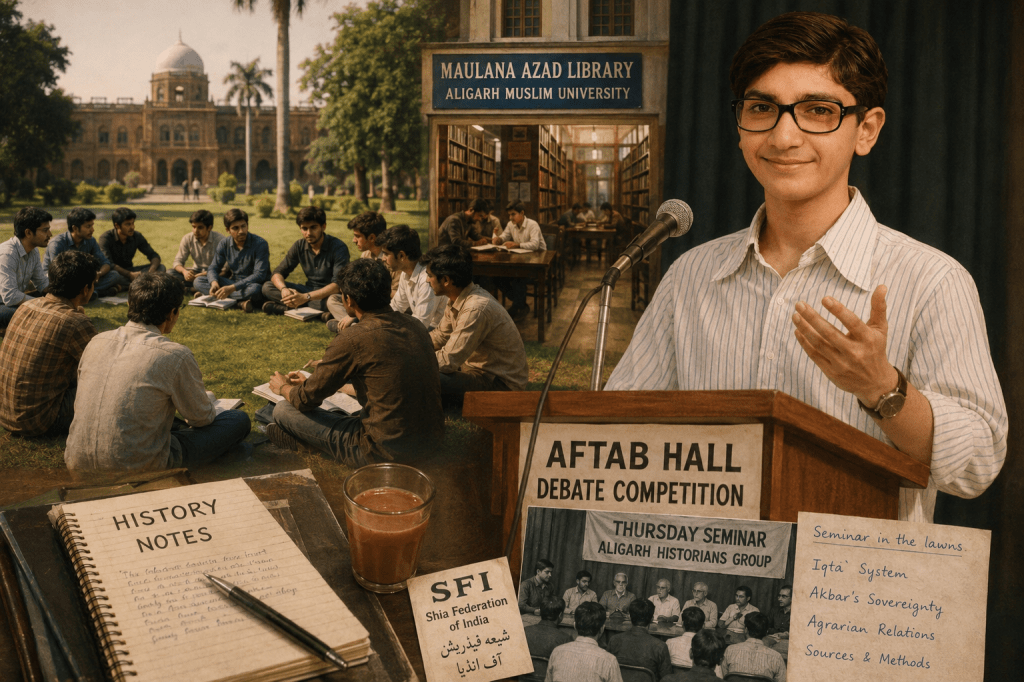
The episode that taught me perhaps the greatest lesson of my student life came quite unexpectedly. One afternoon a few friends informed me that Aftab Hall was organising its annual debate competition. One of them requested that I write a speech for him opposing the motion. I readily agreed. Writing had never frightened me. I spent the next few hours preparing what I thought was a reasonably convincing speech. Just before the competition was about to begin, an idea suddenly struck me. If I could write a speech for someone else, why could I not deliver one myself? With all the confidence that only youth can possess, I walked to the organisers’ table and entered my own name as a speaker. Since my friend was speaking against the motion, I decided to speak for it.
There was only one small problem. I had completely forgotten who I was. Throughout my school life I had remained painfully shy. Public speaking was something I had carefully avoided. Standing before an audience had never been one of my strengths. Yet, buoyed by the confidence that the University had slowly instilled in me, I convinced myself that speaking would be no more difficult than writing. Confidence, however, is not always accompanied by experience. When my name was announced, I walked confidently towards the podium. The confidence lasted exactly as long as it took me to look at the audience. My mind went completely blank. Not a single sentence remained. Not a single argument survived. Everything that I had thought I knew vanished in an instant. I stood there staring at the audience while the audience stared back at me. Then came the inevitable hooting. The louder the hooting became, the more paralysed I felt. It was as though someone had suddenly switched off my brain. I do not know how long I stood there. It could not have been more than a minute or two, but to me it felt like an eternity. Eventually, defeated and utterly embarrassed, I lowered my head and quietly stepped down from the podium.
For a young man who had only recently begun to discover confidence, it was a crushing humiliation. There remained, however, another problem. The debate was to be followed by dinner. Anyone who studied at Aligarh in those days will understand that one simply did not miss a hostel dinner after a hall function, especially when qorma and freshly baked rotis, kabābs and biryāni followed by a sweet dish, mostly shāhi tukda were on the menu. But how could I possibly return after making such a spectacular fool of myself? Providence, or perhaps desperation, suggested an ingenious solution. I walked straight to Shamshad Market and entered a barber’s shop. “Shave it off,” I said, pointing to my beard. The barber looked mildly surprised but asked no questions. Within minutes the beard that I had carefully nurtured had disappeared. I looked into the mirror. The young man staring back at me appeared sufficiently different to convince even me that he was someone else. Feeling reassured, I returned to the lawns of Aftab Hall where dinner was being served. I quietly joined the table, accepted my plate of qorma and rotis, found a comfortable corner and enjoyed my meal with complete satisfaction. As far as I could judge, nobody recognised that the clean-shaven fellow enjoying his dinner was the very same unfortunate individual who, less than an hour earlier, had stood speechless before the audience while they mercilessly hooted him down.
Even today, whenever I remember that evening, I cannot help smiling. What seemed at the time an unbearable humiliation became one of the most valuable lessons of my life. That evening taught me that possessing knowledge and communicating knowledge are two entirely different accomplishments. It is not enough to understand a subject. One must also learn to express one’s thoughts clearly, confidently and persuasively. Scholarship locked away within one’s own mind serves little purpose. Knowledge fulfils its true purpose only when it is communicated to others. Ironically, the greatest lesson I ever learnt about public speaking came not from delivering a memorable speech but from being completely unable to utter a single word. Far from discouraging me, that failure transformed me. I resolved that never again would I allow fear to silence me. From then onwards I deliberately sought every opportunity to speak before an audience, however small. Every discussion, every seminar, every informal gathering became an exercise in overcoming the paralysis that I had experienced that evening at Aftab Hall. Looking back today, I often tell my own students that failure is sometimes the finest teacher one can ever have. Success may give confidence, but failure gives determination.
Around the same time another transformation was quietly taking place. I came from a deeply religious Shi’i family. My father had been a distinguished theologian, and religion naturally formed an integral part of my upbringing. Yet almost as soon as I entered the University I found myself exposed to an intellectual atmosphere very different from the one in which I had grown up. Many of the brightest students in the Department were associated with the Students’ Federation of India, the student wing of the Left. Before long I too found myself attending their meetings. The experience introduced me to Marxist literature, political activism and ways of looking at society that were entirely new to me. I learnt much from those associations. At the same time, I remained deeply rooted in my own religious traditions. There were aspects of Left politics that appealed to me greatly, particularly its emphasis on social justice and equality. There were others with which I felt less comfortable.
Perhaps it was an unconscious attempt to reconcile these different worlds that led me to one of the more amusing episodes of my undergraduate years. If there could be an SFI representing the Students’ Federation of India, why could there not also be another SFI? And so, with all the idealism and confidence of youth, I floated an organisation bearing exactly the same initials. Mine stood for the Shia Federation of India. The similarity of names was entirely intentional. It never possessed the organisational machinery or political ambitions of the other SFI. Nor was it intended to. It simply reflected the world from which I had come and the identity that continued to shape me. Through this organisation I began arranging programmes entirely at my own expense. Looking back, I often wonder where the money came from, given the financial circumstances through which my family was then passing. Somehow, however, one always managed. I do remember one benefactor however: an Engineering teacher at ZH Engineering College, Dr Aliul Hasan of Banaras, who would keep on funding my programme materially and intellectually. During my undergraduate years we organised three substantial functions. One was held in the Arts Faculty Lounge, another at Bait-us-Salaat, the University’s principal centre of Shi’i religious and cultural activity, and a third in the Kennedy Auditorium. Those programmes gave me an education that no classroom ever could. They taught me how to organise an event from beginning to end, how to persuade people to participate, how to coordinate speakers, arrange logistics and assume responsibility for success as well as failure. Only much later did I realise that these experiences were preparing me for a lifetime spent organising seminars, conferences and academic gatherings. The training had begun long before I knew that I would spend my professional life in a university.
By the time I entered the MA programme, however, another transformation had quietly begun to take place. The rather exclusive outlook that had characterised my undergraduate years slowly gave way to something much broader. It was not that I had become any less attached to my own religious identity. My upbringing, my family and my father’s influence remained inseparable parts of who I was. Rather, I had begun to appreciate that history, by its very nature, refuses to remain confined within narrow boundaries. The more one reads, the more one realises that societies, cultures and religions are intertwined in ways that simple labels fail to explain. The historian’s first loyalty must ultimately be to evidence and understanding rather than to inherited assumptions. Without consciously deciding to do so, I found myself moving away from specifically Shi’i student activities towards a much more inclusive academic engagement. The change was so gradual that I scarcely noticed it myself. Instead of organising religious gatherings, I began organising student seminars on Medieval Indian History. They were modest affairs by the standards of later years, but for us they represented an entirely different kind of intellectual exercise. Students were encouraged to read original texts, prepare papers and defend their arguments before their peers. We learnt not merely to collect information but to formulate questions, construct arguments and, perhaps most importantly, accept criticism.
Not every initiative, however, received enthusiastic encouragement. There were occasions when the then Chairman of the Department (I won’t name him as I still respect him a lot) would take a rather dim view of our activities. Sometimes we were told that the Seminar Room could not be occupied indefinitely. On other occasions we were gently reminded that students were expected to attend classes rather than organise them. Being young and thoroughly convinced of the importance of what we were doing, we accepted these interruptions with remarkable good humour. If we were turned out of the Seminar Room, we simply shifted the seminar to the lawns. Someone would spread a newspaper on the grass, another would produce a notebook, and within minutes the discussion resumed exactly where it had been interrupted. Looking back today, I often feel that those informal baithaks beneath the trees were among the finest seminars I have ever attended. There were no microphones. No inaugural ceremonies. No chief guests. No interminable votes of thanks. Only students, and occasionally a visiting Professor, arguing passionately about history.
One afternoon the discussion might revolve around the nature of the iqta system under the Delhi Sultans. On another occasion we debated whether Akbar’s theory of sovereignty represented a genuine ideological departure or merely a political necessity. Sometimes the arguments became so animated that passers-by would stop and look at us with curiosity. They probably wondered why a group of young men seemed prepared to quarrel so passionately over emperors who had been dead for centuries. For us, however, those emperors were very much alive. They represented ideas. They represented problems. Above all, they represented different ways of understanding the past.
It was during those years that another important academic tradition began within the Department. Professor Irfan Habib initiated what were then known as the Thursday Seminars of the Aligarh Historians Group, an enterprise that would, in later years, evolve into the Aligarh Historians Society. Few of us realised at the time that we were witnessing the birth of an institution that would eventually become one of the most respected historical forums in the country. To us it was simply Thursday. Those seminars became an event around which our week revolved. There was much to be done before each meeting. Chairs had to be arranged, notices circulated, visiting scholars received, papers duplicated and countless small details attended to. A seminar that appears effortless to an audience invariably rests upon the unseen labour of volunteers. I was fortunate to be one of them. Along with a few fellow students, I became actively involved in organising these meetings. There was no financial reward, no certificate of appreciation and no expectation of recognition. We participated simply because we enjoyed being part of an intellectual community that was visibly growing before our eyes.
The rewards were immeasurable. For the first time I found myself listening not only to my own teachers but also to distinguished scholars from universities across the country. I watched eminent historians disagree with one another, sometimes quite vigorously, yet without any trace of personal bitterness. Arguments were supported by evidence, challenged by evidence and refined through evidence. That experience fundamentally altered my understanding of scholarship. Until then I had imagined that history consisted of established facts waiting to be learnt. The seminars taught me something very different. History is, in reality, an unending conversation. Every generation returns to the same evidence with new questions. Every historian contributes one interpretation amongst many others. Scholarship advances not because everyone agrees, but because informed disagreement compels us to think more carefully. It was a lesson that remained with me throughout my own academic career.
The MA Seminar Room itself gradually acquired an almost sacred significance. It was no longer merely a room where students sat between classes. It became the intellectual heart of our lives. Hours disappeared there unnoticed. One discussion naturally gave birth to another. Someone would introduce a newly published article. Another would disagree with its conclusions. A third would rush to the library to fetch a relevant book. Before long what had begun as a casual conversation had become a miniature research seminar. Equally important was the Maulana Azad Library. To visitors it was one of the University’s most magnificent buildings. To us it was home. I often think that no historian is ever truly educated until he has learnt to lose himself in a great library. One entered intending to consult a single volume and emerged several hours later carrying references to half a dozen books that one had never originally intended to read. A footnote led to another book; that book suggested another article; the article referred to an obscure Persian source; and before one realised it, the entire afternoon had disappeared. Long before electronic databases transformed research into a matter of computer searches, scholarship depended upon serendipity. One learnt to browse. One learnt to wander. Above all, one learnt patience.
The friendships forged during those years have remained amongst the greatest blessings of my life. Some began in classrooms, others in the Seminar Room, still others over countless cups of tea in the canteens and dhabas that surrounded the campus. We borrowed one another’s books, criticised each other’s papers with ruthless honesty, argued over historiography with youthful certainty and reconciled ourselves over yet another cup of tea. Looking back now, I realise that the University was educating us in ways that no curriculum could ever prescribe. The lectures gave us knowledge. The library taught us discipline. The seminars taught us to think. Friendships taught us generosity. Failure taught us resilience. Organisation taught us leadership. And life itself taught us humility.
When I first entered Aligarh, I imagined that education took place inside classrooms. By the time I completed my MA course, I knew better. The classrooms had given me teachers. Life beyond them had made me a historian. The story, however, was far from over. The years that followed would take me from the Seminar Room to research, from student life to teaching, and eventually to the very Department that had nurtured me. Looking back now, I often feel that everything that came later had its origins in those unforgettable years when the University quietly taught me lessons that no textbook could ever contain. That, however, is a story yet to be told.


