Syed Ali Nadeem Rezavi
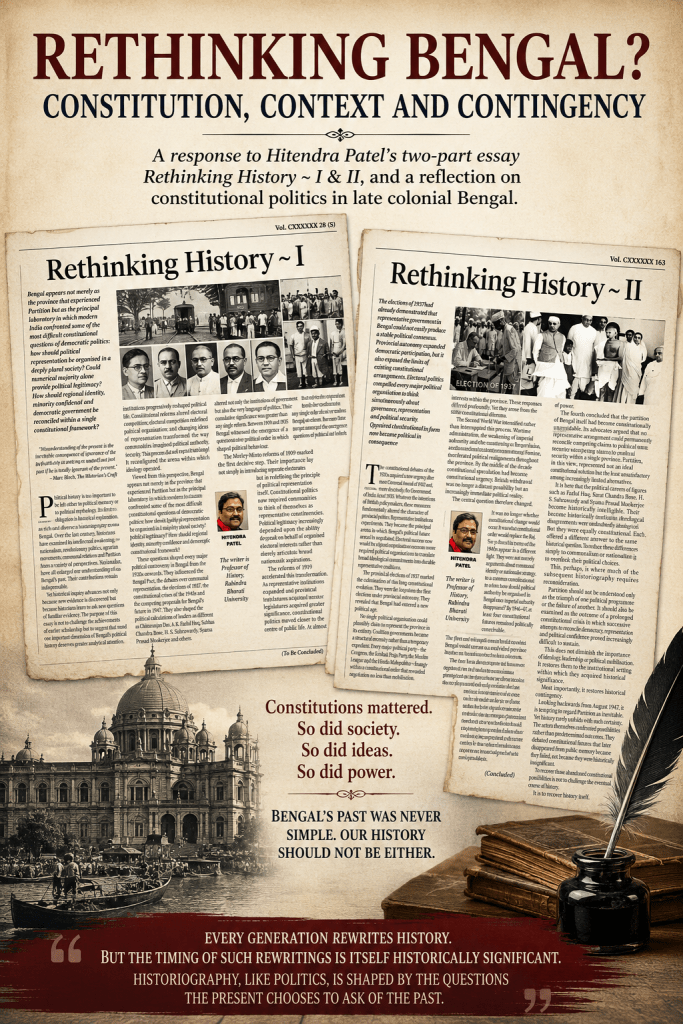
Professor Hitendra Patel’s two-part essay published in The Statesman on July 12 and July 13, 2026 is a thoughtful reminder that constitutional history deserves sustained attention in any account of late colonial Bengal. His emphasis on the Morley-Minto reforms, the Government of India Act of 1935, provincial autonomy, coalition politics, the Bengal Pact, and the constitutional debates of the 1940s serves as a useful corrective to historical narratives that concentrate exclusively on nationalism, communalism or Partition. Political institutions undoubtedly mattered. Constitutional debates shaped the language through which Bengal’s political elite articulated competing visions of representation, democracy and provincial autonomy.
Yet the essays also invite a number of questions. They claim to “rethink” Bengal’s history by placing constitutional politics at its centre. The issue is whether this constitutes a genuinely new historiographical direction or simply shifts emphasis within an already well-developed body of scholarship.
The first difficulty lies in the suggestion that constitutional history has been relatively neglected. This is not entirely convincing. Much of the finest scholarship on Bengal over the past four decades has consistently explored the relationship between constitutional reforms, representative institutions, communal politics and provincial autonomy. The works of Joya Chatterji, Sugata Bose, Sekhar Bandyopadhyay, Ayesha Jalal, Gordon Johnson, Judith Brown and others have never treated constitutional developments as peripheral. Rather, they have integrated them into broader analyses of Bengal’s political transformation. Constitutional politics is therefore hardly a neglected subject awaiting rediscovery.
More importantly, the essays tend to present constitutional politics as an almost autonomous sphere of historical explanation. Constitutions, however, do not operate independently of society. Institutions derive their significance from the social, economic and cultural contexts within which they function.
The elections of 1937 provide a good illustration. They certainly marked a constitutional watershed. Yet their outcome cannot be explained merely by electoral arrangements or representative institutions. They reflected agrarian discontent, the mobilisation of Muslim peasantry, the rise of the Krishak Praja Party, urban Hindu politics, educational expansion, changing social aspirations and the cumulative consequences of colonial land revenue policies. Constitutional reforms created the arena within which politics unfolded, but they did not determine the political forces that occupied it.
Similarly, the Bengal Pact of 1923 was far more than a constitutional compromise. It represented an attempt to address longstanding anxieties over education, employment, representation and access to public institutions. Those concerns had emerged through wider social and economic developments. Constitutional negotiation was therefore one expression of deeper historical processes rather than their origin.
The role of colonial power also receives less attention than it deserves. British constitutional reforms were not neutral experiments in democratic development. Every constitutional measure, from the Morley-Minto reforms onwards, sought to reconcile limited political participation with the preservation of imperial authority. Separate electorates, reserved representation and provincial autonomy were carefully calibrated mechanisms of colonial governance. To analyse constitutional evolution without placing imperial objectives at the centre risks overlooking the very framework within which these institutions operated.
The essays also establish an unnecessary opposition between constitutional reasoning and ideology. Professor Patel argues that constitutional considerations rather than ideological differences explain many of the choices made by Bengal’s political leadership. Yet constitutional preferences themselves emerged from ideological commitments. Fazlul Huq, Sarat Chandra Bose, H. S. Suhrawardy, Syama Prasad Mookerjee, Muhammad Ali Jinnah and others differed not merely over constitutional arrangements but over fundamentally different conceptions of community, democracy, federalism and the future of India. Constitutional arguments were themselves expressions of political ideology.
Nor can constitutional history be separated from popular politics. The legislative debates of the period unfolded alongside the Swadeshi movement, peasant mobilisation, labour unrest, revolutionary nationalism, communal mobilisation and, ultimately, the Bengal Famine. Public opinion, organised protest and mass political participation shaped constitutional developments as much as constitutional institutions influenced society. The relationship was reciprocal rather than one directional.
The second essay rightly emphasises that the constitutional alternatives discussed during the 1940s remind us that Partition was not inevitable. This is an important point. Yet it is also one that modern historiography has long recognised. Historians have repeatedly demonstrated that multiple constitutional futures remained possible until remarkably late in the transfer of power. The existence of unrealised alternatives enriches our understanding of contingency, but it does not fundamentally revise the existing historiography.
There is another omission that deserves attention. Throughout both essays, constitutional debates are largely viewed from the perspective of political leaders and legislative institutions. Missing are the experiences of ordinary Bengalis. Constitutional ideas were interpreted, contested and reshaped through newspapers, voluntary associations, student movements, district politics, caste organisations, religious institutions, municipal bodies and peasant organisations. The constitutional history of Bengal was not written only in Calcutta or in legislative chambers. It was equally fashioned in villages, towns and local public spheres.
Ultimately, the greatest strength of Professor Patel’s essays lies in reminding readers that constitutional history deserves serious consideration. Their weakness lies in presenting constitutional politics as the principal explanatory framework for understanding Bengal’s modern past. Constitutional institutions mattered enormously, but they functioned within larger processes of social change, economic transformation, ideological contestation and imperial governance. None can adequately be understood in isolation from the others.
History rarely advances by replacing one dominant narrative with another. Rather, it progresses through synthesis, by recognising the interaction of institutions, ideas, social forces and historical contingency. Bengal’s history is no exception. Its richness lay precisely in the complex interplay between constitutional innovation, political ideology, agrarian change, communal negotiation, intellectual life and popular mobilisation.
There is, however, one final point that deserves reflection. Every generation rewrites history, but the timing of such rewritings is itself historically significant. The current enthusiasm for “rethinking” Bengal’s past has emerged not in an intellectual vacuum but in the aftermath of a major political realignment within the state. That fact neither invalidates nor validates the arguments advanced. It does, however, remind us that historiography, like politics, is often shaped by the questions the present chooses to ask of the past. Historians should therefore examine not only the new interpretations being proposed but also the intellectual and political moment that has made these particular reinterpretations appear especially urgent.
The challenge, then, is not simply to rethink Bengal’s history. It is equally to remain attentive to the contexts in which history itself is being rethought. Only by doing so can historiography remain both intellectually rigorous and historically self-aware.


