Architecture of the Sharqis of Jaunpur: The Atala Devi Mosque

After the decline of the Tughluq Sultanate and the invasion of Timur, a new independent sovereign state was inaugurated in AD 1394 which came to be known as the Sharqi Empire. The Sharqi Empire extended from Koil (modern Aligarh) in the west to the frontiers of Bengal in the east; and from the foothills of the Himalayas to the borders of Malwa in the south.

It lasted for around a century and had six rulers: Malik Sarwar (1394-99), Mubarak (1399-1401), Ibrahim (1401-40), Mahmud (1440-57), and Husain (1458-1505).

All of them were great patrons of art and architecture and are credited to have erected numerous religious and secular buildings in their realm. Malik Sarwar added new buildings to the old fort and renovated the palace which was now renamed as dār us surūr. Sultan Ibrahim and Sultan Husain built splendid mosques, madrasas, palaces, libraries, bazaars, tombs, baolis, bridges and gardens. Unfortunately most of these architectural accomplishments of the Sharqis were destroyed in 1495 by Sikandar Lodi when he defeated the last Sharqi Sultan.

Presently the Sharqi architecture is represented by five or six mosques at Jaunpur (the Atala, Jami’, Masjid Shaikh Barha, Khalis Mukhlis, Jhanjiri, Lal Darwaza and Jami’ ush Sharq) and some remains within the fort (the gate, the baths and a mosque).

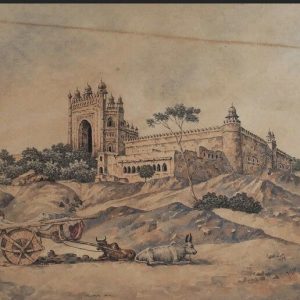
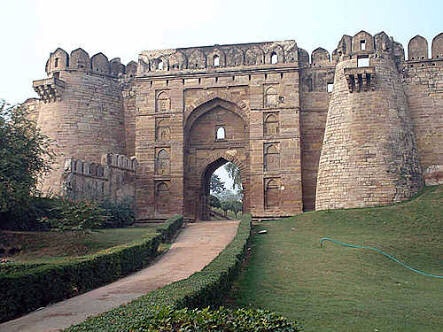
The fort of Jaunpur is in the form of an irregular quadrangle having stone fortification built around an artificial mound which stands on the northern bank of the Gomti river. The entrance to the fort is through a gateway in the east. On both sides of this gateway are large projecting piers connected by a lofty archway, divided in four storeys by ornamental mouldings. It is flanked by semi-circular tapering bastions.

The school of architecture which emerged at Jaunpur was a harbinger of all that was best in the Delhi Sultanate which suited the local conditions. The Sharqi mosques were the improved versions of the Alai Darwaza and the Begumpuri mosque. The pylon of the later served as the model for the propylon as it developed at Jaunpur.

The architectural scheme followed in the Sharqi mosques include the tapering minarets, battered sides of the propylons, stucco decoration, arch-and-beam openings and low four-centred arches with decorative fringes all derived from Tughluq style.

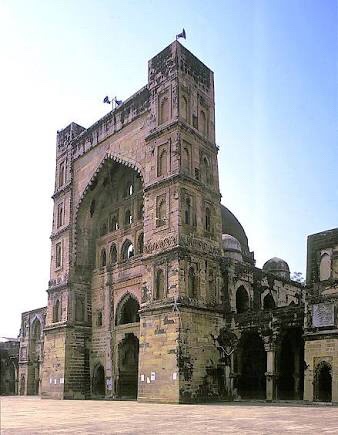
The most distinctive feature however is the tall propylon, a gigantic arch framed within a rectangular frame with much emphasised battered sides. This propylon completely obscures the front view of the massive hemispherical dome built over the sanctuary. In fact the massive propylon appears to be an architectural element completely independent of other subsidiary features.

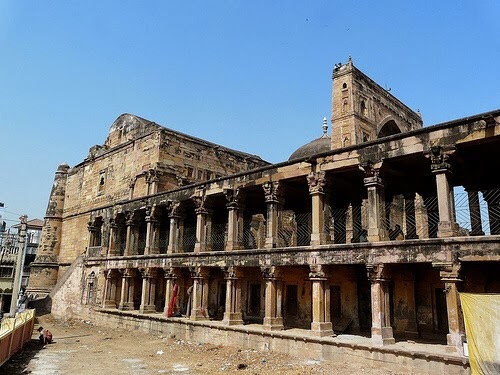
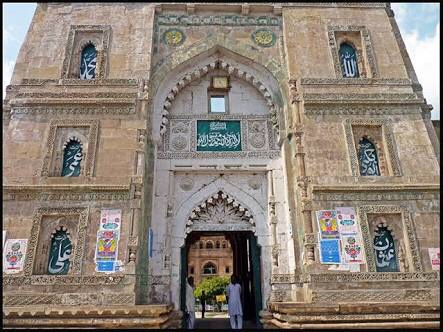
The Atala Masjid, built in 1408 on the foundations of a temple dedicated to the goddess Atala, earlier destroyed by Firuzshah Tughluq in 1376 is the first Sharqi structure in Jaunpur. It does not stand on a plinth and thus its façade loses much of the charm and impressive character gained by structures built on a high platform, a feature of prominent Tughluq mosques.

The outer walls at Atala have monumental gateways which closely follow the design of the propylon. The courtyard of the mosque 78.7 m on a side is surrounded with cloisters on three sides and a prayer chamber on the west which is divided into five compartments which are five bays deep.

The propylon comprises of two 22.9m high battered towers framing a large recessed arch. The structure is 16.61m across the base and 14.33m at the top showing a batter of 1.13m on either side.

The main entrance is through a beam-and-lintel opening flanked by two smaller arched entrances.

The battered towers, divided through string courses, are decorated with four small sunk arches arranged in a vertical order, on each side. The lower section is severely plain. The whole exterior of the propylon uses the arch, in various shapes and sizes as a decorative motif, creating the most fascinating façade. Almost all the arches, big and small, are fringed with stylised spearheads.

To the left and right of the central propylon stand two smaller propylons of similar design which considerably reduce the disparity between the stupendous height of the propylon and the modest height of the side wings.

India as Reflected in Amir Khusrau’s Nuh Sipihr

It appears that by the thirteenth century, the concept of India as a distinct geographical entity, came into Indo-Persian literature along with an understanding of a composite culture, and, also with it, a sense of love of the country. The most prominent examples of such patriotism and ideas of a common heritage appear in the writings of Amir Khusrau, the poet-laureate of the Delhi Sultanate.

Amir Khusrau was born at Patiali in the modern district of Etah in Uttar Pradesh in 1253. His father, Amir Saifuddin Mahmud was a Turk who had migrated to India during the reign of Iltutmish, some years prior to Khusrau’s birth, from the city of Kush (now known as Shahr-i Sabz) in Uzbekistan. His mother was the daughter of Imadul Mulk, a noble from Delhi.

Khusrau was a prolific writer and has left behind important works like Qirānu-s Sa’dain, Miftahu-l Futuh, Shirin wa Khusrau, Hasht Bihisht, Masnavi Dewal Rani wa Khizr Khan, Matlau’l Anwar, I’jaz-i KhusravI, Khazainu-l Futuh and Nuh Sipihr.

Although in almost all these works Khusrau has left behind statements which help us understand his vision and concept of India, the Nuh Sipihr appears to be the most prolific in the outflow of patriotic statements.

The Nuh Sipihr is a masnawi which was completed by Khusrau in 1318 and eulogises Mubarak Shah Khalji. It appears to reflect most perfectly the ideas of Khusrau about India which he had tried to develop in his earlier works.

This work is divided into nine chapters which correspond to the nine skies or spheres (sipihr) of the heavens. It is in the third chapter of this work that we find a long and detailed eulogy of India. Amir Khusrau proudly asserts:

If my adversary taunts me as to why I prefer (tarjīh) Hind over other lands.

(I would say:)There are two reasons for this assertion (hujjat):

The first reason is that this land since time immemorial (has been destined)

To be the place of my birth (maulūd), abode (māwa) and motherland (watan)}

He further justifies the praise and precedence which his motherland deserves by citing a well known tradition of the Prophet: “the love of motherland is an essential part of the true faith (hub al-watan min al-īmān)”.’He asserts that this is an essential part of his creed (dīn).

In the introductory section of this chapter Khusrau clarifies that the praise of India was reserved in this section as the presiding planet of both, the seventh sky (to which this chapter corresponds) and India was zuhl (Saturn). He claims that although ‘Rum (Greece), Khurasan (Iran) and Khotan (China)’ allege (ta’na) their superiority, he had knowledge of the efficacy of this country’s magic and thus could prove that Hind is better than any other country. For:

If the Creator bestows upon me the gift (So that) my easy flowing pen (kilk) may be empowered to express qualities to perfection, I aspire not to leave the greatness of this land on earth (concealed). But raise it to the sky upto the (height) of the heaven (khuld-i barīn).

Khusrau then goes on to enumerate seven rational (aqli) proofs (asbāt) of the assertion (hujjat) that India was the earth’s Paradise. The first argument is that after being thrown out from heaven Adam found refuge in this country. According to him,

“As Hind was just like heaven (khuld nishān), Adam could descend here and find repose”.

Secondly, India was the land of the peacock, a heavenly bird.

“Had Paradise (firdaus) been in some other country (lit. garden, (bāgh) this bird would have gone thither.”

Thirdly, the serpent, which was a companion of the peacock in heaven, also accompanied it to this land, but as this land was known for its good and beneficial deeds while the serpent had the vice of biting, it was allotted a place below the earth and not above it.

Khusrau puts forward four other arguments, which include the moderate climate of India as compared with the severe climatic conditions of his Central Asian homeland and the tradition of the Prophet that the faithful would receive their reward not in this world but in the heaven while the unbelievers would enjoy here itself:

“Hind was a Paradise for the unbelievers since the advent of Adam till the coming of Islam, Even in recent times, these infidels (gabar) have had every pleasure of heaven like wine and honey.”

After establishing that India was the heaven on earth, Khusrau goes on to discuss the ‘reasons’ of his ‘preference of Hind over Rum, Iraq, Khurasan and Qandhar’ and discourses on the ideal climate of his country, its flowers, and fruits. Discussing the moderate Indian climate Khusrau remarks:

They (Khurasanians) are deafened (by the excessive cold) and do not listen to the arguments (of India being heaven) (And) instead accuse it of possessing an extremely hot climate. In reply (to this) I cite again what the prophet had said. The hot weather is troublesome and that is all But every one is killed through cold weather.

Further praising the Indian climate, Khusrau says that it is so moderate that a poor peasant (dahqān) spends the night in the pasture-land grazing his flock with only a single worn-out cloak (kuhn chadaraki) wrapped around him, a Brahman can take his bath in the cold water of the river early in the morning, while a mere branch of a tree is enough to shade the poor of the country.

There is the spring season (bahār) all the year round in India and thus an abundance of greenery and beautiful fragrant flowers which do not lose their fragrance even after they wilt. Among the juicy fruits of India, Khusrau mentions mangoes (naghzak), bananas (mazi), which are extremely soft; and nabāti bamri (sugarcane). Cardamom (lāchi), camphor (kāfūr) and cloves (qaranfal) are mentioned by him as the dry fruits of India.

Betel- leaf (tanbūl) comes for special mention as a

‘leaf which is eaten like a fruit (mēvā) and there is nothing elsewhere in the world like it.’

He tells us that the betel leaf, presumably an expensive commodity at the time, was something meant for the elite:

The ordinary people (ahl-i shikam) have no taste (zauq) for it, Only the high (mihtar) and their sons relish it. Its special (preparation) is not for every one Except for the Qutb-i falak (the king).

Amir Khusrau’s idea of India and its geographical boundaries, comes out more clearly when he mentions the different languages which the people of this country speak:

There are different languages in every area (‘arsa) and region (nāhiyat) of this land. Having their own special phraseology and rules which are not transient (‘āriyati) are Sindhi, Lahauri (Punjabi), Kashmiri, Kubri, Dhur-Satnandri (Kannada),Tilangi (Telugu), Gujar (Gujarati), Ma’abari (Tamil), Gauri (dialect of Northern Bengal), Bengali, Awad (Awadhi), Dehli. All around, within the boundaries of this land, are these Hindavi languages since olden times, and all of them are spoken by the people for all purposes.

It is interesting to note that Marathi and Malayalam are not mentioned by Khusrau. Malayalam had not perhaps separated from Tamil by this time, but the omission of Marathi is difficult to explaine unless it is represented by ‘Kubri’. Dealing with the commonly spoken languages during his time (Hindavi and Persian) and the regional dialects, Khusrau points out:

Surely! The popularity of Turkish grew similarly. It spread with the Turkish rule on the earth. As it was the language of the prominent people (khāsa). The commoners also adopted it, and it became popular in the world. Hind similarly got its spoken languages. Hindavi is and has been the (spoken language) of India.

The Ghurids and the Turks came, and Persian was spoken by them. The people when they came into contact with them. By and by (beh wa beh) acquired the knowledge of Persian. The other languages which were there Were constrained to be confined in their own areas.

Khusrau also mentions the linguistic versatility of the Indians. He says that whereas an Indian can fluently converse in any of the foreign languages, people outside India (aqsa-i digar) are unable to speak ‘Indian dialects’ (sukhan-i Hindi).

The people of Khita, Mongols, Turks and Arabs In (speaking) Indian dialects get sewn lips But we can speak any language of the world As expertly as a shepherd tends his sheep.

Khusrau’s patriotism was not just theoretical. He claims to have himself mastered the Indian languages:

In most of these people’s languages I have gained knowledge (i.e. learnt) I know them, enquired about them, and can speak them And to an extent, more or less, have been enlightened by them.

Amir Khusrau also mentions Sanskrit and its rich literature but remarks that it was the language of the Brahmans. Even amongst them not all can claim mastery over this language. Like Arabic, Sanskrit has its grammar, definitions, system, techniques, rules and literature. Further:

This language (Sanskrit) has the quality of a pearl amongst pearls It is inferior to Arabic, but superior to Dari (Persian)”

Khusrau with great pride mentions that scholars from all over the world come to India to gain knowledge and expertise. However a Brahman never leaves the boundaries of India to acquire knowledge as there is no need for it.

Brahmans in their knowledge and intellect Are far superior to (the knowledge of) all the books of Aristotle… Whatever the Greek revealed in philosophical thought to the world The Brahmans have a greater wealth (of it)”.

However these Brahmans are by nature quite and do not speak much, so that most of their knowledge remains hidden from the world and tends generally to be misunderstood. Khusrau however counts himself amongst those who acknowledge their virtues and qualities:

As nobody has tried to learn from the Brahmans They have remained unrevealed. But I to an extent have done a bit of research in this matter (And after) putting a stamp of confidence on their heart Have gained some insight into their secrets (of learning). Whatever I could grasp has not been contradicted (from any quarter) so far.

Dealing with the superior knowledge and learning of the Indians, he remarks:

I may be slightly biased in my views Yet whatever I will submit, I shall justify Though there are men of letters (elsewhere), Nowhere is wisdom (dānish) and philosophy (hikmat) so well written.”

Logic (mantiq), astrology (tanjim) and scholastic theology (kalām), except fiqh (Islamic law), are found and well understood in India. All rational sciences, the natural sciences (tabi’yi) and Mathematics (riyāzi) originated in India. Regarding the Indian origin of the numerals (hindsa), Khusrau writes:

Even if Wisdom (‘aql) makes a detour of the world It will not find such a gift of hikmat (i.e. arithmetic) Take ‘zero’ for instance, which is a blank mark in itself When used along with something else, becomes meaningful When the science of mathematics (riyāzi) developed from it The Book Almagest (of Ptolemy) and Euclid came into existence When this science of numerals with its addition and subtraction Is not based on this system it becomes zero. The scholars have not been able to add to(the science of hindsa) And it has remained unchanged since its origin. The inventor of it was one Asa, a Brahman And in this there is no doubt From him (this science) got its name Hind Asat Which was shortened by the intelligent to hindsa. Creator of this science was a Brahman And however strange it may appear The Greek science came to depend on it.

Apart from the invention of the numerals, especially zero, Amir Khusrau also mentions the invention of chess (shatranj) by the Indians which according to him was ‘a unique contribution of Hind to the world’. A similar contribution of India to world culture was the ‘Kalila wa Dimna‘ or the Panchatantra, which had such an ‘excellent flight of imagination’. Another singular contribution of the Indians which Khusrau mentions is Indian music and its hypnotising effect even on the animals.

Apart from all this Khusrau’s patriotism makes him sing paeans for the Indian female beauty, Indian clothes, and even its animals. He singles out the Indian parrot (tūti), magpie (sharak), crow, skylark, wood-pecker, crane (bagula), peacock, monkey and elephant which were unique in the world due to their intelligence. As to wine, he exclaims:

“Give me wine, but not of any other country. Give me wine of this country (the juice of sugarcane).”

India in the eyes of Amir Khusrau was not only his watan but a geographic, cultural and multi-religious entity. In one of his works Khusrau mentions a Hindu who worships fire. When asked why he did so, he replied that the burning fire lights a divine yearning in him and a desire to attain annihilation (Fana) in order to gain eternal life (baqa). Khusrau lauds this feeling.

Although a second generation migrant to India, Khusrau appears to have fully imbibed the idea of India as a unique country, distinct in many ways from other countries. To quote:

How exhilarating is the climate of this country Where so many birds sing melodiously. Poets, composers and singers rise from this land As abundantly and as naturally as the grass…. How great is this land which produces men Who deserve to be called men! Intelligence is the natural gift of this land. Even the illiterate are as good as scholars There cannot be a better teacher than the way of life of the people It is this which enlightens the masses. It is a gift of the Almighty!

This is very rare in other countries It is the effect of the cultural environment of this land…. If perchance any Iranian, Greek, or Arab comes by, He will not have to ask for anything Because they will treat him as their own. They will play an excellent host and win his heart! Even if they indulge in humour with him They also know how to smile like a flower.

With the glory of India, Khusrau cannot help linking his own fame!

No wizard in the art of poetry like Khusrau exists under the sun Because Khusrau belongs to India and he is the admirer of Qutb-i Ālam (the Sultan). Even if Jupiter, who is the wisest of the Celestial beings,comes from the sky He would also not raise any doubt (to this statement) And will acknowledge its truth.

(C) Syed Ali Nadeem Rezavi

Medieval Building Materials and Techniques of Construction and Thakkur Pheru

With the ‘Arab’ Conquest of Sindh, not only a new political class and polity were introduced, but there was also the introduction of new types of building material and concept of architectural planning. Stone was gradually replaced with bricks and brick-tiles and lime mortar and gypsum to bond these bricks, was used for the first time.

In a number of palatial and residential buildings at Mansura in Sindh the excavators found below ground level a basement ‘built of brick and white lime mortar’, as well as gypsum along with lime at the upper levels of construction. Similarly in the mosques of Deybul and Mansura founded after the conquest by Muhammad bin Qasim, square sized burnt bricks, brick-tiles and gypsum and lime-mortar are encountered as the building material.

In the Indo-Gangetic plains where the Turkish Sultanate was established, the use of lime-mortar starts from the 13th Century. The distinguishing element at Lal Kot, near the Qutb complex at Delhi, which marks the archaeological remains of the pre-Sultanate from the Sultanate period, is the use of lime plaster.

The use of lime as mortar though known in the ancient period there are extremely few examples which survive. Use of gypsum as mortar had also been known but confined only to the Indus cities of the third millennium BC.6 Similarly prior to its profuse use in Medieval India, surkhi had also been employed only at Mohanjo Daro, after which it is not encountered.

Irfan Habib rightly points out that the medieval use of lime and gypsum mortars was eminently due to the combination of building methods derived from Byzantium and Sassanid Iran under the Arab caliphates.

The use of these new building materials: the lime-mortar, gypsum, surkhi and the brick which they helped to bind, led to cheaper costs of construction. There was a proliferation in the building constructional activity. With cheaper costs, men of lesser means could also indulge in the luxury of building activity.

Thus if in Ancient India only public structures and places of worship were generally constructed, now a large variety of buildings, both religious (mosques, temples, tombs, khānqāhs) and secular (palaces, sarais, bazars and residential structures, works of hydraulics etc) sponsored both by king and laity resulted.

The need for these new building materials had arisen due to the introduction of the arcuate technique of construction. It was a system in which the enclosed space is roofed and vaulted with the help of an arch. The arch itself is a structure, especially one of masonry, forming the curved, pointed, or flat upper edge of an open space and supporting the weight above it, as in a bridge or doorway. This arch when in its true form (the ‘arcuate’ system) is constructed with the help of wedge-shaped stones known as voussoirs and a key stone.

Two spans are constructed, each springing from the imposts on the wall, pier or pillar. At the point of their contact a triangular key stone is added to hold them together. In this technique the durability of the enclosed space was guaranteed till the ‘keystone’ was in place. Secondly, the voussoirs ensured that the weight of the stones radiated in different directions, leaving the ceiling almost weightless. Thus the structure roofed by such a ceiling could be larger and higher. Thirdly the angle or slant of the voussoir could help in getting the desired breadth of the building. In this system, small medium of construction provided flexibility of attaining the myriad shapes and sizes. Thus brick was more suited which in turn needs a good binding material like lime mortar and gypsum.

We have evidence to suggest that these innovations in the field of architecture after the Turkish conquest were soon imbibed and indigenised by the Indian architects and engineers who appear to have incorporated these techniques and principles in their practice and knowledge systems.

A well-known fourteenth century polymath and Jain scholar, Thakkura Pheru (b. 1270), who served Alauddin Khalji at some high position in his treasury, compiled amongst other works, Gaṇitasārakaumudi, a mathematical text in Apabhramṣa, in which he claims to have borrowed material from past teachers and contemporaries, apart from his own personal experience.

In this text Thakkura Pheru clearly mentions the mathematical measurements of not only wells (kūpa, kuva & vavi) and wells (pāya-seva, sovana) but also domes (goṃmaṭṭa), minarets (munāraya) and arch (tāka). The terms goṃmaṭṭa (gumbad), munāraya (mināra) and tāka (tāq) themselves suggest indigenization of a recent import. These domes, minarets and arches, according to him were constructed of bricks (iṭṭa) whose procedure of construction (citi-vyavahara) he goes on to discuss.

Pheru goes on to elaborate the computation of the bricks and mentions that the length, width and height of a brick are half, one-third and one-eighth (hattha) respectively. Regarding the dome, he mentions:

Half the circumference of a dome at its foot, multiplied by one-quarter of the circumference and increased by one-ninth (of itself), is the piling (cayaṇa) (when the circumference is measured) from the inside of the wall (bhiti-gabhāo). (When the circumference is measured) at the middle of the outside (? bāhira-majjhāu), it is the area (khitta)…..The circumference multiplied by half the diameter and increased by one-ninth (of itself) is (the volume of) the empty space (khalla) in a dome. This has been told according to experience. There is no doubt. It should be known thus.

Similarly Thakkura Pheru, in this work, also discusses the mathematics of an arch:

In case of an arch (tāka) above a door, multiply the length and height and further multiply the thickness of the wall. This diminished by one and a half times its one-seventh, is the volume of the empty space (khalla) along its apex (sihā).

We know that it in 1311, during the reign of Alauddin Khalji, employer of Thakkura Pheru, a true dome was constructed which covers the structure known as Alai Darwaza. The arches, squinches and the dome are all of the true order in this building. It was during the same period that the first arcuate mosque is the Jama’at Khana mosque constructed by Alauddin Khalji around 1312 AD. By the period of Akbar, the four-centred Iranian arch had been popularised and came to be identified as a typical Mughal arch.

Whither AMU Canteens?

On this day and date probably AMU is the only University in India which has the distinction of there being no University Canteen!

Probably since it’s inception no one felt need of having a respectable place to sit and have something to eat: if you see the M.A.O. College campus, there too you would find a Museum, a library, an auditorium, certain other big halls and a mosque but no canteen.

During our time as students, there was a University Canteen but it was housed in a building constructed in 1928 which was meant to be an “art gallery”. A medallion fixed on the facade of this structure even nomenclates it as ‘Moinuddin Art Gallery.

A Nawab Sahib used to run it along with a servant. Being mostly deserted it used to be the place for the few daring couples. One would go there and wait for the boy to come to take your orders. And then he would go to fetch the milk for the tea. Only those with ample time at hand would visit it!

Later on it was given on contract and soon got converted into a bustling canteen selling vegetarian and non-vegetarian thhalis, as well as biryāni. A cigarette shop too opened up nearby.

The University Canteen was housed in this structure till October 2013, when the structure was reconverted as an Art Gallery. A new building for the Canteen was subsequently built but now that too has since closed and the structure is now being used for some other purpose! Even when it was functional it was almost out of the way for any casual visitor!

Almost every other University have a plethora of not only canteens but Subsidised Canteens to boot! Why can’t AMU provide this facility is unfathomable!

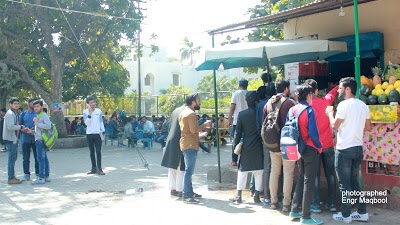
Why can’t we develop the small chai dhaba behind the Library into a full fledged Canteen? There are some fruit juice sellers and a chāt seller already having their ‘thhela’ there.

Once upon a time AMU campus did boast of a number of eateries, each famed for something or the other. Instead of developing, they have either degenerated or disappeared.

Just behind the erstwhile ‘Ziauddin Hostel’ in MM Hall there used to be a Āshiq Ali Canteen. I remember that this joint was alway overcrowded and was a favourite spot for those living not only in MM Hall but also RM Hall. His hot samosas with sauce, omelettes and tea were hot selling stuffs. Namakparas were also a favourite. I remember going there on my tricycle with 50 paisas to have samosas and kāla jām in late 1960’s! Probably it was the first eatery which I visited in my life! Ashiq Ali Uncle would take the 50 paisa from me and give me the samosa with a liberal sprinkling of tomato ketchup, followed by a hot juicy kāla jām! The day when I had more more money, I would also treat myself with a Coca Cola or, sometimes, a Fanta!

Ashiq Ali Canteen in more recent times
I subsequently kept on visiting the place till I was doing my BA (Hons). However in my graduation and PG days, the more frequented spot was Hafeez ka Dhaba which was a respectable canteen near the Faculty of Arts. This place was frequented by both teachers and students. I remember frequently bumping into Iqtidar Alam Sahib, Irfan Habib Sahib and M Athar Ali Sahib here. Dr Rizvi “Gama” of Economics was a daily fixture there. Even girls and lady teachers too would visit this place. Bread pakodas were the usp of this place! It would open at 8:00 am and close down around 8:30 pm. It would also sometimes be open during late nights. Many a relationships were made and unmade there!

More famous were the iconic Cafe de Phoos and Cafe de Laila. Much has been written on them so I won’t talk much about them. Suffice to say that these two “canteens” made the fried dālmoth and barfi into status symbols of Aligarh!

And then of course there were innumerable road side tea shops in the Shamshad Market, as there are now: but then there is one primary difference between then and now! Then the chai was always served brewed in a white porcelain teapot and matching cups and saucers! Nearby were the shops of bun-kababs and omelette buns. And toast and butter were always served with steel butter spoons! Most of these places in Shamshad, Purani Chungi and Mandi had a gramophone blaring old classic Bombay songs.

At Purani Chungi there was this eatery called Jai Jawān, run by an ex-subedar of Indian Army! The bread pakodas sold there were unique and I still wish to taste them once more in life, but alas!

Aligarh had a tahzeeb which slowly disappeared with this canteen culture!

Tomb of Sultan Ibrahim Lodi

Sultan Ibrahim Lodi (r. 1517-26) was the last Lodi ruler to sit on the throne of Delhi. It was during his reign that the Mughals started knocking at the doors of India.

Zahiruddin Babur, the Timurid prince of the House of Ferghana, after his defeats at the hands of the Uzbeks, had been holding Kabul since 1504. Since coming to Kabul, his eyes were towards India. His first formal contact with India was in 1519 when he fought a battle at Bajaur, where for the first time he used the Rumis and their canons. After Bajaur he came in contact with Alauddin and Daulat Khan Lodi, the recalcitrant Lodi commanders of Ibrahim Lodi. During the same period letters were also sent to him by Rana Sangram Singh inviting him to come to India. The idea was that Babur would come, defeat Ibrahim and gift the territory to the collaborators and after taking his booty return back. This information is given to us by Babur’s cousin, Mirza Haider Dughlat. Babur too subsequently alludes to it later on.

In 1525 Babur thus assured of local help, started for India. And in April 1526 he reached the environs of Delhi. The battle was fought at Panipat. The large unmanageable army of Ibrahim Lodi was defeated. In the face of the new battle formation and the use of hand guns as well as canons in open battle, the Lodi army was surrounded. In the face of the effectiveness of Babur’s military strategy and techno superiority the Lodi army was worsted. Ibrahim Lodi was killed in the battle and the area of Delhi passed over to Babur.

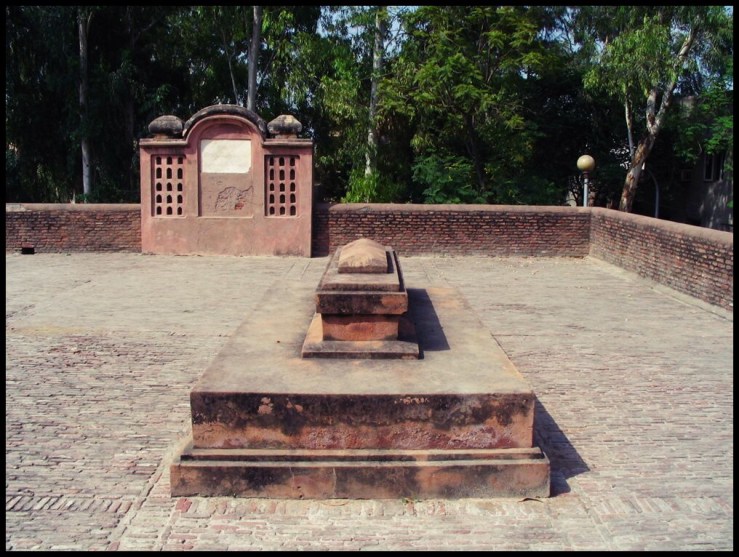
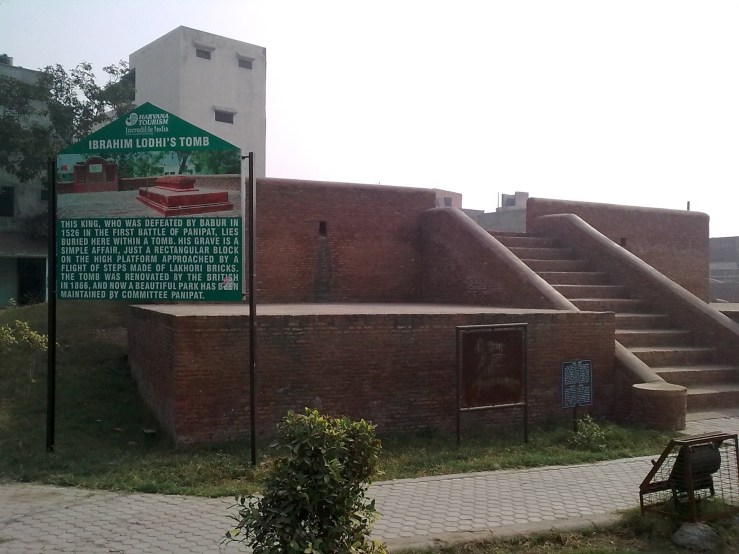
After the battle of Panipat, Ibrahim Lodi was buried near the battlefield itself. His tomb survived till the Colonial period. At the time when the Grant Trunk Road was being built by the British, the tomb was shifted to its present location.

Today it exists in the form of a simple but high brick platform with the grave of the Sultan marked at the top. Probably in its original form too it was simply conceived as a platform tomb.

The view that the grave of Ibrahim Lodi is in the Lodi Gardens in Delhi is a later day concoction.

Answering Nanda!

Countering our charge of wilful destruction of the monuments by reconstructions in the name of conservation, Ratish Nanda of Agha Khan Trust told ‘Newslaundry’ that:

a) I (Nadeem Rezavi), Prof Shireen Moosvi and Professor Irfan Habib have “a political agenda”! And we want to drag the name of Modiji in this!

b) That they brought all the essentials (tiles etc) from Central Asia “ artisans from where built the tomb”!

I would just like to reiterate that it is not only us who opposed the vandalism! All professional historians in India (except some individuals) have done so! And the proof is the Resolution passed by the JNU session of the Indian History Congress in 2014. (Attached as Photo)

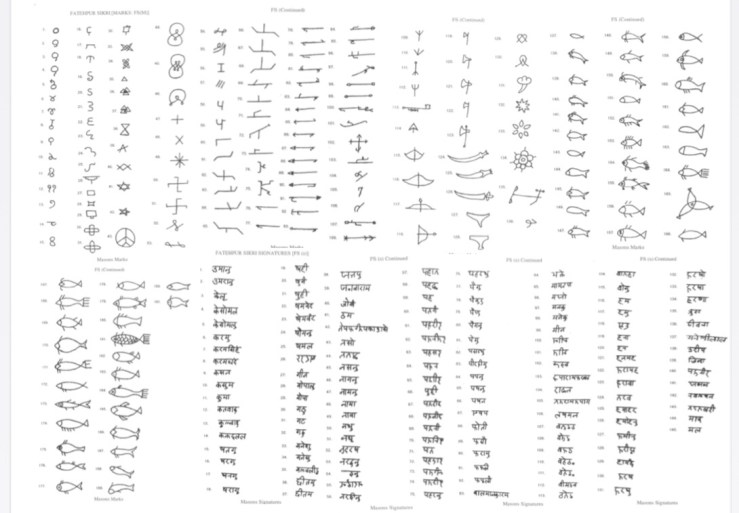
Secondly had Mr Nanda paused to look at the original sandstone slabs lining the floors of the platform of the tomb, he would have seen for himself the names and marks of the original craftsmen involved in construction work! All are indigenous (Hindu) names written in Nagri! Had he read some basic works on this issue (works of Pushpa Prasad, RNath, my book and papers, even the book Complete Taj by Ebba Koch!) what to talk about primary sources like the Ain-i Akbari, he would have realised that since Sultanate period, the structures might be conceived and designed by Central Asian architects, the actual execution was by the locals! (See Photo 2)

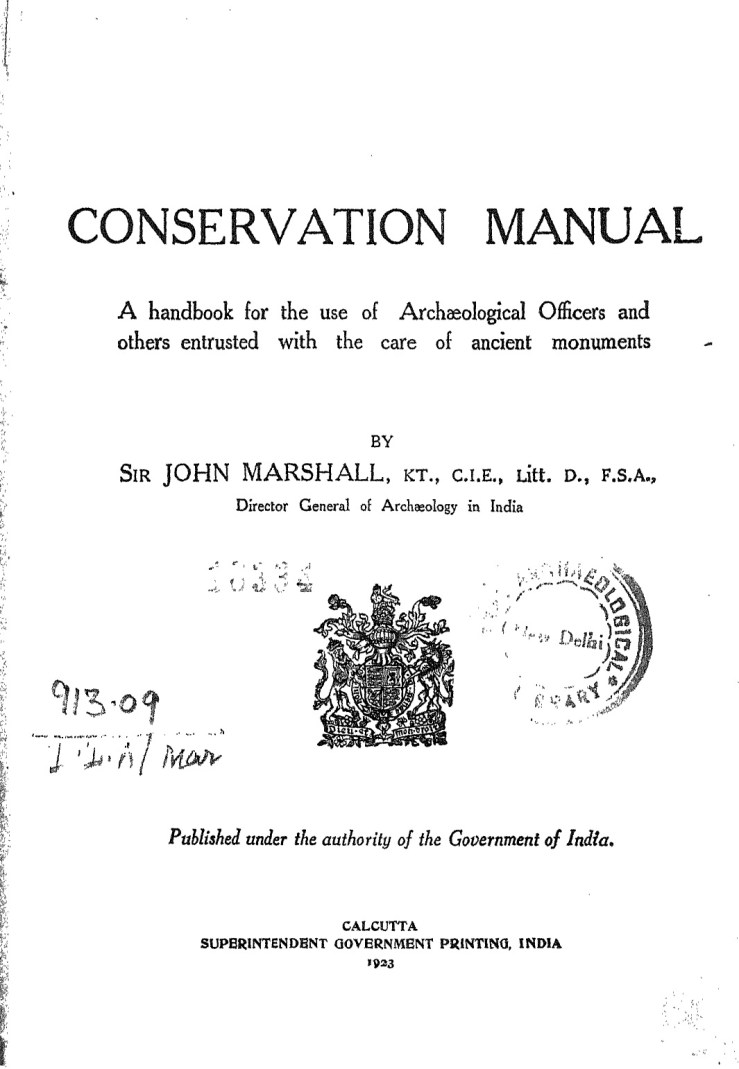
Further, Ratishji, could you also justify please why within a couple of years of finishing “renovations” and spending crores in the process, your new plasters are pealing off? Or could you also elaborate as to from which Mughal sources did you get the formula of making Mughal mortar? Incidentally the Mughal plaster remains steadfast even after centuries! Which experts of history did you consult? What was the need to scrap off the full layer of original mortar and consequent loss of designs and murals over them? Why did you violated every rule laid out since 19th Century in India on the Conservation of Monuments, specially the very important Manual of Conservation by Sir John Marshall?

There are many many more questions which beg for an answer! Incidentally these questions cannot be satisfactorily answered with a cool tall glass in our hands!

Newslaudry Report