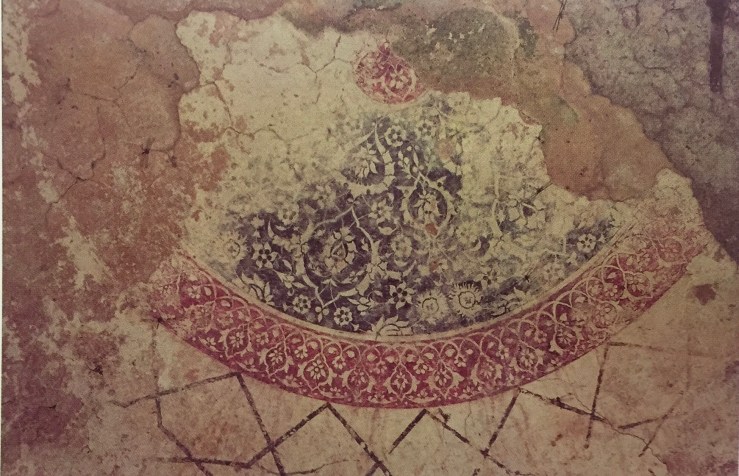
Sultanate Remains at Fathpur Sikri

In popular perception Fathpur Sikri was a wild jungle before Akbar. Reality check however tells us that the area was inhabited ever since pre-historic times. Painted Grey Ware (PGW) sherds and beads have been found besides the lake.

For Medieval period the first textual reference comes from Tārīkh-i Mubārakshāhi dating from the reign of Sultan Mubarak Shah (1421-34)

According to Sultanate sources by the end 12th Century the area was taken over from Sikarwar Rajputs. In 1196 AD it passed into the hands of Malik Bahauddin, governor of Muizzuddin bin Sām. The survival of structural remains prove the written sources.

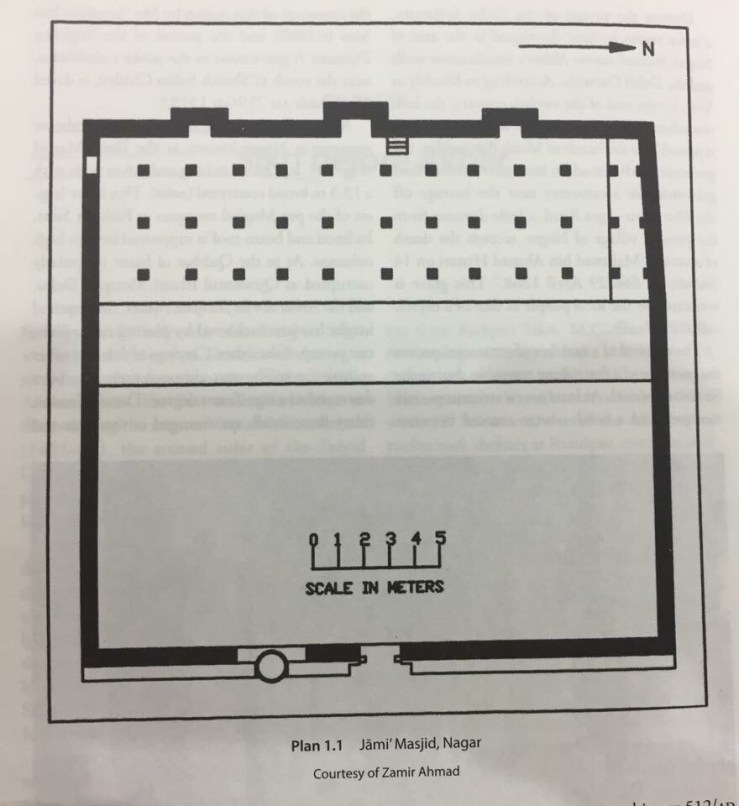
At least seven structures – 6 mosques and a tomb – were erected at Sikri between the conquest of this region by Muizuddin bin Sām (c. 1200) and the Tughluq period. A gravestone near the Tomb of Salim Chishti is also dated 15 Ziqåda AH 719 / AD 1319….

The earliest Medieval structure at Fathpur Sikri is a mosque which was probably constructed in or around AH 512 / AD 1118.

Like the Qubbatul Islam and Arhai Din Ka Jhoñpra the prayer chamber of this mosque is raised with shafts of temple pillars. Requisite height is attained by placing two or three shafts one on top of the other. But unlike them, it lacks in an arched screen. The trabeate roof is of simple stone slabs while the mihrab is of white marble with Quranic verses inscribed in Kufic script. It was constructed probably soon after the first few years of continuous Muslim occupation of Sikri.

Carvings of fish and other animals can still be seen on these pillar shafts.

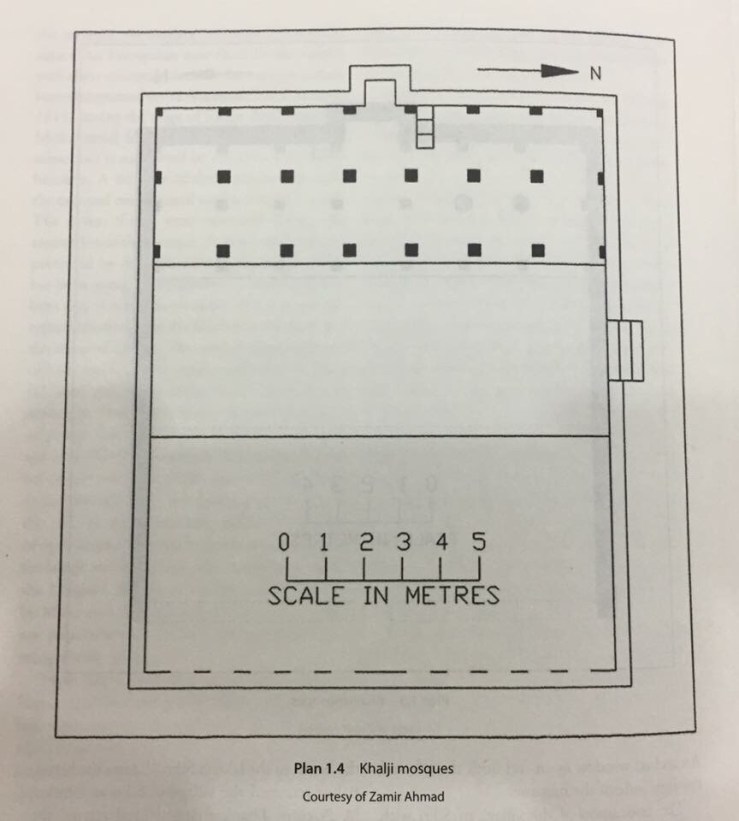
One of the Khalji period mosque, today known as Masjid-i Anbiya (Prophets Mosque) survives almost intact. Two or three other Khalji period mosques survive too. All these mosques testify to a sizeable town that Sikri was during the period.

• Syed Ali Nadeem Rezavi

Muslim Presence in Early Medieval India: Merchant Communities

According to David Pingree, epigraphic evidence attests to the presence of Persian (either Zoroastrian or Muslim) merchants on the Konkan coast of western India as early as the late 7th century.*

[* David Pingree, ‘Sanskrit evidence for the Presence of Arabs, Jews, and Persians in Western India: ca. 700-1300’, Journal of the Oriental Institute M S University of Baroda, 1981, p. 177]

The geographer al-Masūdi visited Saymur (modern Chaul, south of Mumbai) in AH 304 / AD 916 and saw there a large community of Muslims comprising merchants from Basra, Baghdad, Oman, Siraf, and Yemen.*

[* Abul Hasan Ali al-Masūdi, Murūj al-Dhahab WA Mada’adin al-jawhar, (9vols ed & tr C Barbier de Meynard and Pavet de Courteille, Paris, 1861/77, vol I, p. 187; Buzurg ibn Shahryat Ramhurmuzi, Kitāb ‘ajā’ib al-Hind, ed. P A van der Lith and L. Marcel Devic, Leiden, Brill, 1883-86, pp. 142-44]

During this period the denizens of Sirāf were active in the maritime trade as far east as China, and the best documented of the Sirāf merchants, Ramisht (d. AH 537 / AD 1142), is said to have made a future in the Indian trade, with some of which he endowed and embellished the sanctuary at Mecca.*

[* Hugh R. Clark, ‘Muslims and Hindus in the Culture and Morphology of Quanzhou from the Tenth to the Thirteenth Centuries, Journal of World History, vol. 6, no. 1, 1995, (pp. 49-74), po. 59-60; SM Stern, ‘Rāmisht of Sirāf, a Merchant Millionaire of the Twelfth Century’, Journal of the Royal Asiatic Society, 1967, pp. 10-14]


Selections from Finbarr Barry Flood, Objects of Translation, Princeton, 2009

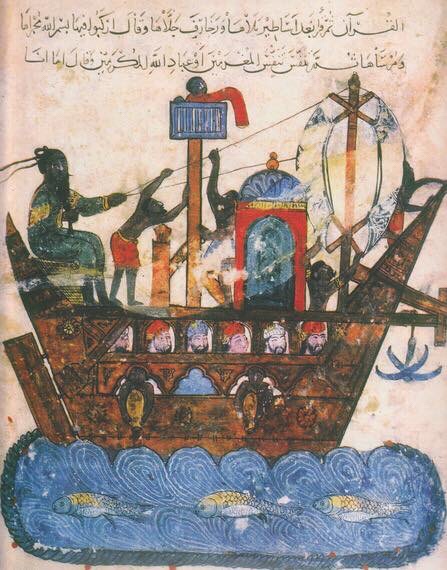
A ship manned by Indian sailors, Maqāmāt of al-Hariri, Baghdad (?), 1237, Bibliothèque Nationale de France, Ms. Arabe 5847, fol. 199 v

Muslim Communities and Structures in Early Medieval India: 8th – 10th Century

Here is an excerpt from Finbarr Flood, Objects of Translation Material Culture and Medieval Hindu-Muslim Encounter Material Culture and Medieval Hindu-Muslim Encounter, Princeton, 2009

According to the contemporary sources, both literary and epigraphic, during 8th to 10th century, the Muslim merchant communities coming towards and settling in India, especially in the western parts, were provided with both neighbourhood mosques (masājid) and congressional mosques (jawāmi‘ or masājid-i ādhīna) standing in close proximity to idol temples (but-khāna) endowed with minarets from which the call to prayer (adhān / azān), the takbīr (the cry ‘God is great’ – Allaho Akbar) and the tahlīl (the statement that there is no god but God- ‘Ash-hado an lā ilāha illallāh‘) were given.*

From the contemporary epigraphs we also come to know that the name ‘Muhammad’ was usually transliterated as Madhumati, Madhumata or Madumod. The name ‘Ali was on the other hand transliterated as Alliya, or Aliyama.

The existence of these diasporic communities is confirmed by inscriptions of the Rashtrakutas and Kadambas found on the west coast of India.

For example, the Chinchani copper-plate inscription of Śaka Samvat 848 (AD 926) mentions that a Tajīka (Turk/Muslim), named ‘Madhumati Sugatipa’ (Muhammad Lord of the Virtuous) son of ‘Sahiyarahara’ (Shahriyar), evidently a Persian Muslim, governed the region of Sanjan (Samyana) which was situated on the Karnataka coast of western India for the Radhtrakutas during the reigns of Krishna II (AD 878 – 915) and Indra III (AD 915 – 928), who elsewhere describes his dominion as including the Tājikas and Purasikas (Muslims & Persians/Parsis).

This inscription indicates that ‘Madhumati’ (Muhammad) established ‘free ferries and a feeding house’ and endorsed the establishment of a Hindu monastery and an endowment to ensure its support by a Brahman who was an associate of his minister. The foundation is mentioned in a later inscription too which is dated Śaka Samvat 956 (AD 1034). This later inscription also refers to the merchants Alliya (‘Ali), Mahara (Mihr), and Madhumata (Muhammad).**

Contrarily we also find reference that when a mosque was damaged in a sectarian riot in Cambay, the Chalukyan king Jayasimha Siddharaja (1094-1144) paid for its reconstruction. We also get a report that a Jain merchant funded construction of a mosque in the coastal Gujarati town of Bhadreśvar.***

Further south along the Konkan coast, two inscriptions in the name of Kadamba ruler Jayakeśin I (c. 1050-80) found at Panjim in Goa, attest the presence of Muslim communities in that region.

The first of these inscriptions, dated AD 1053, grants permission to an official named Chadama, son of a Tajīka merchant Madumod (Muhammad), to collect taxes from ships entering the port in order to fund construction of a “mijigiti” (masjid/mosque).

The second is a royal inscription of AD 1059 and it reports the grant of a village to the said Chadama, who is mentioned as the son of Madhumada (Muhammad), son of Aliyama (‘Ali), a Tayika (Tajīka) merchant who hailed from the port of Cemulya (Saymur).^

Apart from the coastal towns of Karnataka, Konkan, Gujarat, and Maharashtra, Muslim merchant communities also are attested to in the cities of the Gangetic plain.

Al-Muqaddasi, for example, reports the existence of a jāmi’ (congressional mosque) in the suburbs (al-rabāz) of Kannauj, the capital city of Gurjara-Pratiharas, a kingdom considered by the contemporary Muslim geographers as inherently hostile to Islam.^^

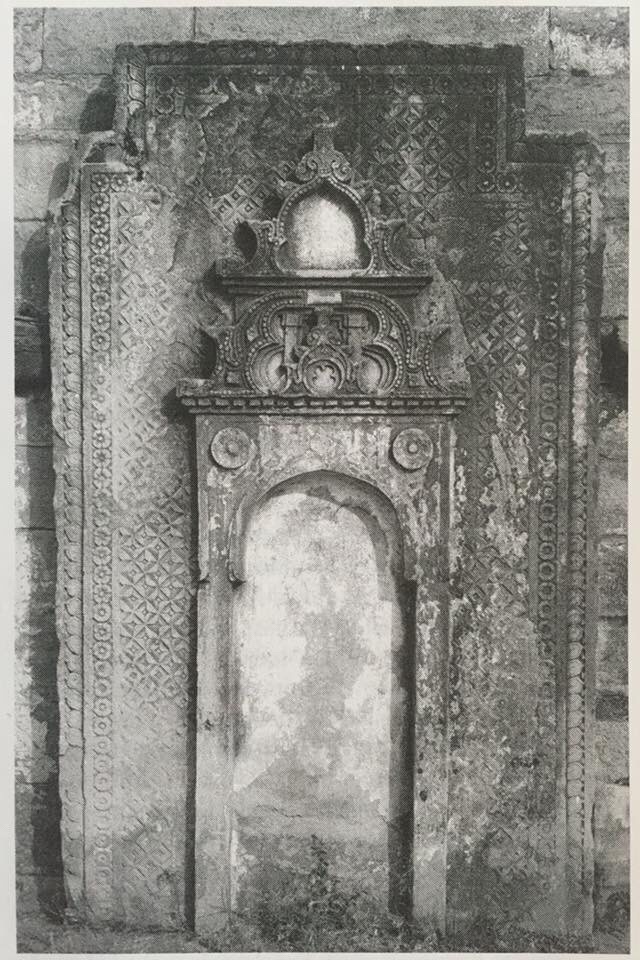
A mihrab datable to 9th-10th century survives at Gwalior near Kannauj, confirming that Muslims and mosques existed even within the urban centres of Gurjara-Pratiharas.^^^

This mihrab adapts a contemporary Indic architectural vocabulary and anticipates the idiomatic transformations associated with later Indo-Islamic architecture.

_________________________________

References:

* al-Masūdi, Murūj al-dhahab (9 vols, ed. & tr. C Bardier de Meynard & Pavet de Courteille, Paris, 1861-77), I, p. 382; idem, Le Prairies d’or, tr. C B Meynard & Pavet de Courteille, Paris, 1962, I, p. 154; Abu Ishaq al-Farisi al-Istakhri, Kitāb Masālik wa’l Mamālik, ed., J de Goeje, Brill, Leiden, 1967, pp. 173, 176; Anon., Hudūd al-‘Ālam, ed., Manuchehr Sutudeh, Teheran, 1962, p. 66; JH Kramers & G Wiet, Configuration de la terre (Kitāb surat al-ard, ed., JH Kramers, Brill, Leiden, 1967, p. 320; V Minorsky, Hudūd al-‘Ālam, “The Regions of the World”: A Persian Geography, 372 AH – 982 AD, Karachi, 1980, p. 88

** Epigraphia Indica, no.32, 1957-58, esp. 47, 50; D C Sircar, Studies in the Society and Administration of Ancient and Medieval India, vol I: Society, Calcutta, 1967, pp.77-85; David Pingree, ‘Sanskrit Evidence for the Presence of Arabs, Jews and Persians in Western India: ca. 700-1300,’ Journal of the Oriental Institute MS University of Baroda, 1981, vol 31, no.1, (pp. 172-82), pp.176-77; Ranabir Chakravarti, ‘Monarchs, Merchants and a Matha in Northern Konkan (c. AD 900-1053),’ in idem, (ed.), Trade in Early India, New Delhi, pp. 257-81 (pp.65-69)

*** G. Bühler, ‘The Jagducharita of Sarvananda, a Historical Romance from Gujarat,’ Sitzungsberichte der Philosophisch-Historischen Classe der Kaiserlichen Akademie der Wissenschaften, vol 126, pp.1-74 (p.18); Elliot & Dawson, The History of India as Told by its own Historians, 4vols, Delhi, 1990, vol 2, p. 162

^ D C Sircar, Studies in the Society and Administration of Ancient and Medieval India, vol I: Society, Calcutta, 1967, p.77; David Pingree, ‘Sanskrit Evidence for the Presence of Arabs, Jews and Persians in Western India: ca. 700-1300,’ Journal of the Oriental Institute MS University of Baroda, 1981, vol 31, no.1, (pp. 172-82), p.178

^^ Muhammad ibn Ahmad al-Muqaddasi, Kitāb Ahsan al-Taqāsīm fi Ma’rifat al-Aqālīm, ed., MJ de Goeje, Brill, Leiden, vol III, p. 480

^^^ Michael D. Willis, An Eighth Century Mihrab in Gwalior,’ Artibus Asiae, vol 46, no 3, pp. 227-46

Photo: A 9th or 10th Century Stone Mihrab now preserved on the exterior wall of Gwalior Fort, Gwalior
Tazkira-i Majīd: A Biography of Akbar’s Qazi, Nūrullah Shūstari d.1611

The Tazkira-i Majīd is the biography of Qazi Nurullah Shustari, the Iranian jurist, judge and divine who joined the service of Akbar and was executed during the reign of Jahangir. It is written by Saiyid Sibtul Hasan, Fāzil-i Hanswi.

Its first edition came out in 1962, while the fifth was completed just two days prior to the author’s death in 1978. A sixth edition was printed from Pakistan sometime in late 1980’s.

سیدسبطالحسنفاضلھنسویتذکِرہمجید

It is a first complete biography of Qazi Nurullah Shustari based on primary Persian sources. Fazil-i Hanswi, amongst other contemporary sources uses the letters written by the Qazi, his son and other contemporary theologians. He also used the account of Taqi Auhadi, as well as Farīd Bhakkari’s Zakhīrat ul Khawānīn, to describe how the Qazi met with his end.

Later a well known historian, Saiyid Athar Abbas Rizvi, who wrote a history of Shias in India in two volumes used the entire information in his book without referring to my father’s work or acknowledging him. He wrote in English and used the craft of a professional historian, instead the straight style of a theologian! Tazkira-i Majīd stood forgotten, at best neglected, being in Urdu, and a work of a traditional scholar!

Very recently in 2016 the Indian Sub-Continental Literary Revival Centre [MAAB], London had it translated and published in English. It was translated by Sheikh Abbas Raza.

Saiyid Sibtul Hasan Fāzl-i Hanswi Tazkira-i Majīd English

Recently I was informed that some one in Pakistan, who otherwise is well known, has printed the Urdu original in his own name. I can but pity him!


It was when my father was collecting material for this book that he was informed about the existence of a portrait of the Qazi which was on display at the Delhi Fort Museum. My father had it photographed, and wanted to include it in the 4th edition of Tazkira-i Majīd.

But unfortunately as the portrait showed the Qazi as a typical noble of the period wearing a coat with floral design over a Mughal jāma and a headgear which was typical of nobility, the ulama (Shi’a theologians) of Lucknow objected to its inclusion! In their view the Qazi should have been shown wearing the typical dress of the Shi’a mullahs: a black qaba and donning a black ammāna (turban)!

Thus they ordered another portrait, based on the original, but wearing the desired attire. But my father refused to include a fake portrait in a book which was an authoritative and authentic account of the life of Qazi Nurullah!

Was this the actual portrait or an ascribed one?

It definitely belongs to Jahangir’s reign. It shows the Qazi drawing on the pipe of a huqqa (hubble bubble). From Waqāi Asad Beg (of Asad Beg Qazwini) we come to know that tobacco and the hubble bubble was brought to Akbar’s court around 1602. And when Akbar saw it and wanted to try it out, the physicians present in the court objected that its efficacy was yet to be tested!

The fact that an artist draws this huqqa in this miniature shows that it was drawn only when its use became acceptable in the court. We know that the Qazi was executed in 1611, that is within six years of Jahangir’s accession. Probably it was posthumously drawn, or was just an attribution.

Types of Wall Paintings at Fathpur Sikri

The wall paintings technically can either be in the form of frescoe-buono, stucco, or frescoe-secca. The frescoe-buono (generally referred to simply as frescoe) is a technique of applying colour pigments on a wet lime-plaster surface. In this technique, the dry colour pigments are absorbed by the plaster as it gradually dries.

In the case of stucco-painting, the colour is applied on relief ornamentation on slow setting hydraulic lime plaster. The frescoe-secca (generally referred to simply as a mural; though the term mural simply implies any surface ornamentation on the wall) implies a painting done on a

(generally thin layer of) plaster which has set in. This type is also referred to as tempera.

In either case, the outline of the paintings was drawn with red ochre (geru) or black colour, for which generally carbon was used. The pigments, for painting the surfaces were generally prepared from the minerals like red ochre, lapis lazuli, sulphides of mercury, lead and other arsenic and copper ores. Some colours were also prepared

from plant extracts like indigo, lac and dhak.

Evidence gathered through the surviving architectural remains suggests that the Mughal architects resorted to this art while decorating their structures from the reign of

Babur itself. The now demolished Mir Baqi’s Mosque at Ayodhya (c.1528-29 AD) was adorned with stucco-painted soffits, lunettes and extrados. For Humayun’s period, we

have the Kachhpura Mosque at Agra and Humayun’s Library (‘Sher Mandal’) at Delhi.

Just like the Ayodhya Mosque, The Kachhpura Mosque of Humayun, constructed a year later (1530 AD) has traces of stucco-paint on soffit, lunette and extrados of the central

dome and mihrab. The walls of the main chamber of the Humayun’s Library are replete with floral and vegetal patterns and designs. Under Akbar, the art of wall painting was employed to such an extent that it came to be counted as one of the essential architectural features of Akbari Architecture.

The most prominent examples of murals are now to be found in the Khwābgāh, the khizāna-i anūptalao (popularly known as the ‘Painted Chamber’), and the so-called Sonahra Makān (Gilded House) or Maryam’s House.

The Jami’ Masjid, the so-called Jodhbai Palace (the Major Haramsara, ‘shabistan-i iqbal’) and the hammams, especially the Imperial Baths (in the daulatkhāna quadrangle), the so-called Hakim’s Bath (infact the main Imperial Baths), and the small bath on the slope adjoining the southern wall of the daulatkhana-i am provide us with the examples of the wall paintings in the stucco form.

As against the general belief, walls of Fathpur Sikri are covered not only by murals painted during the reign of Akbar but also those which were executed during the reigns of Jahangir and Shahjahan.

The murals at Fathpur Sikri are generally in a form resembling tempera (fresco secca), the extant examples of which are in the Khwabgah (the khilvat-kada), the

Khizana-i Anuptalao (popularly known as the ‘Painted Chamber’), and the so-called Sonahra Makan or Maryam’s House. At Khwābgāh and the ‘Sonahra Makan’ the colour

pigments have been applied on a very thin layer of intonaco (plaster background).

However in the Khizāna-i Anūptalao and the verandah encompassing the Khwabgah, the colour-pigment appears to have been directly applied on the red sand-stone surface.

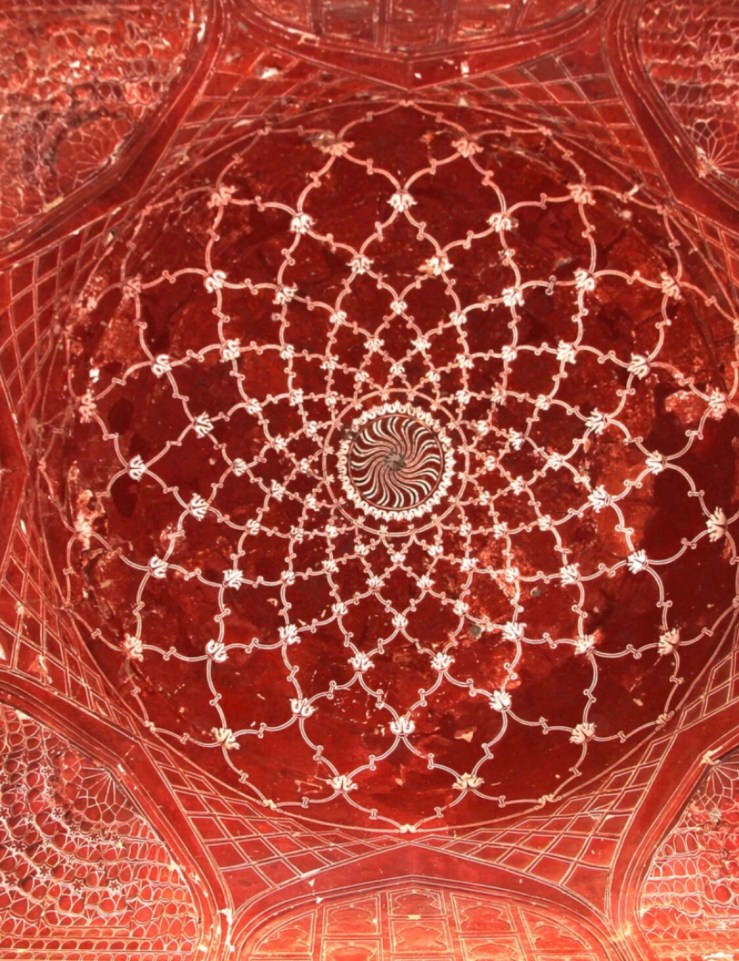
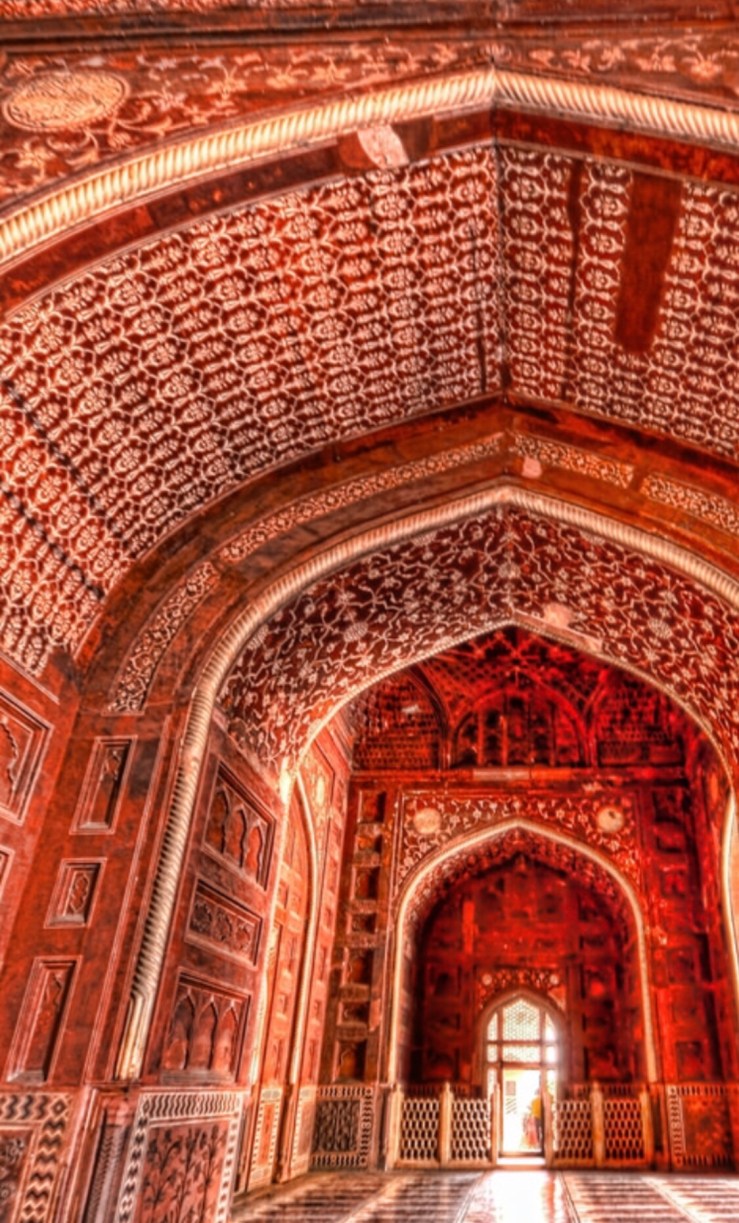
Another type of wall paintings are also found at Fathpur Sikri. But this is found in the structures which were either built or renovated during the period of Shahjahan. Sgraffito or Carvo-intaglio was a style of painting which was used in abundance in the buildings of Shahjahan. The best example of this type are the mosque and the mehmānkhāna flanking the Taj Mahal.

In this style, two layers of paint are applied, one on top of the other, say white and brick red. Then when both the layers have dried, a design is sketched. Then slowly as per the design the upper layer is scratched, exposing the inner one.

At Fathpur Sikri this sgraffito is represented in the Daulatkhāna of Shahjahan and his hammam. An underground chamber of the palace has beautiful sgraffito dados as well as vault decorations.

• Syed Ali Nadeem Rezavi