Rethinking Bengal, or Reframing It? A Response to Rethinking History I & II

Syed Ali Nadeem Rezavi

Professor Hitendra Patel’s two-part essay published in The Statesman on July 12 and July 13, 2026 is a thoughtful reminder that constitutional history deserves sustained attention in any account of late colonial Bengal. His emphasis on the Morley-Minto reforms, the Government of India Act of 1935, provincial autonomy, coalition politics, the Bengal Pact, and the constitutional debates of the 1940s serves as a useful corrective to historical narratives that concentrate exclusively on nationalism, communalism or Partition. Political institutions undoubtedly mattered. Constitutional debates shaped the language through which Bengal’s political elite articulated competing visions of representation, democracy and provincial autonomy.

Yet the essays also invite a number of questions. They claim to “rethink” Bengal’s history by placing constitutional politics at its centre. The issue is whether this constitutes a genuinely new historiographical direction or simply shifts emphasis within an already well-developed body of scholarship.

The first difficulty lies in the suggestion that constitutional history has been relatively neglected. This is not entirely convincing. Much of the finest scholarship on Bengal over the past four decades has consistently explored the relationship between constitutional reforms, representative institutions, communal politics and provincial autonomy. The works of Joya Chatterji, Sugata Bose, Sekhar Bandyopadhyay, Ayesha Jalal, Gordon Johnson, Judith Brown and others have never treated constitutional developments as peripheral. Rather, they have integrated them into broader analyses of Bengal’s political transformation. Constitutional politics is therefore hardly a neglected subject awaiting rediscovery.

More importantly, the essays tend to present constitutional politics as an almost autonomous sphere of historical explanation. Constitutions, however, do not operate independently of society. Institutions derive their significance from the social, economic and cultural contexts within which they function.

The elections of 1937 provide a good illustration. They certainly marked a constitutional watershed. Yet their outcome cannot be explained merely by electoral arrangements or representative institutions. They reflected agrarian discontent, the mobilisation of Muslim peasantry, the rise of the Krishak Praja Party, urban Hindu politics, educational expansion, changing social aspirations and the cumulative consequences of colonial land revenue policies. Constitutional reforms created the arena within which politics unfolded, but they did not determine the political forces that occupied it.

Similarly, the Bengal Pact of 1923 was far more than a constitutional compromise. It represented an attempt to address longstanding anxieties over education, employment, representation and access to public institutions. Those concerns had emerged through wider social and economic developments. Constitutional negotiation was therefore one expression of deeper historical processes rather than their origin.

The role of colonial power also receives less attention than it deserves. British constitutional reforms were not neutral experiments in democratic development. Every constitutional measure, from the Morley-Minto reforms onwards, sought to reconcile limited political participation with the preservation of imperial authority. Separate electorates, reserved representation and provincial autonomy were carefully calibrated mechanisms of colonial governance. To analyse constitutional evolution without placing imperial objectives at the centre risks overlooking the very framework within which these institutions operated.

The essays also establish an unnecessary opposition between constitutional reasoning and ideology. Professor Patel argues that constitutional considerations rather than ideological differences explain many of the choices made by Bengal’s political leadership. Yet constitutional preferences themselves emerged from ideological commitments. Fazlul Huq, Sarat Chandra Bose, H. S. Suhrawardy, Syama Prasad Mookerjee, Muhammad Ali Jinnah and others differed not merely over constitutional arrangements but over fundamentally different conceptions of community, democracy, federalism and the future of India. Constitutional arguments were themselves expressions of political ideology.

Nor can constitutional history be separated from popular politics. The legislative debates of the period unfolded alongside the Swadeshi movement, peasant mobilisation, labour unrest, revolutionary nationalism, communal mobilisation and, ultimately, the Bengal Famine. Public opinion, organised protest and mass political participation shaped constitutional developments as much as constitutional institutions influenced society. The relationship was reciprocal rather than one directional.

The second essay rightly emphasises that the constitutional alternatives discussed during the 1940s remind us that Partition was not inevitable. This is an important point. Yet it is also one that modern historiography has long recognised. Historians have repeatedly demonstrated that multiple constitutional futures remained possible until remarkably late in the transfer of power. The existence of unrealised alternatives enriches our understanding of contingency, but it does not fundamentally revise the existing historiography.

There is another omission that deserves attention. Throughout both essays, constitutional debates are largely viewed from the perspective of political leaders and legislative institutions. Missing are the experiences of ordinary Bengalis. Constitutional ideas were interpreted, contested and reshaped through newspapers, voluntary associations, student movements, district politics, caste organisations, religious institutions, municipal bodies and peasant organisations. The constitutional history of Bengal was not written only in Calcutta or in legislative chambers. It was equally fashioned in villages, towns and local public spheres.

Ultimately, the greatest strength of Professor Patel’s essays lies in reminding readers that constitutional history deserves serious consideration. Their weakness lies in presenting constitutional politics as the principal explanatory framework for understanding Bengal’s modern past. Constitutional institutions mattered enormously, but they functioned within larger processes of social change, economic transformation, ideological contestation and imperial governance. None can adequately be understood in isolation from the others.

History rarely advances by replacing one dominant narrative with another. Rather, it progresses through synthesis, by recognising the interaction of institutions, ideas, social forces and historical contingency. Bengal’s history is no exception. Its richness lay precisely in the complex interplay between constitutional innovation, political ideology, agrarian change, communal negotiation, intellectual life and popular mobilisation.

There is, however, one final point that deserves reflection. Every generation rewrites history, but the timing of such rewritings is itself historically significant. The current enthusiasm for “rethinking” Bengal’s past has emerged not in an intellectual vacuum but in the aftermath of a major political realignment within the state. That fact neither invalidates nor validates the arguments advanced. It does, however, remind us that historiography, like politics, is often shaped by the questions the present chooses to ask of the past. Historians should therefore examine not only the new interpretations being proposed but also the intellectual and political moment that has made these particular reinterpretations appear especially urgent.

The challenge, then, is not simply to rethink Bengal’s history. It is equally to remain attentive to the contexts in which history itself is being rethought. Only by doing so can historiography remain both intellectually rigorous and historically self-aware.

Book Review: Maulvi Haji Sayyid Wāhid ‘Ali Sahib ‘Akhlaṣ’. Tārīkh-i Haswa. With a preface by Mufti Sayyid ‘Abd al-Qawi, author of Rashīd al-Mu’allifīn. Banaras: Matba’ Kamāl al-Maṭābi’, 1330 AH (1912–13 CE). 72 pp.

Syed Ali Nadeem Rezavi

For a long time, the history of medieval and early modern India has been written largely from the perspective of kings and emperors. Dynastic chronicles, imperial memoirs and colonial settlement reports have justly dominated the field, but they have also tended to crowd out a quieter, equally rich tradition of historical writing that flourished in provincial North India during the late nineteenth and early twentieth centuries. This is the tradition of the Urdu local history, or tārīkh-i maqāmī. These works were not produced in royal courts but in small towns (qasbas) by scholars who were deeply embedded in their communities. They preserve a remarkable wealth of detail about genealogy, patterns of settlement, education, religious institutions and collective memory. Among them, Tārīkh-i Haswa by Maulvi Haji Sayyid Wāhid ‘Ali Sahib ‘Akhlaṣ‘ deserves special attention. Though it focuses on a single qasba in what is now Fatehpur district in Uttar Pradesh, its insights reach far beyond the boundaries of that one locality.

The qasba as a social and cultural formation has drawn renewed interest from historians in recent decades. The late Mushirul Hasan, in his influential study From Pluralism to Separatism: Qasbas in Colonial Awadh, described these settlements as historic ‘rurban’ spaces – smaller than cities but larger than villages – that were once vibrant centres of Sufism, Urdu literature, refined conversation (tehzib) and cross-cultural encounter. In the Awadh region, with its epicentre in Lucknow, these towns nurtured a remarkable composite culture, where Hindus and Muslims participated freely in each other’s festivals, contributed together to literary traditions, and shaped a shared social world. Haswa, lying within this cultural orbit, exemplifies precisely such a milieu. Its history, as recorded by Sayyid Wāhid ‘Ali, is not merely a local chronicle but a testament to the pluralistic and intellectually rich life of the Awadhi qasba that Hasan so eloquently evoked.

Published in Banaras in 1330 AH (1912–13 CE), the book runs to seventy-two pages and is introduced by a preface from Mufti Sayyid ‘Abd al-Qawi, the author of Rashīd al-Mu’allifīn. The title page tells us that Sayyid Wāhid ‘Ali was a retired tehsildar, and this detail is more significant than it might first appear. Unlike many local chroniclers who relied almost exclusively on oral tradition, he brought to his task both the sensibilities of a local scholar and the practical training of a revenue official. That dual perspective shows throughout the work, in his careful attention to genealogy, landholding patterns, institutional history and documentary exactness.

The volume belongs to a distinguished but understudied group of Urdu local histories, alongside works on Bilgram, Sandila, Kakori, Amroha and Dewa Sharif. Together, these texts form one of the richest archives we have for reconstructing the social history of provincial Muslim society in northern India. Yet they have received only sporadic scholarly attention, overshadowed by the better-known Persian chronicles of the Delhi Sultanate and the Mughal Empire, or by the district gazetteers compiled by British officials. Tārīkh-i Haswa shows precisely why this neglect ought to be remedied.

Unlike the Persian chronicles of the Delhi Sultans or the Mughal emperors, Tārīkh-i Haswa does not seek to narrate the rise and fall of empires. Instead, it asks a different set of historical questions. Who first settled here? Which families established the town’s scholarly reputation? Which mosques and shrines shaped its religious life? How did successive generations preserve their lineage and identity? Who were the teachers, judges, physicians and poets who made Haswa an intellectual centre? These questions reflect a conception of history rooted not in kingship but in community. The author’s understanding of what constitutes history is fundamentally different from that of a court chronicler. Political events are given only a secondary place. Instead, the narrative centres on the origins of Haswa, the settlement of its Sayyid families, the founding of mosques and imambaras, the careers of local scholars and jurists, and the preservation of communal memory. History here is not the story of rulers succeeding one another but the story of a community enduring over time.

One of the striking features of the work is the author’s concern with place. The opening pages describe the physical setting of Haswa, its surrounding villages and the natural environment in which the settlement evolved. The qasba is presented as an organic part of the countryside rather than an isolated urban enclave. Agricultural prosperity, access to communications and proximity to neighbouring settlements all contributed to its emergence as a regional centre. Such observations correspond closely with what historians now understand about the growth of qasbas under the Delhi Sultanate and the Mughals. These settlements typically developed where agrarian expansion created a surplus capable of supporting religious scholars, administrators and artisans.

The Sayyids and Scholars of Haswa

The genealogical tables reproduced in Tārīkh-i Haswa are among the most remarkable features of the work. They demonstrate the author’s determination to preserve precise relationships between successive generations rather than relying upon vague family traditions. The author carefully traces the descent of the main Sayyid families, recording relationships, migrations and family lore. Modern historians are rightly cautious about genealogical evidence, aware that lineage is often shaped as much by memory as by documentation. From the standpoint of historical methodology, such material deserves careful evaluation. Genealogies often preserve accurate information over remarkably long periods because inheritance, marriage and religious succession depended upon them. At the same time, they occasionally incorporate omissions, simplifications or retrospective adjustments intended to strengthen claims of prestige. The historian must therefore compare local genealogies with contemporary documents wherever possible.

Nevertheless, even when minor inaccuracies occur, genealogies remain invaluable historical evidence. They reveal patterns of migration, demographic growth, educational succession and the distribution of landed property. They also illuminate the remarkable stability of certain scholarly families whose influence extended across several centuries. The genealogical portions of Tārīkh-i Haswa deserve to be treated as primary historical evidence, not merely as curious relics of antiquarian interest.

The Sayyids of Haswa constituted what may appropriately be described as a scholarly aristocracy. Their authority rested upon learning rather than military power. Their prestige derived from scholarship as much as descent. They taught in madrasas, delivered legal opinions, supervised religious endowments, led prayers, composed literary works and trained successive generations of students. Their homes often functioned as informal academies where instruction continued outside the formal classroom. In doing so, they bore out Hasan’s observation that these towns were much more culturally refined than either large cities or ordinary villages, and that their residents often took immense pride in their heritage, comparing their homes to illustrious centres like Baghdad or Córdoba.

Mosques, Imambaras and Sacred Geography

Every historic qasba possesses two histories. One may be reconstructed through chronicles, administrative records and genealogies. The other is inscribed upon the landscape itself. Mosques, imambaras, shrines, cemeteries, madrasas and family residences collectively form what historians increasingly describe as a town’s sacred geography. These buildings are more than architectural monuments. They embody memory, patronage, scholarship and communal identity. In Tārīkh-i Haswa, Sayyid Wāhid ‘Ali devotes considerable attention to these institutions, recognising that they constituted the very heart of the town’s historical existence.

The emergence of sacred landscapes formed one of the defining characteristics of Muslim settlement in medieval India. Wherever scholars, Sayyids or Sufis established themselves permanently, they founded mosques, schools and cemeteries. These institutions gradually attracted students, pilgrims and patrons, creating a network of religious activity that transformed an ordinary settlement into a recognised centre of learning.

Haswa appears to have developed in precisely this manner. As successive generations of learned families settled there, each contributed to the religious topography of the town. New mosques were erected, educational circles expanded, imambaras were established for the observance of Muharram, while cemeteries became places where family memory and communal identity converged. The resulting landscape reflected centuries of continuous religious patronage rather than the vision of any single founder. These descriptions preserve information that may no longer be recoverable from surviving buildings or inscriptions. In this sense, the chronicle complements archaeological and epigraphic evidence by recording the social meanings that these institutions held for the local community.

The presence of imambaras within Tārīkh-i Haswa immediately indicates the importance of Shi’i devotional culture within the town. These buildings served as centres for the observance of Muharram, the recitation of marsiyas, majālis and the commemoration of the martyrdom of Imam Husain. The prominence accorded to these institutions suggests that the culture of Azadāri had become firmly rooted within Haswa by the nineteenth century, contributing significantly to the town’s distinctive identity.

Echoes in Stone

Today, one of the most tangible remnants of Haswa’s historical character is not a grand palace or mosque, but a pond. The Rani ka Talab, a historic pond in Haswa, is famous for its artistic and unique architecture. It was built in 1871 by Rani Gomati Kunwar, a daughter of a local landlord named Lala Ram Ghulam. The pond stands as a reminder of a time when local patronage shaped the landscape and when a single monument could serve the entire community. It is a quiet, physical link to Haswa’s past, one that embodies the composite culture of which Hasan wrote – a Hindu queen’s gift that became an enduring landmark for the entire town, regardless of faith.

Scholarship and Intellectual Culture

Perhaps the most significant contribution of Tārīkh-i Haswa, however, lies in its biographical material. The author commemorates scholars, jurists, teachers and other notable inhabitants whose names rarely appear in larger historical narratives. Together, these biographies illuminate the intellectual culture of the North Indian qasba. They remind us that the vitality of Indo-Muslim learning did not depend only on celebrated centres such as Delhi, Lucknow or Jaunpur, but also on smaller provincial towns that sustained traditions of scholarship across generations.

Linguistically, the work is an excellent example of mature Urdu historical prose. Though deeply indebted to Persian historiographical conventions in both style and vocabulary, it reflects the gradual replacement of Persian by Urdu as the principal language of Muslim historical writing during the nineteenth century. This shift itself forms an important chapter in the intellectual history of colonial India, and Tārīkh-i Haswa occupies a significant place within that story.

From the perspective of modern historical scholarship, the work is not without its limitations. The author seldom distinguishes explicitly between documentary evidence and oral tradition, and miraculous narratives occasionally sit alongside historically verifiable information without any critical comment. Ordinary cultivators, artisans and women receive relatively little attention, and explicit references to documentary sources are sparse. But these characteristics are largely features of the genre itself rather than shortcomings unique to this particular work. To judge Tārīkh-i Haswa solely by the standards of contemporary academic history would be to misunderstand both its purpose and its historical context.

Indeed, the book’s greatest strength lies precisely in its preservation of material that official records neglect. Colonial gazetteers give us statistics but rarely convey the inner life of a community. Persian chronicles illuminate imperial politics but seldom notice provincial scholars or neighbourhood institutions. Local histories such as this fill that gap by documenting the lived texture of society. When read alongside Persian chronicles, Mughal administrative manuals, district gazetteers, inscriptions and archival records, they become indispensable sources for reconstructing the social and cultural history of the Gangetic plain.

In recent decades, historians have increasingly turned to microhistory as a way of exploring broader historical processes through the detailed study of particular communities. Although the term itself emerged in twentieth-century European historiography, works such as Tārīkh-i Haswa show that Indian scholars had long recognised the historical value of the local. By documenting a single qasba in extraordinary detail, Sayyid Wāhid ‘Ali reveals patterns of migration, education, religious patronage and communal identity that illuminate much wider developments in North Indian history. Yet one cannot help but feel, as Hasan poignantly remarked, that ‘a carefully swept imambara, a functional old kothi, periodic assemblage of aspiring local poets, even an occasional production of local lore, legends and histories are poor substitute for the lost world of the qasbas‘. Works like this one are invaluable precisely because they offer us a glimpse of that vanished world, even as they remind us of all that has been irretrievably lost.

One cannot conclude without expressing the hope that Tārīkh-i Haswa will one day receive the critical edition it deserves. A scholarly English translation, accompanied by a substantial introduction, explanatory notes, genealogical charts, maps, indices and a comparison with Persian and colonial sources, would greatly enhance its accessibility and historical value. Such an edition would constitute a major contribution not only to the history of Haswa but also to the broader historiography of Mughal and colonial India.

Despite its modest size, this is a work of considerable historical importance. It reminds us that the making of Indian history took place not only in imperial capitals but equally in provincial qasbas, where scholars taught, families preserved their genealogies, religious institutions shaped communal life, and local historians consciously recorded the memories of their communities for future generations. More than a century after its publication, Sayyid Wāhid ‘Ali’s work remains an indispensable source for anyone interested in the social, intellectual and cultural history of North India.

Note: A copy of the book was in the library of my father, but is now not traceable. I am thankful to my cousin Mr Masoodul Hasan, former Bureau Chief of Hindustan Times at Lucknow, for sending me a pdf of the same. I also thank my student Ms Shireen Khan in getting it printed and bound for me.

A detailed study of this work will be undertaken later, hopefully.

The Scholar on the Mimbar: Remembering Professor Syed Badrul Hasan Abdi

Syed Ali Nadeem Rezavi

Some scholars are measured by the volumes they produce or the positions they hold. Others leave their truest legacy in the hearts and minds of their students, friends, and all who were fortunate enough to share their company. Professor Syed Badrul Hasan Abdi (1924–2009) belonged unmistakably to the latter. To introduce him merely as Professor of Arabic and Persian at Banaras Hindu University would be to capture only a fragment of a remarkably rich personality. He was scholar, teacher, poet, reciter of majalis, and above all a gentle soul whose profound learning was matched only by his profound humility.

Professor Abdi embodied a generation of scholars now steadily receding from our intellectual landscape. They moved with effortless grace between the lecture hall, the library, the shrine, and the mimbar. They saw no contradiction between academic rigour and religious devotion, between critical inquiry and literary sensibility. For them, learning was not a profession but a way of being.

For decades, Professor Abdi served in the Department of Arabic and Persian at Banaras Hindu University, where he became one of the most revered teachers of his time. His command of Arabic, Persian, and Urdu was the product of years of disciplined scholarship. He belonged to the classical Indo-Persian tradition in which languages were not merely studied but inhabited. Every text was read with care, every expression situated in its historical context, every interpretation tested against evidence. Students who passed through his classroom invariably remembered not simply what he taught but how he taught. He possessed that rare gift of making difficult texts feel accessible without ever diminishing their complexity.

His published writings reflected the same intellectual integrity. They ranged across Arabic and Persian literature, Islamic thought, Qur’anic studies, and the literary traditions of South Asia. Yet, like so many scholars of his generation, he never measured success by the number of books to his name. His greatest contribution lay in the students he shaped and the standards of scholarship he quietly upheld throughout his career.

For me, however, Professor Syed Badrul Hasan Abdi – Badrul Chacha – was never merely a distinguished academic. He was one of the closest friends of my late father, Saiyid Sibtul Hasan. As a child, I grew up seeing him as an honoured guest in our home in Aligarh. Whenever he visited, the conversations between the two friends would stretch for hours. Literature, history, theology, politics, and shared memories flowed together with effortless ease. Looking back now, I recognise that I was privileged to witness a culture of friendship rooted in scholarship, where intellectual companionship formed the strongest of bonds.

Yet, curiously, my most vivid memories of Professor Abdi belong not to Aligarh but to the Mazar of Shahid-e-Salis, Qazi Nurullah Shustari, in Agra. Every year, during the commemorations held there, he would arrive to recite the majalis. Those gatherings remain among the most cherished memories of my youth.

The shrine itself possessed a unique atmosphere. It was not merely a place of pilgrimage; it functioned almost as an academy, where scholars, students, poets, and devotees gathered in remembrance and discourse. Conversations would continue long after the majlis had concluded. Persian poetry, Mughal history, Qur’anic exegesis, Arabic philology, and Shi’i theology were all discussed with remarkable freedom. Professor Abdi was invariably at the centre of these exchanges, not because he sought attention but because knowledge naturally gravitated towards him.

It was upon the mimbar that his extraordinary gifts became fully apparent. Those who attended his majalis quickly realised that they differed profoundly from the style commonly associated with Muharram gatherings. For the greater part of the discourse, Professor Abdi spoke exactly as a university teacher would conduct a class. Listening to him, one often felt that one was attending a postgraduate seminar rather than a religious sermon. Every majlis followed a carefully planned intellectual progression. He would begin with a verse of the Qur’an or a tradition of the Prophet, explain its language and historical setting, and then gradually construct the background necessary for understanding the events of Karbala. Political developments within the early Muslim community, theological debates, the personalities involved, and the historical sources were all examined with the precision of an experienced historian.

Arabic and Persian texts appeared naturally throughout his discourse. They were never quoted merely to display learning; each citation served as historical evidence supporting the argument he was developing. Every assertion rested upon a source. Every narrative was placed within its proper context. For most of the majlis, the atmosphere resembled that of a university classroom. The audience was invited to understand before being invited to mourn. History became the foundation upon which devotion rested.

Then came the moment that everyone awaited. As Professor Abdi entered the masaib, the narration of the sufferings endured by Imam Husain, his family, and companions at Karbala, something remarkable occurred. Almost imperceptibly, the professor disappeared and the traditional zākir emerged. The measured prose of the lecturer gave way to a lyrical cadence that recalled the great majlis tradition of Awadh, a style that has now become increasingly rare. His voice acquired a rhythm of extraordinary beauty. His language became poetic without ever becoming theatrical. The emotional restraint that characterised the old Lucknow school of recitation revealed itself with quiet dignity. He never attempted to force emotion. He never relied upon exaggerated gestures or dramatic effects. Instead, grief unfolded naturally through the elegance of language and the cumulative weight of historical memory. The audience found itself moved because it had first been educated. Understanding prepared the heart, and the masāib completed what scholarship had begun. Even today, when I think of Professor Abdi, it is this transition that remains most vivid in my memory. Few speakers have ever combined historical analysis with devotional narration so seamlessly. He demonstrated that scholarship and emotion need not exist in opposition. Indeed, each gained strength from the other.

There was another dimension to Professor Abdi that many outside literary circles perhaps knew less well. He was an accomplished Urdu poet who wrote under the takhallus ‘Badr Faizabadi’. His poetry reflected the same refinement that marked his scholarship. Much of it celebrated the Ahl al-Bayt, the blessed Household of the Prophet, and commemorated the eternal tragedy of Karbala. His verses belonged to the great tradition of Urdu devotional poetry, in which literary elegance, historical consciousness, and profound faith existed together in perfect harmony. Like his Majālis, his poetry was distinguished by dignity rather than ornamentation. Classical in language yet immediate in feeling, his verses drew upon the immense heritage of Persian and Urdu literature while speaking with an authentic personal voice. Those who knew Badr Faizabadi the poet, recognised immediately the same gentle scholar they encountered in the classroom and upon the mimbar.

His literary and scholarly legacy continues through his family. His son, Professor Syed Ainul Hasan Abdi, is himself an eminent scholar of Persian who served for many years at the Centre of Persian and Central Asian Studies, Jawaharlal Nehru University, New Delhi. He has since held several important academic and cultural positions and currently serves as Vice Chancellor of Maulana Azad National Urdu University, Hyderabad. Like his father, Professor Ainul Hasan is much more than an academic administrator. He is an accomplished Urdu poet and an admired reciter of marsiya. In him, one finds the continuation of a remarkable family tradition in which scholarship, literature, and devotion continue to reinforce one another across generations. Professor Abdi’s family was itself connected with other distinguished scholarly lineages. His daughter Noor is married to Professor Aliul Hasan, son of the revered Maulana Syed Zafrul Hasan of Banaras, who for a period taught at the Engineering College of Aligarh Muslim University. Thus, through scholarship, friendship, and family, Professor Abdi remained part of a larger intellectual world that linked Banaras, Aligarh, Agra, and Lucknow through a shared commitment to learning and culture.

Looking back today, I realise that Professor Syed Badrul Hasan Abdi belonged to one of the last generations of what may truly be called scholar-orators. There was once a time when the majlis served simultaneously as a lesson in history, an exercise in literary appreciation, and an act of devotion. The finest zākirs prepared themselves as carefully as university lecturers. Accuracy mattered. Language mattered. Literary refinement mattered. Above all, respect for history mattered. Professor Abdi embodied that ideal completely. He explained before he exhorted. He educated before he moved. His authority rested not upon dramatic oratory but upon learning. Even when narrating the sufferings of Karbala, he never abandoned historical discipline or literary elegance.

Sadly, this culture has become increasingly uncommon. Modern academic life often leaves little room for the broad humanistic learning that once characterised scholars like Professor Abdi. At the same time, the majlis has in many places become separated from the rich historical and literary traditions that once nourished it. Professor Abdi stood firmly against such divisions. In his life, there existed no separation between the university and the mimbar, between scholarship and remembrance, between history and faith.

When I remember him today, I do not first recall the distinguished Professor of Banaras Hindu University or even the respected poet Badr Faizabadi. I remember instead the quiet figure seated upon the mimbar at the shrine of Shahid-e-Salis in Agra, patiently unfolding the historical background of Karbala before allowing the discourse to blossom into the haunting beauty of the masaib in the old Awadhi style. I remember the evenings that followed, when discussions continued deep into the night among scholars and friends. I remember, too, the warmth of his friendship with my father, a friendship that reflected the finest traditions of civility and intellectual companionship. In remembering Professor Syed Badrul Hasan Abdi, one remembers much more than an individual. One remembers an entire intellectual world that valued learning above recognition, humility above acclaim, and service above ambition. It was a world in which a professor could also be a poet, a poet could also be a zākir, and a zākir could remain, above all else, a teacher.

Such men become rarer with every passing generation. It is therefore both a privilege and a duty to remember Professor Syed Badrul Hasan Abdi ‘Badr Faizabadi’, not simply for what he accomplished, but for what he represented. He was among the last great custodians of a civilisational tradition in which scholarship, literature, piety, and humanity existed in perfect harmony. His voice has fallen silent, but the culture he embodied continues to inspire all those who had the good fortune to hear him teach, to hear him recite, and above all, to know him.

Ayodhya and Its Muslim Connection: A Historical Perspective

Syed Ali Nadeem Rezavi

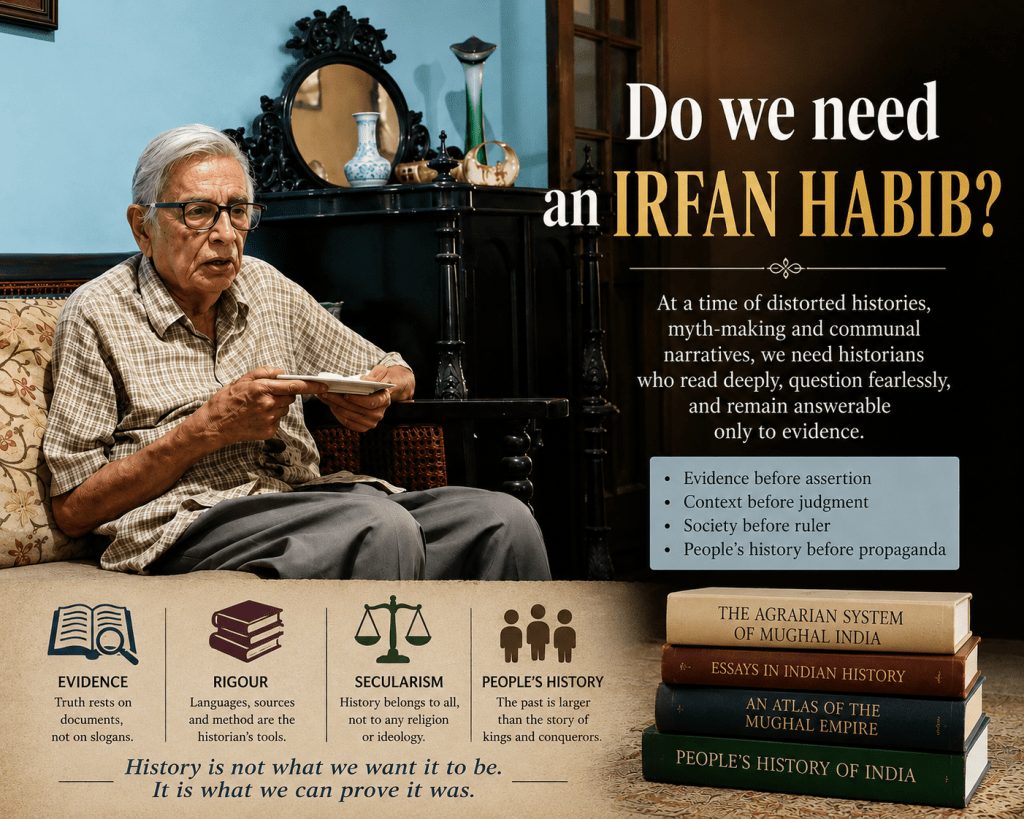
The city of Ayodhya, revered in Hindu tradition as the birthplace of Lord Rama, possesses a rich and complex history that extends far beyond its religious significance. While contemporary discourse often frames Ayodhya exclusively through the lens of Hindu-Muslim tensions, historical evidence reveals a far more nuanced narrative of coexistence, cultural exchange, and shared urban life. The scholarly work of historian Irfan Habib provides invaluable insight into the deep and multifaceted Muslim connection to Ayodhya, demonstrating that the city was not merely a site of conflict but a vibrant centre of Islamic learning, commerce, and community for centuries (Irfan Habib, “Medieval Ayodhya (Awadh), Down to the Mughal Occupation”, Proceedings of the Indian History Congress, Vol. 67 (2006-2007), pp. 378-81).

The Establishment of Muslim Settlement

The Muslim presence in Ayodhya can be traced to the early thirteenth century, following the Ghorian occupation around 1200 CE. While the historian Minhaj Siraj’s claim that a figure named Batua killed “one hundred and twenty-odd thousand Muslims” in the vicinity of Awadh is undoubtedly an exaggeration, the rhetoric itself reveals an important truth: a substantial civilian Muslim population had emerged in the region. As Habib notes, the city of Awadh (as Ayodhya was then known) served as the headquarters of this community and must have contained a sizeable portion of this population. This early settlement pattern established Ayodhya as a significant Muslim centre from the very beginning of the Delhi Sultanate period.

Religious and Scholarly Institutions

The institutional framework of Muslim religious life in Ayodhya developed rapidly alongside its population. Contemporary texts attest to the presence of theologians, mosques, and graveyards. The appointment of Qazi Jalaluddin Kashani as “the Qazi of Awadh” in 1243, and his subsequent elevation to the position of Imperial Qazi in Delhi in 1249, demonstrates the city’s growing religious importance. Even more significant is the presence of a “Shaikhu’l Islam” or “Leader of Islam” in Ayodhya during the fourteenth century. This title, conferred by the Sultan and typically reserved for scholars in Delhi or Multan, indicates that the royal court viewed Ayodhya as a centre of Islamic learning on par with the empire’s most important cities.

The scholarly traditions of Ayodhya are further evidenced by the recollections of Shaikh Nasiru’ddin, a major disciple of the famous Sufi saint Nizamuddin Auliya. Born and raised in Awadh, Nasiru’ddin’s memoirs provide vivid glimpses into the religious and ethical life of the city. His accounts describe gatherings at the Congregation Mosque (Masjid-i Juma’-i Awadh), where worshippers would assemble for Friday prayers and engage in spiritual discussions. The mosque served not merely as a place of worship but as the heart of community life, where merchants, scholars, and ordinary citizens intersected in shared religious practice.

The Life of a Great Sufi Saint

A powerful personal testament to Ayodhya’s deep-rooted Muslim heritage comes from the life of Nasiruddin Mahmud, who lived from approximately 1274 to 1356 CE. He would later become the renowned Sufi saint known as “Roshan Chirag-e-Delhi“, meaning “The Illuminating Lamp of Delhi”. Born and raised in Ayodhya, he was a disciple of the great Nizamuddin Auliya and eventually became his successor. His spiritual lineage and early life in Ayodhya are well documented in historical sources. Remarkably, the shrine of his elder sister, called Badi Bua, still exists in Ayodhya today, serving as a living link to this fourteenth-century figure. His presence, together with the story of his sister’s shrine, offers concrete and humanising evidence of a flourishing Muslim community in the city centuries before the construction of the Babri Masjid.

Sufi Traditions and Religious Syncretism

The Sufi tradition, with its emphasis on spiritual devotion and often its openness to non-Muslims, played a particularly important role in Ayodhya’s Muslim community. The city was home to numerous saints and mystics, including Maulana Daud Pahili, a disciple of the renowned Shaikh Farid of Ajodhan. By the early fourteenth century, there was evidently a market for mystical works in Ayodhya, indicating a sophisticated lay interest in Sufi teachings.

Perhaps most revealing of the city’s spiritual character are the traditions surrounding the tombs of prophets Seth and Job. These impressive graves, measuring six and seven yards in length, were already identified as the resting places of biblical prophets by the sixteenth century, when Abu’l Fazl recorded the popular belief in his Ain-i Akbari. The development of such legends requires considerable time, suggesting that these graves held significance for the local Muslim community long before the Mughal period. The presence of such traditions within a predominantly Hindu city speaks to the complex religious landscape of medieval Ayodhya, where shared sacred spaces and overlapping traditions were likely more common than modern narratives of conflict suggest.

Economic Life and Commerce

Beyond its religious significance, Ayodhya functioned as an important economic centre. The city’s size in the late sixteenth century, estimated at nearly half that of Lahore and Delhi, suggests a prosperous urban community. The merchant Khwajagi Khujandi, a contemporary of Shaikh Nizamuddin Auliya, exemplifies the commercial vitality of Ayodhya. His trade in coarse cloth (pat) from Ayodhya to Delhi reveals the city’s role in regional commerce. Significantly, Khujandi deliberately chose to trade in pat rather than finer cloth, explaining that fine cloth was worn only by “Turks and soldiers” in Delhi, while the poor and dervishes wore pat. This observation reveals a merchant who understood his market and perhaps also embodied the ethical values of Sufi piety.

The presence of a cloth dealer with a capital of over 2000 tankas further testifies to the economic importance of Ayodhya’s textile trade. The city’s markets, including sellers of cooked meat and various commodities, sustained a diverse urban population. This economic vibrancy, combined with Ayodhya’s administrative significance as a provincial capital and later as the seat of a Mughal province, ensured that Muslims and Hindus intermingled in the marketplace as well as in religious spaces.

The Babri Masjid and the Evolving Dispute

The most prominent symbol of Muslim presence in Ayodhya was the Babri Masjid, a mosque completed in 1529 CE under the orders of Mir Baqi, a commander under the first Mughal emperor, Babur. For centuries, the site was a contested space. In the 1850s, during the British colonial era, local disputes were noted, and the administration, in an attempt to maintain order, allowed Muslims to pray inside the mosque while Hindus worshipped outside.

This local conflict was profoundly altered in 1949, when Hindu activists placed idols of Lord Ram inside the mosque. The government ordered the gates locked, and the site became dormant for decades, but the seeds of national conflict were sown. In 1992, the demolition of the mosque by a Hindu mob marked a catastrophic turning point. The event escalated a local dispute into a national flashpoint, unleashing communal violence that killed over 2,000 people. This destruction irrevocably changed the character of the city and its communities.

Shared Urban Space and Collective Memory

Habib’s research reveals that Muslims and Hindus shared the urban landscape of medieval Ayodhya in complex ways. Graves and mango-groves that existed during Shaikh Nasiru’ddin’s youth were later engulfed by the expanding city, suggesting continuous habitation and urban development that accommodated both communities. The presence of Muslim tombs surrounding the mounds of Maniparbat and Kuberparbat further indicates that Muslim burial practices were integrated into the city’s sacred geography.

The coexistence was not without tensions, as evidenced by the occasional conflicts recorded in historical sources. However, the overall picture that emerges from the medieval period is one of a city with substantial populations of both religious communities, engaged in shared economic, administrative, and social life. Ayodhya was simultaneously a Hindu pilgrimage centre and an important Muslim administrative and religious centre, a duality that characterised many Indian cities before the communal divisions of the modern era.

This modern reality of fear and displacement stands in stark opposition to the lived experience of previous generations. Long-time residents of both faiths consistently describe Ayodhya as having a culture of inter-faith harmony that was shattered by outsiders. As one priest of a local Muslim shrine put it, there was “never an iota of communal hatred” among the locals, who historically “were busy saving each other” during times of trouble. This narrative of a shared city, where a Muslim tailor could stitch clothes for the idol of Ram and a Hindu priest might help renovate an old mosque, is a powerful counterpoint to the politics of division that has come to define the city in the national imagination.

The Twenty-First Century: A Community in Transition

In the present day, Ayodhya stands transformed. The Ram Temple has been built on the site, and the city is being reimagined on a grand scale. This has created a stark reality for the local Muslim community, which constitutes a small minority within the old city.

Reports reveal an atmosphere of palpable anxiety and fear among these residents. Many recall the violence of 1992 and worry about their future in the changing city. In the run-up to the temple’s consecration, some Muslim families have seen their properties acquired or demolished, leading to feelings of intimidation and insecurity despite official assurances of safety. The heavy presence of police in Muslim-dominated neighbourhoods reflects the fragile situation.

The lives of individuals such as Iqbal Ansari, the son of a long-time Muslim litigant in the Babri case, illustrate the complex pressures of the era. He has publicly praised the government for the temple, but his stance is seen by many as a symbol of Muslim voices being co-opted in the new Ayodhya, a stark contrast to the fear expressed by others like Meraj, a craftsman who lives in fear of losing his home and workshop.

To conclude, the historical records present Ayodhya not as a site of eternal Hindu-Muslim antipathy but as a city where Muslim communities established deep roots over centuries, contributing to its religious, intellectual, and economic life. From the establishment of Islamic institutions in the thirteenth century through the development of rich Sufi traditions and the growth of a vibrant commercial economy, Ayodhya’s Muslim connection was integral to its urban identity. The life of Nasiruddin Mahmud, the presence of the Babri Masjid for over four centuries, and the memories of shared coexistence all testify to this enduring heritage.

Understanding this complex history is essential for moving beyond the polarised narratives that have come to define contemporary discourse about Ayodhya. The city’s heritage belongs not to one community alone but reflects the layered and intertwined histories of India’s diverse populations. As Habib’s scholarship demonstrates, the Muslim connection to Ayodhya is not a recent imposition but a centuries-old relationship that shaped the city’s development and character. Recognising this shared history offers the possibility of reimagining Ayodhya as a symbol not of division but of the rich cultural synthesis that has characterised Indian civilisation, even as the present reality for the city’s remaining Muslim residents remains fraught with uncertainty and fear.

Historiographical Rejoinder: On Reviewing Munis Faruqui’s Aurangzeb ‘Alamgir and the Mughal Empire

Syed Ali Nadeem Rezavi

The review of Munis D. Faruqui’s Aurangzeb ‘Alamgir and the Mughal Empire: A History Retold carried out sometime back by the Hindustan Times, Delhi edition, contains a number of factual inaccuracies and interpretative problems. Given the constraints of space, however, I shall confine myself to addressing only some of the most significant historiographical errors rather than cataloguing every shortcoming. Even a brief engagement with these issues, I believe, is sufficient to show that the review’s framing does a disservice both to Faruqui’s work and to the broader tradition of Mughal scholarship.

The first and most fundamental problem is the review’s attempt to position Faruqui in opposition to what is described as the ‘Aligarh School of History’, represented principally by Professor Irfan Habib. Such a framework is historically misleading. There is, in fact, no intellectual contest between Faruqui and the Aligarh historians on the question of Aurangzeb. If anything, Faruqui’s work should be understood as part of the long evolution of Mughal historiography that has unfolded over the past half century.

The review repeatedly invokes Irfan Habib as Faruqui’s principal predecessor, but this is difficult to justify. Habib’s seminal contributions lie in the study of agrarian relations, the Mughal economy, technology, historical methodology and the structural foundations of the Mughal state. He did not produce a sustained interpretation of Aurangzeb’s reign comparable to those of Jadunath Sarkar, M. Athar Ali or Satish Chandra. To compare Habib and Faruqui on Aurangzeb is therefore to compare scholars who addressed fundamentally different historical questions.

The more appropriate historiographical comparison is with M. Athar Ali and Satish Chandra. Athar Ali’s The Mughal Nobility under Aurangzeb transformed our understanding of the political composition of the Mughal ruling class, while Satish Chandra’s work on the jagirdari crisis and the later Mughal Empire shifted explanations of imperial decline away from moral judgements about Aurangzeb’s personality towards structural and institutional processes. It is precisely against these interpretations that Faruqui’s emphasis on the Deccan campaigns and on the political significance of the imperial household should be evaluated.

Faruqui does not reject the structural analyses of Athar Ali or Satish Chandra. Rather, he supplements them by drawing attention to dimensions of imperial politics that earlier scholarship had not examined in comparable detail. His extensive use of the Akhbarat-i Darbar-i Mu’alla, together with documentary collections such as the Dastawizat, allows him to reconstruct the workings of the imperial court, the harem, the eunuchate and the mechanisms of decision-making with a richness unavailable to earlier historians. These are additions to the historiography rather than repudiations of it.

The second problem is the review’s division of recent Mughal scholarship into an ‘Aligarh School’ and a supposedly more political revisionist school represented by Muzaffar Alam, Richard Eaton, Audrey Truschke and Faruqui. Such categories obscure more than they clarify. These historians differ considerably in their interests, methods and conclusions. Their common rejection of communal interpretations of Mughal history does not make them members of a single intellectual school, nor does it reduce their scholarship to contemporary political intervention. Faruqui’s work is first and foremost an archival and institutional study rooted in close engagement with Persian documentary evidence.

The review also places undue emphasis on Faruqui’s use of Persian sources, contrasting it with Irfan Habib’s command of Persian. Such comparisons are beside the point. Originality in historical scholarship is not measured by linguistic competence alone, but by the questions posed to the sources and the ways in which they are interpreted. Athar Ali, Satish Chandra, Muzaffar Alam and numerous other historians also worked extensively with Persian materials. Faruqui’s contribution lies not in the mere use of Persian sources but in his systematic exploitation of underutilised archival collections and the fresh historical questions he asks of them.

Another weakness is the review’s repeated insistence that Faruqui seeks to ‘rescue’ Aurangzeb from modern political distortions. This interpretation risks attributing motives rather than evaluating arguments. Faruqui’s central objective is to recover the complexity of Mughal governance and political culture through sources that have been neglected by earlier scholarship. Whether or not one accepts all of his conclusions, the book is fundamentally an exercise in historical reconstruction rather than political rehabilitation.

Finally, the review creates an unnecessary impression of conflict where there is, in reality, historiographical continuity. Modern scholarship on Aurangzeb has developed cumulatively. Jadunath Sarkar established the foundational narrative. Athar Ali and Satish Chandra transformed its explanatory framework by emphasising institutions, political structures and fiscal processes. Muzaffar Alam and others enriched our understanding of Mughal political culture and intellectual life. Faruqui extends this trajectory through a remarkable reconstruction of court politics based on previously underused documentary archives. His work belongs within this continuing conversation rather than outside it.

Faruqui’s book deserves critical scrutiny, and some of its arguments, particularly the relative weight assigned to the Deccan campaigns in explaining the transformation of the Mughal Empire, will undoubtedly stimulate further debate. Such debate, however, should proceed by comparing his interpretations with those of Athar Ali and Satish Chandra, whose works remain the principal reference points for any serious discussion of Aurangzeb’s reign. To construct instead a contest with Irfan Habib is to misidentify both the historiographical lineage of the subject and the real significance of Faruqui’s contribution.

The history of Mughal historiography is not a succession of mutually exclusive schools overthrowing one another. It is a cumulative enterprise in which each generation asks new questions of an expanding archive. Faruqui’s book is an important contribution precisely because it continues that process. It deserves to be assessed within that larger historiographical tradition, rather than through artificial oppositions that obscure more than they illuminate.

When Diplomacy Spoke Through the Qur’an

Syed Ali Nadeem Rezavi

آئے گی میری قبر سے آواز میرے بعد
ابھریں گے عشقِ دل سے ترے راز میرے بعد

Aayegi meri qabr se aawaaz mere baad
Ubhrenge ishq-e-dil se tere raaz mere baad

A voice will come from my grave after I am gone; the secrets of your heart will emerge from my love after me.

Mīr Taqi Mīr

*

The funeral of Ayatollah Ali Khamenei in Tehran was not merely an occasion of mourning. It was also a carefully orchestrated moment of political communication. As delegations from across the world approached the bier to pay their final respects, the Qur’anic verses recited changed from one group to another. Iranian authorities offered no official explanation for these choices, yet the pattern was so striking that observers could not help but see in it a sophisticated form of diplomacy expressed through revelation itself.

More than just sending messages, the ceremony revealed Tehran speaking as a victor, not a mourner. Iran had not only survived a devastating war but had emerged from it stronger, with control of the Strait of Hormuz tantalisingly close to becoming a fait accompli. The funeral was religious, but it was also theatre of state. Iran used it to tell its own public that the state could still rally the country in victory and grief; to reassure allies that Tehran had not buckled; to show major powers that it had not been broken; and to remind rivals that it was keeping score. Look closely at the verses and a clear hierarchy appears.

The Saudi Arabian delegation attracted particular attention. As Saudi Deputy Foreign Minister Waleed bin Abdulkarim approached the coffin, the recitation turned to Surah Āl ʿImrān, 3:13, a verse recalling the Battle of Badr, where a vastly outnumbered Muslim force routed a much larger army “by the will of God”. Heard at a funeral in modern Tehran, this passage evoked memory, conflict, judgement and moral responsibility. It reminded listeners that history’s verdict is not determined by military might alone, but by divine will. The selection of this particular verse, referring to a battle fought on what is now Saudi soil, seemed to cast Iran as the protector of prophetic virtue while implicitly questioning the Saudi position during recent regional conflicts, particularly reports that Saudi Arabia had allowed US military operations from its territory while also urging Washington to avoid a wider war. Riyadh stayed on the sidelines or, according to some reports, acted against Iran, while Israel sought to “plunge the region into ruin”. Read against that context, the verse takes on a sharper tone: a clear reference to what many are increasingly calling Iran’s victory over the US and Israel.

The Indian delegation encountered a noticeably gentler tone, placing it in the category of “state allies”. Reports described India receiving a passage from Surah Āl ʿImrān, 3:173, often rendered as “do not falter or grieve”. This verse honours those who, when faced with threats or intimidation, respond with absolute trust in God rather than fear. For India, a nation that had maintained contact with Iranian leadership while preserving its relationship with the United States, the message appeared to acknowledge the difficulty of its balancing act without drawing it into the rhetoric of militant resistance. Iran seemed to recognise India as a friendly civilisational partner, while respecting its neutral position.

The Turkish delegation heard a rather different message, placing it in a middle category of “regional partners”. The passage selected, reportedly Surah al-Nisāʾ, 4:95, contrasts those who actively strive in God’s cause with those who remain behind. This verse has long been understood as praising commitment over passivity. Ankara stayed out of the war, making clear from the start that it would not take part. Read in the context of contemporary politics, it appeared to chide Turkey for its cautious neutrality during the recent conflict and broader regional crises, subtly reminding Turkish officials that status is determined not by words alone but by action and responsibility.

What made these recitations remarkable was not only their political suggestiveness, but the extraordinary range of the Qur’an itself. The same sacred text could address Saudi Arabia through the memory of Badr, India through reassurance, Turkey through exhortation, Hamas through fidelity to covenant, and Hezbollah through the promise of triumph. No speech could have achieved such nuanced communication with equal economy and dignity. The Qur’an supplied the vocabulary of grief, diplomacy, gratitude, rebuke and political memory all at once.

For the “Axis of Resistance”, the verses shared a common theme: martyrdom, unbroken pledges to God and victory. For Hamas, the recitation reportedly turned to Surah al-Aḥzāb, 33:23, praising believers who remained true to their covenant with God. The verse celebrates steadfastness, sacrifice and fidelity to one’s pledge. For Hezbollah, whose very name means “Party of God”, the selected passage came from Surah al-Māʾidah, 5:56, promising victory to the “Party of God”. Here the Qur’anic language was not merely consolatory. It affirmed loyalty, sacrifice and ideological companionship. Iran framed the heavy losses sustained by these allies not as military setbacks but as the fulfilment of a sacred contract. For Yemen’s Houthis, the verse selected was Surah Al-Fath, 48:29, a passage on loyalty, discipline and growth in the face of pressure, framing the movement as hard against its enemies but bound by internal solidarity. Iraq’s Hashd al-Shaabi received the well-known line from Surah Āl ʿImrān, 3:169, insisting that those “martyred in the cause of God” are not dead but alive, simply beyond ordinary perception. Palestinian Islamic Jihad and the Taliban were both read the opening of Surah Al-Fath, 48:1, speaking of “a clear triumph” granted so that past shortcomings are forgiven.

The Lebanese state delegation, notably, received a different passage from Hezbollah. As Defence Minister Michel Menassa approached, the recitation came from Surah An-Nisa, 4:66, speaking of obedience and sacrifice, and the consequences of failing to follow difficult instructions. The verse reads: “If We had commanded them to sacrifice themselves or abandon their homes, none would have obeyed except for a few. Had they done what they were advised to do, it would have certainly been far better for them and more reassuring.” In Islamic tradition, this verse addresses authority and cohesion. Its use was read by observers as a rebuke to the Lebanese government for failing to do enough to resist Israel’s occupation while attacking Hezbollah’s retaliatory strikes. The symbolism was made more prominent by over a year of worsening relations between Beirut and Tehran, and Hezbollah representatives, attending separately, were seen visibly emotional during the ceremony, highlighting Lebanon’s deep internal political split.

The Qatari delegation received a notably conciliatory message, placing it among the “regional partners”. The verse from Surah Al-Fath, 48:2, spoke of God forgiving sins and completing His favour, guiding one to a straight path. This surah is linked to the Treaty of Hudaybiyyah, a truce that initially appeared unfavourable for Muslims but later came to be seen as a strategic breakthrough. The verse was widely read as aligning with Qatar’s diplomatic positioning, particularly its key role as a mediator in US-Iran negotiations, acknowledging its usefulness while subtly reminding it of the ultimate victory of strategic patience.

The Russian delegation, categorised as a “state ally”, heard a verse from Surah Al-Qasas, 28:83, contrasting arrogance and corruption with humility and righteousness. Drawing on the Qur’anic narrative of Moses and Pharaoh, the verse states: “That home of the Hereafter We assign to those who do not desire exaltedness upon the earth or corruption.” In a modern interpretation, this was read as a caution against domination and overreach in international affairs, acknowledging Moscow’s role as a stabilising actor while warning against the temptations of imperial overreach.

Two other major delegations, Pakistan and Egypt, received multiple verses, reflecting their complex relationships. For Pakistan, a “regional partner”, the recitation was a personal prayer from Surah Al-Isra, 17:80: “Grant me an honourable entrance and an honourable exit”. From early in the war, Islamabad led the diplomatic track, using its relationship with US President Donald Trump to bridge the divide between Iran and the US. Egypt, straddling the categories, received two verses. One, a reward-focused passage from Surah Al-Bayyinah, 98:7-8, promised “Gardens of Eternity” to the pious. The other, placing it among the “state allies”, told them that “those who believe and do good” are “the best of all beings”, destined for gardens where God is pleased with them. These were the states that showed up, gave Tehran legitimacy, but were not folded into its resistance story. The verses read like thanks extended to partners Iran wants to keep close, not recruits it wants to enlist into its war.

This form of diplomatic communication belongs to a much older Islamic tradition. Throughout history, Muslim rulers have used Qur’anic verses in correspondence, inscriptions, coins, public ceremonies and victory proclamations. The Ottomans, Safavids and Mughals all understood that Qur’anic language could legitimise authority, proclaim justice and remind rulers of divine accountability. The inscriptions of Mughal monuments are far more than decorative embellishments. They communicate carefully chosen ideas about kingship, mortality, divine mercy and the hope of Paradise.

The Qutb Minar in Delhi, built in the late twelfth century as a tower of victory, carries intricate carvings and verses from the Qur’an across its red sandstone surface. Its inscriptions declare that the tower was erected “to cast the shadow of God over both East and West”. The Qutb Minar’s epigraphy was not mere ornament, but a statement of Islamic authority and divine sovereignty. Similarly, the Taj Mahal, built by the Mughal emperor Shah Jahan as a mausoleum for his beloved wife, is adorned with verses from twenty-two different chapters of the Qur’an. The passages were selected to guide the viewer from mortality towards divine mercy, transforming architecture into a form of spiritual and political conversation conducted through revelation.

What the organisers of the Tehran funeral understood, like their Mughal and Mamluk predecessors, was that a carefully chosen verse can achieve what even the most skilfully drafted diplomatic note often cannot. It can praise without appearing partisan. It can caution without causing offence. It can remind without humiliating. And above all, it can invite reflection instead of provoking confrontation.

This brings to mind Fizza, the Abyssinian companion of Lady Fatima, remembered in Shi’i tradition as one so immersed in the Qur’an that she could answer ordinary questions through its verses. Whether understood literally or symbolically, the tradition expresses a profound idea: for one who has truly absorbed revelation, the Qur’an becomes not only a text to be recited, but a language through which life itself is interpreted. Fizza used the Qur’an in personal speech. The organisers of the funeral used it in diplomatic theatre. The scale was different, but the underlying idea was the same. Revelation was treated as a living vocabulary, capable of speaking to human beings, communities and nations.

The event was not without its domestic political dimensions. Another widely discussed moment came when Hassan Khomeini, grandson of the Islamic Republic’s founder and a figure associated with the reformist camp, approached the coffin. As he did so, Verse 95 of Surah An-Nisa, which contrasts believers who stay at home with those who strive “with their wealth and their lives” in God’s cause, began to be recited. Videos circulating online appeared to show him leaving the ceremony shortly after the recitation began, prompting criticism from some conservatives. This suggested that the tailored recitations were not only for foreign delegations but also carried messages for domestic political factions.

The choice of passages prompted widespread discussion on Persian and Arabic-language social media. Iranian news outlets, including the website Fararu, wrote that the verses appeared to have been chosen “not randomly, but deliberately,” while the conservative outlet Tabnak described the practice as “an innovation in public diplomacy.” Supporters argued the selections reflected the recent conduct of regional governments rather than personal criticism. One Persian-language user wrote that reminding neighbouring countries of the consequences of their policies during the war was “a reminder of responsibility, not an insult.” Others argued that using Qur’anic verses to criticise official mourners was inappropriate, with one user stating, “I do not agree with reciting Quranic verses to criticize anyone who has come to pay their respects. It is inappropriate. As far as I know, reproaching guests was never the practice of the prophets, the Prophet Muhammad, the Imams, or the martyred leader.” This debate spread across Arabic-language social media as well, with Iraqi commentator Yaseen Aziz describing the verses recited for the Saudi delegation as “an indicator of the existing hatred and the diplomatic stupidity of the current leadership in Iran.”

One may agree or disagree with the policies of the Islamic Republic. That is a separate debate. Yet it is difficult not to admire the intellectual confidence displayed in this particular ceremony. At a moment when the eyes of the world were fixed upon Tehran, Iran chose not to speak through politicians but through scripture. It trusted the Qur’an to convey gratitude, solidarity, encouragement and moral reflection with a dignity that no political speech could equal. The funeral of Ayatollah Ali Khamenei therefore belongs to a long Islamic tradition of political communication through revelation. It reminded the world that the Qur’an is not merely a book of worship, but a language of civilisation. At a time when modern diplomacy is often reduced to press releases and slogans, the ceremony demonstrated a different register of political speech. Without direct accusation, without flattery and without formal explanation, the Qur’an spoke. Those who understood its verses heard in them grief, judgement, loyalty, warning and consolation. Its power to provoke, as the social media debates showed, was matched only by its capacity to inspire.

The most eloquent diplomacy at that funeral was not spoken by diplomats. It was spoken by the Qur’an.