Syed Ali Nadeem Rezavi
At a time when serious attempts are being made to distort India’s past, compressing six centuries into an indistinguishable age of Hindu-Muslim strife; when the Mughals are either invisibilised or reduced to demonic carnivores; when Vikram Sampath’s works normalise the self-professed ‘Veer’ Savarkar as a genuine nationalist; when Sanjeev Sanyal rewrites early history on the basis of later period sources; and when non-professionals presume to instruct historians on how their discipline should be practised, one is compelled to ask: Do we still need an Irfan Habib?
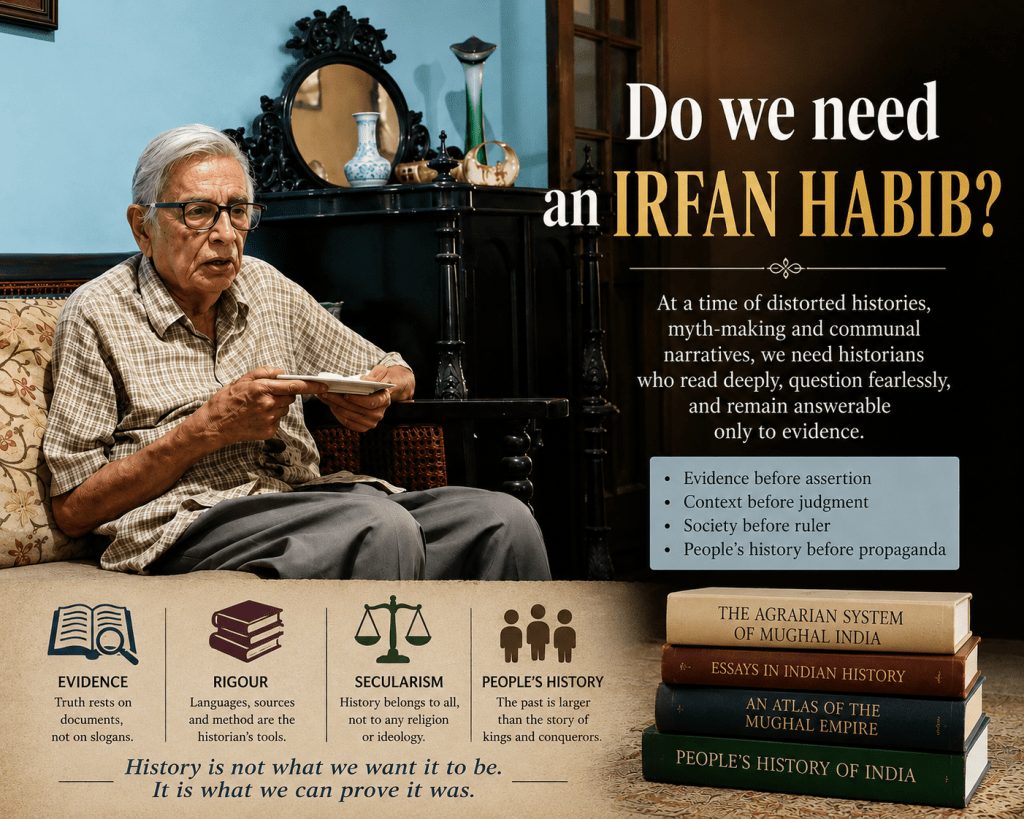
The answer is emphatically yes. But not because Habib must always be right, or because his interpretations should be treated as final. We need him because his scholarship represents the primacy of evidence, mastery of sources, intellectual rigour, secular explanation and the courage to resist politically convenient myths.
Historical revision is not objectionable; history advances through it. Habib himself challenged earlier interpretations. His The Agrarian System of Mughal India transformed a history dominated by emperors by asking different questions: Who produced the empire’s wealth? How was surplus appropriated? What relationships existed between peasants, zamindars and the state? This shifted attention from the ruler’s religion to society’s structure. Once the peasant and artisan entered the picture, the inadequacy of explaining six centuries through communal antagonism became obvious.
That lesson is urgently relevant. We increasingly encounter representations in which Alauddin Khalji, Babur, Akbar and Aurangzeb become a single category: Muslim rulers confronting an eternal Hindu India. Political rivalries, caste, class and commercial interests are subordinated to religion. Yet Rajputs fought Rajputs and allied with Mughals. Mughal princes fought one another with Hindus and Muslims on every side. Marathas served the Mughal state as well as fought it. Muslim rulers fought other Muslim rulers with ferocity inexplicable through communal categories.
None of this requires sanitising the medieval past. Temples were destroyed. Discrimination existed. Habib’s writings hardly present Mughal India as idyllic. But that is precisely the point: History requires neither glorification nor demonisation, it requires explanation.
Today, the Mughal is transformed from a historical subject into a political metaphor, the permanent foreigner, the destroyer. Once caricature replaces analysis, the purpose is no longer to understand the empire but to manufacture an adversary for the present.
The same problem appears in modern history. Savarkar deserves serious study. His revolutionary career and conception of Hindutva are important. But his transformation into the self-evident Veer Savarkar raises another problem. Recovery is legitimate; rehabilitation must remain answerable to the complete record. A historian cannot decide beforehand that the subject is a national hero and then arrange inconvenient evidence around that conclusion.
Similarly, Sanjeev Sanyal and other non-professionals have entered the popular arena. His ‘Stitched Ship Project’ “created a 5th Century ship” based on 17th century sources!
The distinction that matters is not between professional and non-professional. It is between history and assertion. Historical method demands asking who produced a source, when and why, whether independent evidence corroborates it, and whether our interpretation survives contrary evidence. Learning Persian, Sanskrit or Arabic is not academic gatekeeping; it is elementary discipline. Yet we inhabit a culture in which years of such expertise count for less than the confidence of a television assertion.
This brings us to a deeper question: What is the job of a historian? Is it merely to narrate stories of the past, or to guide us to a better future? Sympathisers of extreme rightist forces, eager to break the communal fabric, suggest that historians should remain aloof from prevailing politics, lower their gaze, retreat into an imagined mythical past, and let politicians break the country. This is a convenient demand. It asks the historian to abdicate their most essential duty: to hold a mirror to the present by illuminating the past.
A historian cannot remain aloof. The very act of choosing what to study, what questions to ask, and what evidence to privilege is inherently political. But the historian’s politics must be the politics of truth, not of partisanship. Their duty is not to serve any faction but to serve evidence. They must guide us by showing that the past is complex, that communities were never monolithic, that conflict and coexistence were always intertwined. When politicians peddle a binary, mythical past to fracture society, the historian’s silence is complicity. Speaking truth to power is not activism; it is professional integrity.
Habib’s opposition to communal historiography has never depended upon defending one community against another. Communal history, whether Hindu or Muslim, imagines religious communities as homogeneous entities moving unchanged through centuries. Habib’s historical materialism challenged this by revealing the competing interests of classes, castes and regions that repeatedly crossed religious boundaries. His secularism emerged not merely from political conviction but from historical method.
This becomes particularly important in our emerging post-history world. History has never been more visible, with medieval rulers appearing in election speeches, monuments becoming controversies, studios debating centuries-old battles. The past is everywhere. But historical thinking is increasingly absent. We are in danger of producing a society saturated with the past but indifferent to history. This is post-intellectualism: expertise is suspect, complexity is evasion. The specialist who says “the evidence is complicated” appears weaker than the propagandist who announces “the truth is simple.” But the historian’s truth is often complicated. Akbar could order massacres and later proclaim sulh-i kul. Aurangzeb could destroy particular temples and patronise others. Rajputs could resist Mughal armies and become pillars of the Mughal ruling class. None fits the binary world of communal mythology.
So, do we still need an Irfan Habib? Perhaps more urgently today than in 1963. Not because we require another orthodoxy. We need him because we need historians who will insist that the past cannot be bullied into saying what the present wants to hear. We need historians willing to tell governments that evidence cannot be changed by notification; religious communities that faith cannot determine historical fact; political movements that mythology cannot substitute for documentation; and fellow historians that ideological sympathy cannot rescue a proposition unsupported by sources.
There are many today who wish him and his work forgotten. They seek to invisibilise scholars like him, just as they must forget the medieval period itself. Such people exist even within the institution he considered home turf, the very institution known throughout the world by his name. His work remains inconvenient to those who manufacture a mythical past, for it insists on complexity where they demand simplicity, on evidence where they offer assertion. The attempt to erase him mirrors the attempt to erase the very centuries he illuminated.
At ninety-five, the question is not simply whether India still needs Irfan Habib. It is whether India can continue to produce historians prepared to practise history with that degree of rigour and courage. For the real danger is not that one interpretation may defeat another. It is that history itself may be displaced by myth-making. And if that happens, the politician will have broken the country while the historian lowered their gaze. We need historians who will look up, speak out, and guide us, not to a mythical past, but to a future built on an honest reckoning with what truly was.


