Syed Ali Nadeem Rezavi
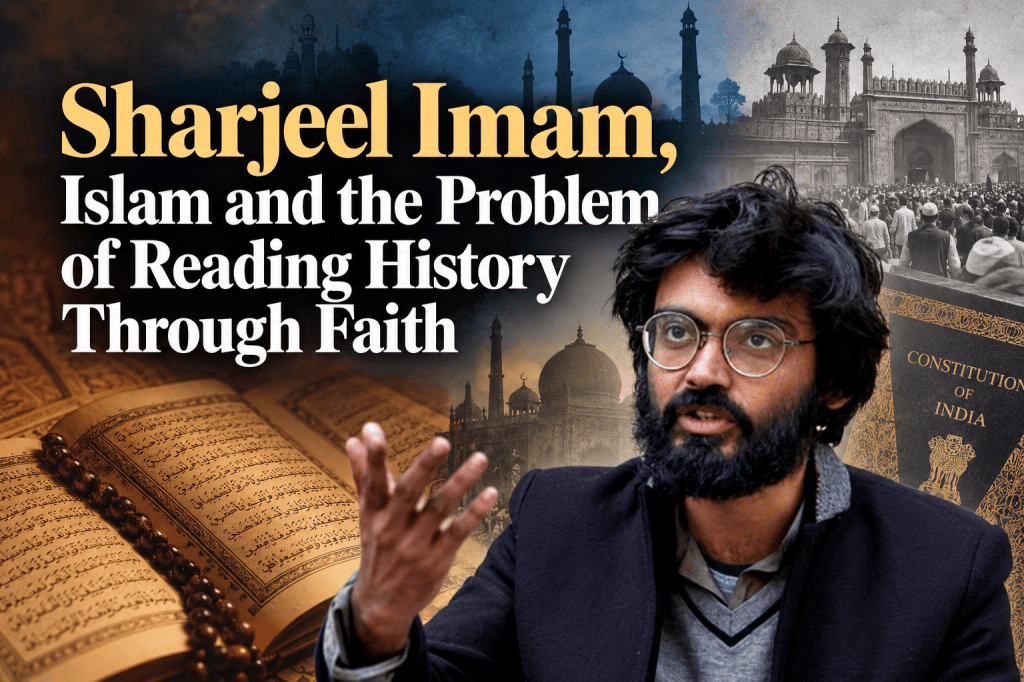
Sharjeel Imam’s extensive interview with Athique Haneef (The Quint, 29 September 2026) has generated considerable discussion among intellectuals, political commentators and civil rights activists. And that is what I am dealing with today.
The responses have ranged from strong criticism of his political philosophy to sympathetic attempts to understand the historical experiences that have shaped his thinking. What makes the interview significant is that Imam is not merely commenting upon the contemporary condition of Indian Muslims. He is offering an interpretation of Indian history, nationalism, secularism, constitutionalism and the relationship between religion and political identity.
There can be little disagreement that the questions he raises about discrimination, political representation, communal violence and the marginalisation of Muslims deserve serious attention. Nor should criticism of his political views obscure his prolonged incarceration as an undertrial. As Md Zeeshan Ahmad (The Quint, 23 October 2026) emphasises, the defence of constitutional liberty cannot depend upon the ideological acceptability of the person concerned. His right to due process must be defended independently of whether one agrees with his arguments.
Yet the legitimacy of Imam’s grievances does not automatically establish the historical validity of his conclusions. His interview reveals an intellectual framework in which Islam, or rather his particular understanding of Islam, becomes the principal means of interpreting history, society and political emancipation. It is precisely here that a historian must begin asking questions.
Islam is not a single interpretation
Imam identifies himself with a tradition of Islamic modernism associated with Jamaluddin Afghani, Muhammad Abduh, Rashid Rida, Muhammad Iqbal and Ali Shariati. He invokes tawhid, the unity of God, as the foundation of justice, liberty and equality, while extending the concept of shirk beyond its conventional theological meaning to encompass nationalism, materialism, casteism, despotism and other forms of oppression.
This is an interesting intellectual exercise. But it remains an interpretation, not an uncontested definition of Islam.
Islam, like other major religious traditions, has never possessed a single, universally accepted understanding of society, political authority or the relationship between faith and reason. Sunni and Shi’i theological traditions, Mu’tazili rationalists, Ash’ari theologians, philosophers, Sufis, jurists and modern reformers have differed profoundly on questions of authority, free will, reason, religious knowledge and political legitimacy.
Even within Shi’i thought, interpretations of religious and political authority have varied considerably. The political philosophy of Ali Shariati, for example, cannot simply be equated with that of traditional Shi’i jurists, much less with every strand of Shi’i intellectual history.
The same diversity characterises Islamic modernism. Afghani, Abduh, Rashid Rida and Sir Syed Ahmad Khan were responding to different historical circumstances and did not arrive at identical conclusions. Indeed, Rashid Rida’s later political and theological positions differed substantially from some of the rationalist tendencies associated with Abduh.
Why, then, should Imam’s particular selection of thinkers and theological concepts be treated as representative of an Islamic worldview?
One might equally invoke Maulana Abul Kalam Azad, Husain Ahmad Madani or the numerous Muslim intellectuals who defended composite nationalism and regarded religious faith as entirely compatible with participation in a shared political community.
Sir Syed Ahmad Khan himself, whose rationalist religious writings challenged conventional interpretations of scripture, would resist easy placement within any single contemporary political category. His intellectual legacy cannot be reduced to Muslim communal politics.
There is a fundamental difference between Islam as a religious tradition, the many historical interpretations of Islam, and Sharjeel Imam’s own interpretation of that tradition. To confuse these is to turn one individual’s political theology into an apparently universal religious position.
When theology becomes historical explanation
Imam’s understanding of history as a struggle between tawhid and shirk raises a methodological difficulty. Religious beliefs can certainly inspire movements against injustice, but they cannot by themselves explain the complex historical processes through which societies have developed.
If tawhid necessarily produces liberty and equality, how are we to explain the histories of slavery, monarchy, social hierarchy, sectarian persecution and political despotism within Muslim societies themselves?
The Delhi Sultanate, the Mughal Empire, the Ottoman state and the Safavid monarchy were not interchangeable political formations merely because their rulers professed Islam. Their institutions, social structures, economic interests and political cultures emerged from particular historical circumstances.
Nor were their societies divided neatly between believers and non-believers. Political alliances frequently crossed religious boundaries, while conflicts within Muslim ruling groups could be as intense as conflicts between different religious communities.
The Mughal experience is particularly instructive. Akbar’s policy of sulh-i kul, the incorporation of diverse groups into the imperial nobility and the intellectual exchanges encouraged at his court cannot be explained through a simple theological opposition between monotheism and its supposed alternatives.
Imam is entitled to understand the world through his faith. A historian, however, must ask whether that understanding adequately explains the evidence. The distinction between religious conviction and historical explanation must not disappear.
Partition and the temptation of selective history
Imam’s interpretation of Partition provides another illustration of the difficulties inherent in his approach. He places considerable responsibility upon the Congress leadership, particularly its insistence upon a strong Centre, while presenting Jinnah and the Muslim League as defenders of Muslim political autonomy.
There is nothing illegitimate about questioning the decisions of Gandhi, Nehru or the Congress leadership. Historical scholarship has long examined Congress centralism, the failure of the Cabinet Mission Plan and the competing constitutional visions of the 1940s. Yet criticism of Congress cannot become a justification for treating Jinnah’s political project as though it were free from contradictions.
Md Zeeshan Ahmad (The Quint, 23 October 2026) challenges Imam’s interpretation of the freedom struggle as reductive. His critique draws attention to the danger of presenting a complex anti-colonial movement primarily as a confrontation between Congress and the Muslim League, thereby diminishing the role of British imperial power and other political formations.
K.B.S. Sidhu (ThePrint, 10 October 2026), writing from the perspective of Sikh history, raises a related objection. The Cabinet Mission Plan, which Imam regards favourably, would have placed Punjab within a grouping of Muslim-majority provinces. Sikh leaders feared that their own political interests would be subordinated within this arrangement. Thus, a constitutional formula presented as protection for one minority could appear threatening to another.
This is precisely why the history of Partition cannot be written exclusively from the standpoint of either Congress or the Muslim League. It must also incorporate the experiences of Sikhs, Dalits, regional political formations and those Muslims who rejected the demand for Pakistan.
One might also ask why the ideas of Maulana Azad, Khan Abdul Ghaffar Khan, Husain Ahmad Madani and other advocates of composite nationalism should receive less consideration than those of Iqbal and Jinnah. They too were Muslims, many deeply committed to Islam, but they arrived at very different political conclusions.
Their existence challenges the assumption that a particular conception of Muslim political autonomy represented the inevitable political expression of Islam.
Secularism is not synonymous with majoritarianism
Imam’s criticism of secular nationalism is among the more provocative elements of his interview. He suggests that the secular consensus has obscured Muslim political interests and that secular nationalism shares certain assumptions with Hindutva, particularly concerning national unity and centralised political authority.
There are genuine historical questions here. Indian secularism has frequently been inconsistent, and governments professing secular principles have sometimes failed to prevent communal violence or protect minorities.
Yet the failure of a political principle in practice does not necessarily invalidate the principle itself.
Md Zeeshan Ahmad cited above, questions Imam’s characterisation of secularism as a trap. Indian secularism emerged through a complicated intellectual and political history. As Shabnum Tejani demonstrates in Indian Secularism: A Social and Intellectual History, 1890–1950 (Indiana University Press, 2008), it developed through competing political and social understandings rather than as a single, predetermined ideological project.
There is also a fundamental distinction between a constitutional arrangement that recognises equal citizenship irrespective of religion and a political ideology that privileges the identity of the religious majority.
Criticism of secular governments is entirely compatible with defending secularism as a constitutional principle. Indeed, such criticism frequently draws its moral force from the failure of governments to honour their professed commitments.
At the same time, secularism must be examined critically rather than idealised. The relationship between religious personal laws, community rights and gender equality demonstrates that protecting religious communities can sometimes generate tensions with the rights of individuals within those communities.
This is a question Imam’s emphasis upon collective Muslim rights does not sufficiently resolve.
Who speaks for the Muslims?
One of the more problematic implications of Imam’s argument is his repeated treatment of Muslims as a collective political subject, frequently expressed through the vocabulary of qaum.
But who constitutes this qaum, and who possesses the authority to speak on its behalf?
Indian Muslims have never formed a homogeneous social or political community. Differences of caste, class, gender, language, region, sect and intellectual orientation have shaped their experiences.
The political concerns of a Pasmanda agricultural labourer may differ considerably from those of an urban ashraf professional. Muslim women have their own histories of struggles over education, property, marriage, divorce and participation in public life.
Md Zeeshan Ahmad raises important questions about the relationship between collective Muslim identity, internal inequalities and the broader solidarities visible during the anti-CAA protests.
Imam does acknowledge the importance of backward-caste Muslims and proposes measures for their representation. Nevertheless, recognition of social diversity is not quite the same as allowing that diversity to reshape the foundations of one’s political argument.
The question remains whether religious identity should become the principal organising category of political life, or whether the struggle against discrimination can be pursued through broader solidarities encompassing caste, class, gender and citizenship.
The anti-CAA protests themselves demonstrated the possibilities of such solidarities. Their constitutional vocabulary, public readings of the Preamble and participation across religious communities constituted an important part of their political character.
To understand that movement primarily as an expression of Muslim communal mobilisation would be to overlook one of its most distinctive features.
A different reading: Asim Ali and radical democracy
Not all responses to Imam have been critical. Asim Ali (The Telegraph, 24 October 2026) offers a more sympathetic interpretation, arguing that Imam’s political ideas should be understood against the accumulated historical experiences of discrimination and violence faced by Muslims.
Drawing upon the historian Reinhart Koselleck’s concept of a shared space of experience, Ali suggests that memories of communal violence and political exclusion help explain why Imam’s arguments resonate with sections of educated Muslim youth.
Ali also interprets Imam’s proposals for decentralisation, proportional representation and political alliances through the framework of radical democracy associated with Ernesto Laclau and Chantal Mouffe. From this perspective, particular communities can articulate their demands without necessarily abandoning the possibility of broader democratic cooperation.
This interpretation adds an important dimension to the discussion. Religious or community-based mobilisation need not automatically entail separatism or rejection of democracy. Historically disadvantaged groups may organise around shared identities precisely because existing political institutions have failed to address their concerns.
Yet an explanation of why a political worldview emerges is not the same as a demonstration that its historical interpretation is accurate.
The experience of discrimination may explain Imam’s distrust of Congress nationalism and secular constitutionalism. It does not, by itself, establish that his understanding of Partition is correct, that Jinnah’s political programme offers an appropriate model for the present, or that his interpretation of Islam should provide the intellectual foundations of Muslim political mobilisation.
Nor should the historical experiences of Indian Muslims be reduced entirely to victimhood. Their history includes intellectual creativity, political participation, social mobility, commercial enterprise, cultural interaction and contributions to the making of modern India.
A history organised exclusively around persecution risks becoming as selective as one that refuses to acknowledge persecution at all.
The neglected histories of coexistence
What is particularly striking about Imam’s historical imagination is the limited place it leaves for the long and complicated history of coexistence and interaction in the Indian subcontinent.
The history of medieval and early modern India was not simply a history of religious communities confronting one another. It was also a history of shared institutions, overlapping identities and continuous cultural exchanges.
The Mughal nobility incorporated individuals of diverse religious, ethnic and regional backgrounds. Commercial partnerships frequently crossed confessional boundaries. Persianate literary culture flourished alongside Sanskrit, Braj, Awadhi and other vernacular traditions. Religious and intellectual exchanges shaped artistic production, architecture, literature and everyday life.
None of this implies that precolonial India was free from religious conflict or social inequality. Such romanticisation would be equally misleading.
But these experiences demonstrate that religious identity was only one among several forces shaping historical relationships.
Even within the domain of Islamic intellectual history, there were competing understandings of religious authority and political legitimacy. The debates surrounding Akbar’s religious policies, the responses of different Muslim scholars, the intellectual positions of Shaikh Ahmad Sirhindi and the traditions of Shi’i scholarship illustrate a much more complicated religious landscape than a singular Islamic political philosophy would suggest.
It is therefore necessary to distinguish between the history of Islam in India, the history of Indian Muslims and the history of Muslim political movements. These are related fields of enquiry, but they are not interchangeable.
The danger of replacing one communal narrative with another
There is a larger issue underlying this entire debate.
Much of the contemporary rewriting of Indian history seeks to portray the medieval period as an age of Hindu subjugation under Muslim rulers. Historians have repeatedly challenged this interpretation by demonstrating the diversity of political relationships, the importance of economic and institutional structures and the inadequacy of reducing historical developments to religious conflict.
But the same methodological standards must apply when history is interpreted from a Muslim communitarian perspective.
If Hindu majoritarian historiography is criticised for treating Hindus as an undifferentiated historical community, it would be inconsistent to accept an equally undifferentiated conception of Muslims.
If the claim that Indian history represents a continuous Hindu struggle against Muslim domination is historically untenable, an interpretation centred upon an equally continuous struggle for Muslim communal autonomy must also be examined critically.
The two narratives arise from different political circumstances, and the unequal distribution of power in contemporary India must not be ignored. They should not be treated as equivalent in their social consequences. Nevertheless, neither should be exempt from historical scrutiny.
History cannot become an instrument for confirming the collective grievances or aspirations of whichever community happens to be narrating it.
It must remain open to evidence, contradiction, complexity and revision.
The Constitution, its limitations and its possibilities
Imam’s constitutional arguments deserve examination beyond the simple opposition between defending the Constitution and rejecting it.
He raises questions about centralisation, minority representation, decentralisation and the inadequacy of existing political safeguards. Some of these concerns have also been discussed by constitutional scholars and advocates of federalism.
K.B.S. Sidhu (ThePrint, 10 October 2026), while disagreeing with Imam’s larger framework, acknowledges the legitimacy of debating proportional representation and the exclusion of Dalit Muslims and Christians from Scheduled Caste recognition. He also points to the constitutional guarantees already available to religious minorities, including their educational and cultural rights.
Sushim Mukul (India Today, 24 October 2026) similarly argues that the Constitution provides mechanisms through which inequalities can be challenged and institutional arrangements reformed. He distinguishes between the failure of constitutional institutions to deliver equality and the claim that the Constitution itself is responsible for discrimination.
The existence of constitutional protections does not prove that they have always been effectively implemented. Equally, failures of implementation do not necessarily demonstrate that the constitutional framework is incapable of reform.
A further question concerns the relationship between communal representation and common citizenship. Electoral arrangements designed exclusively around religious identity may strengthen the representation of particular communities, but they may also institutionalise the very divisions that a plural democracy seeks to negotiate.
These are questions of constitutional design, not matters that can be settled through historical grievance alone.
Islam, history and the plurality of Indian experience
Sharjeel Imam’s interview offers an opportunity to reflect upon the relationship between religious belief, political identity and historical understanding. His arguments emerge from genuine concerns about the condition of Indian Muslims, but they also reflect a particular selection of intellectual traditions and historical experiences.
His interpretation of Islam is one among many. His reading of Partition is one among several competing historical explanations. His conception of Muslim political representation is likewise a political proposition that must be debated rather than accepted as the inevitable expression of communal interests.
Faith can inspire individuals to resist injustice, pursue equality and imagine a better society. It can provide moral strength in circumstances of suffering and political exclusion. But faith, however sincerely held, does not confer immunity from historical criticism.
Nor can any individual, whether a religious scholar, political activist or intellectual, claim to speak for the entirety of a religious community whose members differ profoundly in their beliefs, experiences and aspirations.
The history of Indian Muslims cannot be reduced to the history of the Muslim League, just as the history of India cannot be reduced to the history of the Congress. Equally, Islam cannot be reduced to the interpretations of Iqbal, Jinnah, Maududi, Shariati or Sharjeel Imam.
The central question is whether a politics seeking to overcome exclusion can do so without making religious identity the overriding category through which history and citizenship are understood.
Perhaps the most useful lesson emerging from this controversy is that defending an individual’s constitutional rights and critically examining his intellectual positions are not contradictory obligations. Both are essential to a society that values freedom of thought.
The historian’s task is neither to sanctify the past nor to place it at the service of contemporary political identities. It is to recover its complexities, recognise its contradictions and resist the temptation to turn history into theology, whether majoritarian or minoritarian.
My own view, thus, is that Sharjeel Imam’s interview is best read as a symptom rather than a solution. The grievances it articulates are real, and the state’s prolonged detention of an undertrial without trial remains a standing indictment of our constitutional practice. But the remedy he proposes, reading Indian history and citizenship primarily through the lens of a particular Islamic theology, risks substituting one closed narrative for another. The task before those who genuinely wish to overcome the exclusion of Indian Muslims is not to choose between a majoritarian and a minoritarian reading of the past, but to insist that both be held to the same standards of evidence and complexity. Imam deserves to be heard, and he deserves due process; his arguments, however, deserve to be answered rather than sanctified. A plural democracy is strengthened not by elevating any single community’s faith or grievance into the organising principle of national life, but by defending the constitutional space in which competing claims – religious and secular, individual and collective – can be argued out on equal terms. That, rather than the recovery of a lost political theology, is where the real possibilities of justice lie.
Principal articles Consulted:
Athique Haneef, interview with Sharjeel Imam, The Quint, 29 September 2026.
Md Zeeshan Ahmad, “Where Sharjeel Imam’s Arguments on Constitutionalism and Secularism Fall Short”, The Quint, 23 October 2026.
K.B.S. Sidhu, “Sharjeel Imam Wants to Pick Up Where 1946 Left Off. A Sikh Reads the Fine Print”, ThePrint, 10 October 2026.
Asim Ali, “Demonised Voice”, The Telegraph, 24 October 2026.
Sushim Mukul, “Countering Sharjeel Imam with the Constitution He Challenged”, India Today, 24 October 2026.


