Syed Ali Nadeem Rezavi
Every year in October we remember Sir Syed Ahmad Khan, and at Aligarh the occasion inevitably brings before us the founder of the institution which eventually became Aligarh Muslim University. We remember the Muhammadan Anglo-Oriental College, the Scientific Society, Tahzīb-ul Akhlāq, his advocacy of modern education and his struggle to persuade a community shaken by the catastrophe of 1857 that its future could not be secured by turning away from the new sciences and intellectual currents of the age. All this is deserved, yet there is another Sir Syed whom we have gradually allowed to recede from view.
Long before he became the great educationist of Aligarh, Sir Syed was a historian, an editor of historical texts, an epigraphist, a collector of antiquities and, I would argue, one of the earliest Indian practitioners of what we would today call ‘historical archaeology’. His concern with education and his fascination with the material remains of the past were not two unrelated phases of his life. They emerged from the same intellectual disposition. He wanted people to look at evidence, interrogate inherited assumptions and acquire the intellectual equipment necessary to understand both their past and their changing present.
That is the Sir Syed whom I wish particularly to remember. It is also necessary to recover him because Sir Syed has increasingly become the subject of two contrary but equally unhistorical tendencies. One converts him into an icon before whom ritual homage must be offered but whose writings need not necessarily be read. The other selects a few statements from a long and evolving intellectual life and attempts to make him responsible for political developments which occurred decades after his death. Between adulation and denunciation, the historical Sir Syed disappears. A historian’s tribute must be different. Sir Syed deserves neither a halo nor a charge-sheet prepared retrospectively from the politics of our own times. He deserves to be placed in his nineteenth-century world and read seriously.
A Man Born into One World and Forced to Enter Another
Sir Syed Ahmad Khan was born in Delhi on 17 October 1817. The Delhi of his childhood still possessed a Mughal emperor, a courtly culture, an extraordinary world of Persian and Urdu learning, and families whose identities remained connected with the political and cultural structures of the old empire. Yet British power was already determining the material realities of northern India.
Sir Syed consequently belonged to a generation which witnessed not simply political change but the collapse of an intellectual universe. Persian lost its position in the colonial administration. New systems of law and education appeared. Print began transforming the circulation of knowledge. European scholarship introduced new methods of chronology, philology, numismatics and antiquarian investigation. Then came 1857, destroying much of the Delhi into which Sir Syed had been born. His intellectual life has to be understood against this background. He was not simply a Muslim intellectual confronting the West. He was an Indian scholar standing between two systems of knowledge, attempting, sometimes successfully and sometimes awkwardly, to understand what could be retained from one and what had to be learnt from the other. The important point is that he chose engagement rather than retreat. His later insistence upon modern education grew from this encounter, but so too did his historical scholarship.
Sir Syed as a Scholar of the Past
Before the Aligarh Movement acquired its institutional form, Sir Syed was already deeply involved with history. He engaged with some of the most important Persian historical texts of medieval India and helped bring historical material into print at precisely the moment when the older manuscript culture was becoming increasingly vulnerable. Apart from his celebrated edition of Abu’l Fazl’s Ā’īn-i Akbarī (1855), Sir Syed Ahmad Khan also edited two other important Persian historical texts: Ziyauddin Barani’s Tārīkh-i Fīrūzshāhī (1862) and Emperor Jahangir’s memoirs, the Tuzuk-i Jahāngīrī (1864). These editorial undertakings testify to his significant, though often overlooked, contribution to the preservation and critical study of Indo-Persian historical sources.
Whatever reservations a modern textual editor may have about nineteenth-century editorial practices, the significance of making such works available in print should not be underestimated. A manuscript might exist in a few libraries or private collections and remain inaccessible to all but a handful of scholars. A printed edition could circulate throughout India and beyond.
His engagement with the Indo-Persian historical tradition was therefore not antiquarian nostalgia. It belonged to a much larger process through which the sources of medieval Indian history were being collected, compared, edited and transferred from manuscript to print. Sir Syed was associated with the publication or study of important Indo-Persian historical materials, including the Āʾīn-i Akbarī and texts connected with the Mughal historical tradition. His own Silsilat-ul-Mulūk represented another attempt to arrange India’s rulers within a chronological framework. There is an interesting symbolism here. Sir Syed was simultaneously attempting to preserve the documentary remains of an older intellectual world and preparing his contemporaries for a new one. But it was with Āsār-us-Sanādīd that his historical imagination took its most remarkable form.
Āsār-us-Sanādīd and the Monument as Historical Evidence
The first edition of Āsār-us-Sanādīd appeared in 1847, and a substantially revised edition followed in 1854. C. M. Naim has demonstrated how substantially the second differed from the first, to the extent that the two versions reveal the transformation of Sir Syed’s own intellectual method. To describe Āsār-us-Sanādīd merely as a history of Delhi would be inadequate. It was an attempt to create an archive of the historic city through its buildings, inscriptions, topography, personalities and memories. Modern scholarship has increasingly recognised the originality of this achievement. Mrinalini Rajagopalan has drawn attention to the extraordinary scale of Sir Syed’s documentation of Delhi and to the visual, chronological and comparative character of the project. This is important because it challenges the assumption that the supposedly scientific documentation of India’s architectural heritage was exclusively a product of European colonial scholarship.
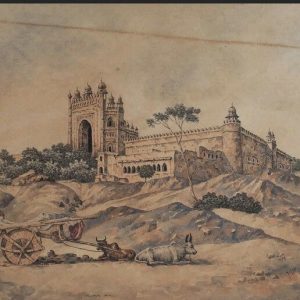
Sir Syed served for a period at Fathpur Sikri during his early judicial career. His appointment there offered him an opportunity to encounter the architectural remains of Akbar’s former imperial capital at close quarters. His interventions at Anūptalāo and the structure beneath the Khwābgāh at Fathpur Sikri deserve particular attention. The case of Anūptalāo is especially interesting. The Archaeological Survey of India’s World Heritage Series: Fatehpur Sikri records that the tank was given a new floor in the 1840s, substantially reducing its original depth. This is precisely the period of Sir Syed’s association with Fathpur Sikri. During this period his office is said to have been in the chamber below Khwābgāh.
As mentioned below in this essay, Sir Syed’s remarkable effort to copy the inscriptions on the Qutb Minar, while suspended in a basket secured by ropes, demonstrates the extraordinary lengths to which he was prepared to go in obtaining first-hand epigraphic evidence. It also reflects his commitment to examining historical monuments directly rather than relying solely on received accounts.
He went to the monuments, examined them, measured them, copied their inscriptions and attempted to establish their chronology. He compared what survived on the ground with what written sources and traditions claimed about it. This is the point at which antiquarianism begins to move towards historical archaeology. The distinction is important. An antiquarian may admire an ancient building because it is old or beautiful. A historical archaeologist asks what the physical fabric of that building can tell us about the society which produced it. Once measurements, building materials, inscriptions, architectural sequences and artefacts are treated as independent historical evidence, the monument ceases merely to illustrate history. It becomes a source for writing history. Sir Syed was moving precisely in that direction.
Was Sir Syed a Plagiarist?
It is within this context that we should consider a recent discussion concerning an early manuscript collection of the inscriptions of Delhi associated with Hafizuddin and copied by Mirza Sangin Beg. Dr Ather Farouqui deserves our thanks for drawing wider attention to this important material. Whenever a manuscript or source of information hitherto neglected comes to light, historians have reason to be excited. New sources complicate what we thought we knew. They may confirm an established interpretation, modify it, or overturn it altogether.
We have repeatedly witnessed this in medieval Indian history. The study of the Waqāʾiʿ-i Ajmer helped M. Athar Ali reconsider the political circumstances surrounding Aurangzeb’s conflict with the Rathors and move the discussion beyond explanations which reduced imperial policy to religious animosity. Similarly, the recovery and publication of Abdus Sattar Lahori’s Majālis-i Jahāngīrī provided historians with a remarkable record of discussions at Jahangir’s court and opened new questions concerning imperial culture, religion and intellectual exchange. The sources were not, of course, literally new. They had existed all along. What was new was their entry into active historical scholarship. The Hafizuddin material deserves to be approached in the same spirit.
The manuscript takes us further back into the history of antiquarian activity in early nineteenth-century Delhi. Mirza Sangin Beg, who copied it, subsequently wrote Sair-ul-Manāzil. Later we encounter other attempts to collect Delhi’s inscriptions. Sultan Singh copied inscriptions for Munshi Muhammad Hasan, and a manuscript associated with that project survives in the Royal Asiatic Society and has been studied by Professor Chander Shekhar. Hafizuddin’s collection, therefore, was not unique. There were several collections and transcripts of inscriptions from Delhi’s monuments. This immediately suggests another question. Why were so many people copying inscriptions?
The answer is actually quite simple. Before photography became available as a routine instrument of archaeological documentation, copying was itself a means of recording. If an inscription on a mosque, tomb, gateway, pillar or minaret was to be preserved and communicated to somebody elsewhere, somebody had to copy it. It might be transcribed by hand, traced, drawn or reproduced by a calligrapher. The epigraphist’s notebook performed part of the function which photography would subsequently perform with far greater accuracy. This makes the allegation of plagiarism considerably more complicated.
An inscription is fundamentally different from an original passage of historical prose. The Persian inscription above a gateway does not become the intellectual property of the first antiquarian who copies it. If Hafizuddin copied an inscription, Sangin Beg copied it afterwards, Sultan Singh recorded it subsequently and Sir Syed copied it yet again, the similarity of their texts proves very little. They were all attempting to reproduce the same physical object. The real test must therefore be different.
We need to place the surviving collections side by side. If Sir Syed’s inscriptions reproduce Hafizuddin’s collection in precisely the same sequence, contain precisely the same omissions, repeat precisely the same errors and reproduce peculiar misreadings which could only have been inherited from the earlier copy, then we would possess serious evidence of textual dependence. If, moreover, Sir Syed included nothing which his supposed source had omitted and there were no independent evidence of his own fieldwork, one could reasonably suggest that he had simply reproduced an earlier collection. But what if the readings differ? What if Sir Syed corrects an earlier reading? What if he records an inscription which Hafizuddin missed? What if the earlier collection contains something which Sir Syed does not? What if his transcript reveals an attempt to reread the physical inscription rather than mechanically reproduce a manuscript? Most importantly, what if independent evidence demonstrates that Sir Syed himself went to the monuments and attempted to record what was actually there? Then we are dealing with something altogether different.
These are questions capable of being tested. What is now required is a proper comparative concordance of the epigraphic collections. Hafizuddin, Sangin Beg, Sultan Singh and Sir Syed should be placed alongside one another, inscription by inscription, and wherever possible compared with later Archaeological Survey readings and the surviving monuments themselves. Variants, omissions, additions and shared errors should be identified. Only then can relationships of dependence be established with confidence. That is how historians should settle the matter. Not by accusation and certainly not by reverence for Sir Syed, but by collation and evidence.
Sahbai, Sir Syed and the Collective Production of Knowledge
There is another problem with applying the modern accusation of plagiarism too casually to the scholarly world of early nineteenth-century Delhi. Knowledge was often produced collaboratively. Scholars, munshis, scribes, calligraphers, draughtsmen, assistants and local informants participated in collecting and transmitting information. Sir Syed himself does not conceal the assistance he received from Imam Bakhsh Sahbai. Hali’s Hayāt-i Jāved preserves the memory of Sahbai accompanying him during visits to the monuments. Sahbai assisted him in examining inscriptions and in the laborious work involved in surveying the remains scattered around Delhi. This was not a modern academic sitting alone at his desk and claiming another person’s research as his own. It was a scholarly workshop operating according to the conventions of its own age.
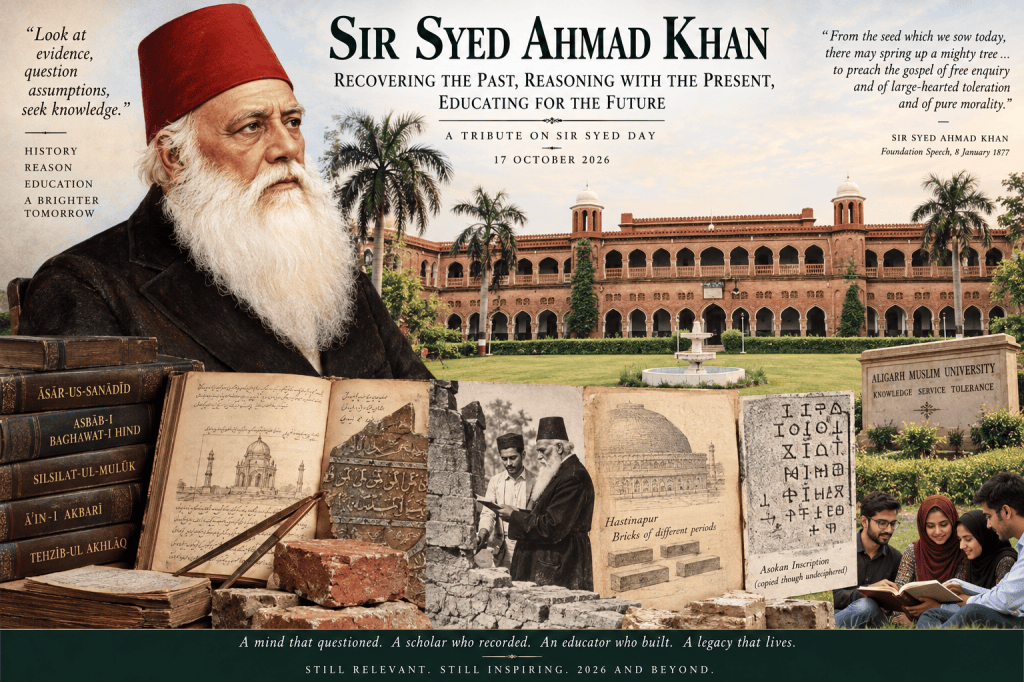
More importantly, the evidence for Sir Syed’s direct engagement with monuments cannot simply be dismissed. Perhaps the most revealing evidence is provided by those inscriptions which he could not even read. Among these were the ancient inscriptions on the Ashokan pillar. Sir Syed encountered characters outside his own linguistic and palaeographical competence, yet he attempted to reproduce them. His inability to decipher the script did not persuade him that the inscription could simply be ignored. There is something profoundly important in this. Sir Syed was effectively saying: I may not understand this evidence, but that does not make the evidence unimportant. Someone else may understand what I cannot. My responsibility is to record what survives. That is an archaeological instinct of a very high order.
It also complicates the plagiarism argument rather decisively. A man who physically records scripts he himself cannot decipher is plainly engaged in collecting primary evidence from monuments. That does not prove that he never consulted earlier collections. He almost certainly did, just as every serious historian consults predecessors. But consultation, comparison, collaboration and plagiarism are not interchangeable categories. The discovery of the Hafizuddin manuscript should therefore lead us towards a much more interesting historical question. Instead of searching for a culprit, we should reconstruct an epigraphic and archaeological community in pre-1857 Delhi. Hafizuddin, Sangin Beg, Sahbai, Sultan Singh, Syed Ahmad and their European associates belonged to overlapping networks concerned with Delhi’s antiquities. Information moved between manuscripts, inscriptions, personal observation, oral traditions, copies and institutional organisations. What we are seeing is not necessarily a succession of people stealing from one another. We may instead be witnessing the gradual creation of an archive of Delhi before photography and before the Archaeological Survey of India had been established. Within this larger process, Sir Syed’s achievement remains distinctive. He attempted to bring architecture, chronology, epigraphy, textual evidence, measurements, drawings and field observation together into a coherent historical description of the city. That is why Āsār-us-Sanādīd matters.
When a Brick Became a Historical Document
There is another aspect of Sir Syed’s archaeological work which deserves far greater attention because it demonstrates that his interests went considerably beyond impressive monuments and elegant inscriptions. He became actively associated with the Archaeological Society of Delhi and wrote a remarkable paper in Urdu on the dimensions of bricks belonging to different historical periods. A brick hardly possesses the grandeur of the Qutb Minar. Precisely for that reason, Sir Syed’s interest in it is revealing.
He observed that the dimensions and proportions of bricks varied through time. He attempted to distinguish bricks associated with what he understood as Hindu, Pathan, Akbar, Shah Jahan, Muhammad Shah and other periods.
His argument was that brick dimensions varied across historical periods, including what he identified as the Hindu, Pathan, Akbar, Shah Jahan and Muhammad Shah periods. Consequently, the dimensions of bricks could provide evidence for dating archaeological remains.
This was a remarkably early attempt to employ brick typology as a method of archaeological chronology, well before the institutionalisation of systematic archaeological investigation in India.
His suggestion that variations in brick dimensions might assist in determining the approximate age of the buildings in which those bricks occurred was unique for his age. Whatever corrections modern archaeology would make to his chronology or classifications, the methodological principle was remarkably perceptive. A manufactured object possesses chronological characteristics. Those characteristics can be measured. Measurable differences in material culture may provide evidence for dating. This is archaeological reasoning.
Sir Syed went further. At Hastinapur he had digging undertaken to recover bricks from below the surface and recorded their dimensions. He was not content with saying vaguely that ancient bricks appeared larger. He measured them. And he was doing this in the 1840s. This deserves particular emphasis because the systematic use of brick dimensions subsequently became familiar within Indian archaeological investigation. Sir John Marshall, whose archaeological career in India belonged to the twentieth century, also recorded brick dimensions and proportions in his archaeological work. Marshall’s archaeology naturally operated within a far more developed professional discipline, and one should not manufacture a direct intellectual descent where documentary evidence does not demonstrate one. But the chronology remains striking. Sir Syed was writing about bricks as chronological archaeological evidence decades before Sir John Marshall was doing so.
We need not claim that Sir Syed invented archaeological method. Nor should we project the fully developed stratigraphic archaeology of the twentieth century backwards upon him. But it would be equally misleading to ignore what the evidence plainly demonstrates. Before Cunningham’s Archaeological Survey had acquired institutional shape, and long before Marshall’s great archaeological projects, an Indian scholar writing in Urdu was asking whether monuments could be dated through their material fabric, whether inscriptions should be copied even when the investigator could not decipher them, and whether the dimensions of bricks could reveal chronological change. This is why I would describe Sir Syed not merely as an antiquarian or a connoisseur of India’s architectural heritage, but as one of the pioneers of historical archaeology in India.
From Delhi’s Ruins to the Collections at Aligarh
The archaeological impulse did not disappear when Sir Syed’s centre of activity shifted to Aligarh. He continued to take an interest in antiquities from Aligarh and neighbouring areas. Sculptures, architectural fragments, door jambs and other objects came into collections associated with the institution he founded. Significantly, these were not restricted to Islamic remains. Buddhist, Jain and Hindu antiquities were also preserved. The surviving account reproduced with this essay is particularly revealing. It refers to material from Hathras, Mathura and Balai Qila and records the subsequent attempt to gather scattered pieces into the University’s museum collection. Professor R. C. Gaur later catalogued this material, preserving an important record of what came to be known as the Sir Syed Collection.
There is something particularly appropriate about this connection. The institution established to prepare Indians for the intellectual challenges of the future simultaneously became a repository for fragments of their ancient and medieval past. Much later, the Department of History at Aligarh developed an archaeological tradition of its own. Excavations and explorations at Atranjikhera, Jakhera, Lal Qila and Fathpur Sikri, together with investigations of Mughal highways, settlements and monuments, helped establish a distinctive Aligarh tradition in which historians were encouraged to work with material evidence as well as texts. Sir Syed could not have anticipated the precise form this scholarship would take. But its basic principle would have been immediately intelligible to him. The historian must sometimes leave the library and confront the material remains of history upon the ground.
1857 and a Historian Confronting His Own Present
Then came 1857. The significance of the uprising in Sir Syed’s intellectual development can hardly be exaggerated. The old Delhi world was devastated. Mughal sovereignty disappeared. Families with which he had grown up were destroyed or dispersed. British reprisals were brutal, and Muslims in northern India came under particular suspicion. Sir Syed might simply have mourned the catastrophe. Instead, he asked a historian’s question: Why had this happened?
The result was Asbāb-i Baghāwat-i Hind. What makes this work remarkable is that Sir Syed himself served the colonial administration. Yet he refused to accept the comfortable explanation that the uprising could simply be attributed to Indian treachery, religious fanaticism or conspiracy. He examined failures of governance, the exclusion of Indians from consultation, British ignorance of Indian opinion, anxieties concerning religious interference and the accumulation of grievances which had produced the explosion. This complicates the easy caricature of Sir Syed as merely a British loyalist.
He undoubtedly became convinced that direct confrontation with British power would be disastrous, particularly for the Muslims of northern India who had suffered enormously after 1857. He sought accommodation with colonial rule and regarded education as more urgent than political confrontation. We may analyse and debate that judgement. But loyalty did not mean intellectual silence. The colonial employee told the colonial rulers that their own policies had helped create the conditions for rebellion. His Tārīkh-i Sarkashī-i Bijnor similarly attempted to document events he had himself witnessed. Once again we encounter the same intellectual instinct that animated his archaeological investigations: observe carefully, record evidence, compare accounts and seek causes. The monument and the mutiny appear to be completely different subjects. Yet the mind examining them was recognisably the same.
From Historical Enquiry to Educational Reform
After 1857 Sir Syed became increasingly convinced that the central problem confronting Indian Muslims was not simply their loss of political power. Something still more dangerous was taking place. They were in danger of becoming intellectually marginal to the new world emerging around them. The answer, for Sir Syed, was education.
Schools were established at Moradabad and Ghazipur. The Scientific Society became one of the most imaginative components of his educational programme. Its purpose was not simply to teach Indians English. It sought to make European works on science and other fields accessible through Indian languages. This is important because Sir Syed is sometimes too casually described as an advocate of Westernisation. His project was subtler. He did not initially demand that Indians abandon their languages in order to acquire modern knowledge. He wanted modern knowledge to enter those languages. Translation therefore became an instrument of intellectual democratisation.
It is precisely this inclusive educational vision that certain vested interests today seek to distort by reading the politics of the present into the nineteenth century. A familiar allegation now circulating in Pasmanda Muslim discourse is that Sir Syed was concerned only with the education of the Ashrāf, that he had no place in his scheme for the ajlāf, let alone the razīl. The claim is that the Muhammadan Anglo-Oriental College was designed as an exclusive preserve of the upper-caste Muslims and that the founder actively discouraged the education of the so-called low-born. This is a serious charge, but it is also a fundamentally unhistorical one.
The allegation rests upon a selective reading of a handful of statements from a long and evolving public life, divorced from their context and from the institutional record. Sir Syed certainly belonged to a nineteenth-century social world in which distinctions of birth and status were deeply embedded, and it would be dishonest to pretend that he was entirely free of the prejudices of his time. But the claim that his educational project was designed to exclude the ajlāf and the razīl collapses the moment we examine what he actually built. The Madrasatul Uloom, founded in 1875, was open to all, irrespective of religion, caste or creed. The first graduate of the MAO College was a Hindu, Ishwari Prasad, and the first postgraduate was also a non-Muslim, Amba Prasad. The college admitted students from all communities and had a sizeable number of Hindu students from its earliest years. Sanskrit was taught from the beginning, and the institution’s secular character was widely acknowledged by contemporaries, including Sir William Hunter, President of the Education Commission of 1882.
Nor does the documentary record support the suggestion that Sir Syed sought to confine modern education to the Ashrāf alone. When he founded a madrasa at Moradabad in 1859, the school report of January 1860 showed a student population of 175, of whom 103 were Muslims and 72 Hindus. In his report for the year 1877, he wrote explicitly that it was never the intention of the founders of the college that other races should be shut out from reaping the benefits of the high and liberal education which the college professed to impart, adding that it could not be entertained for a moment that public-spirited and patriotic persons should be possessed of such narrow minds and hard hearts as not to appreciate the value of human sympathy. These are not the words of a man constructing a caste-exclusive institution.
It is true that Sir Syed’s primary concern in the aftermath of 1857 was with the Muslim gentry and middle classes, who had suffered most severely from the collapse of the old order and who possessed the social capital to engage with the new colonial administration. But this was a judgement about the most urgent practical priority of the moment, not a principled exclusion of the ajlāf and the razīl from the benefits of education. The Pasmanda critique, whatever its legitimacy as a contemporary political intervention, commits a fundamental historical error when it projects the identity politics of the twenty-first century backwards onto a nineteenth-century reformer whose intellectual world was shaped by entirely different categories and constraints. To hold Sir Syed responsible for the later structural exclusion of Pasmanda Muslims from Aligarh is to make him answerable for developments he did not control and could not have foreseen. The institution he founded was, by the standards of its time, remarkably open. That its subsequent history became more socially narrow is a matter for historians of the twentieth century, not for retrospective indictment of the founder.
The Aligarh Institute Gazette carried the project further, while Tahzīb-ul Akhlāq, launched in 1870, extended it into the realm of social criticism. Sir Syed increasingly confronted customs, habits and intellectual assumptions within his own community which he regarded as obstacles to advancement. Naturally, he was attacked.
The Naturī and the Defence of Reason
His opponents mocked him as a Naturī. He was accused of subordinating revelation to nature, denying miracles and compromising Islam in his eagerness to reconcile religion with modern science. Sir Syed was certainly no conventional theologian. His religious thought placed unusual emphasis upon ʿaql, reason. He was deeply suspicious of an intellectual culture in which inherited authority and taqlīd could close the door upon enquiry. His interpretation of scripture attempted to reconcile revelation with what he regarded as the established laws of nature.
Yet here again the caricature fails. The same Sir Syed who was accused of capitulating before Christianity challenged William Muir’s representation of Islam and the Prophet. At the same time he was capable of engaging sympathetically with the Bible. Intellectual engagement did not, for him, necessarily mean intellectual surrender. Barbara Metcalf has made an important point in this regard. Sir Syed’s modernist interventions preceded some of the Egypt-based Muslim modernists who are often treated as the originators of this tendency. She has also cautioned against drawing too rigid a line between Aligarh and Deoband. Both emerged from the intellectual upheavals of nineteenth-century north India. Their responses differed profoundly, but they shared an anxiety about the future of Indian Muslim intellectual and institutional life. Sir Syed’s answer was distinctive. Faith could not be protected by forbidding questions.
The Aligarh Movement and the Gospel of Free Enquiry
The culmination of these experiments was the institution which became the Muhammadan Anglo-Oriental College. The Madrasatul Uloom was established at Aligarh in 1875. On 8 January 1877 Lord Lytton laid the foundation stone of the MAO College. Sir Syed had visited England and observed Oxford and Cambridge, and his ambition was to create an institution which could combine aspects of modern Western education with the cultural and ethical formation of Indian Muslims. But perhaps no administrative account conveys his vision as beautifully as his own words on that occasion.
He hoped that the seed being planted might grow into a mighty tree, like the banyan, whose branches would themselves strike roots into the earth and produce new saplings. He hoped that the College would eventually become a University whose sons would go throughout the length and breadth of the land preaching the gospel of free enquiry, large-hearted toleration and pure morality. These words deserve to be remembered every Sir Syed Day. Free enquiry. Large-hearted toleration. Pure morality. The College was not conceived simply as a machine for producing degrees or government servants. It was intended to produce a particular kind of mind.
Sir Syed and the Politics of His Age
A tribute, however, should not become hagiography. Sir Syed’s political thinking changed during his lifetime and contained tensions which historians must acknowledge. He eventually became a determined opponent of the Indian National Congress. He feared that representative institutions based simply upon numerical majority could place Muslims, particularly the educationally disadvantaged Muslims of northern India, at a permanent disadvantage. His attitude towards Bengali political leadership could sometimes be sharp and prejudiced. These aspects of his thought should neither be concealed nor explained away. Great historical figures do not require us to pretend that all their opinions were great. But they do require us to respect chronology and context.
The Congress of the 1880s was not the mass nationalist organisation of Gandhi’s time. Questions of representation, employment, language, education and community were being negotiated within a colonial political system in which Indians themselves possessed extremely limited power. Nor was Sir Syed’s political vocabulary static. In earlier speeches he could speak of Hindus and Muslims as members of a common Indian qaum. He famously employed the metaphor of Hindus and Muslims as the two eyes of the beautiful bride that was Hindustan. Later statements placed greater emphasis upon political differences between communities. The tension is real. It should be studied, not concealed. But the nineteenth-century word qaum did not possess one immutable twentieth-century meaning. It could refer to a religious community, a social collectivity, a people or the inhabitants of a territory. To translate every nineteenth-century occurrence mechanically into the modern concept of a sovereign nation-state is to erase precisely the historical vocabulary we are supposed to be explaining.
Was Sir Syed the Father of Pakistan?
This brings us to one of the more striking attempts in our own times to retrospectively malign Sir Syed: the claim that he was somehow the intellectual architect of Pakistan. There are serious historical debates about the longer genealogy of Muslim political identity in India. Some historians have located elements of later Muslim political separatism in Sir Syed’s later speeches. Such arguments deserve to be examined on their evidence. What cannot responsibly be done is to collapse concern for Muslim representation, the recognition of Muslims as a political community, the theory of two nations and the demand for a sovereign territorial Pakistan into a single timeless idea.
Chronology matters. Sir Syed Ahmad Khan died on 27 March 1898. The All-India Muslim League was founded at Dacca only in 1906, eight years after his death. He therefore did not found it, could not have joined it and obviously played no role in its subsequent political development. The explicit programme associated with the name Pakistan belongs to a still later period. Choudhry Rahmat Ali’s Now or Never appeared in 1933, thirty-five years after Sir Syed’s death, and explicitly proposed a separate political arrangement under the name Pakistan. V. D. Savarkar, addressing the Hindu Mahasabha in 1937, spoke explicitly of Hindus and Muslims as two nations, although his proposed political solution differed fundamentally from the territorial partition later pursued by the Muslim League. Muhammad Ali Jinnah’s Lahore address of 1940 then articulated the League’s claim that Hindus and Muslims constituted distinct social and political collectivities within the context of the Lahore Resolution.
Whatever genealogies historians may trace backwards from these later developments, the territorial Pakistan of the twentieth century cannot simply be attributed to a man who died in 1898. One may criticise Sir Syed’s opposition to the Congress. One may analyse his changing conception of qaum. One may question his political judgements. One may examine the tension between his earlier language of common nationhood and his later concern with separate Muslim political interests. That is history. To make him an advocate of the Partition of 1947 is retrospective politics.
Neither Saint nor Sinner
Perhaps we honour Sir Syed best when we stop requiring him to be either flawless or wicked. He had prejudices. He made political judgements which subsequent generations may question. His confidence in British rule after 1857 appears uncomfortable when viewed from the history of the later national movement. His attitude towards Bengali political leadership deserves criticism. His religious interpretations were contested in his lifetime and remain contested today. None of this diminishes the magnitude of what he achieved.
He belonged to a defeated social world and refused to accept intellectual defeat. He saw Delhi devastated and began recording what remained of its past. He saw a community suspicious of modern science and created institutions to transmit it. He encountered religious orthodoxy and insisted upon the legitimacy of reason. He served the colonial state and nevertheless told that state that its policies had contributed to the catastrophe of 1857. He belonged to the culture of Persian manuscripts yet recognised the revolutionary possibilities of print. He admired the past without believing that society could continue living in it. That combination is what makes him extraordinary.
From a Brick to a University
There is, for me, something deeply moving in connecting the young Syed Ahmad wandering among the monuments of Delhi with the older Sir Syed standing at Aligarh and imagining the university which might one day arise there. At first sight, a brick measured at Hastinapur and the foundation stone of the MAO College appear to belong to completely different stories. Perhaps they do not.
The man examining the brick was already learning that received opinion was insufficient. Measure it, compare it, ask where it came from and establish its relationship with other evidence. Do not simply repeat what tradition tells you. The man recording an inscription which he could not decipher was making another intellectual commitment. Evidence does not cease to matter merely because I cannot understand it. The man writing Asbāb-i Baghāwat-i Hind carried the principle into contemporary politics. Do not explain a catastrophe simply by blaming those who rebelled. Ask what conditions produced it. The man establishing the Scientific Society extended the principle into education. If knowledge exists elsewhere, translate it, discuss it and make it available. The religious reformer carried it into theology. Do not silence ʿaql before taqlīd. And finally the founder embodied it in an institution.
The line connecting these apparently different activities is remarkably clear. It is enquiry. That is why the phrase Sir Syed used in 1877, free enquiry, matters so much. It was not merely an ornamental expression appropriate to a ceremonial speech. In a very real sense, he had spent his adult life practising it.
Sir Syed in 2026: A Legacy That Still Lives
On 17 October 2026, as we celebrate the 209th anniversary of Sir Syed Ahmad Khan’s birth, we are therefore not merely commemorating a nineteenth-century reformer. Nor are we simply remembering the founder of an institution which subsequently grew into Aligarh Muslim University. We are remembering a way of thinking which, nearly a century and three decades after his death, continues to challenge, provoke and influence us.
The world in which Sir Syed lived has disappeared. The Mughal Delhi of his childhood vanished before his own eyes. The East India Company disappeared. The colonial empire against which, and within which, he negotiated his intellectual position is gone. The political questions of his age have assumed forms he could never have anticipated. Yet many of the questions with which he struggled remain strangely familiar. What should be the relationship between faith and reason? How should a society respond when new knowledge challenges inherited assumptions? How can education rescue communities from intellectual and economic marginalisation? Can tradition survive without becoming taqlīd? Can modernity be embraced without producing cultural amnesia? How should we preserve the material remains of our past? What responsibilities does a historian have towards evidence which contradicts received wisdom? And, above all, can a university remain worthy of the name if it becomes afraid of questions? These were Sir Syed’s questions. In different forms, they remain ours.
That is also why reducing him to the political controversies of the late nineteenth century, or retrospectively making him responsible for political programmes which developed decades after his death, impoverishes our understanding of him. The Sir Syed who continues to matter is larger than these retrospective quarrels. He is the man who could examine an old brick and ask whether its dimensions might reveal its date; copy an inscription whose script he himself could not decipher because he understood that evidence mattered independently of his ability to interpret it; edit the texts through which India’s medieval past could be recovered; tell the colonial rulers after 1857 that their own policies had contributed to rebellion; translate modern knowledge into Indian languages; confront religious orthodoxy with ʿaql; and finally build an educational institution around the hope that future generations would possess the courage to enquire.
From the inscriptions of Delhi to the bricks of Hastinapur, from the pages of Abul Fazl to Asbāb-i Baghāwat-i Hind, from the Scientific Society to Tahzīb-ul Akhlāq, and from the modest beginnings of the Madrasatul Uloom to the University that ultimately emerged from it, there runs one persistent thread. It is the conviction that knowledge must be sought rather than inherited unquestioningly, that evidence must be examined rather than made subordinate to prejudice, and that education should liberate the human mind rather than discipline it into conformity.
The banyan whose seed Sir Syed spoke of in 1877 did indeed grow. But the real measure of his achievement is not simply the size of the institution which grew from that seed. It lies in the intellectual inheritance he left behind. His hope that its students would carry the principles of free enquiry, large-hearted toleration and pure morality throughout the land remains an unfinished responsibility.
Perhaps that is the most meaningful way of celebrating Sir Syed Day in 2026. We celebrate a man born in 1817 not because he belongs safely to the past, but because he has never entirely left our present. Sir Syed remains relevant because the questions he raised about reason, education, scientific temper, historical enquiry, tolerance and intellectual openness remain relevant. He continues to influence the questions we ask, the manner in which we approach our past, and the kind of university and society we wish to create.
More than a century after his death, Sir Syed Ahmad Khan therefore remains among us, not merely in portraits, buildings, ceremonies or institutional memory, but in an idea. It is the idea that no society can advance if it is afraid of knowledge, no intellectual tradition can remain alive if it is afraid of questioning, and no university can fulfil its purpose if it ceases to encourage free enquiry. That is why, as we celebrate Sir Syed in 2026, we do not merely remember him. He remains relevant to our present, continues to influence us, and still compels us to think, question, enquire and learn.


