Syed Ali Nadeem Rezavi
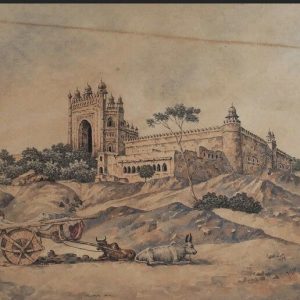
My association with Professor Gautam Sengupta, whom we affectionately called Gautam da, goes back many years. I was introduced to him by Professor Aniruddha Ray. My first interaction with him came when he organised a seminar under the auspices of the Centre for Archaeological Studies and Training, Eastern India (CASTEI), Kolkata, an institution earlier inaugurated by Professor Irfan Habib. Gautam da invited us to Kolkata, and I was asked to present a paper on Fathpur Sikri. That was the beginning of an association which continued over the years, bringing us together on numerous academic and institutional occasions.
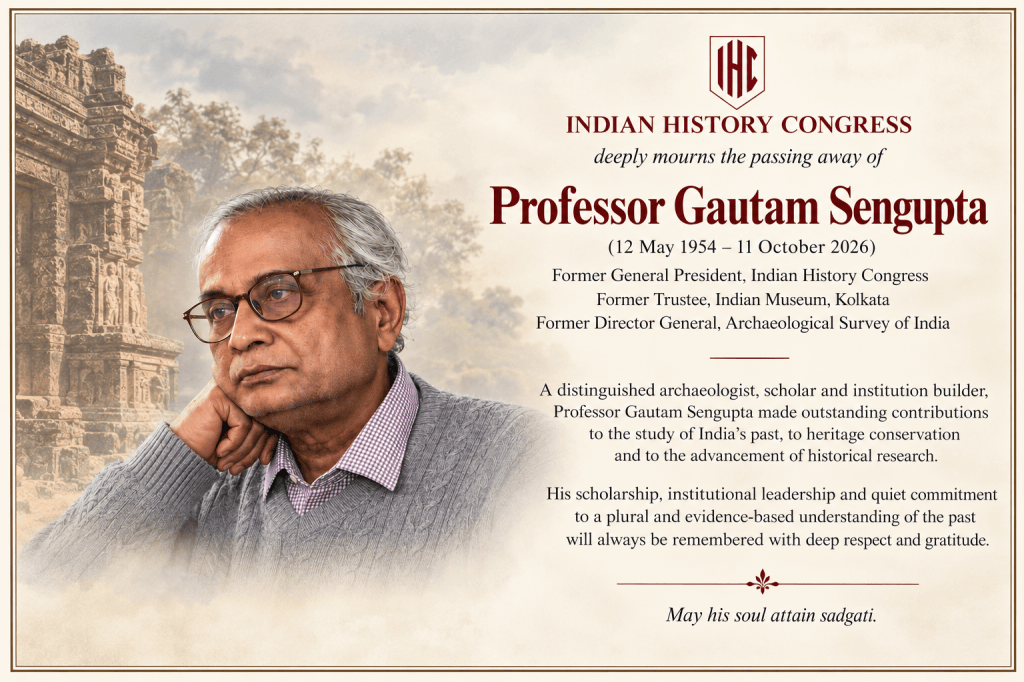
Subsequently, he invited me to CASTEI as a Visiting Fellow, where I was asked to deliver a series of ten lectures. What I remember most vividly is that Gautam da attended every single one of them. Despite his own academic commitments and administrative responsibilities, he would sit through the lectures, listening attentively and joining the discussions. This reflected something fundamental about his personality. He was not merely an organiser or administrator who brought scholars together. He was himself deeply interested in scholarship and remained an enthusiastic student of history and archaeology throughout his life.
Our interactions continued when he became Director General of the Archaeological Survey of India in New Delhi. On several occasions, I met him in the company of Professor Irfan Habib, who held him in considerable esteem. Gautam da belonged to that tradition of Indian archaeology which regarded the material remains of the past not simply as monuments to be preserved or objects to be classified, but as evidence through which the history of society, its economy, cultural interactions and everyday life could be reconstructed.
One of my most vivid memories of him relates to the 2023 session of the Indian History Congress at Patiala. When we were considering whom to invite as General President, I telephoned Gautam da, and he graciously accepted our invitation. By then his health was already a matter of concern, but he showed no hesitation in accepting the responsibility. What followed was a remarkable demonstration of his commitment to the institution. Despite his physical difficulties, he attended the proceedings on all three days. He would remain present even during the late evening sessions and would enthusiastically ask me where else his presence was required.
I particularly remember the late-night meeting of the Executive Committee. It was a cold Punjab winter, and the meeting followed an already long and exhausting day. Yet Gautam da not only presided over the proceedings but participated actively in the deliberations. Every now and then, he would lean towards me and whisper, asking what he was expected to say or how he should proceed with a particular matter. There was something deeply endearing about those exchanges. Here was a distinguished archaeologist, a former Director General of the ASI and the General President of the Indian History Congress, completely free from any sense of self-importance. He was willing to seek guidance, to listen and to work collectively. His concern was never with asserting his authority but with ensuring that the proceedings were conducted properly.
When I spoke to him in April this year and mentioned that the next session of the Indian History Congress might possibly be held in Bangalore, he was immediately enthusiastic. “Oh! I live there,” he exclaimed, “and I will surely attend.” He also promised to participate in the panels being organised by the Aligarh Society of History and Archaeology (ASHA) and the Aligarh Historians Society (AHS). Even when I informed him more recently that the venue had been shifted, his enthusiasm had not diminished. He assured me that he would still try to attend, health permitting. Unfortunately, that was not to be. Before we could meet again, Gautam da left us.
His contributions to archaeology were substantial, both as a scholar and as an institution-builder. His work was particularly important in expanding the scope of archaeological research in eastern and north-eastern India. He helped bring into focus regions, sites and categories of material evidence that had often remained peripheral to the larger narratives of Indian archaeology. His interests extended from early settlements, terracotta traditions and sculptural remains to the historical landscapes and urban centres of medieval Bengal.
His publications provide ample evidence of this breadth. Among the important works associated with him were Archaeology of Eastern India: New Perspectives (2002), edited with Sheena Panja; An Annotated Archaeological Atlas of West Bengal (2005), edited with B. D. Chattopadhyaya and Sambhu Chakrabarty; Past and Present: Ethnoarchaeology in India (2006), edited with Suchira Roychoudhury and Sujit Som; and Archaeology of Early Historic South Asia (2008), edited with Sharmi Chakraborty. These volumes brought together scholars working on different periods and regions, encouraging approaches that connected archaeological discoveries with broader historical questions.
Equally significant was Archaeology in India: Individuals, Ideas and Institutions (2009), edited with Kaushik Gangopadhyay, which explored the development of archaeology as a discipline and the people and institutions that shaped it. His Eloquent Earth: Early Terracottas in the State Archaeological Museum, West Bengal (2007), prepared with Sima Roy Chowdhury and Sharmi Chakraborty, reflected his concern with documenting and interpreting material culture. Later, as Director General of the ASI, he co-edited Custodians of the Past: 150 Years of the Archaeological Survey of India (2012) with Abha Narain Lambah. His more recent Ganga-Brahmaputra & Beyond: Exploring Art and Iconography of Eastern and North-Eastern India (2023) demonstrated that his engagement with the archaeological heritage of the region continued well into his later years.
But perhaps what deserves particular emphasis today is the intellectual integrity with which Gautam da approached the discipline. The later decades of his professional career coincided with a period when the growing influence of Hindutva began casting its shadow over the study and interpretation of India’s past. Archaeology, like history, was increasingly becoming a contested field, with attempts to privilege certain periods and traditions while marginalising others. It was in this atmosphere that Gautam da’s contribution acquired a significance extending beyond his individual research.
As Professor Irfan Habib pointed out on several occasions, Gautam da ensured that the secular traditions of archaeology were not abandoned and that the medieval remains of Bengal, including those associated with its Islamic past, continued to receive scholarly attention. This was no small achievement in an atmosphere in which the medieval period was increasingly being subjected to selective interpretations. Under his stewardship, archaeological work in West Bengal continued to reflect an understanding of the region’s past as a product of multiple cultural, religious and social traditions.
One particularly telling example was the attention devoted to the medieval city of Gaur. The thematic volume Gaur: The Medieval City of Bengal, edited by Gautam Sengupta and Sheena Panja, brought together studies of a city whose architectural and archaeological remains testify to the richness of Bengal’s Sultanate heritage. Such work was important not simply because it documented monuments, but because it resisted the tendency to treat the Islamic centuries as an interruption in India’s historical development.
Gautam da understood that the archaeological record could not be divided into compartments of religious identity. The temples, mosques, monasteries, settlements, fortifications, sculptures, inscriptions and everyday objects of the past were all part of the same historical inheritance. To study one while deliberately neglecting another was to distort the past itself. His approach was grounded in the conviction that archaeology must remain an evidence-based discipline, free from the demands of contemporary political ideologies.
His association with CASTEI was equally important. The Centre became a meeting ground for archaeologists and historians, encouraging interdisciplinary conversations and providing opportunities for younger scholars. It was this spirit of intellectual exchange that I had personally experienced during my visits to Kolkata. Gautam da believed in institutions, in collective scholarship and in the necessity of bringing people together. His administrative positions never diminished his interest in academic discussion. Rather, he used the opportunities provided by those positions to promote research and strengthen the institutions with which he was associated.
It is difficult for me to separate the scholar from the man I knew. His warmth, simplicity, intellectual curiosity and complete absence of pretension made every encounter memorable. He could preside over an important academic gathering with dignity and, a moment later, turn to a colleague with the informality and affection of an old friend. Even when his health was failing, his enthusiasm for academic work and institutional responsibilities remained undiminished.
When I think of Gautam da today, I remember not merely the distinguished archaeologist or the former Director General of the ASI, but the man who sat through all ten of my lectures at CASTEI, who remained at the Executive Committee meeting in Patiala late into a freezing winter night, and who, despite his failing health, was still looking forward to attending another session of the Indian History Congress.
His passing is a loss to Indian archaeology, to the Indian History Congress and to all those who believe that the study of the past must remain committed to evidence, reason and the recognition of India’s composite historical inheritance. For me, it is also the loss of an affectionate friend and senior colleague whose kindness and encouragement I shall always remember.
Farewell, Gautam da. You will be missed, not only for what you contributed to our understanding of the past, but also for the warmth and humanity with which you enriched our lives.


