Syed Ali Nadeem Rezavi
This is, perhaps, the last write up of mine on the executive heads of AMU. The period after his time are too close to us to assess: they were mostly a continuation or a response to what happened under Shah. And I am writing this as yet another ‘crisis’ involving mass mobilisation of both boys and girls and another vc appears to be moving towards resolution (hopefully).
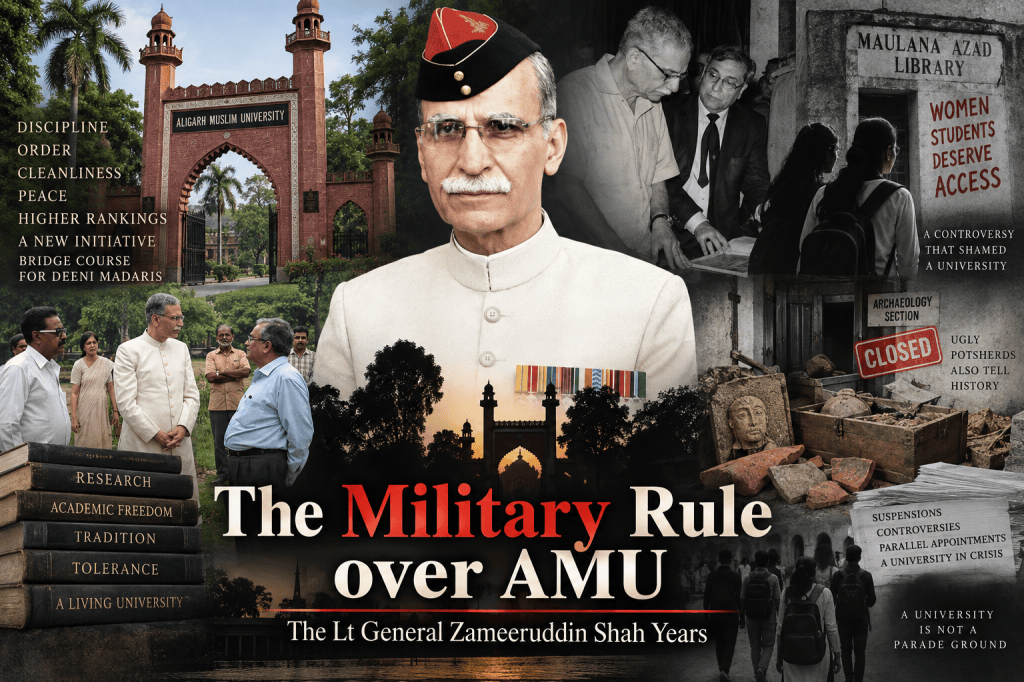
The Vice-Chancellorship of Lt General Zameeruddin Shah, from 2012 to 2017, remains one of the more unusual chapters in the recent history of Aligarh Muslim University. He came to Aligarh after a distinguished career in the Indian Army, carrying with him the reputation of a soldier, an administrator and a man accustomed to discipline. When he arrived, there were many within the University, including myself, who welcomed precisely these qualities. Aligarh had known periods of indiscipline, factionalism and administrative drift, and there was a widespread feeling that a firm hand might restore order. To an extent, particularly during the earlier part of his tenure, this expectation was fulfilled. The campus appeared more orderly, discipline became visible, cleanliness received attention and the administration projected an impression of decisiveness.
It would therefore be unfair to write the history of the Shah years merely as a catalogue of controversies. There were achievements, and there were people within the University who admired him. He was energetic, physically active, accessible in his own fashion and capable of taking decisions rapidly. He placed considerable emphasis upon punctuality, cleanliness and discipline. The campus, for substantial periods, was peaceful, and the endless disruptions which had afflicted Aligarh at other moments did not define his entire tenure. He wanted AMU to rise in national rankings and repeatedly spoke of improving its standing. Nor should every attempt to enforce discipline be dismissed merely because it came from a former General. A residential university with thousands of young students requires rules, and Aligarh certainly had problems which demanded firm action.
Yet the great weakness of the Shah administration lay elsewhere. Lt General Shah appeared never fully to understand the difference between administering a college and presiding over a research university. Still less did he appear to understand that the habits of command which serve a military officer extraordinarily well cannot simply be transplanted into an academic institution. A university is not merely a larger college. A college may principally concern itself with teaching prescribed courses, examinations, attendance and student discipline. A university must also create knowledge. Research, doctoral supervision, laboratories, archives, archaeological exploration, museums, libraries, seminars and intellectual disagreement constitute its life. Its professors are not simply employees delivering lectures according to a timetable. They belong to disciplines extending far beyond the boundaries of their own institution. A Vice-Chancellor therefore administers something he does not intellectually own. This distinction repeatedly became blurred during the Shah years.
One small but extraordinarily revealing example concerned the appointment of examiners for PhD theses. Restrictions were placed upon inviting examiners from distant places and departments were encouraged to choose scholars located nearer Aligarh. The administrative logic presumably appeared impeccable: why incur unnecessary expenditure when an examiner could be found closer home? But this was precisely where the difference between a college administrator and the head of a research university became apparent. A PhD examiner is not selected according to railway distance. The question is not whether an examiner lives in Delhi rather than Chennai, Kolkata or elsewhere. The question is who possesses the expertise necessary to judge the thesis. If the leading authority on a subject lives a thousand kilometres away, the thesis should travel a thousand kilometres. Scholarship has never recognised geographical proximity as an academic qualification.
Nothing, however, illustrated this incomprehension of university life more painfully than what happened to the Archaeology Section of the Department of History. The Archaeology Section was one of the prides of our Department. It represented decades of painstaking work by archaeologists and historians, including Professor Nurul Hasan, Professor R. C. Gaur and others who had created at Aligarh a significant tradition of archaeological teaching, exploration and excavation. The University’s own account today acknowledges the importance of finds from Atranjikhera, Jakhera, Lal Qila, Daulatpur, Sidhpur and Fatehpur Sikri, while the restored Archaeology Section now houses more than 15,000 artefacts and antiquities. It was considered as good as, if not better, the Archaeological sections of ASI itself. It had all the equipment, staff and expertise required from such units. During the Shah administration the building in which this Section functioned was identified for another purpose. As those of us who were present in the University witnessed, the premises were wanted to provide an office for a fellow Army officer who had been inducted into the administration. An academic institution painstakingly built over decades suddenly became expendable because its physical space appeared administratively useful.
What followed was far worse than a simple relocation. Archaeological collections are not collections of beautiful things. Much of archaeology consists of objects which appear singularly unimpressive to the untrained eye: potsherds, fragments of terracotta, bricks, pieces of metal, slag and other apparently insignificant remains. Their importance lies not in their beauty but in their archaeological context. A potsherd may establish chronology. A piece of pottery may reveal trade connections. A fragment may identify a cultural phase. The archaeologist is trained precisely to discover historical meaning in things which others might throw away. During the displacement of the Archaeology Section, however, much of this material appeared to be treated as though it were useless. Why, after all, should anyone preserve ugly potsherds when there were sculptures and attractive antiquities which could be placed in showcases?
The consequences were disastrous. Material regarded as sufficiently attractive or worthy was selected for removal to the University Museum. Other archaeological material (a back bone for any research) was dumped into a structure which had itself earlier been identified for demolition. The transfer was anything but the careful movement of a scholarly collection. Furniture and tables were damaged, some expensive pieces crumbled during the process, and archaeological material was in places treated virtually as garbage. The technical staff of the Archaeology Section were transferred elsewhere. Once the collections, staff and working space had been separated from one another, meaningful archaeological work became virtually impossible. There is an almost painful symbolism here. The potsherd which appeared ugly and useless was actually a test of whether the administration understood what a university was. A museum curator may display the beautiful sculpture, but an archaeologist also needs the broken pot. Knowledge frequently resides in precisely those things which have no aesthetic appeal.
The University’s present account of the Musa Dakri Museum itself confirms the provenance of the collection. It acknowledges the sculptures collected by Sir Syed Ahmad Khan, the archaeological material subsequently assembled through Professor R. C. Gaur’s excavations and explorations, and the eventual shifting of the collection to the Kennedy Hall complex. There was a further irony. The collection had an obvious historical association with Sir Syed Ahmad Khan, whose Āsār-us-Sanādīd itself demonstrates his remarkable interest in monuments, inscriptions and the material remains of the past. Yet the Museum came to be named not after Sir Syed but after Musa Dakri, described in the University’s own account simply as a magnificent donor. There is nothing wrong with honouring philanthropy. Universities need donors and should acknowledge generosity. But the academic identity of a museum ought surely to reflect the intellectual history of its collections. Sir Syed possessed a direct relationship with archaeology and antiquarian scholarship. A donor need possess no such qualification beyond generosity. It was therefore a matter of considerable satisfaction that the Archaeology Section could subsequently be revived and rebuilt. The later cataloguing of its holdings and the publication of History Through Archaeology in 2019 represented, in a sense, the intellectual reclamation of something which ought never to have been dismantled. The present Section again possesses technical staff, a laboratory, drawing facilities, archaeological collections and other facilities, but at a much reduced level: something once violently dismantled, can never gain its former glory. Till date the vacancies in the technical staff due to subsequent retirements have yet to be filled.
There was another curious feature of these years. Alongside the ordinary professoriate appeared a small category whom one might, with some humour, call the super professors. These were individuals whose arrival and position within the University appeared to many teachers to bypass the normal rhythms through which academic careers are built. Questions were consequently raised about qualifications, procedures and the relationship between the posts against which people were appointed and the functions they actually performed. One particularly revealing case involved an individual appointed as a Professor who, as we observed within the University, did not function in the Department where his selection was, in the normal manner. His work was instead associated with students entering the University from the Deeni Madaris and with the special programme established for them.
There was nothing inherently objectionable about the programme. Indeed, the Bridge Course for Graduates of Deeni Madaris was one of the genuinely imaginative initiatives associated with the Shah years. The attempt to equip madrasa graduates with English and other subjects required for entry into mainstream higher education addressed a real educational problem. The programme survives at AMU today, which itself demonstrates that the underlying idea had value. The question was different. Why should someone appointed as a Professor of English not function as an ordinary Professor within the Department of English? If the Bridge Course required a Director, Coordinator or Professor, an appropriate position could have been be created or advertised according to the University’s procedures. A professorship is not simply a salary grade which can be detached from the discipline against which it was sanctioned.
This became particularly galling when placed alongside the treatment meted out to established teachers who disagreed with the administration. During these years three teachers were suspended, including the Secretary of the Teachers’ Association (AMUTA). I too was subjected to disciplinary proceedings and suspension following my public criticism of the Vice-Chancellor. Contemporary reporting records the special meeting of the Executive Council convened in July 2014 in connection with my Facebook remarks. This was where the military conception of authority became particularly troublesome. In the Army, public criticism of a commanding officer by a subordinate is incompatible with the chain of command. In a university, the situation must necessarily be different. A professor or any teacher is not the intellectual subordinate of the Vice-Chancellor. Universities exist because people disagree. Historians challenge interpretations, scientists overturn established propositions and teachers criticise institutions. A Vice-Chancellor has to possess the capacity to be criticised, sometimes unfairly and sometimes unpleasantly, without confusing criticism of himself with an attack upon the University. The Vice-Chancellor is not the University.
Mustafa Zaidi too was suspended. He was suspended in October 2015 after participating in an AMUTA dharna. The agitation was a cause considered genuine by the majority of the staff: it was not for a personal cause. The administration characterised the matter as dereliction of duty and misconduct; AMUTA regarded it as action against dissent.
The Shah administration justified the action against Zaidi on the grounds that he had remained absent from his assigned academic duties without obtaining proper leave and had conducted himself inappropriately towards the Vice-Chancellor. Shah subsequently portrayed his activities as “disruptive”. Zaidi, however, argued that he had been taking part in a peaceful protest in his capacity as Secretary of the Teachers’ Association. AMUTA, together with the Federation of Central Universities Teachers’ Associations, viewed the disciplinary action rather differently, seeing it as an attempt to curb organised criticism of the administration.
The matter did not end with suspension. In 2016, the Executive Council under Shah’s direction went considerably further and ordered Zaidi’s compulsory retirement on charges that included neglect of duty, misleading the authorities, misconduct and insubordination. Zaidi challenged the decision in the Allahabad High Court, which set aside the compulsory retirement order on 6 April 2017. The change of Vice-Chancellor subsequently brought the episode to a close. After Professor Tariq Mansoor assumed office, Zaidi was reinstated, the period of suspension was counted as duty with full pay and allowances, and both the charge-sheet and the disciplinary proceedings against him were withdrawn.
The third was a case where the charges were obscure and never explained: Professor Hasan Mateenul Islam of the Department of Statistics and Operations Research was suspended following two fact-finding enquiries. One, conducted by Professor Ali Athar, concerned “issues relating to his appointment”; the other, by Professors Iqbal Parwez and Shoaib Zaheer, examined allegations of “misconduct, violation of University rules and wilful disobedience”. The Shah administration maintained that both enquiries substantiated the allegations and consequently initiated disciplinary proceedings. However, it was never publicly clarified as what those specific alleged irregularity in his appointment were nor details of his alleged acts constituting misconduct ever revealed. Islam contested the proceedings, and Executive Council records of August 2015 show that he objected to his continued suspension, the sealing of his chamber, and the conduct of the enquiry without first obtaining his clarification.
What followed the suspension made Professor Hasan Mateenul Islam’s treatment particularly degrading. His chamber in the Department of Statistics and Operations Research was sealed, depriving a senior academic of access to his normal place of work and to the papers and other academic material kept there. Similar action was reportedly taken in the my case and that of Mustafa Zaidi. Mine was locked after one month into suspension. To many teachers, the locking of chambers appeared unnecessarily punitive, turning an administrative suspension into a visible demonstration of exclusion before colleagues and students.
There was also a powerful symbolism in physically sealing a professor’s room. Suspension from official duties did not necessarily require that an academic be literally locked out of his chamber. Such an action publicly marked him as someone who had been cast out of the institution’s normal academic life.
The controversy over dress reflected the same desire to regulate university life from above. In 2013 male students wishing to meet the Vice-Chancellor were instructed to wear sherwanis. At Abdullah Hall an order went further, prescribing salwar-kameez with dupatta for women residents, regulating mobile telephones and movement outside the hostel, and threatening disciplinary action including a five hundred rupee fine. Following criticism, the dress order was withdrawn. There was something almost touching in Shah’s desire to recover the old Aligarh sherwani. But riwāyat cannot be resurrected by administrative order and tahzīb cannot be produced through circulars. The sherwani had meaning in the old Aligarh precisely because generations of students voluntarily made it part of their identity. Once culture becomes compulsory, it ceases to operate as culture and begins to operate as regulation.
But by far the darkest episode in this sphere was the controversy concerning the undergraduate women students of the Women’s College and the Maulana Azad Library. It deserves to be remembered precisely because it exposed, in a single moment, the limitations of the administrative outlook which had developed. The immediate issue possessed complications which subsequent public discussion sometimes obscured. Women postgraduate students and research scholars already had access to the Maulana Azad Library, while undergraduate students of the Women’s College had their own library. Shah subsequently maintained that the real difficulty was shortage of space in the central library, and the administration pointed to money sanctioned for improving the Women’s College library. These facts need to be recorded if the episode is to be judged historically rather than polemically. But none of them can erase the extraordinary statement which came to define the controversy. When the demand was raised that undergraduate women students should have access to the Maulana Azad Library, Shah remarked that admitting the girls would bring four times more boys into an already overcrowded library. The Allahabad High Court subsequently issued notices to the Vice-Chancellor and Registrar on a PIL seeking access for the women students, while the Union HRD Ministry sought an explanation.
For me this remains one of the darkest moments of the Shah Vice-Chancellorship. A library is the intellectual heart of a university. Access to books cannot be made dependent upon speculation about how male students might respond to the presence of women. If there was insufficient space, create more space. If there was overcrowding, regulate numbers according to academically neutral criteria. If there were problems of discipline, discipline those who misbehaved. But why should the possible behaviour of boys determine whether girls were entitled to enter a library? The argument was troubling not merely because it disadvantaged women. It transferred responsibility from those whose conduct was supposedly feared to those whose presence might supposedly provoke that conduct. The girl seeking a book became the problem because boys might follow her. For a university which had played such an important historical role in the advancement of women’s education, this was a particularly unfortunate message. The controversy also did considerable damage to the public image of AMU. It allowed an institution with a long and complicated history of women’s education to be caricatured nationally as a university which did not permit women into its library. That caricature was inaccurate: women postgraduates and research scholars already used the Maulana Azad Library. But the administration had itself supplied the sentence which made the caricature possible. Even the Students’ Union became involved in protesting what it regarded as misleading media coverage. Good leadership does not merely require making the correct decision. It requires understanding how one’s words represent an institution.
Yet balance demands that the other side of the Shah years also be remembered. There was, particularly for substantial stretches of his tenure, a visible sense of order on campus. Discipline improved in several areas. He attempted to confront unauthorised occupation and criminal elements. He emphasised cleanliness and physical appearance. The Bridge Course was an innovative experiment. His supporters believed that after years of drift the University once again possessed an administration willing to take decisions rather than endlessly postpone them. Indeed, one reason Shah initially attracted support was that many Aligarians were tired of disorder. A Vice-Chancellor who walked around the campus, demanded punctuality and insisted upon discipline could appear refreshingly different. There is much to be said for administrative energy, and no serious university can flourish in an atmosphere where rules have ceased to matter. The tragedy was that discipline gradually became too closely associated with obedience.
And even the claim of restored order suffered a devastating blow in April 2016. On the night of 23 April rival groups clashed on the campus, firearms were used, two people were killed, vehicles were torched and a mob attacked the Proctor’s Office and vandalised the office of the Dean Students’ Welfare. Shah himself subsequently acknowledged that some mistakes may have been made by University authorities while demanding a CBI or Special Task Force investigation to identify those responsible. The Teachers’ Association accused his administration of failing to contain criminal gangs, an allegation Shah rejected as part of a campaign by disgruntled elements. The irony was painful. A former Lieutenant General had been brought to Aligarh amid expectations that he would restore discipline, yet one of the most serious armed confrontations in the recent history of the campus occurred during his tenure.
More disturbing were the persistent allegations that, in the effort to control student agitation, the administration came increasingly to depend upon favoured non-student and anti-social elements who enjoyed an unusual degree of access and protection. Within the University they were sometimes spoken of, with bitter irony, as a species of ‘official goondas’. The charge acquired greater seriousness after the violence of April 2016, when AMUTA publicly alleged that unauthorised occupants of University hostels were able to operate with impunity because they enjoyed patronage from sections of the administration, and demanded a CBI enquiry to uncover their sponsors and financiers. Shah emphatically denied such accusations, maintaining instead that criminal outsiders, expelled students and a handful of serving students were responsible for the violence. What remained deeply troubling was the widespread perception that, in attempting to contain organised student opposition, the administration had allowed a parallel culture of patronage and muscle power to take root.
Still, that tragedy should not retrospectively erase every peaceful day which preceded it. History should resist such simplification. Shah did bring a certain order to AMU. He did restore confidence amongst those who believed that the University required firmer administration. He did undertake initiatives which deserve acknowledgement. The Bridge Course is one. His insistence upon cleanliness and punctuality was another. There were periods of genuine campus peace, and many students went about their studies without the repeated closures and disturbances that had characterised some other phases of Aligarh’s history.
The problem was not discipline itself. It was the conception of discipline. A university needs discipline, but it needs the discipline of scholarship rather than the discipline of the parade ground. The scholar’s discipline consists in checking evidence, acknowledging contrary arguments, respecting expertise, submitting oneself to criticism and accepting that intellectual authority cannot be created by administrative rank. This is why the seemingly minor restriction concerning PhD examiners, the destruction of the Archaeology Section, the dispersal of its technical staff, the emergence of the super professors, the suspension of teachers, the dress-code controversies and the library episode belong within the same history. They were not identical events. But behind them one can discern a recurring difficulty in understanding the peculiar character of a university.
The Archaeology Section offers perhaps the perfect metaphor. To an administrator, a broken potsherd may look like rubbish and a room containing thousands of such objects may look like valuable office space being wasted. To an archaeologist, that same room is a laboratory of history. The difference between those two ways of seeing is precisely the difference between administering buildings and understanding a university. This was ultimately the contradiction of the Zameeruddin Shah years. He possessed many qualities of a strong administrator: energy, decisiveness, physical courage, personal discipline and an impatience with disorder. These qualities produced some positive results. But the virtues of a military commander do not automatically become the virtues of an academic leader. Indeed, without modification, some can become liabilities.
A General commands. A Vice-Chancellor must persuade. A General operates through a chain of command. A Vice-Chancellor presides over colleagues who possess independent intellectual authority. A General expects an order to be obeyed. A Vice-Chancellor must sometimes listen while a professor tells him that his decision is wrong. A military establishment requires uniformity for operational effectiveness. A university requires disagreement for intellectual effectiveness. This does not mean that universities should become anarchic. Quite the contrary. AMU needed discipline then and needs discipline now. Criminality, intimidation, unauthorised occupation and violence cannot be romanticised as student politics or academic freedom. Shah was right to recognise these as problems and right to attempt to confront them. Where his administration went wrong was in allowing the boundary between enforcing legitimate discipline and demanding conformity to become blurred.
His five years therefore resist a simple verdict. They contained peace as well as violence, administrative energy as well as institutional disruption, worthwhile initiatives as well as deeply questionable decisions. The Bridge Course deserves acknowledgement. The greater emphasis upon discipline had positive consequences. His desire to see AMU perform better nationally was legitimate and welcome. But there were also wounds. For those of us associated with the Department of History, the treatment of the Archaeology Section remains one of them. For teachers who saw colleagues suspended for confronting authority, the assault upon academic dissent remains another. And for the history of women’s education at Aligarh, the Maulana Azad Library controversy remains especially difficult to forget. The image of undergraduate women students standing outside the intellectual heart of their own University while their access was debated partly in terms of how many boys might follow them is not an image which belongs comfortably with Aligarh’s claims to educational progress. It should remain in our institutional memory precisely so that it is never repeated.
Lt General Zameeruddin Shah came to Aligarh believing, I think genuinely, that discipline could cure many of its ailments. In some respects he was right. Aligarh needed discipline. What he did not sufficiently understand was that the greatest discipline of a university is the discipline imposed by scholarship upon power itself. A university is not a parade ground. Its professors are not soldiers, its students are not recruits, its departments are not battalions and its Vice-Chancellor is not a commanding officer. Its strength lies not in how obediently everybody falls into line but in how freely its members can think, research, question and disagree. The Shah years brought Aligarh a measure of order. They also demonstrated the price that can be paid when order becomes confused with academic governance. That is why his Vice-Chancellorship deserves neither unqualified condemnation nor nostalgic celebration. It deserves to be remembered as a period of achievement, contradiction and controversy, but above all as a warning that administering a university requires something more difficult than command. It requires understanding what a university actually is.


