Syed Ali Nadeem Rezavi
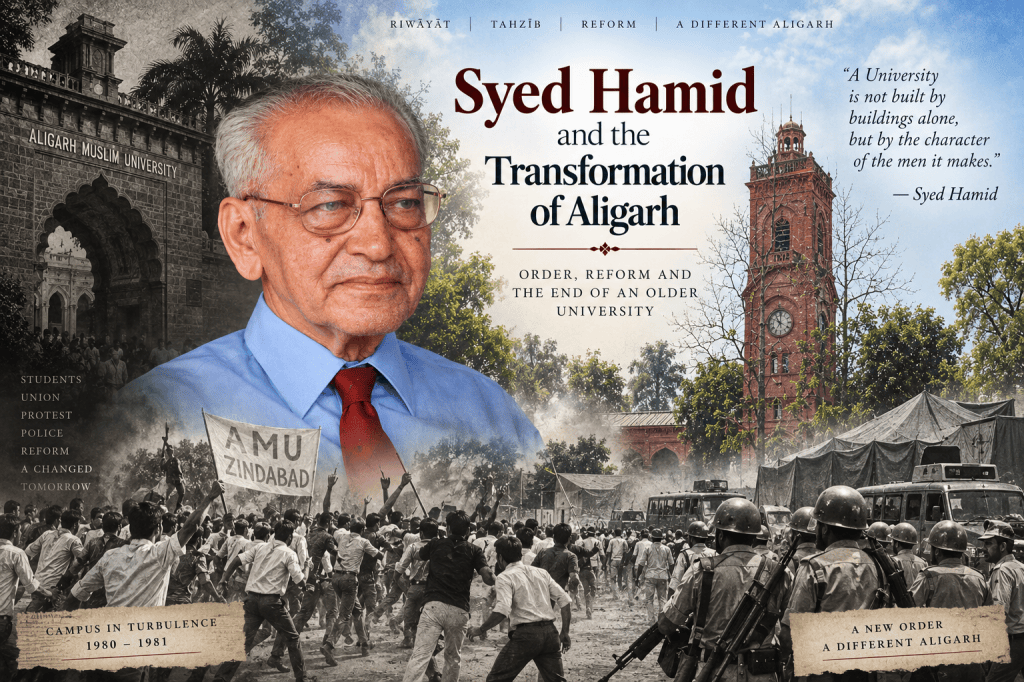
Let me return back to the theme of discussing those Vice Chancellors of Aligarh who made a difference, negative or positive. Today I will discuss a man who transformed the Aligarh as it existed before him and created an institution which then took a different trajectory after him. I am going to describe a period when I myself was mature enough to understand what was happening: I was a student of MA for a part of this period, and I don’t have to depend on either childhood memories or memories as communicated by others. I am also writing this at a time when once again a struggle between the students and the administration is going on, and when once again, the grey dominates over pure white or black. These shades are to be remembered and appreciated.
One has to remember that there are Vice-Chancellors who administer universities, and there are those whose tenure divides an institution’s history into a before and an after. In the history of Aligarh Muslim University, Dr Zakir Husain belonged unmistakably to the second category. So did Colonel Bashir Husain Zaidi and, in a rather different way, Badruddin Tyabji and Nawwab Ali Yawar Jung. Saiyid Hamid, who became Vice-Chancellor in June 1980, must also be placed among them. Yet the Aligarh he inherited was very different from the one his distinguished predecessors had known. Zakir Husain had confronted the existential crisis created by Partition; Zaidi had presided over expansion and institution-building; Tyabji had tried to consolidate that inheritance. Under Jung Aligarh had put forward its most ugly face till then. Saiyid Hamid inherited a university in which ordinary structures of authority had become dangerously weak, and in which strikes, gheraos, hostel politics and student agitations had increasingly come to define Aligarh in the public imagination.
The crisis had not begun with Saiyid Hamid, and its roots, as we have seen in my earlier blogs, went back considerably further. The events of the mid-1960s had already shown how rapidly a dispute within the university could become a major political confrontation. After that, the question of the minority character of AMU came to dominate campus politics for nearly a decade and a half. Professor Abdul Aleem, who served as Vice-Chancellor from January 1968 to January 1974, therefore governed in extraordinarily difficult circumstances. Professor A. M. Khusro, who followed him from September 1974 to September 1979, inherited many of the same tensions. And then came Saiyid Hamid, an IAS officer and an Alig, who occupied office from June 1980 to March 1985.
The minority-character movement arose from a genuine and deeply felt question about the historical identity and constitutional position of the university. It would be quite wrong to dismiss it simply as student disorder. It mobilised students, teachers, old boys, Muslim organisations and political figures throughout India. Yet political movements also develop their own methods, and methods created for a larger struggle can eventually become habits of everyday institutional life. Strikes, demonstrations, deputations, boycotts and gheraos increasingly became accepted means of extracting concessions from an administration. The problem confronting successive Vice-Chancellors was therefore no longer merely how to administer a large residential university. It was how to administer one in which almost permanent political mobilisation had become a way of life.
Meanwhile, another problem was developing within the residential system. It was less ideological but ultimately more corrosive. Aligarh had always possessed a powerful tradition of student politics. The Students’ Union was one of its great institutions, and to speak from its platform was an achievement. Its debates trained generations of students in public speaking and political argument, and its office-bearers frequently went on to distinguished careers in politics, administration, law, academia and public life. The Union Hall itself belonged to the intellectual and cultural landscape of Aligarh. But there is a distinction between student politics and student power exercised without institutional restraint. During the 1970s that distinction became increasingly blurred.
The residential character of AMU magnified the problem. A Hall at Aligarh was never merely a hostel. It was a community with traditions, loyalties, hierarchies and a memory of its own. This was one of Aligarh’s great strengths, but under conditions of administrative weakness the same structure could become a source of informal power. Students who remained in residence for long periods acquired influence over younger residents. Former students and persons whose academic connection with the university had become tenuous could continue to exercise influence. Admission to another course could prolong residence. The distinction between a student, an old student and an influential resident sometimes became difficult to maintain. By the end of the 1970s the expression “illegal boarder” had become part of the vocabulary of campus administration.
Certain large residential complexes acquired particular importance in this culture. S. S. Hall (both North and South) and Aftab Hall possessed formidable traditions and strong internal loyalties. It would be grossly unfair to describe the Halls themselves as centres of criminality. Hundreds of perfectly ordinary students lived there, attended their classes and had nothing whatsoever to do with violence. Yet during moments of confrontation particular hostel networks could become extraordinarily difficult for the administration to penetrate. Senior residents could mobilise juniors, former students could retain influence, and the collective strength of a Hall could become far greater than that of any individual student. Thus, by the time Saiyid Hamid arrived in 1980, AMU had acquired an unenviable public reputation. A university which had produced distinguished scholars, scientists, judges, administrators, writers and political leaders was increasingly mentioned in newspapers in connection with strikes, closures, student violence and administrative paralysis. This picture was unfair to the thousands who quietly attended classes, worked in laboratories and studied in the Maulana Azad Library, but neither was the problem entirely imaginary.
Saiyid Hamid was himself an Alig. He knew the institution from within, but he returned to it after a long career in administration. He therefore brought to the Vice-Chancellorship a temperament different from that of the traditional academic administrator. He understood the emotional vocabulary of Aligarh, but he was unwilling to accept the proposition that affection for the university required tolerating the erosion of its rules. Files had to move. Regulations had to mean something. Hostel rooms had to belong to those entitled to occupy them. Admissions could not simply become devices for perpetuating residence. Above all, the Vice-Chancellor could not govern if every administrative decision was ultimately subject to ratification by whichever organised group could assemble the largest crowd. It was inevitable that such an administrator would collide with the political culture which had developed during the preceding decade.
The explosion came in January 1981, and ironically its immediate cause was not an order issued by Saiyid Hamid but the controversy surrounding Professor Irfan Habib. Habib was then Dean of the Faculty of Social Sciences and already one of India’s most distinguished historians. His public criticism of conditions within the university, including the presence and protection of undesirable and criminal elements, touched the rawest nerve of campus politics. But there was already a history behind the confrontation. The subsequent Supreme Court judgment in Wasiuddin Ahmed v. District Magistrate, Aligarh recorded earlier disciplinary proceedings involving a leading agitator, Habib’s role in reporting misconduct and unfair means, threats against him, and Students’ Union pressure on the Vice-Chancellor even before the confrontation reached its climax.
The issue very quickly ceased to be simply whether Habib’s assessment of AMU was correct. A substantial section of organised student opinion interpreted the remarks attributed to him as an insult to Aligarh, and the demand arose that he should be removed as Dean and punished. The Students’ Union became the principal organisational vehicle of the agitation. Pamphlets circulated, meetings were held and slogans were raised. What might have remained a controversy between a professor and his critics became a confrontation over who possessed authority within the university. Then came the gherao of the Vice-Chancellor. The Supreme Court record provides a disturbing picture. Students began a dharna at the Vice-Chancellor’s residence; its main gate was locked and Saiyid Hamid was prevented from leaving. Doors of university departments were also locked and normal functioning came to a standstill. The gherao continued despite prohibitory orders. On 31 January the police arrested 213 students in a pre-dawn operation, and the university was closed indefinitely. This was no longer merely vigorous student protest. A fundamental question had arisen: who governed Aligarh? Was it the Vice-Chancellor and the statutory authorities, or could the Students’ Union and organised groups within the residential Halls compel the administration to punish a professor, reverse a disciplinary decision or accept a political demand? Whatever one’s opinion of Irfan Habib, the physical siege of the Vice-Chancellor represented something more than democratic dissent. Protest had crossed into coercion.
The great residential Halls now became part of the geography of confrontation. Again, the distinction between institutions and particular groups operating within them is essential. But the size of S. S. Hall and Aftab Hall, their internal networks and the influence exercised by politically active senior residents made such residential concentrations important in sustaining mobilisation. The very residential system which had once socialised generations of Aligs could now also provide the organisational structure for resistance to university authority. Then something happened which earlier generations of Aligs could scarcely have imagined. The police entered the campus. For those who know only the Aligarh of later decades, it is difficult to convey what this meant. The university had possessed a very strong conception of the autonomy of its residential space. The campus was not thought of simply as a collection of public buildings through which the district police might move whenever a law-and-order difficulty arose. Its Halls were homes. Its roads were university roads. Discipline within this world was expected to be maintained through the Vice-Chancellor, Proctor, Provosts, Wardens and the university’s own mechanisms of authority. The sight of armed police occupying this space had been almost unthinkable. The agitation of 1981 broke that barrier.
The scale of the deployment was extraordinary. The Supreme Court subsequently recorded that Section 144 was imposed inside as well as outside the university campus and that the district administration called in twenty companies of the Provincial Armed Constabulary and ten companies of the Central Reserve Police to assist the local police. The university eventually reopened on 17 August 1981 after remaining closed for more than six months. For months the appearance of the campus itself was transformed. Those who lived through the period remember police tents and vehicles becoming part of the landscape. Armed policemen moved through spaces which generations of students had regarded as their own. Guns were visible on roads where the normal traffic of Aligarh had once consisted largely of bicycles, rickshaws, students walking to their classes and the occasional university vehicle. Day and night the police presence remained. Parts of the university began to look almost like a police lines campus. The psychological impact was perhaps greater than the physical one. A student emerging from his Hall could encounter an armed policeman. The policeman was no longer somebody beyond the university gate. He had entered the residential world of Aligarh. This was a profound rupture in institutional memory.
Until then, whatever the intensity of student agitation, there had remained an underlying assumption that Aligarh would ultimately settle the problems of Aligarh. Students might strike. The Students’ Union might confront a Vice-Chancellor. Provosts and Wardens might lose control of their Halls. But the campus remained a university space. That assumption was destroyed in 1981. There is an important distinction between asking why the police were called and understanding what their entry did to the university. The administration faced a genuine breakdown of order. The Vice-Chancellor had been confined within his residence. University buildings had been locked. Academic functioning had been paralysed. The scale of the deployment itself indicates the seriousness with which the civil administration viewed the situation. But necessity does not erase consequence. Once armed police had entered and occupied the residential campus, a psychological boundary had been breached. What had earlier been regarded as inconceivable had happened. Formal coercive authority had entered where informal university authority had failed.
Then came the tragedy which gave the entire confrontation its most painful human meaning. During the disturbances a young student, Aftab Ahmad, was killed in police firing. His death could never thereafter be separated from the memory of those years. Whatever explanations may be advanced concerning the circumstances which produced the confrontation, a young student had lost his life. Administrative breakdown, political agitation, student indiscipline and the collapse of internal authority may help the historian understand how the university reached such a point. None of them diminishes the human tragedy. Aftab’s death transformed the emotional character of the crisis. The armed policemen who remained on campus could no longer be viewed simply as an emergency security arrangement. Every police tent, vehicle and rifle became a reminder that a student had been killed within the world which Aligs had traditionally thought of as their own. The Irfan Habib affair itself did not end with the original agitation. Habib was subsequently suspended, along with Professor Rehman Ali Khan, later in 1981. The chronology is important. The demand for action against Habib formed part of the earlier student agitation, but the suspension came later and should not simply be represented as the immediate capitulation of the Vice-Chancellor before the original gherao. Yet by then something much larger than the fate of one professor was at stake. The old mechanisms through which Aligarh had regulated itself had demonstrably failed. For an administrator such as Saiyid Hamid, the conclusion must have seemed unavoidable. If the university was to survive, it had to become governable.
The measures which followed were therefore not simply punitive. Saiyid Hamid attempted to alter the structures which had allowed the crisis to develop. Hostel discipline was tightened. Unauthorised residence was challenged. Administrative authority was strengthened. The power of informal hostel networks had to be broken. The assumption that an organised gherao could secure an administrative decision had to end. At the same time the academic and residential structure of the university was itself changing. The introduction of the 10+2 system gradually separated Senior Secondary education from the older Intermediate and undergraduate structure. Younger boys increasingly came to be housed separately. The Allama Iqbal Boarding House for Senior Secondary School boys belongs directly to this transition; its foundation stone was laid on 28 August 1984, during Saiyid Hamid’s Vice-Chancellorship. Other forms of residential differentiation also became increasingly important. Medical students inhabited an increasingly distinct professional and residential world. Engineering students similarly became concentrated around their own institutional environment. Younger students were placed together rather than being dispersed through a residential system in which several generations of students had once lived side by side. Administratively this possessed a clear logic. Socially, its consequences were far more complicated.
For the old residential Aligarh had rested upon principles which could never be reduced to ordinances. At their heart stood two concepts difficult to translate adequately into English: riwāyāt and tahzīb. The riwāyāt were the inherited traditions of Aligarh. They were not regulations issued by the Registrar. They were habits, conventions and memories transmitted from one generation of Aligs to another. Tahzīb was something more subtle still. It meant manners and etiquette, certainly, but also a particular way of conducting oneself: how one spoke to elders and juniors, how one disagreed without abandoning civility, how one received a guest, how one behaved at a formal dinner, how one dressed for a Hall function, and how one carried oneself in the Dining Hall, Common Room and Students’ Union. One did not acquire these things merely by obtaining admission to AMU. One had to become an Alig. And one of the principal mechanisms through which this happened was the distinction between senior and junior.
The relationship was hierarchical and could certainly be abused. Seniority could become arrogance; discipline could become bullying. Such abuses should never be romanticised. But that was not the whole institution. The senior was also expected to protect the junior. He introduced him to the Hall and its traditions. He explained how one behaved at dinner, how one addressed a teacher, how a formal function was conducted and what behaviour was considered unbecoming of an Alig. The junior in difficulty could turn to a senior. Seniority brought privileges, but traditionally it also imposed obligations. It was through this relationship that riwāyāt and tahzīb passed from generation to generation. The organisation of the old Halls facilitated this process. Students of different ages and disciplines lived together. An undergraduate encountered postgraduate students and research scholars. The engineer might live beside a historian, the student of physics beside someone studying Urdu or philosophy. The cricketer met the debater. The future doctor shared his Dining Hall with the future civil servant. The Hall was, in that sense, a miniature university.
The restructuring which gathered pace in the early 1980s began to disturb this social ecology. If medical students increasingly lived with medical students and engineers with engineers, professional identity began to replace the broader residential identity. If juniors were thrown overwhelmingly together with juniors, an even more basic question arose: who was to teach them traditions which none of them had yet inherited? A group of seventeen-year-olds could create friendships and traditions of their own. They could not transmit to one another a century of riwāyāt. The bifurcation of Sir Syed Hall in 1983 was almost symbolic of this larger change. The oldest Hall of the university, physically and emotionally connected with the M.A.O. College itself, was divided into Sir Syed Hall North and South for what the university’s own institutional history describes as “administrative reasons”. Administrative manageability was becoming the governing principle even within the historic residential heart of Aligarh.
Here lay the great paradox of Saiyid Hamid’s reforms. He confronted a corrupted form of seniority. Powerful senior residents, long-term occupants and former students could dominate younger students and mobilise hostel networks against the administration. Such concentrations of informal power had contributed to the siege-like conditions of 1981. An administrator determined to restore order naturally sought to weaken them. But in weakening the bad senior, the new arrangements also weakened the institution of the good senior. The old Hall had possessed a memory. Seniors remembered its personalities, customs, celebrated sportsmen and debaters, annual functions, rivalries, eccentricities and innumerable little conventions which had never been written down. When generations lived together, that memory travelled downwards. Once generations were separated, the chain weakened. Rules increasingly replaced riwāyāt. Administrative supervision replaced some of the functions once performed by seniority. What had previously been transmitted as tahzīb was increasingly expected to be secured through regulations. But regulations can prohibit misconduct. They cannot manufacture tahzīb.
The disappearance of mixed residential life also altered the intellectual texture of the university. The historian no longer necessarily encountered the engineer every morning over breakfast. The medico increasingly inhabited the company of other medicos. Professional identities grew stronger while the common culture of the residential university became weaker. This was not necessarily what Saiyid Hamid intended. Nor would it be historically fair to attribute the entire transformation to a single Vice-Chancellor. AMU was expanding. Professional education was growing. Student numbers had increased enormously. The national introduction of the 10+2 system itself required restructuring. Some processes had begun before Saiyid Hamid and others continued long after him. Nevertheless, his Vice-Chancellorship marked the moment when these tendencies converged.
There were important achievements as well. The university expanded academically and institutionally. Saiyid Hamid placed emphasis upon competitive examinations and the wider educational responsibilities of AMU. The Centre for Promotion of Science, established on 26 March 1985 under Section 5(2)(c) of the 1981 Amendment Act, explicitly sought to promote science education particularly among Muslim educational institutions across India. There was therefore another Saiyid Hamid alongside the disciplinarian: the educational reformer who wanted Aligarh once again to think beyond its campus. His revival of Tahzib-ul-Akhlaq was particularly significant. It consciously invoked Sir Syed’s intellectual inheritance and the reformist origins of the Aligarh Movement. There was, however, an extraordinary irony in this. At precisely the moment when Tahzib-ul-Akhlaq was being revived as an intellectual project, some of the social mechanisms through which the everyday tahzīb of Aligarh had traditionally been transmitted were disappearing.
This is why Saiyid Hamid’s legacy cannot be described either as a simple triumph of reform over disorder or as the destruction of an idyllic past. The disorder he inherited was real. The need for reform was real. His achievements were real. And the losses were real. Something had broken during those years which was never completely repaired. Aligarh never quite returned to its older self. The police eventually withdrew. The tents disappeared. The PAC and CRPF vehicles no longer defined the appearance of the campus. Classes resumed. Students again filled the Library and Dining Halls. Elections, debates, examinations, Convocations and Hall functions returned. But the old world did not return with them. The invisible assumptions on which that world had rested had been shaken. The campus had discovered that the police could enter it. The Vice-Chancellor’s residence had been placed under siege. A student had been killed. Teachers had become protagonists in factional conflicts. The Students’ Union had demonstrated both the enormous power of organised student mobilisation and its capacity to cross the boundary between representation and coercion. The administration had responded by centralising authority and regulating areas of student life which had previously been governed more informally.
Most importantly, the old chain of transmission had been damaged. The distinction between senior and junior became weaker. Mixed residential communities declined. Professional and Faculty identities became stronger. Younger students increasingly lived with those of their own age. Rules replaced convention; supervision replaced inherited authority; and the Hall gradually ceased to perform all the cultural functions which it had once performed. The Aligarh that emerged was still recognisably Aligarh, but it was no longer quite the Aligarh of the earlier generations. And the story did not end with Saiyid Hamid. The succeeding decades brought their own Vice-Chancellors, their own experiments, their own achievements and their own crises. It would be unfair, and historically inaccurate, to draw a straight line from 1981 to every problem which AMU subsequently experienced. Universities change because society changes around them. Student composition changed. Indian politics changed. Higher education expanded. Patronage networks changed. New social aspirations entered the campus. The relationship between universities and governments changed as well.
Yet the institutional restraints which had once softened conflict were becoming progressively weaker. Successive crises therefore tended to begin from a university already carrying the scars of earlier ones. Student politics repeatedly oscillated between representation and confrontation. Hostel indiscipline returned in new forms. Questions of admissions, appointments, patronage and administrative authority repeatedly produced controversy. Vice-Chancellors came with promises of restoration and reform, but each inherited structures already altered by his predecessors. The decline was therefore not one dramatic collapse. It was cumulative. One convention disappeared here, another weakened there. An institution lost authority. A Hall lost part of its corporate memory. A statutory body became less effective. A practice which had once depended upon mutual respect came increasingly to depend upon enforcement. Political alignments outside the university penetrated more deeply into its internal affairs. Teachers, students, administrators and old boys increasingly interpreted university questions through competing factions. And with every crisis the memory of how Aligarh had once regulated itself became a little more distant.
This is perhaps the larger historical significance of the Saiyid Hamid years. They did not create everything that followed. The crisis had begun before him, during the later years of Abdul Aleem and Khusro, and its causes reached still further back. Nor did the deterioration of subsequent decades arise simply from his reforms. But his period stands at the watershed. Before it lay an older Aligarh, already troubled and in many respects already breaking down, but still sustained by powerful informal structures of authority, seniority, Hall identity, riwāyāt and tahzīb. After it emerged another Aligarh: administratively more regulated, professionally more compartmentalised, increasingly dependent upon formal authority, and progressively less able to rely upon inherited conventions to regulate its everyday life. What followed in later decades was not a return to the older equilibrium. It was a succession of new adjustments and new crises. Some administrations repaired particular institutions; others weakened them. There were periods of academic achievement, expansion and relative tranquillity. It would be unjust to erase them. But the larger trajectory of campus politics and governance repeatedly exposed the fragility of the institutional culture. Crisis followed crisis, each leaving another layer behind.
The Aligarh of today has been shaped by that accumulated history. It cannot be understood merely by looking at the tenure of the present Vice-Chancellor, or the one before, or even the last several administrations. Nor can every contemporary problem be attributed to one political party, one government, one faction of teachers or one generation of students. What we see today is the product of several decades during which older forms of institutional authority were dismantled faster than equally effective new ones could take their place. That is why nostalgia alone cannot recover the old Aligarh. Buildings can be restored. Hostels can be renovated. Dining Halls can be modernised. Rules can be rewritten and security increased. A university can even revive the names and ceremonies of its past. But riwāyāt cannot simply be notified by an office order, and tahzīb cannot be imposed by a Proctor. They exist only when one generation receives them from another, understands their meaning, modifies what deserves modification and passes what remains valuable to those who come afterwards. This is what was gradually interrupted.
Perhaps, then, the Saiyid Hamid years should be remembered neither as the moment when Aligarh was “saved” nor as the moment when it was destroyed. They were the moment when one historical form of Aligarh finally gave way to another. Saiyid Hamid inherited a university approaching ungovernability. He restored the authority of administration, reorganised important parts of its academic and residential structure and sought to reconnect AMU with the larger educational mission of the Aligarh Movement. But the university which emerged from that process was different from the one which had entered it. The old Aligarh had believed that a university educated a student not merely through his teachers and textbooks but through his Hall, his seniors, his dining table, his Common Room, his Students’ Union and the generations which had occupied those spaces before him. It believed that an Alig was not merely admitted; he was formed. That world had already begun to decay before Saiyid Hamid. The upheavals and reforms of the early 1980s accelerated its passing. The police tents eventually came down. The armed men disappeared from the roads. The university reopened and life resumed. But Aligarh never really returned to where it had been.
The decades that followed carried it through further upheavals, further experiments and deeper institutional crises. Each generation inherited a little less of the old consensus and a little more of the unresolved conflicts of the generation before it. In that long process were fashioned the campus, the politics, the administration and the institutional culture that confront us today. The tragedy is not simply that the old Aligarh disappeared. No institution can remain frozen in time, nor should it. The deeper tragedy is that while much of the old order was dismantled, an equally compelling new culture of institutional responsibility did not always take its place. Somewhere in that transition, the balance between freedom and responsibility, protest and restraint, seniority and obligation, administration and community began to be lost. And with it faded something which generations of Aligs had once understood instinctively, without needing anyone to define it for them: the riwāyāt and tahzīb of Aligarh.


