Syed Ali Nadeem Rezavi
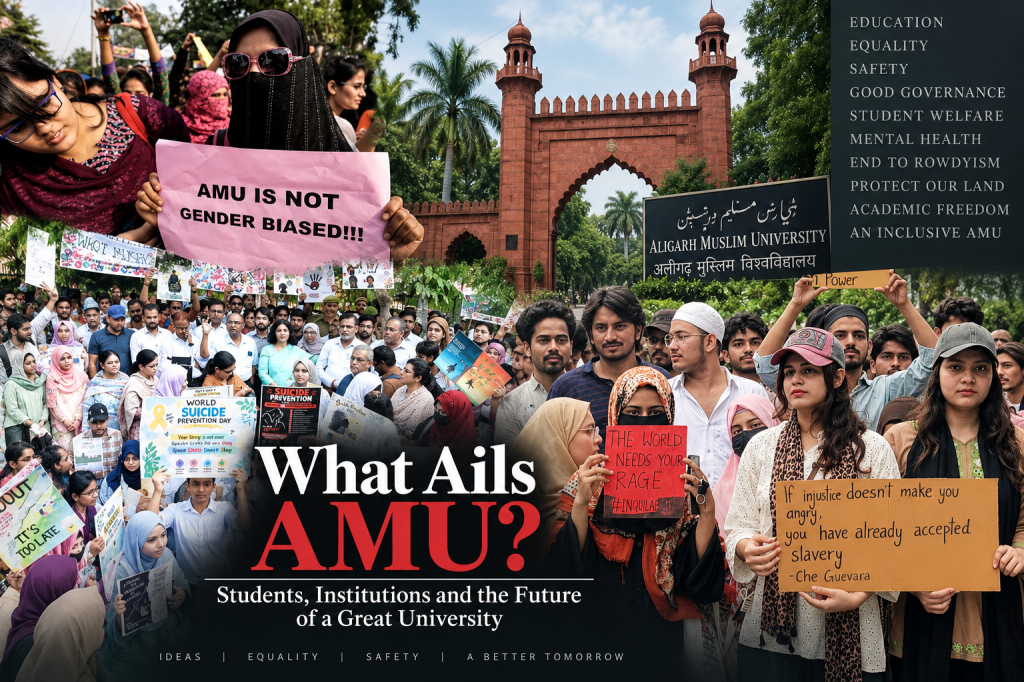
Something is seriously wrong at Aligarh Muslim University, and the evidence is not difficult to find. Open the newspapers in almost any given week and AMU appears for reasons that would have been unimaginable for an institution which once measured itself by its scholars, its intellectual debates, its libraries, laboratories and classrooms. Students assaulting other students. Illegal occupants in residential halls. Weapons and fake currency allegedly recovered from a hostel room. A student reportedly beaten with an iron rod over an altercation that began with something as trivial as asking for a water jug. A man scaling the wall of a women’s hostel and allegedly attempting to molest a student. Protests and confrontations involving the Proctor’s Office. Students taking, or attempting to take, their own lives. And beyond the campus walls, enormously valuable University lands becoming the subject of repeated attempts at takeover. These cannot indefinitely be dismissed as unrelated incidents, for patterns emerge when one looks closely enough, and the pattern here is deeply troubling.
On 8 September 2026, for example, it was reported that three AMU students had been suspended following an assault in which a student suffered a fractured jaw after allegedly being struck with an iron rod. In April, police searching a University hostel room reportedly recovered ammunition, counterfeit currency, multiple identity documents and other material while investigating an accused in a firing case. In May, a man accused of stalking women students was arrested after allegedly scaling the boundary of a women’s hostel, and police said a knife was recovered from him. And now, on 12 September, another disturbing case has been reported involving alleged blackmail and honey-trapping, with a student arrested and suspended, ten rooms in V. M. Hall reportedly sealed after suspicious activities were found, and a person described in the report as a history-sheeter allegedly found to have been residing illegally on the campus.
What does all this tell us? It is easy to blame students, and it is even easier to invoke that favourite administrative phrase, law and order. But a residential university is not merely a collection of young people over whom guards must maintain control. Its halls are institutions. They have Provosts, Wardens, Senior Hall functionaries, Proctors and an elaborate administrative machinery. AMU’s own description of the Proctor’s Office states that its responsibilities include maintaining law and order, preventing unwanted elements from entering the campus, protecting University property and preventing antisocial activities. If unauthorised persons can nevertheless establish themselves in halls, if rooms can become centres of activities having little connection with student life, if weapons can allegedly find their way into hostel accommodation, the question cannot simply be what is wrong with AMU students. The question must also be who allowed the residential system to reach this condition.
The Official Goonda
This problem did not arise yesterday, and it will not be solved by pretending that it is new. For years AMU has suffered from a phenomenon that deserves to be called by its proper name: the emergence of the official goonda. I use the expression deliberately because it captures something that ordinary language about indiscipline fails to convey. Every large university may occasionally have violent or troublesome students, and that is not peculiar to AMU. What is far more dangerous is the individual who acquires power because he enjoys administrative protection. He may occupy a room to which he has no legitimate entitlement, establish his own kitchen, gather followers around himself, cultivate officials and politicians, and conduct personal activities from within a University hall. Everyone knows who he is, yet somehow the rules that apply to ordinary students cease to apply to him. Such people do not survive because the administration is unaware of them. They survive because someone finds them useful.
We saw the grotesque extent of this phenomenon during the COVID lockdown. Ordinary students could be ordered to leave the halls, yet favoured elements could continue to enjoy access to residential spaces, operate kitchens and maintain their networks. If rules are enforced against the ordinary student but suspended for the politically or administratively useful individual, this is not simply a failure of discipline. Selective lawlessness protected by authority becomes an instrument of authority. The latest revelations therefore need to be understood historically. They are not merely isolated failures of the present Proctor or the present Vice-Chancellor. They are the accumulated consequence of an administrative culture that AMU has allowed to develop over many years.
Where Did This Culture Come From?
A recent article in Muslim Mirror has attempted a sweeping diagnosis of AMU’s problems, speaking of patronage, parasites, sexual predators and persons occupying lucrative administrative positions such as OSDs and Directors. Much of what it identifies deserves serious discussion. But there is a remarkable silence at the heart of that indictment. It attacks the beneficiaries without adequately examining the system that produced them. The practice of maintaining sponsored goondas is not new. It may have existed in rudimentary form earlier, but it was perfected and made systematic from the period of Mahmoodur Rahman as Vice-Chancellor. By the time of Tariq Mansoor, it had been turned into a fine art. What changed over the decades was not the existence of protected troublemakers but the sophistication with which they were cultivated, deployed and shielded. Under Mahmoodur Rahman, the practice acquired a more organised character. Under later administrations, and most openly under Tariq Mansoor, it became embedded in the everyday workings of the University. The goonda was no longer merely tolerated. He became an instrument of governance, useful for managing halls, intimidating rivals, delivering political access and enforcing informal discipline where formal authority preferred not to appear directly responsible.
The later, more visible phase of that genealogy takes us back at least to 2012, when Lt General Zameer Uddin Shah became Vice-Chancellor. Shah did not arrive alone. His administration brought other retired military officers into important positions, including Brigadier Ahmad Ali as Pro-Vice-Chancellor and another former military officer, perhaps a Major, as Registrar. Thus a remarkable military troika came to occupy the upper reaches of a great academic institution.
The significance was larger than the individuals involved. A different culture of governance began asserting itself, one emphasising command, personal loyalty and administrative authority rather than consultation and the collegiate traditions of a university. Then came 2014, when the victory of Narendra Modi and the BJP transformed the political landscape. Sections of the Muslim elite began arguing that Muslims must accommodate themselves to the new political order, and Lt General Syed Ata Hasnain publicly argued that Muslims should not miss the bus and should find ways of engaging with the BJP. Within AMU, something similar was happening. The Shah administration began cultivating access to the new political establishment. Persons with dubious reputations could become useful as intermediaries because they possessed political connections. Shah eventually obtained his meeting with the Prime Minister, but some of those who facilitated such access proved considerably more successful in ingratiating themselves with the emerging political order than Shah himself.
Meanwhile Shah became embroiled in noisy public confrontations with the local illiterate BJP MP, Satish Gautam. Those quarrels have sometimes been treated as proof that Shah stood against the BJP, but that is to mistake public theatre for the deeper political process. One could quarrel with the local BJP representative while simultaneously seeking accommodation with Narendra Modi and the national leadership. The saffronisation of AMU did not begin with Tariq Mansoor. Its foundations were being laid during the Shah years after 2014. Under Tariq Mansoor, the process became more open and acquired far greater impetus. What had initially required intermediaries, manoeuvring and political bridge-building increasingly became an identifiable relationship with the ruling establishment. Mansoor’s subsequent political career merely made visible a transformation whose origins preceded his vice-chancellorship.
And what happened to the University while enormous administrative energy was being consumed by politics, image management and the cultivation of power? The most important question received progressively less attention. What about education? Universities do not become great because their Vice-Chancellors possess access to Prime Ministers, Governors or ministers. They become great because they appoint outstanding teachers, protect academic freedom, encourage research, maintain libraries and laboratories, attract excellent students and create an atmosphere in which intellectual distinction is rewarded. AMU increasingly developed another culture, the culture of the OSD, the Director, the Coordinator, the favourite and the indispensable intermediary. The Centres of Excellence closed or were let to rot. This is precisely why those who today attack particular individuals occupying lucrative positions should look backwards. Patronage has a history. Today’s favourites did not invent favouritism. They inherited it.
The question of who is fit to lead a university is therefore not a side issue. Irfan Habib often recalls that when Jawaharlal Nehru was asked why India was not establishing more universities, Nehru replied, in substance, that he did not know where he would find people qualified to be appointed Vice-Chancellors to lead them. The anecdote is usually remembered as a comment on the scarcity of academic leaders in the early years of the Republic, but it carries a sharper lesson for AMU today. If a university’s fate depends on the calibre of those chosen to lead it, then the selection of Vice-Chancellors, Pro-Vice-Chancellors, Registrars, Provosts and Deans cannot be treated as an exercise in political accommodation or administrative convenience. Nehru’s standard was qualification to lead an academic institution. AMU’s recent history suggests that the standard has too often been political usefulness, personal loyalty or the capacity to manage patronage. That inversion lies close to the heart of the present crisis.
The Women Who Rebelled
One of the earliest serious challenges to Shah’s conception of authority came, significantly, from women students. The controversy over access by Women’s College students to the Maulana Azad Library was not merely an argument about library membership. It revealed an entire conception of the university. Women students wanted access to the Central Library. The administration responded with arguments about security, boys and girls being together late in the evening, and the alleged danger of the route between Women’s College and the Central Library. The contradiction was breathtaking. If women students were unsafe travelling between two institutions belonging to the same University, whose responsibility was it to make the campus safe? Instead of making the road safe for women, their inability to travel safely became an argument for restricting them.
The women students resisted, and in retrospect, that episode deserves to be remembered as an important moment in AMU’s recent history because it exposed the limitations of an administrative philosophy that confused discipline with control and paternalism with protection. It also revealed something about the relationship between power and vulnerability within the institution. Those who are most vulnerable to harm are often the ones whose freedoms are curtailed in the name of protecting them, while those who pose the threat remain untouched. This inversion of responsibility lies at the heart of much that has gone wrong at AMU, and it continues to shape the experience of women students on campus today.
When Students Begin Losing Hope
There is, however, another crisis unfolding today which cannot be discussed in the language of discipline. It concerns the mental well-being of AMU’s students, and it demands attention that goes beyond periodic gestures. On 12 August, a second-year student was found dead in her room in Indira Gandhi Hall, and contemporary reporting described it as the third student suicide on the campus within nine months. Another AMU undergraduate died by suicide later in August at his rented accommodation outside the campus. More disturbing still, an investigation published on 30 August reported that five students had died by suicide over roughly two years and that, during seven months, five students had themselves written that they were experiencing suicidal thoughts. The same report stated that none of the Provosts of AMU’s twenty halls had approached the Psychology Department for counselling assistance. Then, on 5 September, came another report of a student attempting suicide after being made to vacate a room.
These cases should not be casually joined together as though they necessarily had a single cause. Suicide is complex, intensely personal and cannot responsibly be attributed to the University merely because the person concerned happened to be an AMU student. But when several such tragedies and warning signs occur within a relatively short period, an institution has a duty to ask difficult questions. Do our halls possess functioning systems for identifying students in distress? Do Wardens actually know their residents? Where is professional counselling? What happens when a student begins withdrawing from classes and friends? Is there a mechanism through which roommates can quietly alert someone? Are Provosts trained to recognise psychological distress? And above all, does the University still possess that older residential ethos in which the hall was supposed to be something more than a collection of rooms?
AMU has responded with programmes around World Suicide Prevention Day, including awareness and wellness initiatives, and that is welcome. But mental health cannot be addressed by commemorating a day. It requires a permanent institutional structure, a culture of care that permeates the residential system, and a recognition that the well-being of students is not a peripheral concern but a central responsibility of the University. A university which speaks endlessly about controlling its students must learn once again how to care for them.
Law and Order Cannot Mean Policing Alone
The present administration is clearly attempting to restore order. Suspensions have been issued. Rooms have been searched or sealed. Police have been called where criminal allegations are involved. AMU officially proclaims zero tolerance towards indiscipline. Some of this is necessary, and no one should suggest that rules can be flouted without consequence. But AMU should beware of believing that the answer to decades of administrative failure is simply a more powerful Proctor’s Office. A Proctor can punish a student who assaults another student. He cannot by himself restore the intellectual culture of a university. A security guard can stop an unauthorised person at a gate. He cannot explain why unauthorised people were permitted to acquire influence inside halls in the first place. A CCTV camera can record a crime. It cannot reconstruct a residential system in which teachers, Wardens and students actually know one another.
The danger is that AMU may respond to the consequences of failed governance by constructing an increasingly elaborate apparatus of surveillance and punishment while leaving untouched the patronage structures that produced the crisis. There must certainly be law and order. But there must also be law applied equally. The politically connected student, the Vice-Chancellor’s favourite, the protected hostel occupant and the ordinary first-year student must encounter the same rules. Otherwise discipline becomes merely another word for selective power, and the resentment it generates will only deepen the problems it claims to address.
And Now They Come for the Land
There is another dimension to AMU’s present vulnerability which has received insufficient attention: its land. The University possesses an extraordinarily valuable estate, much of it acquired through donations, historical grants and acquisition proceedings extending back to the MAO College and early University periods. As Aligarh has expanded, land that once lay on the outskirts has become immensely valuable urban property. The consequences are now before us. In April 2025, the Aligarh Nagar Nigam took possession of a substantial tract in the Bhamola-Nagla Patwari area that AMU claimed as its Riding Club land. The Municipal Corporation relied upon contemporary revenue entries, while AMU maintained that the property had been legally acquired and remained University land.
The dispute returned with extraordinary force in August 2026. Municipal authorities entered approximately 3.863 hectares claimed by AMU, brought earthmoving equipment, levelled parts of the area, erected fencing and asserted municipal ownership. Contemporary reports valued the disputed property at around five hundred crore rupees. AMU responded that it possessed historical acquisition documents and announced its intention to pursue the matter legally. Eventually the District Magistrate ordered maintenance of the status quo pending determination of the ownership dispute, and students subsequently demonstrated against the attempted takeover of Riding Club land. This is not merely a dispute about 3.8 hectares.
AMU’s land question has a much longer history. University land has repeatedly attracted encroachment and competing claims. The Riding Club lands themselves have been the subject of anxiety for decades. Those of us who remember the University of the 1990s also remember the unease surrounding attempts to protect its estate and the extraordinary sensitivity that attached to questions of land. Today those lands are worth hundreds of crores. The University therefore needs something much more substantial than episodic litigation after somebody arrives with bulldozers. It needs a professionally maintained Land and Estate Cell, digitisation of every title deed, acquisition notification, revenue entry, map and mutation record, GIS mapping of every parcel belonging to AMU, regular physical inspection and immediate legal intervention whenever an adverse revenue entry or encroachment appears. A university that cannot protect its land today may discover tomorrow that a court is being asked to decide ownership on the basis of records altered decades earlier. The defence of AMU’s estate is not a real-estate issue. University land is a public educational endowment entrusted to one generation for transmission to the next.
What, Then, Ails AMU?
It would be comforting if there were one answer, but there is not. AMU suffers from the accumulated consequences of patronage, political accommodation, administrative authoritarianism, declining academic priorities, the weakening of the residential system, selective enforcement of discipline, protected intermediaries, institutionalised favouritism and the gradual disappearance of accountability. The crisis did not begin with the present Vice-Chancellor, nor did it begin with Tariq Mansoor. Its recent genealogy must be traced at least to the Zameer Uddin Shah period, and particularly to the political realignment that followed 2014. Under Tariq Mansoor the process acquired a much more explicit political character. Successive administrations inherited structures that had already become entrenched.
But identifying this genealogy does not absolve the present administration. Every administration inherits problems. The question is whether it perpetuates them or dismantles them. Today AMU faces an extraordinary convergence of challenges. It must recover its academic standards. It must clean up its halls without turning them into police barracks. It must remove unauthorised occupants irrespective of their political connections. It must dismantle the culture of administrative favourites and unnecessary sinecures. It must create a serious mental-health and counselling system. It must restore confidence among women students that the campus belongs equally to them. It must defend its enormous landed estate with professional competence. And it must establish that the same rules apply to everyone. And most importantly, once again give some emphasis to academics, which has been neglected since long.
Above all, it must recover its purpose. Sir Syed Ahmad Khan did not create the MAO College so that generations later its energies would be consumed deciding who should become an OSD, who should control a hall, who has access to a politician, who can retain an unauthorised room, or which official can obtain another extension. He created an educational institution. The tragedy of contemporary AMU is that governance has increasingly become an end in itself, while education, which should have been the reason for governance, has too often become secondary.
The question before AMU is therefore larger than who should be the next Proctor, Provost, Registrar, Director or OSD. It is whether the University can once again make scholarship, teaching, intellectual freedom, integrity and the welfare of its students the standards by which authority is judged. Those who criticise the parasites are right to do so, but they must also ask who created the conditions in which parasites prospered. Those who condemn student rowdyism must ask who protected rowdies when they were useful. Those who demand discipline must demand it first from those who exercise power. Those who lament suicide among students must build an institution in which a distressed young person knows where to turn before despair overwhelms him or her. And those entrusted with AMU’s property must remember that they are custodians, not owners, of an inheritance created through the sacrifices and benefactions of generations before them.
What ails AMU is therefore not simply bad students, bad officials, bad teachers or bad appointments. It is the erosion of institutional principle. Until that principle is restored, changing individuals will accomplish very little. One set of favourites will replace another, one group of OSDs will succeed the previous group, yesterday’s protected strongman will give way to tomorrow’s, and every new administration will announce that it is cleaning up the mess left by its predecessor. AMU does not need another cycle of patrons and protégés. It needs its institutions back. It needs its robust educational system back.

 ASHA: Blast From The Past