Syed Ali Nadeem Rezavi
We live at a curious moment in our relationship with the past. History has perhaps never been so publicly visible, yet the historian’s craft has rarely been so poorly understood. Television studios debate medieval rulers, social media circulates claims about events supposed to have occurred centuries ago, monuments are made to testify to identities they may never have possessed, mythology is presented as documented fact, and inconvenient evidence is dismissed because it does not conform to the past we would prefer to possess. Increasingly, the question asked is not “What happened?” but “What should our past have been?” Once that shift takes place, history ceases to be history. It becomes memory, mythology, propaganda or political mobilisation. All these may themselves be legitimate subjects of historical enquiry, but they cannot substitute for history. It is therefore worth returning to a deceptively simple question: what actually is history?
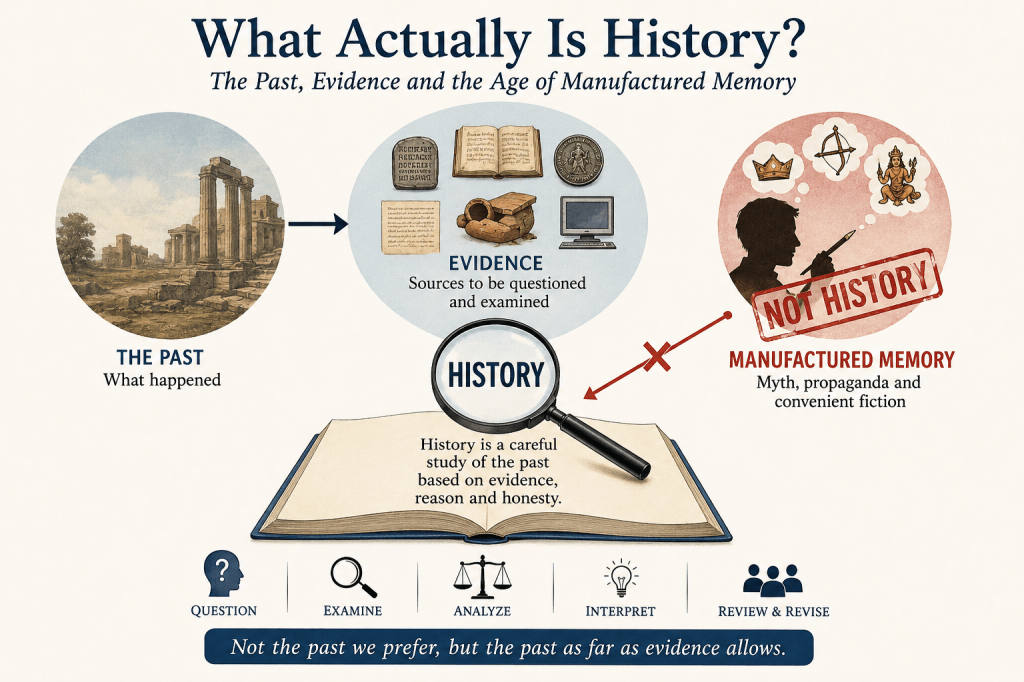
The first distinction that must be made is between the past and history. The past consists of everything that has happened. History is our disciplined attempt to recover, reconstruct and explain that past from the evidence it has left behind. The past cannot be altered. Our understanding of it can and must change when new evidence is discovered, old evidence is reconsidered, or new questions are asked, but that revision must arise from historical method, not contemporary convenience. This distinction lies at the heart of E. H. Carr’s classic What Is History?, in which he rejected the comforting nineteenth-century notion that ‘historical facts’ simply lie waiting for the historian to collect them. Countless events occurred in the past, but only some become historically significant because historians ask questions of them, hence Carr’s celebrated description of history as “an unending dialogue between the present and the past.” The phrase is sometimes misunderstood. Carr was not suggesting that historians may construct whatever past suits their present. Quite the contrary: the historian approaches the past with questions, but the answers remain constrained by evidence. Interpretation is unavoidable; fabrication is not interpretation. There is an enormous difference between saying “this evidence can be interpreted differently” and saying “evidence does not matter,” and that distinction is particularly important today. And thus, every one with a pen, has started writing about the past!
Marc Bloch, in The Historian’s Craft, offered another memorable definition: history is “the science of men in time.” For Bloch, history was not a catalogue of kings, battles and dates but the investigation of human societies across time. The historian seeks to understand institutions, economies, beliefs, social relationships, technologies, landscapes and mental worlds, and above all how they changed. Bloch also insisted upon something fundamental to historical method: sources must be interrogated. A document does not become true simply because it is old. A court chronicler may exaggerate the achievements of his patron; an inscription may proclaim a victory that was less complete than it claims; a colonial administrator may describe Indian society through categories produced by colonial assumptions; a nationalist writer may romanticise the past; a religious tradition may preserve an important collective memory without providing a literal account of an event. The historian’s responsibility is therefore neither to believe nor disbelieve automatically, but to ask questions. Who produced this source? When? For whom? Why? What did its author know? What interests did the author possess? Is the account contemporary with the event? Is it corroborated by independent evidence? What does archaeology suggest? What do coins, inscriptions, administrative records, literary texts and material remains tell us? This process is called source criticism, and without it there can be no professional history. R. G. Collingwood made the point differently in The Idea of History: historical knowledge, for him, arose from the relationship between question and evidence. Sources do not simply speak; historians question them. An imperial order tells us that something was commanded, but the historian asks why it was issued, what circumstances produced it, what assumptions informed it and how it was implemented. The historian is therefore not a stenographer of the past, but neither is the historian its novelist.
At this point we encounter one of the most difficult questions in historical practice: can a historian ever be entirely free of bias? The answer must be an emphatic no. Every historian belongs to a particular time and society. Historians possess languages, educations, intellectual traditions, political environments, moral assumptions and personal experiences. These inevitably influence the questions they consider important. A nineteenth-century colonial historian, a nationalist historian writing during the freedom struggle, a Marxist historian concerned with class and production, and a historian of gender writing today may approach precisely the same period with very different questions. This is not necessarily a defect. Some degree of perspective is unavoidable because history cannot be written without selection. The moment a historian chooses to study peasants rather than emperors, women rather than wars, technology rather than diplomacy, or religious interaction rather than dynastic succession, a choice has already been made. Carr’s “dialogue between the present and the past” recognises precisely this reality: we ask questions of the past partly because of concerns arising in our own time. But there is a fundamental distinction between having a standpoint and falsifying evidence. A historian may possess sympathies, and may even begin with a hypothesis, but what the historian may not legitimately do is suppress evidence because it is inconvenient, distort a translation because its actual meaning is embarrassing, quote selectively so as to reverse the meaning of a source, treat supportive testimony as unquestionably reliable while subjecting contrary testimony to impossible standards, or decide the conclusion before beginning the investigation. The problem, therefore, is not whether historians have biases, for they inevitably do. The real question is whether they possess the intellectual discipline to prevent those biases from determining their conclusions. There are biases that are practically unavoidable, arising from one’s historical location, and biases against which the historian must consciously guard, such as communal prejudice, racial assumptions, national chauvinism, ideological loyalty, personal hostility, hero worship, political expediency and the deliberate selection or suppression of evidence to produce a predetermined conclusion. These must be resisted. The true historian therefore develops habits of self-suspicion. Before questioning the prejudices of a source, the historian must remain conscious of his own; before asking why a medieval chronicler viewed an event in a particular manner, the historian should also ask why he himself finds one interpretation more immediately attractive than another. One of the most dangerous sentences in historical research is: “This must have happened.” Once we decide what must have happened, evidence easily becomes merely the material with which we prove what we already believe. The proper historical question is different: “What does the evidence permit me to say happened?” That small difference contains much of the ethics of historical scholarship.
There is a useful analogy which describes the historian as three persons in one. First, the historian becomes the lawyer for the prosecution, assembling the strongest possible evidence for one interpretation, asking what evidence supports it, how the sources can be read in its favour, and what arguments make it plausible. Then he must change sides and become the lawyer for the defence, subjecting his own first argument to the strongest possible criticism. What evidence contradicts it? Which sources were overlooked? Could apparently decisive evidence bear another interpretation? Are the witnesses reliable? Are there inconsistencies in their testimony? Has chronology been respected? Have later assumptions been projected backwards? Only after both exercises have been undertaken should the historian assume the third role, that of the judge. The judgement must then be based not upon which side the historian personally prefers, but upon the relative weight of the evidence. This is an extraordinarily useful discipline because the greatest danger in historical research is not always deliberate dishonesty; more often it is confirmation bias. We notice evidence that confirms what we already suspect and unconsciously minimise evidence that troubles our interpretation. The historian should therefore deliberately search for the evidence that might disprove his own argument, for that is one of the strongest safeguards against bias. Yet the courtroom analogy requires one important qualification: a historian’s judgement is rarely the equivalent of an absolute judicial verdict. Historical evidence is often incomplete. Sources disappear; witnesses contradict one another; documents survive accidentally; archaeological evidence may permit more than one interpretation. The responsible historian therefore gives not necessarily a final verdict but the most plausible judgement that the surviving evidence permits. Sometimes that judgement will be firm, sometimes provisional, and sometimes the only intellectually responsible judgement will be that the evidence is insufficient for us to know. There is no shame in that conclusion. On the contrary, the willingness to admit uncertainty is one of the marks distinguishing scholarship from propaganda. The propagandist must always possess an answer; the historian must sometimes possess the courage not to.
How, then, does a serious historian minimise bias if bias can never be eliminated completely? The first precaution is comprehensiveness of evidence: one must actively seek evidence that contradicts one’s hypothesis rather than merely accumulating material that supports it. The second is source criticism: sources must be examined for authorship, date, context, purpose, audience and reliability. A statement hostile to an emperor cannot automatically be accepted because the historian dislikes that emperor, any more than an official chronicle praising him can automatically be believed. The third is corroboration: wherever possible, one category of evidence should be tested against another, chronicles against documents, documents against inscriptions, textual evidence against archaeology, official claims against private testimony. The fourth is context: words, institutions and actions must be understood within the circumstances of their own time, and modern meanings cannot casually be projected backwards. The fifth is linguistic competence: whenever possible, historians should engage with sources in their original languages, for translation is itself interpretation, and dependence upon selective or inaccurate translations can reproduce another scholar’s assumptions without the historian even realising it. The sixth is comparison: a policy or event that appears extraordinary in isolation may look very different when compared with contemporary practices elsewhere. The seventh is transparency: the historian should show the reader where the evidence comes from, and footnotes and references are not decorative academic machinery but part of the discipline’s system of accountability, allowing another scholar to ask whether the evidence actually supports this claim. And finally there is peer criticism, for historical knowledge develops through disagreement. Another historian may notice evidence we overlooked, challenge our translation, question our chronology or expose an assumption we did not realise we possessed. A serious historian does not fear such criticism; it is one of the mechanisms through which historical knowledge improves.
These precautions have become particularly urgent in an age in which extraordinary historical claims can travel instantly to millions of people. A statement repeated ten thousand times on social media does not acquire evidentiary value through repetition; a viral video is not a primary source for an event five centuries earlier; a confident assertion is not evidence; nor does an interpretation become historically correct because it flatters the identity of those hearing it. History is not decided by applause. The methods developed by Bloch and the Annales historians remind us that evidence is far wider than written chronicles. Coins, buildings, pottery, inscriptions, maps, agricultural patterns, settlement remains, technologies, languages, revenue records, commercial documents and landscapes can all provide historical evidence. This is important because manufactured histories often depend upon extraordinarily selective evidence: a sentence is removed from a chronicle; a translation is circulated without context; an inscription is interpreted without palaeography; an archaeological claim is made without stratigraphy; a modern meaning is imposed upon a medieval term. The professional historian works in precisely the opposite manner. Evidence is multiplied and cross-examined. A Persian chronicle may be compared with a Sanskrit inscription; an imperial order may be placed alongside a revenue document; a traveller’s description can be tested against archaeological remains; a literary representation may be compared with administrative evidence; coins can contradict chronicles, and archaeology can overturn assumptions derived from texts. This is why historical training matters.
It is also why the contribution of Irfan Habib, particularly in works such as Agrarian System, and explained in his lectures at NEHU, published as Interpreting Indian History, remains so important. Habib insists upon history as an evidence-based discipline and simultaneously demonstrates that evidence does not exist independently of interpretation. The task is not to eliminate interpretation, which is impossible, but to distinguish interpretation grounded in evidence from assertion driven by ideology. Indian historiography provides an especially instructive example. James Mill famously divided Indian history into Hindu, Muhammadan and British periods. This classification was itself an interpretation, and it encouraged generations of readers to imagine centuries of Indian history primarily through the religious identities attributed to rulers. Once such categories become normalised, they begin determining the questions that are asked. A battle involving a Muslim ruler and a Hindu ruler can easily become Hindu-Muslim conflict, yet battles between Muslim rulers do not prove Muslim-Muslim civilisational conflict, nor do wars between Hindu kingdoms demonstrate an eternal Hindu-Hindu antagonism. The historian must therefore change sides repeatedly, like the two advocates in our courtroom analogy. If religious conflict appears to explain an event, assemble the evidence supporting that interpretation, then deliberately ask what evidence might undermine it. Were political alliances crossing religious boundaries? Were material interests involved? Did members of the supposedly antagonistic communities fight on both sides? Were revenue, territory, succession or local power actually at issue? Only then should judgement be offered. Consider the Mughal Empire. To describe it simply as “Muslim rule over Hindu India” may satisfy a contemporary ideological narrative, but it explains remarkably little about how the empire actually functioned. One must examine the mansabdari system, jagirs, zamindars, revenue structures, commercial networks, regional elites and the composition of the nobility. None of this requires romanticising the Mughal Empire. There were wars, coercion, exploitation, discrimination and religious conflict. Temples were destroyed in particular circumstances; others received patronage and grants. Political alliances were made and broken. Policies changed between rulers and sometimes during the reign of the same ruler. The historian’s responsibility is not to make the Mughals either heroes or villains; it is to understand them historically. The same principle applies to every period. History is not a court in which Ashoka, Akbar, Aurangzeb, Shivaji, Tipu Sultan or the British are summoned before the political prejudices of the twenty-first century and simply declared innocent or guilty. And yet, in another methodological sense, the courtroom remains useful: evidence must be heard on all sides before judgement is reached. The difference is crucial: the historian must be a judge of evidence, not a judge passing retrospective moral sentences upon the past.
There is another danger in our present relationship with history: the desire for a glorious or convenient past. Every society understandably seeks pride in its heritage. India possesses an extraordinarily rich civilisational inheritance, but genuine achievements require no imaginary embellishment. The history of Indian mathematics, astronomy, medicine, philosophy, architecture, literature, metallurgy and state formation is impressive precisely because it can be studied through evidence. When modern scientific discoveries are casually projected thousands of years backwards, no honour is done to ancient India; on the contrary, its real intellectual achievements are obscured beneath claims that cannot withstand scrutiny. There is also an important difference between mythological truth and historical truth. Myths can possess profound cultural, philosophical and religious meaning, and they tell us how communities understand themselves and the universe. The historian studies mythology seriously for precisely this reason, but archaeology is not mythology, and mythology is not archaeology. The greatness of a civilisation does not require the falsification of its chronology.
Historical interpretations inevitably change, and this is not a weakness of history but one of its strengths. New documents appear; archaeological discoveries are made; previously neglected groups become visible; questions change. Histories once concerned almost entirely with kings and battles expanded to include peasants, workers, women, merchants, artisans, tribes, castes and marginal communities. Economic history, social history, gender history, environmental history and histories of technology have transformed our understanding of the past. This is legitimate revision of history. But revision based upon new questions or evidence must not be confused with rewriting the past to satisfy present political requirements. The distinction may be expressed very simply: the historian revises conclusions when evidence demands it; the propagandist revises evidence when conclusions demand it. That distinction goes to the heart of our present predicament. History has always been connected with power because control over representations of the past helps shape identities in the present. Nations require narratives; communities preserve memories; governments commemorate some events and neglect others; monuments are built, renamed and reinterpreted. The historian cannot exist entirely outside these processes. Carr was right: historians themselves inhabit the present. But precisely because historians possess perspectives and biases, the discipline developed methods intended to restrain them: citation, verification, source criticism, linguistic competence, archaeology, comparison, scholarly debate and the requirement that claims must be open to examination by others. A historian must, in principle, tell the reader: here is my evidence; here is how I have interpreted it; now examine both. That is what separates historical scholarship from propaganda.
This is perhaps the quality most endangered when societies become intensely politicised about their past. We increasingly want history to reassure us. We want our ancestors always to have been right, our community always tolerant, our opponents always oppressive, our civilisation always superior and our preferred political identity to have existed unchanged from antiquity. But the past owes us no such comfort. Human beings in earlier centuries did not live in anticipation of our political arguments. Their identities were multiple, their loyalties shifting and their worlds fundamentally different from ours. Terms such as nation, religion, caste, community and state have themselves changed historically. To impose our categories upon them is not to recover the past; it is to colonise it. What, then, actually is history? History is the disciplined reconstruction and explanation of human societies in time through the critical interrogation of surviving evidence. It begins with questions but does not predetermine answers. It recognises interpretation and acknowledges bias, but develops methods to restrain both. It distinguishes a historian’s standpoint from the deliberate distortion of evidence. It requires the historian to argue one case, then construct the strongest case against it, and finally to weigh the evidence as impartially as humanly possible. It acknowledges uncertainty without surrendering the possibility of knowledge. And above all, history requires an intellectual quality increasingly difficult to preserve in polarised times: the willingness to discover that the past was not what we wanted it to be. Carr’s dialogue between present and past must remain a dialogue: the present may question the past, but it cannot dictate the answers. Bloch’s historian must interrogate evidence, not torture it into confession. Collingwood’s questions must arise from enquiry rather than predetermined verdicts. And Habib’s insistence upon evidence and historical explanation reminds us that interpretations of India’s past must ultimately submit themselves to the discipline of historical method.
The defence of history therefore matters far beyond universities and history departments. A society that becomes accustomed to falsifying its past eventually loses the ability to recognise falsehood in its present. Once evidence ceases to matter for events five hundred years ago, there is little reason why it should matter for events five years ago, five months ago or yesterday. That is why the historian’s craft represents something larger than the study of bygone centuries. It represents a commitment to evidence, reason, argument, intellectual honesty and the possibility of establishing truths about human experience even when those truths are uncomfortable. A historian may never be completely free from bias, for no human being can be, but the integrity of the historian lies not in claiming to possess no bias, but in recognising it, controlling it, exposing one’s argument to contrary evidence and refusing to allow preference to become proof. The historian has no obligation to provide society with the past it desires; the obligation is far more demanding: to hear the evidence for the prosecution, hear the evidence for the defence, interrogate both, and then offer the most plausible judgement the surviving evidence allows. And even that judgement must remain open to reconsideration if new evidence appears. That is not the weakness of history; that is what makes history a discipline.


