Syed Ali Nadeem Rezavi

By the sixth instalment of this memoir, destiny had finally relented enough to let me secure a teaching position at Aligarh Muslim University. After years spent as a research scholar, living on fellowships, presenting papers at seminars and travelling across the country in search of archives and conferences, I had finally become a temporary Lecturer in the Department of History in February 1989. In those days there were no Assistant Professors. We were simply Lecturers, a designation that sounded reassuringly simple until one actually became one.
My appointment, however, was temporary. Permanency, much like paradise, was promised only to those who displayed sufficient patience. It eventually arrived in 1992, after three years of waiting. Three years during which I learned that the University’s definition of “temporary” bore absolutely no relation to the dictionary definition.
Professor Irfan Habib, my supervisor, meanwhile ensured that no one under his care remained idle. If there was a shortage of teachers anywhere in the University, one of his research scholars was quite likely to be volunteered. I sometimes suspected he kept a mental ledger of everyone’s free time and treated it as University property.
Thus my first teaching assignment was not in the Department of History but at the Students’ Union School. There was a shortage of teachers but an even greater shortage of funds. Permanent appointments were impossible, so the solution was beautifully economical. Seema Singh, Jawaid Akhtar, Sumbul Haleem Khan, Farhat Hasan and I were “requested” to teach there. It was a ‘gratis’ assignment where instead of getting paid, you contributed. A request from one’s supervisor was a curious thing. It sounded optional but rarely was. In fact, it occupied a peculiar space in the academic vocabulary where “optional” meant “compulsory” and “request” meant “command delivered in a gentle tone”.
Soon afterwards I was shifted again, this time to ST School, better known as Minto Circle. That move carried a small but memorable distinction. For the first time since qualifying the UGC NET Fellowship in 1984, I stopped withdrawing fellowship money and began receiving the salary of a Post Graduate Teacher. Looking at my first salary slip gave me a quiet sense of achievement. After years of being a professional student, I had finally become a salaried employee. The amount was modest, but the feeling of respectability was immense.
Not for long, however.
After my temporary appointment as Lecturer in the Department, another assignment came my way. A teacher in the Women’s College had gone on leave and someone was needed to teach the course on History of England. Naturally, the newest recruit was considered the ideal candidate. There was a certain logic to this. If you were the most recent arrival, you were also the most expendable. And if you had not yet learned to say no, you were practically irresistible.
I entered the Women’s College with all the confidence that only an inexperienced young lecturer can possess. I had prepared my lectures meticulously. I had memorised dates, rehearsed arguments and practised my delivery in front of a mirror. What I had not prepared for was the students.
To say that I was nervous would be an understatement.
I was young, untrained, painfully shy and convinced that the hallmark of a good teacher was to remain permanently serious. I never gossiped, never smiled unnecessarily and carefully maintained what I imagined to be an appropriately scholarly distance from my students. I believed that familiarity bred contempt and that a stern expression was the foundation of classroom discipline. How wrong I was.
The students, bright young women that they were, saw through me almost immediately. They recognised my nervousness, my discomfort and my desperate attempts to appear authoritative. They were kind enough not to mock me openly, but I could see the amusement dancing in their eyes.
One afternoon, after finishing my classes, I tucked the attendance register into the carrier of my bicycle and rode away.
My bicycle, unfortunately, had a characteristic common to many owned by young people of modest means.
It had no brakes.
This particular detail is important not because it caused any accident, but because it explains why I was pedalling so slowly. My progress was stately, almost regal. I moved at a pace that would have embarrassed a tortoise. And it was during this leisurely journey that fate, or perhaps a mischievous student, decided to intervene.
Somewhere between the College gate and my destination, one enterprising student quietly removed the attendance register from the carrier without my noticing anything at all. I pedalled merrily home, blissfully unaware that the most important document in my possession had disappeared.
When I finally realised what had happened, I entered a state bordering on administrative despair. The attendance register was not merely a book. It was proof that I had actually been teaching. It was evidence that students had actually been attending. Without it, my entire academic existence could be called into question. I imagined the Principal asking, “How do we know you were ever there?” and myself replying, “Well, I remember being there,” which would hardly count as documentary evidence.
For several days I wandered about wondering whether it was easier to recover the register or simply remain quite. Both options seemed equally plausible. Fortunately, another student, who happened to be rather more responsible than her mischievous friend, managed to recover it. She returned it to me safely and then, instead of expecting gratitude, delivered a stern lecture on the importance of vigilance. She explained, with the patience of someone addressing a particularly slow child, that attendance registers should not be left unattended in bicycle carriers, even if the bicycle was moving at a glacial pace.
The student had become the teacher.
I accepted the lesson with due humility. It was the first of many occasions on which my students would educate me far more effectively than I ever educated them.
Destiny had a great role through out my career. Within a a couple of years of my appointment, it played one of its favourite tricks.
This was before my confirmation as Lecturer. Like every young academic anxious about his future, I was exploring opportunities elsewhere. An advertisement appeared from Jawaharlal Nehru University. I applied and, to my pleasant surprise, was called for an interview.
The difficult part was not qualifying.
It was actually going.
Even today I cannot satisfactorily explain why I lost my nerve. Perhaps it was uncertainty. Perhaps it was diffidence. Perhaps I simply could not imagine leaving Aligarh. Whatever the reason, at the very last moment I decided not to travel to Delhi.
The following day the Selection Committee at Aligarh was scheduled.
As I sat outside the Committee Room rehearsing sensible answers and praying that no difficult questions would be asked, Professor Irfan Habib emerged.
He walked past me.
Stopped.
Turned around.
Looked at me with an expression that suggested I had personally sabotaged Indian historiography.
“Why did you not appear at JNU?” he growled.
“The Vice Chancellor was waiting for you!”
Those were hardly the words one wished to hear a few minutes before facing one’s own interview. I felt my carefully rehearsed answers evaporate from my mind. The dates I had memorised suddenly seemed uncertain. The theories I had prepared appeared flimsy. I sat there contemplating the various ways in which I had managed to disappoint my supervisor before I had even entered the interview room.
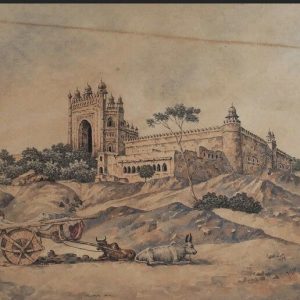
The Vice Chancellor was Professor M. S. Agwani, a distinguished scholar who had heard me present at least two conference papers and had shown considerable interest in my early work on medieval archaeology. He had even gone through my preliminary Survey Report on the structures of Fatehpur Sikri, a modest piece of work into which I had poured enormous enthusiasm. And I had stood him up. Magnificently.
As Professor Habib disappeared down the corridor, I could think only of the opportunity that had slipped away.
Surely I had missed the chance of a lifetime.
The following day I was confirmed at Aligarh.
Looking back now, I have no regrets. Had I gone to JNU, life would certainly have followed an entirely different course. Instead, destiny quietly whispered, “Not yet.”
I did not realise then that this whisper would return many years later.
Nearly a decade passed.
I had settled comfortably into teaching and research. My work on Fathpur Sikri had begun attracting attention and several papers had appeared in print. Professionally, however, I remained a Lecturer, though by then I had reached the Senior Scale. Promotions at Aligarh had almost become mythical creatures. Everyone spoke about Selection Committees. Very few had actually seen one. They occupied the same category as unicorns and sensible administrative decisions.
Then came another opportunity.
There was a vacancy for the post of Reader at the Maharaja Sayajirao University of Baroda.
Friends encouraged me to apply.
I did.
Soon both my senior colleague and friend, Dr Jabir Raza, and I found ourselves travelling by train to Baroda for the interview. The journey was long, the seats were uncomfortable and our conversation consisted entirely of speculation about what questions might be asked. We constructed elaborate theories about the composition of the Selection Committee and debated the relative merits of various possible responses.
We stayed at a modest hotel near the railway station and spent the evening discussing probable interview questions with the supreme confidence that only anxious candidates possess. By the time we went to bed, we had convinced ourselves that we were prepared for every possible question. We were prepared for nothing.
The interview, however, itself proved unexpectedly pleasant.
Among the experts sat Professor Zamiruddin Siddiqui from Aligarh, who represented what was politely called the “other side” in the long-running academic debates that surrounded Professor Irfan Habib. We had never exactly belonged to the same intellectual camp. In fact, we occupied different continents of intellectual thought. I entered the room expecting a thorough interrogation about my academic loyalties.
The second expert was Professor Kapil Kumar, who by then had begun moving towards the Right and had become an increasingly vocal critic of Professor Habib. Between the two of them, I anticipated a vigorous cross-examination that would test both my scholarship and my diplomatic skills.
I therefore entered the interview room with modest expectations.
To my surprise, neither gentleman dominated the proceedings.
Instead, the Acting Vice Chancellor, an accomplished civil servant and a remarkably well-read lady, conducted most of the interview herself. She seemed genuinely interested in my work, asked probing questions and demonstrated a familiarity with medieval history that I had not anticipated from an administrator.
She questioned me extensively on historical archaeology, medieval architecture and my work on Fathpur Sikri. I found myself warming to the subject, forgetting my nervousness and actually enjoying the conversation.
Halfway through she suddenly asked,
“Are you genuinely interested in joining Baroda?”
One does not usually expect philosophical questions in a job interview.
I assured her that I certainly was. I had prepared a list of reasons why Baroda would be an excellent career move. I had rehearsed my enthusiasm. I was ready.
After the interview was over she called me back once again.
This, I thought, could either be very good news or very bad news.
Fortunately it was neither.
She wanted to show me the University’s Archaeology Laboratory.
Much of its equipment still lay unopened in its original packing cases. The machines were gleaming, sophisticated and entirely foreign to me. They looked as though they belonged in a science fiction film rather than a history department.
Pointing towards the instruments, she asked,
“Can you use these?”
The machines looked extremely impressive.
I looked considerably less so.
With confidence far greater than my actual knowledge, I replied,
“Yes.”
It remains one of the boldest answers I have ever given. It was also one of the least truthful. I had no idea what those machines did, how they worked or even what they were called. But I had learned that in academic interviews, confidence often counted for more than competence. It was a lesson I would later regret.
That evening Jabir and I decided to visit our senior from Aligarh, Iftikhar Bhai, who taught in the History Department at Baroda.
Finding his house, however, became an education in itself.
As we asked residents of the colony for directions, they looked at us rather coldly.
“We don’t know any Mulla.”
The same reply came again.
And again.
No one said “Iftikhar”.
No one said “History Department”.
Simply, “We don’t know any Mulla.”
The words were spoken casually.
Their effect was anything but casual.
They remained with me long after the interview had ended. I could not shake the feeling that I had glimpsed something important about the world beyond Aligarh, something that my comfortable academic existence had sheltered me from.
A few months later the results were announced.
I had been selected.
Reader.
It was a tremendous leap.
At a time when promotions at Aligarh appeared frozen indefinitely, I was being offered a position above the one I held. That too at a place like Vadodara, the city of palaces. Many of those waiting for promotion were my seniors. Some had even been my teachers. The promotion was not merely professional advancement. It was a complete transformation of my academic status.
Naturally I decided to go.
Or so I imagined.
My wife Annie and I began preparing in earnest. Household items were purchased. Utensils appeared from nowhere. Furniture was discussed. The Registrar at Baroda informed me that University accommodation had been identified and that I would receive possession within a month or two. In the meantime he said a Guest House room had been booked for us.
Everything appeared settled.
Except destiny.
Professor Irfan Habib opposed my leaving.
Professor Shireen Moosvi, then Dean of the Faculty of Social Sciences, also advised against it.
I argued. I pleaded. “This is a promotion.”
“There is no Selection Committee at Aligarh.” “I may wait forever.”
Nothing worked.
Professor Moosvi even enlisted my mother.
That, I realised, was unfair.
My mother naturally trusted Professor Moosvi’s judgement far more than mine. She had heard me speak about my academic achievements with characteristic modesty, which in my case meant not mentioning them at all. Professor Moosvi, on the other hand, spoke with authority. When she advised against the move, my mother listened.
Then came another surprise: Professor Aniruddha Ray telephoned from Calcutta. He too advised me not to leave Aligarh. So did a number of others.
By this stage I had begun wondering whether the entire fraternity of medieval historians had secretly conspired to keep me imprisoned within the walls of Aligarh. I imagined them gathered in some hidden chamber, plotting my confinement while I blithely packed my belongings.
Then history intervened.
The year 2002 arrived.
Ahmedabad burned.
Baroda witnessed violence.
Large parts of Gujarat were engulfed by one of the darkest communal tragedies in independent India. The images on television were horrifying. The reports from the ground were worse. Neighbourhoods that had coexisted peacefully for generations turned against each other. Families were displaced. Lives were destroyed. All over Gujarat thousands were killed. Ahsan Jafri was murdered. The tomb of Wali Dakani disappeared overnight. At Baroda I and Jabir Bhai had visited a Dargah: it was vandalised. NDTV flashed these news for all to see. The PM Atalbihari Bajpai was see reminding rāshtra dharma to the butchers.
Watching those horrifying events unfold on television, I slowly realised what my teachers had perhaps sensed much earlier than I had.
Sometimes the road we fail to take turns out to be the safer one.
Professor Hasan Mahmood himself, a senior Historian at MS University of Baroda at Vadodara eventually had to leave Gujarat but was fortunate to find a new beginning at Jamia Millia Islamia. Many others were not so lucky. The academic opportunities that had seemed so attractive just months earlier now appeared in a very different light.
When I think back today, I cannot help thanking Providence for preventing my departure. I think of all the things I might have lost, all the dangers I might have faced, all the colleagues who had to flee their homes.
Soon afterwards, a Selection Committee was finally held at Aligarh itself.
Farhat Hasan and I were promoted as Readers.
Several of our seniors unfortunately continued waiting. The system was slow, inefficient and deeply frustrating. But it had finally moved.
Although Professor Moosvi had advised both of us not to go to the Selection Committee, as, according to her, we would be humiliated and rejected. For that opportunity I remain deeply grateful to the then Vice Chancellor, Mr Mahmoodur Rahman, who insisted that the Selection Committee be held and, despite considerable opposition from different quarters, ensured that the appointments went through. He was a man who believed in doing what was right, regardless of the consequences. I am also beholden to Professor SP Gupta, the then Chairman, who despite his animosity towards my supervisor, supported me. We had been friends since long: remember he and I had actually visited many historical places together as friends, in spite of all departmental back room politics and groupings.
Looking back over those years, I am struck by a curious pattern.
Whenever I tried to leave Aligarh, something happened.
First it was JNU.
Then it was Baroda.
On both occasions I believed I had lost the opportunity of a lifetime.
On both occasions destiny quietly compensated me without my even realising it. I got what was my due.
There is perhaps a lesson somewhere in all this, though I am still not entirely sure what it is.
Maybe destiny occasionally knows more than we do. Or perhaps Aligarh simply refused to let me escape. Either way, I stayed. And flourished.
The next twist in this improbable journey was still to come.
It involved another promotion, another battle and another chapter in the strange conversation between ambition and destiny.
But that story and some more, must wait until the next instalment.

 ASHA: Blast From The Past