Syed Ali Nadeem Rezavi
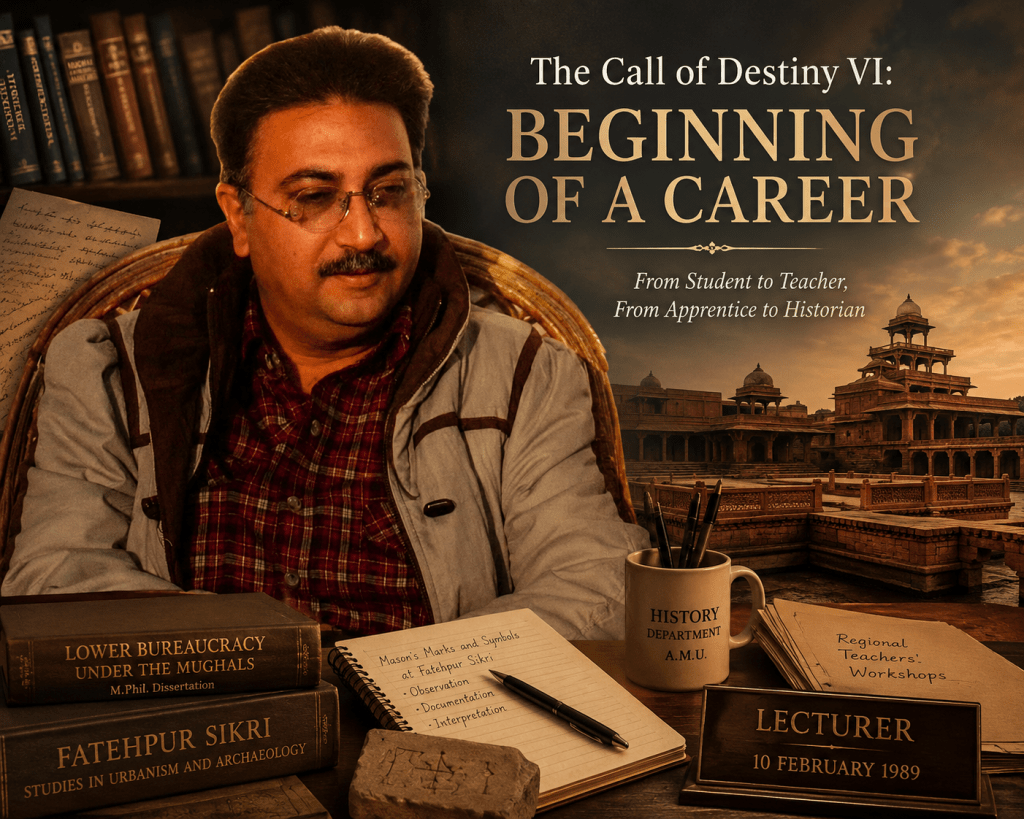
If the earlier chapters of this memoir were about discovering history, this one is about discovering that becoming a historian was, in itself, a rather long historical process. One might even say it required the patience of a medieval scribe and the constitution of a Mughal revenue collector.
Those were the days when the academic system was very different. Admission was formally to the PhD programme, but the first stage was effectively an MPhil. One had to complete a substantial piece of research before being allowed to proceed seamlessly to doctoral work. It was not the neatly packaged coursework one encounters today, where students are handed reading lists like supermarket shopping catalogues. Under Professor Irfan Habib, the MPhil had already become a miniature PhD – which is to say, it was a PhD in miniature, but without the miniature expectations.
My assigned topic was Lower Bureaucracy under the Mughals.
To an unsuspecting student, the title sounded harmless enough. Little did I know that it meant months and years buried beneath manuscripts, Persian chronicles, archival documents, rotographs, photographs of manuscripts, and endless reels of microfilm. Those who have never used microfilm can never appreciate the peculiar form of torture it represented. After hours spent peering into the dimly lit machine, every passing pedestrian appeared to be made of blurred black and white images. I occasionally found myself wondering whether the entire world had been reduced to grainy negative strips, and whether I too might soon dissolve into celluloid.
Friends in other universities often remarked that the MPhil was merely a training exercise. Not in Aligarh. Professor Habib had converted it into a full-fledged exercise in original research based on primary sources. There was no escaping the archives. Every assertion had to be traced back to documentary evidence. Every conclusion had to be earned. You could not simply wave your hands and declare something to be ‘generally accepted’. You had to produce the exact folio, waqai or the akhbarat or the particular farman that proved your point, or else retreat in ignominy.
In retrospect I remain grateful for that uncompromising training, although at the time I confess I entertained less charitable thoughts. I occasionally wondered whether Professor Habib had been sent by some celestial authority to test the patience of aspiring historians, much as the Mughal emperors tested the patience of their karkhanas.
There was, however, one great consolation. Under the UGC regulations prevailing then, an MPhil qualified one to apply for a university lectureship. It was comforting to know that one might at least find employment before completing the seemingly endless PhD. This was rather like being told that one could start building a house before finishing the architectural drawings—slightly unorthodox, but reassuring.
The viva voce remains one of my most vivid memories which perhaps I can never forget.
Professor Harbans Mukhia had been invited as the external examiner, while Professor Habib sat beside him as my supervisor.
Naively, I imagined the examination would consist of questions directed at me.
How mistaken I was.
Within minutes the discussion had ceased to be about my dissertation. Instead it transformed into a spirited scholarly contest between the two distinguished historians. One would make a point. The other would disagree. References flew across the table like arrows at Panipat. Counter-arguments followed. Interpretations collided. Professor Habib’s face gradually turned crimson with intellectual excitement, while Professor Mukhia’s famous mane shook energetically as he defended his position. It was rather like watching two heavyweight champions spar, except the blows were delivered in Persian citations and the footwork consisted of academic footnotes.
I, meanwhile, sat silently between them like an accidental spectator who had wandered into the wrong room. I felt rather like the unfortunate clerk in a Mughal diwan who finds himself caught between two contending nobles, each demanding his allegiance.
Occasionally I would turn hopefully towards one, then towards the other, wondering whether someone might remember that I was actually the candidate. I even considered raising my hand, but thought better of it.
After what seemed an eternity- and I suspect the actual duration was considerably less than what my anxiety suggested – Professor Mukhia smiled and announced, “Congratulations. You are awarded the MPhil degree leading to the PhD.”
My immediate reaction was one of immense relief.
Not because I had passed.
Because my supervisor had finally won.
I had acquired the valuable academic skill of knowing when to remain silent and allow the senior scholars to resolve their differences. This, I later discovered, was a survival strategy that would serve me well in countless committee meetings.
The years that followed were devoted almost entirely to satisfying Professor Habib’s exacting standards. Material had to be collected, references checked, arguments refined and evidence expanded. It was rather like being a Mughal munshi who must verify every revenue record before submitting it to the diwan. During this period I also began presenting papers at the annual sessions of the Indian History Congress. Some found their way into publication, while others appeared in edited volumes. And some, I confess, vanished into that mysterious void where unpublished papers go to rest, occasionally haunting their authors at inconvenient moments.
Looking back, those years quietly laid the foundations of whatever confidence I later acquired as a researcher. They were the academic equivalent of learning to walk – painful, frequently humiliating, but ultimately necessary.
Then, sometime around 1985, Professor Habib summoned me to his chamber.
“I want you to work on urban housing at Akbar’s capital,” he said.
The proposal itself was fascinating. Fathpur Sikri had already begun exercising a strange attraction over me. Yet another puzzle had been occupying my mind – a puzzle that, I confess, had been irritating me for some time.
For years Professor Habib had entrusted me with taking groups to Fathpur Sikri. Sometimes they were participants in the Teachers’ Workshops organised by the Department. At other times they were visiting scholars from abroad or researchers passing through Aligarh. I had walked through the ruins so often that I almost knew every street, courtyard and building by instinct. I could have navigated the city blindfolded, or at least with one eye closed.
And almost invariably someone would stop before a wall and ask, “What do these strange marks carved on the stones signify?”
I always had an answer.
Unfortunately, it was rarely the correct one.
Like all confident young scholars, I possessed the remarkable ability of converting ignorance into plausible-sounding explanations. This is a skill that is not taught in any university curriculum but is, I suspect, unconsciously acquired by every postgraduate student within the first six months.
The visitors generally appeared satisfied. They would nod sagely, murmur something about ‘fascinating’, and move on to the next structure.
I was not.
The marks continued to haunt me. They appeared everywhere – on walls, on pillars, on lintels. They were not inscriptions in any conventional sense. They were symbols, signs, mysterious glyphs that seemed to say something but refused to speak. I found myself lying awake at night, staring at the ceiling and wondering what those marks might mean. This was not, I should add, a healthy development.
Eventually I confessed to Professor Habib that before taking up urban housing I wished to solve this particular mystery. I wanted to understand the masons’ marks and symbols scattered across the monuments of Fathpur Sikri.
To my delight he agreed.
That decision altered the course of my academic life. It was rather like setting out to investigate a minor footnote and discovering that the footnote contained an entire library.
My first sustained research on Akbar’s capital was therefore not on palaces, planning or imperial ideology, but on the humble marks left behind by anonymous craftsmen centuries earlier. I spent months crawling through ruins, squinting at stones, making rubbings, photographing symbols, and generally behaving in a manner that caused the local guides to regard me with deep suspicion. I suspect they thought I was either a spy or a madman. Possibly both.
Let me narrate an episode: One day while I was collecting and sketching the mason’s marks on my notebook at Akbar’s tomb at Sikandara, I heard a young voice “Mama, I am feeling so sorry for that guy! He is handsome, youthful but mad. Instead of looking at the monument, he is walking in circles with his head down!” I went to the child, smiled at her and told her that I was looking for such and such scrawling on the stone slabs. After some time I heard her call me: “Hey Man! Look here, those scratching are here too”.
Once that work was completed, I moved on to surveying the excavated residential structures of the city. This was archaeology of a different sort – not the digging kind, but the patient, systematic examination of what had already been uncovered. It required the eye of a detective, the patience of a saint, and the capacity to spend hours contemplating a broken wall without losing one’s sanity.
Without realising it, I had crossed an invisible frontier.
I was no longer merely reading about medieval history.
I was walking through it.
Every ruined wall became a document. Every foundation trench became a text. Every discarded fragment of pottery demanded to be read with the same care as a Persian manuscript. I found myself developing a new vocabulary, a new way of seeing, a new appreciation for the material remains of the past. It was rather like learning a new language, except this language was spoken in stone and mortar.
Those years were enriched enormously by Professor Habib’s Regional Teachers’ Workshops. Lasting nearly a fortnight, these workshops attracted scholars from universities across the country. Many who later emerged as some of India’s finest historians first crossed my path during those gatherings. For a young researcher they were an extraordinary education. The lectures were stimulating, the discussions often fierce, and the conversations over tea sometimes even more enlightening than the formal sessions. I learned as much from the gossip in the corridors as from the papers in the auditorium.
Looking back, those workshops created a generation of historians who remained connected through friendship as much as scholarship. We argued fiercely in the seminar rooms and drank chai together afterwards. We disagreed about interpretations but never about the importance of the enterprise. It was, I now realise, a golden age of academic camaraderie – the sort of thing that probably only exists in retrospect, but which felt real enough at the time.
Then came 1989.
For me it was the year in which history finally began paying a salary. This was, I should add, a welcome development, as my previous method of subsistence had involved eating less and hoping for the best.
In January the local Selection Committee selected both my friend Jawaid Akhtar and me for appointment as Lecturers. Curiously, both of us had also been selected for the post of Research Assistant.
This created a genuine dilemma – the sort of dilemma that only academia can produce, where one is offered two jobs and must choose between them, each with its own advantages and disadvantages.
One evening we found ourselves walking Professor Shireen Moosvi home from the Department, as we frequently did. Seizing the opportunity, we asked for her advice.
Jawaid spoke first.
“Madam, which post should I join?”
She replied without the slightest hesitation.
“The Research Assistant’s post is permanent. The lectureship is temporary. Join as Research Assistant.”
A perfectly sensible answer. Logical, prudent, the sort of advice one would expect from a wise and experienced academic.
Then, without missing a step, she turned towards me.
“Nadeem, don’t even think about it. Join as Lecturer. It is, after all, a teaching post. Don’t worry. This is a clear vacancy. You won’t be thrown out.”
Jawaid and I exchanged bewildered glances.
There we were, walking on either side of Professor Moosvi, both asking precisely the same question, and receiving two completely opposite pieces of advice.
To one she said, “Don’t join the lectureship.”
To the other she said, “Join the lectureship immediately.”
She had assessed not the posts, but the people.
It was one of those moments that only a truly perceptive teacher could produce. She had looked at us, weighed our temperaments, our capabilities, our likely futures, and had tailored her advice accordingly. It was rather like watching a chess grandmaster make two entirely different moves on two different boards, each perfectly suited to the position.
Jawaid and I walked on in bemused silence, each digesting our respective advice. I have often wondered what would have happened if we had asked the question on different days, or in different order. But such speculations are the stuff of counterfactual history, and I have long since learned to leave that to others.
On 10 February 1989 I formally joined the Department as a Lecturer.
I did not know it then, but that appointment marked the beginning of several journeys simultaneously.
It began my career as a teacher, a career that would see me standing in front of hundreds of students, occasionally making sense, frequently being asked questions I could not answer, and learning to say “That’s an excellent question, let me think about it” with sufficient gravitas to convince everyone that I actually knew the answer.
It strengthened my lifelong engagement with Fathpur Sikri, an engagement that would eventually produce books, articles, and a collection of anecdotes that grow taller with every telling.
It gradually drew me towards what would eventually become my second academic identity: that of a historian working through archaeology. This was not a planned development. It was rather like discovering that you have been speaking a second language all along without realising it.
In the years that followed, as I established myself within the Department, I had the privilege of introducing a specialised course on Medieval Archaeology. To the best of my knowledge, it remains one of the very few university courses in India devoted exclusively to that subject. I say ‘to the best of my knowledge’ because I have learned never to make absolute claims in academia—there is always someone who knows better.
The research too continued to evolve.
The work on Fathpur Sikri eventually resulted in my first major book on the city. Field explorations later took me far away into the abandoned settlements of the Jaisalmer region, where deserted villages opened yet another window onto India’s medieval past. There is something profoundly moving about walking through a village that has been empty for centuries – the silence, the crumbling walls, the sense of lives once lived and now vanished. It is rather like reading a history book in which every page has been torn out, but the shadows remain.
And after what often felt like an archaeological excavation of my own unfinished research, complete with layers of delay, periods of abandonment, and occasional discoveries, I finally submitted my long-delayed PhD on the Middle Classes. (Those who have followed this memoir will know that ‘long-delayed’ is something of an understatement, but I am trying to be charitable to myself.)
Its examiners represented three distinguished traditions of historical scholarship: Professor Satish Chandra, Professor Indu Banga and Professor Frank Perlin. I remember sitting through the viva and thinking that, unlike my MPhil examination, I was actually being asked questions. This was both reassuring and alarming, reassuring because I was clearly the subject of the examination, alarming because I had to answer.
Looking back now, I sometimes smile at how uncertain everything had seemed.
The student who once invented explanations for mysterious marks on the stones of Fathpur Sikri would spend decades trying to understand the city. The universe, it seems, has a sense of irony.
The bewildered candidate who watched two eminent historians debate across his MPhil viva would one day himself examine generations of research scholars. (I try to ensure that my own vivas are more interactive for the candidate, though I confess I occasionally find myself getting drawn into scholarly disputes that are, strictly speaking, irrelevant.)
And the young lecturer who walked into the Department on a February morning in 1989, uncertain of what lay ahead, had no inkling that the profession he had entered would soon cease to be merely a career.
It had already become a way of life.

 ASHA: Blast From The Past