Syed Ali Nadeem Rezavi
History stands among the most misunderstood of all academic disciplines. Because everyone possesses a past, many assume that anyone who reads widely, collects anecdotes and narrates events can legitimately claim the title of historian. Few assumptions are more misleading. History is not the mere narration of what happened; it is the disciplined investigation of what can be known about the past through the critical examination of evidence. Like archaeology, law or medicine, it possesses its own methods, conventions and ethical obligations. It requires mastery over sources, familiarity with languages where necessary, sensitivity to context, engagement with historiography, and above all an unwavering commitment to intellectual honesty.
A historian is trained not simply to accumulate facts but to interrogate them. Documents are not accepted at face value. They are questioned for authorship, purpose, audience, silences, bias and context. Contradictory evidence is weighed rather than ignored. Earlier scholarship is critically evaluated, not dismissed because of ideological disagreement. Every interpretation is expected to be supported by verifiable evidence, while every intellectual debt must be acknowledged through proper citation. These are not optional refinements; they are the very foundations of the discipline.
Curiously, history is perhaps the only academic field where society often overlooks the importance of disciplinary training. Nobody would willingly undergo surgery performed by someone who had merely read extensively about anatomy. Nor would a bridge designed by an enthusiastic amateur inspire confidence simply because he had studied engineering manuals. In medicine, law, architecture or engineering, rigorous professional training is regarded as indispensable. History, however, is frequently treated as an exception, as though reading widely about the past were itself sufficient qualification to pronounce upon it with authority.
This is not an argument that only university professors can write history. Some of the finest contributions to historical scholarship have been made by independent researchers. Institutional affiliation alone is no guarantee of excellence. The real distinction lies elsewhere. Serious historical scholarship is defined by method rather than employment, by critical engagement rather than conviction, and by evidence rather than assertion. It is therefore entirely legitimate to ask whether any historical work, irrespective of its author’s background, meets these standards.
The public career of Vikram Sampath illustrates why this distinction matters.
Over the past decade Sampath has emerged as one of the most visible writers on modern Indian history. His biographies of Gauhar Jaan, S. G. Kittappa and especially the two-volume biography of Vinayak Damodar Savarkar have earned him considerable public attention. His writings have been enthusiastically received by organisations and commentators associated with the broader Hindutva movement, which has sought to reshape public narratives about India’s past. His works are widely cited in support of the argument that established academic historiography has marginalised nationalist figures while privileging interpretations associated with what is loosely described as the “Left.”
Sampath’s educational and professional background differs from that of many historians working within universities. He holds a doctorate in ethnomusicology, not history, and his formal historical training is minimal. That fact alone neither disqualifies nor diminishes his work. Independent scholars have enriched historical knowledge throughout the world. The relevant question is whether a writer’s published work exhibits the methodological rigour expected of historical scholarship.
It is on this point that Sampath has attracted sustained criticism.
His biographies of Savarkar seek to recover their subject from what he regards as decades of ideological neglect. There is nothing objectionable in revisiting established historical interpretations. Every generation of historians re-examines accepted narratives in the light of new evidence and new questions. Yet revision demands more, not less, engagement with the existing scholarship. Critics have argued that Sampath’s treatment of Savarkar frequently adopts an apologetic tone, foregrounding his revolutionary activities while giving comparatively less weight to aspects of his later political career that have long occupied historians, including his theory of Hindutva, his views on nationhood, his clemency petitions, his relationship with the Hindu Mahasabha and the wider communal politics of the late colonial period. Whether one agrees with every criticism or not, the debate concerns the balance of evidence and the selective emphasis placed upon it.
The same pattern is visible in Sampath’s interventions on Tipu Sultan and the kingdom of Mysore. Over the last several years he has become a prominent public voice in debates over Tipu’s legacy. His interpretation broadly corresponds with the dominant themes of contemporary Hindutva historiography, presenting Tipu primarily through the lens of religious persecution and intolerance. Few historians would deny that episodes of coercion, forced migration and violence occurred during Tipu’s reign. These subjects have long been discussed in the scholarly literature. The question is not whether they should be studied but how they should be interpreted.
Professional historians have generally sought to place these events within the broader political and military context of the late eighteenth century, drawing upon Persian chronicles, Kannada records, Marathi correspondence, French archives, British documentation and temple records. They have also drawn attention to evidence of Tipu’s patronage of several Hindu institutions, his correspondence with the Sringeri monastery after its desecration by Maratha forces, the religious diversity of his administration and the complexity of state formation in southern India. These elements do not absolve Tipu of criticism, but they complicate any attempt to reduce his reign to a single ideological narrative. Sampath’s writings, his critics argue, tend to privilege evidence that supports a predetermined conclusion while engaging less fully with this wider body of scholarship.
Perhaps the most serious controversy surrounding Sampath, however, concerns not interpretation but scholarly ethics.
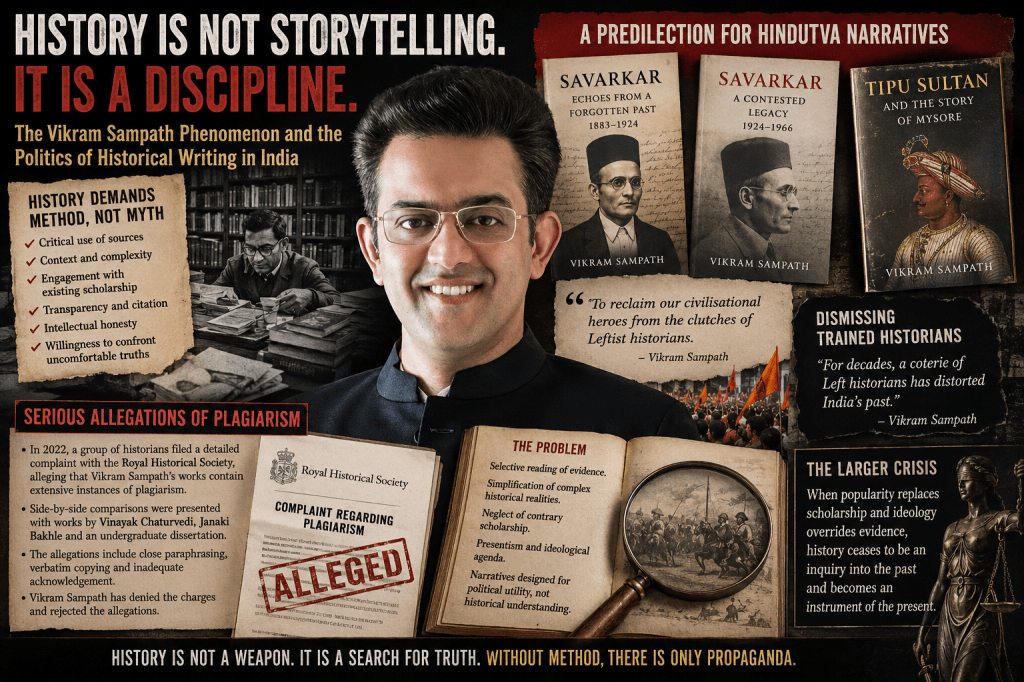
In 2022 a group of historians submitted a formal complaint to the President of the Royal Historical Society alleging repeated plagiarism in Sampath’s published work. The complaint was signed by distinguished scholars including Professor Emerita Barbara D. Metcalf, Professor Sunil Kumar, Dr Vinayak Chaturvedi, Professor Lynn Zastoupil, Professor Christopher Jaffrelot, Professor Gyanendra Pandey, Professor John Zavos, Professor Emeritus Mridula Mukherjee, Professor Emeritus Aditya Mukherjee, Professor J. Devika, Professor Indivar Kamtekar, Professor V. Rajagopal, Professor K. V. Ramakrishna Reddy, Professor Sanjay Subrahmanyam, Professor Nandini Sundar, Dr S. S. Sharma, Professor Saibal Bandyopadhyay and others. The detailed complaint included extensive comparisons between passages from Sampath’s writings and earlier works by scholars such as Vinayak Chaturvedi and Janaki Bakhle, together with material drawn from an undergraduate dissertation. According to The Print (4 March 2022; also reported in the Frontline 18 March 2022), however reported that several prominent figures on that list, including Ramachandra Guha and Pratap Bhanu Mehta, publicly stated they had not signed it. Bakhle stated the essay contained “significant portions of my own article appear without credit”.
The allegations are particularly grave because they document a pervasive pattern rather than isolated incidents. The complainants demonstrated that Sampath’s essay “The Revolutionary Leader Vinayak Damodar Savarkar,” published in the India Foundation Journal in 2017, contained numerous passages that bore a striking resemblance to Chaturvedi’s earlier work published in Postcolonial Studies in 2013. The parallels were not merely thematic but textual. The very opening line of Sampath’s essay, “As an intellectual fountainhead and founder of what is termed as ‘Hindu nationalism,’ Vinayak Damodar Savarkar has emerged as one of the most controversial Indian political thinkers of the 20th Century,” closely echoed Chaturvedi’s formulation: “As an intellectual founder of Hindu nationalism, V D Savarkar has emerged as one of the most controversial Indian political thinkers of the twentieth century.”
The pattern of unattributed borrowing extended well beyond single sentences. Sampath’s discussion of Savarkar’s argument that “writing histories was a necessary step in overthrowing colonial empires” reproduced Chaturvedi’s observation almost verbatim. His account of Savarkar’s arrest on 13 March 1910, including the specific charges of “procuring and distributing arms,” “sedition,” and “waging war against the King Emperor of India,” was lifted directly from Chaturvedi’s article with only the most minimal alteration. The complainants further noted that when they ran the essay through plagiarism detection software, it registered roughly 50 per cent plagiarised content, borrowed largely from Chaturvedi’s essay and that of Dr Janaki Bakhle.
Perhaps most troubling, the complaint documented that Sampath’s two-volume biography of Savarkar contained passages taken from an undergraduate thesis submitted to Wesleyan University in 2012. The thesis, written by Paul Schaffel under the supervision of Dr William Pinch, had discussed A. M. Shah’s characterisation of the Indian Sociologist as only “mild in its criticism of British Rule.” Sampath reproduced this passage with only superficial changes and without attribution. The complaint noted that while Sampath cited the thesis incorrectly in his bibliography, he made no acknowledgement of having drawn directly upon it.
Response from the Royal Historical Society
The Royal Historical Society responded to the complaint by stating that it had examined the allegations and found that, while the evidence did not establish a case of intentional plagiarism sufficient to warrant removal from fellowship, it did identify serious concerns about Sampath’s scholarly practices. The Society’s statement noted that the case raised important questions about citation standards and acknowledged that its fellowship election procedures might require review. This response, however cautious, represented an implicit recognition that the allegations were not without substance. For many observers, the Society’s failure to take more decisive action raised troubling questions about whether professional bodies are equipped to enforce ethical standards when the accused commands significant public influence. The episode also highlighted a deeper dilemma: learned societies, which depend upon the goodwill and participation of their members, are often reluctant to expel fellows, particularly when the charges are denied and the accused enjoys political backing.
Sampath’s Defence and the Pattern of Response
Sampath publicly denied intentional plagiarism, characterising the allegations as politically motivated attacks by historians opposed to his interpretation of Savarkar. He argued that any textual similarities were the result of shared sources or constituted acceptable paraphrasing. This defence strategy is itself revealing. By framing criticism as ideological rather than scholarly, Sampath sought to shift the conversation away from evidence and towards motives. Yet the documentation provided in the complaint, running to many pages of detailed comparisons, was not rebutted with counter-evidence. The question of whether Sampath’s borrowings crossed the line from legitimate scholarly engagement to appropriation was answered not through engagement with the specific examples but through dismissal of the complainants’ political orientation.
This pattern, responding to scholarly critique by impugning the motives of critics, has become a recurring feature of Sampath’s public engagements. It is a strategy that mirrors the broader rhetorical tactics of the political movement with which he is associated. By casting every challenge as an attack by a hostile ideological camp, substantive questions about method and evidence are rendered invisible. The effect is to immunise his work from the kind of critical scrutiny that is the lifeblood of historical scholarship.
The Broader Context: History and the Politics of Memory in Contemporary India
The Sampath phenomenon cannot be understood in isolation from the wider political context in which it has emerged. Over the past decade, India has witnessed an intensifying contest over the interpretation of its past. The ruling Bharatiya Janata Party and its associated organisations have sought to revise the narratives that have dominated academic historiography since independence, replacing them with accounts that foreground Hindu civilisation and minimise or deny the contributions of other traditions. This project has been advanced through multiple instruments: the rewriting of school textbooks, the renaming of cities and institutions, the construction of new museums and memorials, and the promotion of historians and writers whose work aligns with the official vision.
Sampath occupies a privileged position within this ecosystem. His books receive substantial publicity from media outlets sympathetic to the government, his speaking engagements are sponsored by organisations with close ties to the ruling party, and his interpretations are cited in political discourse as authoritative correctives to a supposedly biased academic establishment. This elevation of a writer whose professional training lies outside the discipline, and whose work has been shown to engage inadequately with both sources and scholarly conventions, reflects a profound transformation in the sources of intellectual authority in contemporary India.
The implications extend far beyond the reputation of a single author. When public discourse increasingly privileges works that gratify political preferences over those that submit to scholarly standards, the very meaning of knowledge is transformed. History becomes not a mode of understanding but a weapon of politics. The past is no longer studied for its own sake but constructed to serve the needs of the present. In such a climate, the distinction between history and propaganda begins to dissolve.
The Responsibilities of the Scholar and the Citizen
These developments place historians and citizens alike in a position of difficult responsibility. For historians, the obligation is to maintain the standards of their discipline even when doing so incurs political costs. This means engaging with popular narratives not by dismissing them but by subjecting them to the same rigorous scrutiny that is applied to any historical claim. It means explaining to the public not only what historians have concluded but how they have reached those conclusions, the methods, the evidence, the debates. It means resisting the temptation to retreat into specialised discourse while the public sphere is occupied by works that flout scholarly norms.
For citizens, the challenge is to recognise that not all accounts of the past are equally reliable. Historical authority cannot be measured by a book’s sales figures or its endorsement by political figures. It must be assessed by the quality of the evidence and argument, by the transparency of the method, by the willingness to engage with contrary interpretations. This is not an easy task in a media environment that rewards simplicity and emotional resonance over complexity and qualification. But it is essential for the health of democratic society, which depends upon a citizenry capable of distinguishing between knowledge and assertion.
The Past as an Arena of Struggle
The debate surrounding Vikram Sampath therefore raises questions far larger than the reputation of one author. It asks what contemporary India expects from its historians. Are they to function as custodians of evidence, prepared to follow the sources wherever they lead, even when the conclusions prove uncomfortable? Or are they expected to provide usable pasts that legitimise present political projects? The answer to that question will shape not merely the future of Indian historiography but the very meaning of history as an academic discipline.
History ultimately demands intellectual humility. It requires the historian to recognise that the past is rarely simple, that evidence is often contradictory and that certainty is the enemy of understanding. Whenever the complexity of the past is reduced to a single ideological narrative, whether of the Left or the Right, history ceases to be an inquiry and becomes an instrument. The challenge before Indian historiography today is not merely to defend one interpretation against another but to defend the discipline itself against the erosion of the standards upon which its credibility rests.
The Sampath case is not an isolated aberration but a symptom of deeper structural changes in the production and consumption of historical knowledge. It reveals the vulnerability of scholarship when it is divorced from institutional support and public understanding. It demonstrates the ease with which ideological entrepreneurs can appropriate the language of history while rejecting its methods. And it reminds us that the past is not a settled territory but an arena of struggle, a struggle over meaning, over memory, over the very identity of a nation.
In the end, the integrity of historical scholarship depends not upon the vigilance of any single institution but upon the collective commitment of historians to the norms of their discipline. It depends upon every scholar’s willingness to acknowledge intellectual debts, to engage honestly with contrary evidence, and to place the pursuit of understanding above the vindication of prior convictions. These are not optional virtues but essential obligations. Without them, history cannot fulfil its promise as a mode of understanding that illuminates the human condition while holding power to account.
Moral? Take authors like Vikram Sampath with a pinch of salt: their works are attempts at dāstangoi rather than serious works of history


