Syed Ali Nadeem Rezavi
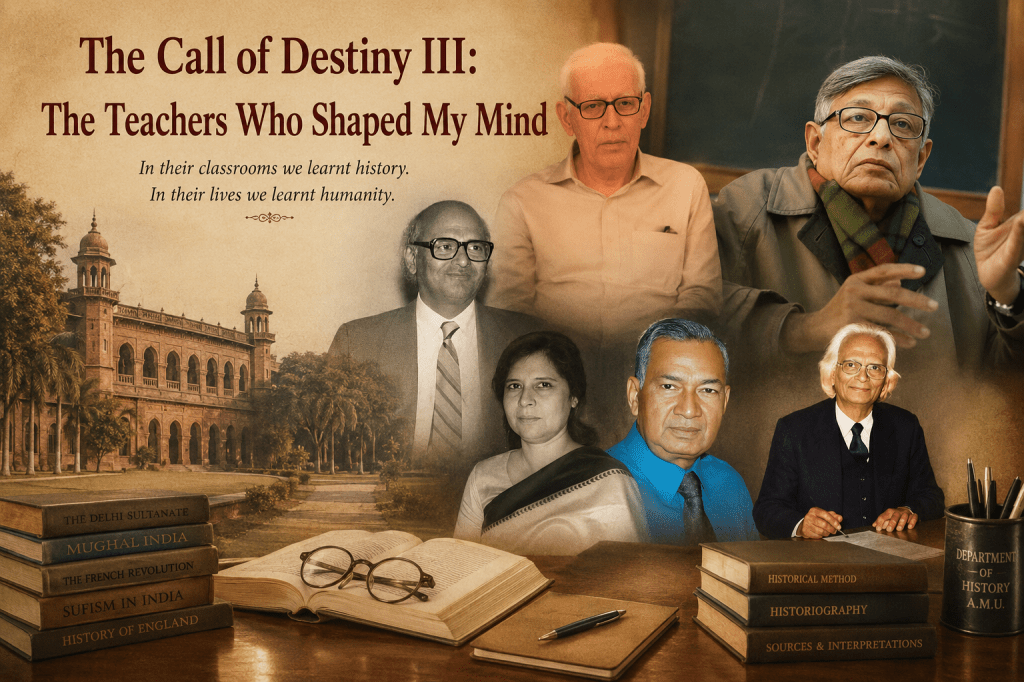
If The Call of Destiny I was how I left the subjects I did not like and waded towards my interests, and The Call of Destiny II recalled the summer during which my father quietly but firmly chose the course of my future, then this is about the remarkable men and women who shaped that future. Looking back after nearly half a century, I realise that while my father had placed me on the path of history, it was my teachers who taught me how to walk it. Whatever little I have achieved as a historian owes an immeasurable debt to them.
I often think that I belonged to perhaps the luckiest generation of students to have studied in the Department of History at Aligarh. The late 1970s and early 1980s represented, in my view, the Department at its intellectual zenith. It was an age when the senior-most faculty members did not consider undergraduate teaching beneath their dignity. On the contrary, they believed that the foundations of scholarship had to be laid at the very beginning. Consequently, students entering the BA (Hons) programme encountered some of the finest historians of the country from their very first day in the classroom. It was an extraordinary privilege, although at that age we scarcely appreciated how fortunate we were. We simply assumed that universities everywhere functioned in this fashion.
Thus, as an undergraduate, I found myself being taught Indian History by the likes of Irfan Habib, M. Athar Ali and Iqtidar Alam Khan. Ancient Indian History was taught by Professor R. C. Gaur, the History of England by Shireen Moosvi, and the Delhi Sultanate by Raza Naqvi. It is remarkable to note that Habib taught Modern Indian history at undergraduate level, and History of Europe and Economic History of Mughals in MA. Khan and Athar Ali taught the Mughals, both at undergraduate and postgraduate levels. Today, looking back, it almost sounds improbable. At that time, however, it appeared perfectly natural. Only years later did I realise that students elsewhere often completed their entire university education without ever entering the classroom of scholars of such distinction.
One of the greatest beneficiaries of this remarkable system was the undergraduate student himself. By the time I reached the MA classes, many of the fundamental questions and debates had already become familiar. We had not merely memorised facts. We had learnt to think historically. That became most evident in the case of Professor Raza Naqvi. Naqvi Sahib taught the Delhi Sultanate with such thoroughness that when we eventually entered Professor K. A. Nizami’s celebrated postgraduate lectures, we realised, somewhat to our surprise, that there was very little in the political history of the Sultanate that Naqvi Sahib had not already covered. This is not intended as a criticism of Nizami Sahib. It is, rather, a tribute to the remarkable thoroughness of Naqvi Sahib’s teaching. He had quietly built such solid foundations that we found ourselves entering postgraduate classes unusually well prepared.
Where Nizami Sahib truly came into his own was in the history of Sufism. Those lectures were unlike any others. As he spoke about the great Chishti saints, mystical doctrines or the spiritual experiences of medieval India, the classroom itself seemed gradually to disappear. Quite suddenly he would fall silent. His gaze would drift somewhere far beyond the walls before us, as though his mind had wandered into another world altogether. We would sit motionless, hardly daring to shift in our seats, convinced that we were witnessing a moment of profound contemplation. Then, after what felt like an eternity, he would gently return to the present, smile almost apologetically and say, “Khair! Let it be! What was I saying?” None of us ever had the courage to remind him. Perhaps we feared interrupting a conversation he had momentarily been holding with the saints themselves. There are historians who explain Sufism. Nizami Sahib seemed, at times, almost to experience it.
Ironically, this deeply mystical scholar remained personally quite orthodox. I discovered that rather painfully. Like many young students intoxicated by newly discovered ideas, I had begun reading Ali Shariati and Seyyed Hossein Nasr. Their philosophical writings fascinated me, and with all the confidence of youth I decided that one of Nizami Sahib’s sessional examinations offered the perfect opportunity to display my intellectual maturity. Instead of writing what the examination required, I produced an elaborate philosophical meditation inspired largely by Shariati and Nasr. I handed it in feeling quietly pleased with myself. Nizami Sahib read every page. He then awarded me just enough marks to pass. No comment. No criticism. No sermon. Merely a mark sheet that gently but unmistakably conveyed the message that while philosophy has its place, historical questions are best answered historically. It was one of the most valuable lessons I ever received.
If Nizami Sahib possessed a mystical aura, Professor M. A. Alvi, whom we all knew as Mujtaba Alvi, possessed something altogether different. He had style. It was said that he had been a classmate of General Zia-ul-Haq at St Stephen’s College. Fortunately for history, only one of them chose the classroom as his destiny. Alvi Sahib taught us the French Revolution. To say that he spoke beautiful English would scarcely do him justice. His language flowed with such elegance that we often found ourselves listening less to the content than to the sheer music of his speech. Every sentence seemed perfectly crafted. Every paragraph unfolded effortlessly into the next. We sat mesmerised, hoping the lecture would never end. Naturally we assumed that if only we faithfully copied every point he made, we too would acquire some measure of that brilliance. One day several of us made a determined effort to note down everything. The experiment proved deeply disappointing. On paper, the points looked perfectly ordinary. The magic had never been in the notes. It had been in the man.
One incident remains unforgettable. A class test had been announced when, just before it was due to begin, a message arrived summoning him to the Vice Chancellor’s office. Most teachers would have postponed the examination. Alvi Sahib calmly distributed the answer books, dictated a few questions and then, gathering his papers, looked at us with complete confidence. “You may attempt any one of them,” he said. “If you wish, you may even consult your books.” And with that he walked out. No invigilator. No supervision. Nothing. For a brief moment we congratulated ourselves on having perhaps the most liberal teacher in the University. Within minutes our celebration ended. The questions demanded understanding rather than information. Every book we opened stubbornly refused to provide an answer. That afternoon we learnt a lesson which has stayed with me ever since. An open-book examination is only easy for those who have never sat one. The books may be open. The mind still has to do the work.
Iqtidar Alam Khan, affectionately known throughout the Department simply as Bhai Khan, represented yet another school of teaching altogether. His lectures on the Mughal Empire were legendary, not merely for their scholarship but for their astonishing richness of detail. Every institution, every campaign, every administrative regulation acquired layer upon layer of explanation until our notebooks began to resemble abbreviated editions of the Akbarnama. By the end of each lecture the real work had only just begun. Before revising our notes, we first had to summarise them. Perhaps that was his hidden teaching method. Without ever announcing it, he compelled us to distinguish between detail and argument, between information and interpretation. In later years, while writing my own books and articles, I often realised how much I owed to those painstaking exercises in condensation. The ability to summarise without oversimplifying is itself a historian’s craft. And Bhai Khan taught it without ever saying so.
If scholarship commanded our admiration, affection belonged, above all, to Professor Satya Prakash Gupta and Dr Shafiullah. Looking back today, I realise that while some teachers impressed us by the brilliance of their intellect, others entered our hearts by the warmth of their humanity. Guptaji belonged unmistakably to the latter category. He was perhaps the least pretentious professor I have ever known. Slightly rotund, always smiling and perpetually approachable, he possessed none of the airs that often accompany academic distinction. There was no invisible wall separating teacher from student. He treated us less as pupils than as younger companions who happened to be travelling along the same intellectual road. He taught us both in the BA and MA classes, and every lecture reflected the same unaffected simplicity. There was nothing theatrical about him. He neither cultivated an aura nor sought to impress. He simply enjoyed teaching.
One incident remains etched permanently in my memory. One evening I was sitting in the MA Seminar Room, deeply engrossed in writing a term paper. Or at least I imagined that I was. Like most postgraduate students, I was probably spending as much time staring thoughtfully at books as actually writing. Suddenly Guptaji appeared at the door. “Nadeem!” I looked up. “Come outside for a minute.” Wondering whether I had inadvertently committed some academic offence, I followed him into the corridor. With complete seriousness he asked, “Can you explain the Nur Jahan Junta to me? I have to take a BA class tomorrow.” For a fleeting moment I confess that I experienced one of the proudest moments of my student life. A professor was asking me to explain a historical problem to him. Perhaps he sensed my swelling self-importance. He immediately laughed and said in his familiar style, “Arrey, time nahin hai itna padhne ka. Tum term paper likh rahe ho. Jaldi se summarise kar do.” There was no embarrassment. No concern that a student might think less of him. No pretence that a professor must always know everything. He simply needed a quick summary and knew that one of his students had recently been reading the subject. Only much later did I appreciate the significance of that episode. Truly learned people are never frightened of admitting that they have not had the time to read something. Intellectual insecurity belongs to the vain, not to genuine scholars.
Outside the classroom Guptaji possessed two abiding passions. The first was travel. The second was food. Whenever vacations arrived, he would gather a few of us and set off to visit historical sites. These journeys gradually acquired a life of their own. We certainly visited forts, mosques, temples and archaeological mounds, but somehow every excursion also involved discovering the best local eateries. Guptaji insisted on paying for much of the journey himself and seemed to derive greater pleasure from watching his students enjoy themselves than from any monument we had gone to see. Looking back now, I sometimes wonder whether we travelled to study history or whether history merely provided a respectable excuse for travelling and eating well. Whatever the answer, those journeys remain amongst my happiest memories of student life.
Then there was Dr Shafiullah. His room stood directly opposite the MA Seminar Room on the third floor of the Department, and he also took my tutorials in English History. Those tutorials rarely remained confined to the prescribed syllabus. A question on the Reform Bill or the English Civil War would somehow lead to discussions on historiography, personalities, university life or some delightful anecdote from his own student days. As a result, many evenings that ought to have been devoted to research quietly dissolved into long conversations in his room. No one regretted the diversion. Originally from Odisha, Shafiullah Sahib had completed his doctoral research on Tārīkh-i Hasan under the supervision of Professor Syed Nurul Hasan. That association itself guaranteed that almost every conversation eventually found its way to Nurul Hasan Sahib. What stories those were! He spoke not merely about the scholar but about the man. There were anecdotes about his scholarship, his habits, his generosity, his humour and the intellectual atmosphere that surrounded him. Through Shafiullah Sahib’s recollections, figures whom we knew only through books gradually became living personalities. His room became an informal classroom where no attendance was taken, no examinations were held and yet some of the most valuable lessons were learnt.
Our relationship with him did not end when classes finished. Every Eid and Baqrid there was an unspoken understanding amongst his students. We would go to his home. He would already be waiting for us with his characteristic smile, while his gracious wife busied herself producing a feast that none of us could ever hope to forget. There was, of course, the obligatory bowl of rich siwai, without which no Eid gathering could ever be complete. But that was merely the beginning. Soon followed grilled mutton, baked mutton and one dish that acquired almost legendary status amongst us. Tarāza. It was dried meat baked until it reached a perfection that I have seldom encountered anywhere else. Many discussions on English constitutional history were undoubtedly enriched by that remarkable dish. Academic hospitality, I discovered, is sometimes best appreciated around a dining table.
Then there was Professor Ahsan Jan Qaisar. Qaisar Sahib suffered from a pronounced stammer. Many teachers might have regarded that as a handicap. He transformed it into an entirely original method of teaching. Instead of speaking continuously for an hour, he would walk quietly to the blackboard and begin writing. One column contained the themes. The next listed the principal historians. Beside each appeared the important arguments advanced by them. Finally came the bibliography. By the time he had finished, the blackboard resembled a carefully prepared map of the historiography of the subject. His concluding instruction was invariably brief. “Now go and read them.” And we did. He compelled us to read the original historians rather than rely upon classroom notes. We encountered interpretations first hand, learnt to compare one scholar with another and gradually discovered that history is constructed through debate rather than dictated from a lectern. Years later I realised what a remarkable education he had given us. One rarely forgets what one has discovered for oneself.
It would, however, be less than honest to suggest that every teacher in the Department possessed such gifts. Every great institution has its own gallery of unforgettable characters. Ours was no exception. There was one colleague whose lectures consisted almost entirely of dictating notes placed carefully before him. We often wondered whether, if someone mischievously removed the file from the desk before class began, the lecture itself might simply fail to take place. Another professor possessed the extraordinary ability to speak continuously for an hour without a single student being able afterwards to explain what had actually been said. We would emerge from the classroom united by complete bewilderment. There was yet another whose English was so magnificently unconventional that the lecture itself became secondary entertainment. We eagerly collected his memorable expressions, repeated them over tea in the canteen and laughed over them for days afterwards. It was perhaps the only class from which students carried away quotations instead of notes. And then there was the teacher whose lectures deserve recognition by medical science. Within ten minutes eyelids became heavy. Within twenty minutes heads began to nod. By the end of the hour an astonishing peace descended upon the classroom. Had the University ever established a clinic for insomnia, this distinguished colleague would surely have been appointed its honorary consultant.
Yet I mention these personalities not in ridicule but with affection. They too belonged to an age that has now passed into history. Together, the brilliant scholars, the gifted teachers, the eccentrics and the absent-minded professors created an academic world unlike any I have known since. Departments are not built merely by distinguished publications or administrative achievements. They are shaped by personalities, friendships, conversations in corridors, shared meals, laughter after class, arguments in seminars and the countless small acts of kindness that never find a place in official records. As I look back today, I realise that I was not merely fortunate to have studied history. I was fortunate to have been taught by historians who were, each in their own way, unforgettable human beings. Some inspired by the sheer brilliance of their scholarship, some by their generosity, some by their originality as teachers and some, quite unintentionally, by the quirks that made them such memorable personalities.
Between them they taught us not only to read sources and weigh evidence, but also to remain intellectually honest, to question received wisdom and, above all, to recognise that learning is a lifelong pursuit. When I entered the Department as a young undergraduate, I imagined that I was merely beginning a degree. I now know that I was answering a call that had begun much earlier and would shape the course of my entire life. My father had shown me the path. These remarkable teachers taught me how to walk it.
The story, however, does not end here. Beyond the classrooms lay another world: the MA Seminar Room, the Maulana Azad Library, hostel debates that continued long after midnight, friendships forged over endless cups of tea, heated arguments over historiography, and the exhilarating discovery that history was not merely a subject to be studied but a way of thinking and living.
That, however, is the material for the next part of this story ….


