Syed Ali Nadeem Rezavi
This is the fourth in the series on devotional practices of ‘Āshūra.
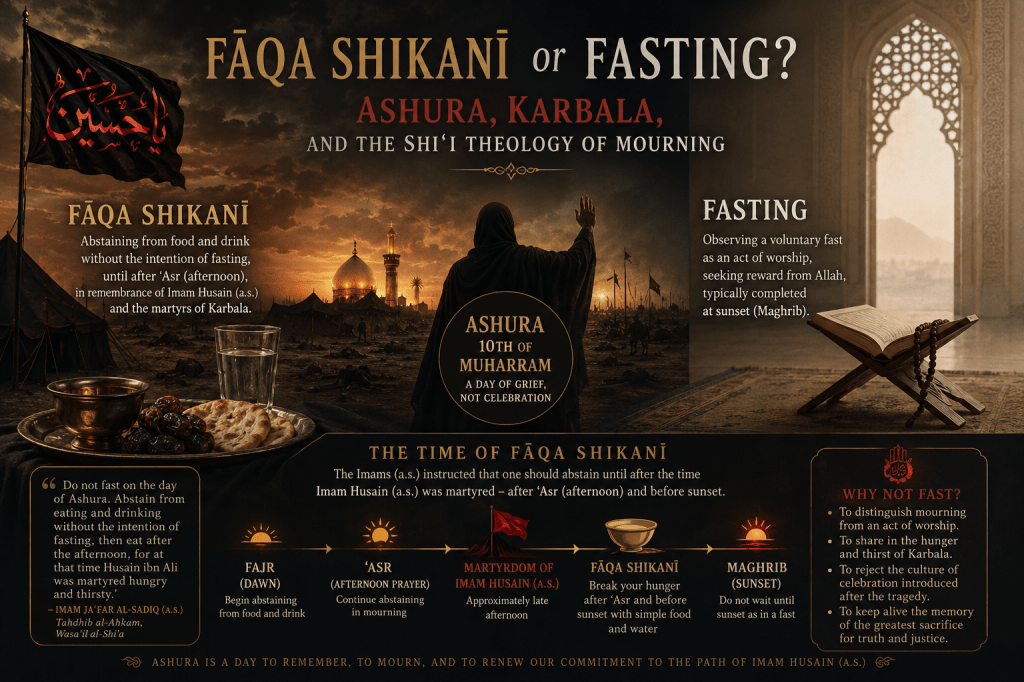
Among the practices that distinguish the Shīʿī commemoration of ʿĀshūrā from that of many other Muslim communities is the observance of fāqa shikanī, which means abstaining from food and drink without the intention of ritual fasting, rather than observing a voluntary fast on the tenth of Muḥarram. While many Muslims regard this day as recommended for voluntary fasting, Twelver Shīʿa refrain from observing it as a ritual fast, which is known as ṣawm. Instead, they abstain from food and drink for part of the day without intending a religious fast, and then break their hunger during the late afternoon in remembrance of the martyrdom of Imām Ḥusain and his companions at Karbala. This distinction is neither incidental nor merely ritualistic. It rests upon the teachings of the Imams of the Ahl al-Bayt, the historical memory of Karbala, and a profound theology of mourning.
The Qurʾān prescribes fasting primarily during the month of Ramaḍān, as set out in verses 2:183 to 187, while voluntary fasting on other days is recommended in various Prophetic traditions. There is, however, no Qurʾānic injunction specifically prescribing fasting on the tenth of Muḥarram. The recommendation derives from traditions preserved in Sunni collections such as Ṣaḥīḥ al-Bukhārī and Ṣaḥīḥ Muslim, where the Prophet is reported to have fasted on this day after observing the Jews of Madīnah commemorating the deliverance of Prophet Mūsā from Pharaoh. He is also reported to have expressed the intention of fasting both the ninth and the tenth in subsequent years. Shīʿī scholars have never denied the existence of these narrations. Rather, they argue that the martyrdom of Imām Ḥusain in 61 AH, which corresponds to 680 CE, fundamentally transformed the religious significance of the day. Whatever earlier associations ʿĀshūrā may have possessed, the massacre of the Prophet’s grandson permanently changed its moral and spiritual meaning. The day became one of the greatest tragedies in Islamic history, rendering celebration or the observance of a meritorious fast incompatible with its solemn character.
The principal evidence for the Shīʿī practice comes from the teachings of the Imams themselves. Imām Jaʿfar al-Ṣādiq is reported in Tahdhīb al-Aḥkām and Wasāʾil al-Shīʿa to have instructed that people should not fast on the day of ʿĀshūrā, and that if they wish, they may abstain from food and drink without intending it as a fast, then eat after the afternoon prayer, for at that time Ḥusayn ibn ʿAlī was martyred hungry and thirsty. Similarly, Imām Muḥammad al-Bāqir advised believers to refrain from eating and drinking until the afternoon and thereafter to break their hunger with water and simple food while remembering Imām Ḥusain. These narrations establish an important legal and theological distinction. The abstention is not ṣawm but imsāk, which means that it is not a ritual fast undertaken as an act of worship, but an expression of grief and solidarity with the suffering endured by the martyrs of Karbala. The intention, known as niyyah, is therefore decisive. One does not seek the reward associated with voluntary fasting. Rather, one symbolically participates in the hunger and thirst that afflicted Imām Ḥusain, his family, and his companions on the banks of the Euphrates.
The prescribed timing of fāqa shikanī itself illustrates this distinction. The traditions do not instruct believers to abstain until sunset, as is the case with a canonical fast. Instead, they specifically state that the abstention should continue until after the afternoon, which is expressed as baʿd al-ʿaṣr, corresponding to the time when Imām Ḥusain was martyred. Classical Shīʿī jurists understood this to mean the latter part of the afternoon, after the ʿAṣr prayer or approximately the time traditionally associated with his martyrdom, which is generally identified as the early afternoon, around midday to mid-afternoon, though some traditions specify the exact hour. Consequently, in Shīʿī communities across Iraq, Iran, the Indian subcontinent, and elsewhere, mourners generally refrain from eating and drinking from dawn until the conclusion of the principal ʿĀshūrā commemorations in the late afternoon. They then perform fāqa shikanī by breaking their hunger with a simple meal, often consisting of water, milk, bread, rice, or other modest food distributed as tabarruk, which means blessed charity. Importantly, this occurs before sunset, thereby distinguishing the practice from a ritual fast. Waiting until Maghrib would make the abstention resemble a formal ṣawm, something the Imams explicitly sought to avoid.
The terminology itself is revealing. The expression fāqa shikanī is Persian and literally means breaking one’s hunger rather than breaking one’s fast, which would be ifṭār. Likewise, the meal taken afterwards is not regarded as an ifṭār in the legal sense, but as the conclusion of an act of mourning. The simplicity of the food recalls the deprivation endured by the people of Karbala rather than celebrating the completion of an act of worship. In Arabic contexts, the practice is sometimes referred to as al-imsāk, meaning abstention, or al-taʿziya bi-al-jūʿ, which means mourning through hunger, though fāqa shikanī remains the most commonly used term in Persian and South Asian Shīʿī communities. Numerous narrations also criticise those who transformed ʿĀshūrā into a day of blessing or rejoicing. Traditions preserved in Al-Kāfī and later compilations attribute to Imām Jaʿfar al-Ṣādiq strong criticism of those who regarded ʿĀshūrā as a festival, known as ʿīd. Shīʿī scholars interpreted this as a reference to Umayyad policies which encouraged fasting, feasting, applying kohl, wearing new clothes, and expanding household expenditure in order to commemorate the military victory over Imām Ḥusain while diverting public sympathy away from the Prophet’s family. This political dimension is significant because the fast was not merely a religious recommendation but a tool of statecraft employed by the Umayyads to reframe the tragedy as a triumph.
Classical authorities such as Shaykh al-Mufīd, who died in 413 AH, and Shaykh al-Ṭūsī, who died in 460 AH, therefore maintained that ʿĀshūrā should be observed through mourning, lamentation, recitation of the martyrdom narrative, charity, and remembrance rather than through voluntary fasting. Muḥammad Bāqir al-Majlisī, who died in 1110 AH, in Biḥār al-Anwār, gathered numerous traditions encouraging believers to spend the day in grief, weeping for Imām Ḥusain, reciting Ziyārat ʿĀshūrā, and remembering the unparalleled sacrifices made at Karbala. Contemporary Shīʿī jurists continue this understanding. Grand Ayatollah ʿAlī al-Sīstānī and Ayatollah ʿAlī Khameneʾi both discourage observing ʿĀshūrā as a recommended fast. They instead advise that if believers abstain from food and drink, they should do so without intending a ritual fast and should end their abstention in the late afternoon, before sunset, thereby preserving the distinction between mourning and worship. Many jurists also note that the day is so profoundly marked by grief that treating it as a day of fasting, a practice often associated with joy or gratitude, would be spiritually discordant.
In recent decades, however, a development has emerged in some communities that has drawn criticism from religious authorities. It has become increasingly common for some mourners to break their fāqa even before the Tazias, which are the symbolic replicas of the martyrs’ shrines carried in processions, have been buried at the end of the ʿĀshūrā commemorations. This practice effectively means that participants are eating at the very moment when the final mourning rituals are still underway, and in some cases, exactly at or around the time of the Imām’s martyrdom. The late Allama Saiyid Sibtul Hasan, a distinguished Shīʿī scholar of the Indian subcontinent, was particularly critical of this development. He used to argue strongly against such people, questioning the logic and sincerity of their observance. His criticism rested on a simple but powerful point: if you are observing fāqa as an act of mourning, what type of mourning is it that you are eating exactly before or at the time of the Imām’s martyrdom? For Allama Sibtul Hasan, the very purpose of fāqa shikanī was to share, however symbolically, in the hunger and thirst of Imām Ḥusain at the moment of his supreme sacrifice. To break that abstention precisely when the tragedy reached its climax was, in his view, to drain the practice of its meaning and to reduce it to an empty formality. He maintained that the fāqa should be maintained until the appropriate time after the afternoon, and that eating before the Tazias had been buried, particularly if that fell before or exactly at the time of martyrdom, contradicted the spirit of mourning that the Imams had sought to instil. His criticism reflected a broader concern that ritual observances, when divorced from their intended meaning and timing, risk becoming mere custom rather than genuine expressions of grief and solidarity.
This distinction reflects a deeper theological principle. In Sunni tradition, ʿĀshūrā fasting commemorates divine deliverance granted to earlier prophets, particularly Mūsā. In Shīʿī thought, while those earlier traditions are acknowledged, Karbala has forever transformed the meaning of the day. The tenth of Muḥarram is above all the day on which the grandson of the Prophet, together with his family and companions, gave their lives to preserve justice, truth, and the moral conscience of Islam. The day is not one of divine rescue but of redemptive sacrifice, a sacrifice that, in Shīʿī theology, serves as an eternal standard of resistance against tyranny. Moreover, the practice of fāqa shikanī embodies a distinct soteriological vision, which holds that salvation is not achieved through ritual observance alone but through affective and embodied participation in the suffering of the righteous. By sharing in the hunger and thirst of Karbala, the believer cultivates not only historical memory but also moral solidarity with the oppressed, a central theme in Shīʿī spirituality. The criticism offered by Allama Sibtul Hasan underscores this point: the timing of the abstention is not arbitrary but is intimately bound up with the narrative of Karbala itself, and to disregard that timing is to misunderstand the very purpose of the practice.
Thus fāqa shikanī is not merely an alternative ritual. It is a profound expression of historical memory and theological identity. Hunger is embraced not to earn the reward of fasting, but to share, however symbolically, in the suffering of Imām Ḥusayn. The water drunk in the afternoon recalls those who died thirsty. The simple meal reminds believers that the martyrs of Karbala were denied even the basic necessities of life. Through this practice, the followers of the Ahl al-Bayt preserve ʿĀshūrā not as a day of celebration or thanksgiving, but as the supreme day of mourning in Islamic history, a day on which grief itself becomes an act of devotion, and abstention becomes a form of witness. The careful observance of its proper timing, as emphasised by scholars like Allama Sibtul Hasan, ensures that this act of mourning retains its spiritual integrity and does not degenerate into a meaningless ritual.
Selected References
The Qurʾān, 2:183–187.
Ṣaḥīḥ al-Bukhārī, Kitāb al-Ṣawm.
Ṣaḥīḥ Muslim, Kitāb al-Ṣiyām.
Al-Kulaynī, Alkali.
Shaykh al-Ṭūsī, Tahdhīb al-Aḥkām.
Al-Ḥurr al-ʿĀmilī, Wasāʾil al-Shīʿa.
Muḥammad Bāqir al-Majlisī, Biḥār al-Anwār.
Shaykh al-Mufīd, Al-Muqniʿah.
Shaykh al-Ṭūsī, Miṣbāḥ al-Mutahajjid.


