Syed Ali Nadeem Rezavi
Every year, as the Day of ʿĀshūrāʾ approaches, millions of believers throughout the world observe a number of devotional practices that have become inseparable from the remembrance of Imam Husain and the tragedy of Karbala. Among the best known are the Āmāl-e ʿĀshūr, the recitation of Ziyārat-e ʿĀshūr, and the repeated invocation of laʿn, the solemn dissociation from and condemnation of those responsible for the murder of the grandson of the Prophet. These three practices are often performed together, yet each possesses its own history, textual foundation and theological significance. Each therefore deserves to be understood independently rather than simply accepted as inherited ritual. In this series of essays, we shall examine each in turn. We begin with the Āmāl-e ʿĀshūr, the devotional acts prescribed for the tenth day of Muharram.
The Arabic word ʿamal (plural aʿmāl) literally means ‘deed’, ‘action’ or ‘practice’. In Shiʿi devotional literature it refers to a prescribed programme of worship associated with particular days, nights or occasions. Such programmes generally include ritual purification, prayer, Qur’anic recitation, supplication, remembrance of God, salutations upon the Prophet and his family, acts of charity, and other recommended devotional exercises. Over the centuries these practices were gathered together in celebrated manuals such as Shaykh al-Ṭūsī’s Miṣbāḥ al-Mutahajjid, Sayyid Ibn Ṭāwūs’s Iqbāl al-Aʿmāl, al-Kafʿamī’s al-Miṣbāḥ, and most famously Shaykh ʿAbbās al-Qummī’s Mafātīḥ al-Jinān. The Āmāl of ʿĀshūrāʾ are therefore not a modern invention but form part of a continuous devotional tradition preserved through successive generations of Shiʿi scholarship.
The roots of these observances lie in the teachings of the Imams of the Ahl al-Bayt themselves. Traditions transmitted principally from Imam Muḥammad al-Bāqir and Imam Jaʿfar al-Ṣādiq describe how the Day of ʿĀshūrāʾ should be observed. Rather than allowing the Umayyad rulers to redefine the day as one of celebration and public thanksgiving, the Imams transformed it into a day of mourning, remembrance, prayer and moral reflection. Imam al-Riḍā relates that when the month of Muharram began, his father Imam Mūsā al-Kāẓim was never seen smiling, and as the tenth day approached his grief only deepened, for it was on that day that Imam Husain was martyred.
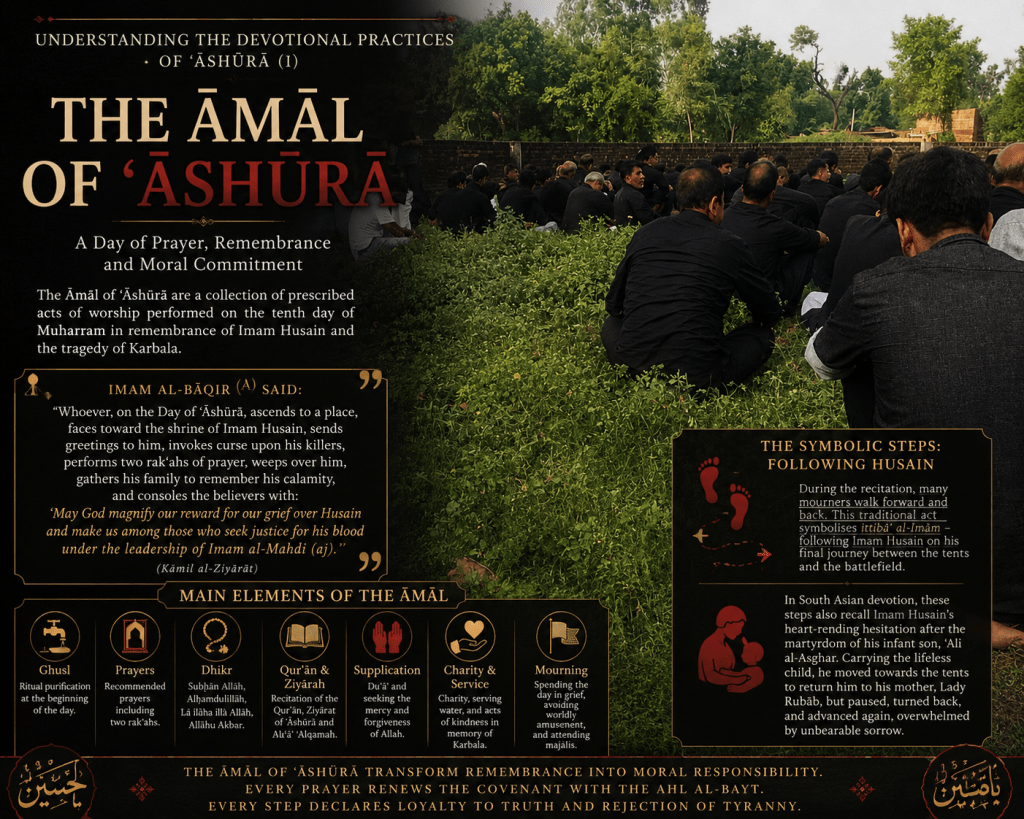
One of the earliest and most important narrations concerning the observance of the day is preserved in Kāmil al-Ziyārāt. Imam al-Bāqir instructed that one unable to visit Karbala should ascend to an elevated place before noon, face towards the shrine of Imam Husain, recite salutations upon him, invoke God’s curse upon his killers, perform two rakʿahs of prayer, mourn sincerely over the tragedy, gather members of the household to remember the martyrdom, and console fellow believers with the prayer:
‘Aʿẓama Allāhu ujūranā bi-muṣābinā bi’l-Ḥusayn wa jaʿalanā wa iyyākum mina’ṭ-ṭālibīn bi-thārihi maʿa walīyihi al-Imām al-Mahdī min Āli Muḥammad.’
‘May God magnify our reward for our grief over Husain and make us and you among those who seek justice for his blood under the leadership of His Friend, Imam al-Mahdi, from the family of Muhammad.’
The Imam further declared that one who performs these rites sincerely shares spiritually in the reward of those who stood beside Imam Husain at Karbala. This remarkable promise illustrates an important principle within Shiʿi spirituality: physical absence from Karbala does not prevent spiritual companionship with its martyrs. Through remembrance, prayer and sincere loyalty, every generation may become a participant in Husain’s cause.
The classical manuals subsequently expanded these transmitted instructions into a complete devotional programme. The Āmāl ordinarily begin with ritual purification through ghusl, followed by recommended prayers, recitation of selected Qur’anic passages, abundant remembrance of God through Subḥān Allāh, Alḥamdulillāh, Lā ilāha illā Allāh and Allāhu Akbar, seeking divine forgiveness, repeated blessings upon the Prophet and his family, the recitation of Ziyārat-e ʿĀshūr together with Duʿāʾ ʿAlqamah, supplication, charity, participation in mourning assemblies, serving water in memory of the thirst endured at Karbala, and refraining from worldly celebrations or amusements. The observance is traditionally completed before noon, corresponding to the period during which the battle reached its climax and Imam Husain attained martyrdom. It is generally offered in an open uncovered ground. In many places in India, as in my village, people assemble in the open grounds of Karbala to offer these prayers.
The objective of these devotional acts is far deeper than ritual observance alone. They seek to cultivate the virtues embodied by Imam Husain himself: steadfastness before oppression, patience in suffering, sincerity in worship, complete submission to God, compassion for humanity, and unwavering commitment to truth. Every prayer recalls the sacrifice of the Prophet’s family. Every tear renews allegiance to the Imam. Every supplication reminds the believer that injustice can never become acceptable simply because it appears victorious.
Among the most distinctive features accompanying the recitation of the Āmāl in many parts of South Asia, Iran, Iraq and elsewhere is the repeated movement of the worshipper forwards and backwards while reciting certain passages. To many observers this appears unusual, yet within Shiʿi devotional culture it carries profound symbolic meaning.
Its primary significance lies in the concept of ittibāʿ al-Imām, or following the Imam. By advancing several paces and then stepping back repeatedly, the believer expresses the desire to accompany Imam Husain on his final journey between the tents and the battlefield. The movement symbolises the declaration that, had one been present at Karbala, one would have walked with the Imam, shared his trials and remained steadfast beside him until the very end. Memory thus becomes participation, and historical remembrance is transformed into embodied devotion.
Alongside this broader symbolism, South Asian devotional tradition preserves an especially poignant interpretation that has deeply touched generations of mourners. According to this understanding, the repeated forward and backward movement recalls one of the most heart-rending moments in the entire tragedy. After the six-month-old ʿAli al-Aṣghar was struck by the arrow of Ḥurmala while in his father’s arms, Imam Husain carried the lifeless infant back towards the tents. As he approached, he is imagined to have hesitated. How could he place the blood-soaked body of his youngest son into the arms of his grieving mother, Lady Rubāb? He moved forwards, then stopped. He turned back, then advanced once more, overcome by the unbearable sorrow of the moment, before finally returning the child to the camp. During the Āmāl, many mourners consciously recall this scene, allowing their own steps to mirror the Imam’s grief and hesitation.
From the standpoint of historical scholarship, however, it should be recognised that this explanation belongs to the rich devotional tradition that developed over the centuries rather than to the earliest transmitted narrations concerning the Āmāl themselves. The classical reports prescribe the prayers, salutations, supplications and mourning, but they do not explicitly describe this physical movement. The walking therefore represents a symbolic devotional elaboration through which successive generations have sought to express emotionally their identification with Imam Husain and his suffering. Like many ritual gestures found across religious traditions, its significance lies not in legal obligation but in spiritual symbolism.
Ultimately, the Āmāl of ʿĀshūrāʾ are not intended merely to commemorate a historical event. Their purpose is to shape the conscience of the believer. Every prayer renews the covenant with the Ahl al-Bayt. Every invocation proclaims loyalty to truth and rejection of tyranny. Every symbolic step declares a willingness to walk wherever justice demands, even when the path leads towards sacrifice. In this lies the enduring genius of the Shiʿi devotional tradition: it transforms remembrance into moral responsibility and history into living faith.
The next essay in this series will examine Ziyārat-e ʿĀshūr, its origins, textual transmission, theological meaning, and the reasons for its unique place within Shiʿi spirituality.
References
al-Qummī, ʿAbbās ibn Muḥammad Riḍā. Mafātīḥ al-Jinān. Tehran: Kitābfurūshī va Chāpkhānah-i Ḥājj Muḥammad ʿAlī ʿIlmī, 1963.
al-Ṭūsī, Abū Jaʿfar Muḥammad ibn al-Ḥasan. Miṣbāḥ al-Mutahajjid wa Silāḥ al-Mutaʿabbid. Beirut: Muʾassasat al-Aʿlamī lil-Maṭbūʿāt, 1998.
al-Qummī, ʿAbbās ibn Muḥammad Riḍā. Mafātīḥ al-Jinān: Urdū Tarjamah, translated by Akhtar ʿAbbās. Lahore: Imāmiyyah Kutub Khānah, 1975.
Ibn Qawlawayh, Jaʿfar ibn Muḥammad. Kāmil al-Ziyārāt. Edited by ʿAbd al-Ḥusayn Amīnī. Najaf: Dār al-Murtaḍawīyah, 1356 AH/1937 CE.
Ibn Ṭāwūs, ʿAlī ibn Mūsā. Iqbāl al-Aʿmāl. Edited by Jawād al-Qayyūmī al-Iṣfahānī. Qum: Markaz al-Nashr al-Tābiʿ li-Maktab al-Aʿlām al-Islāmī, 1994 or 1995.
al-Majlisī, Muḥammad Bāqir. Biḥār al-Anwār al-Jāmiʿah li-Durar Akhbār al-Aʾimmah al-Aṭhār. Beirut: Dār Iḥyāʾ al-Turāth al-ʿArabī, 1983. 110 vols.
Madelung, Wilferd. The Succession to Muhammad: A Study of the Early Caliphate. Cambridge: Cambridge University Press, 1997.
al-Mufīd, Muḥammad ibn Muḥammad. Kitāb al-Irshād fī Maʿrifat Ḥujaj Allāh ʿalā al-ʿIbād. Translated by I. K. A. Howard as The Book of Guidance into the Lives of the Twelve Imams. London: Muhammadi Trust, 1981.
Khān, M. R. The Passion of al-Husayn. In Encyclopaedia Iranica, online edition. New York: Encyclopaedia Iranica Foundation, 2012.
Duas.org. ‘Āmāl of ʿĀshūrāʾ.’ Available at: https://www.duas.org/ashura/amal.htm (accessed 26 June 2026).


