Syed Ali Nadeem Rezavi
Recently a thesis on the political views of Shah Waliullah of Delhi was awarded a PhD and the examiner enquired about the reception of his ideas. Here I am dealing only with his reception in modern times. The reception by the contemporaries will be dealt later.
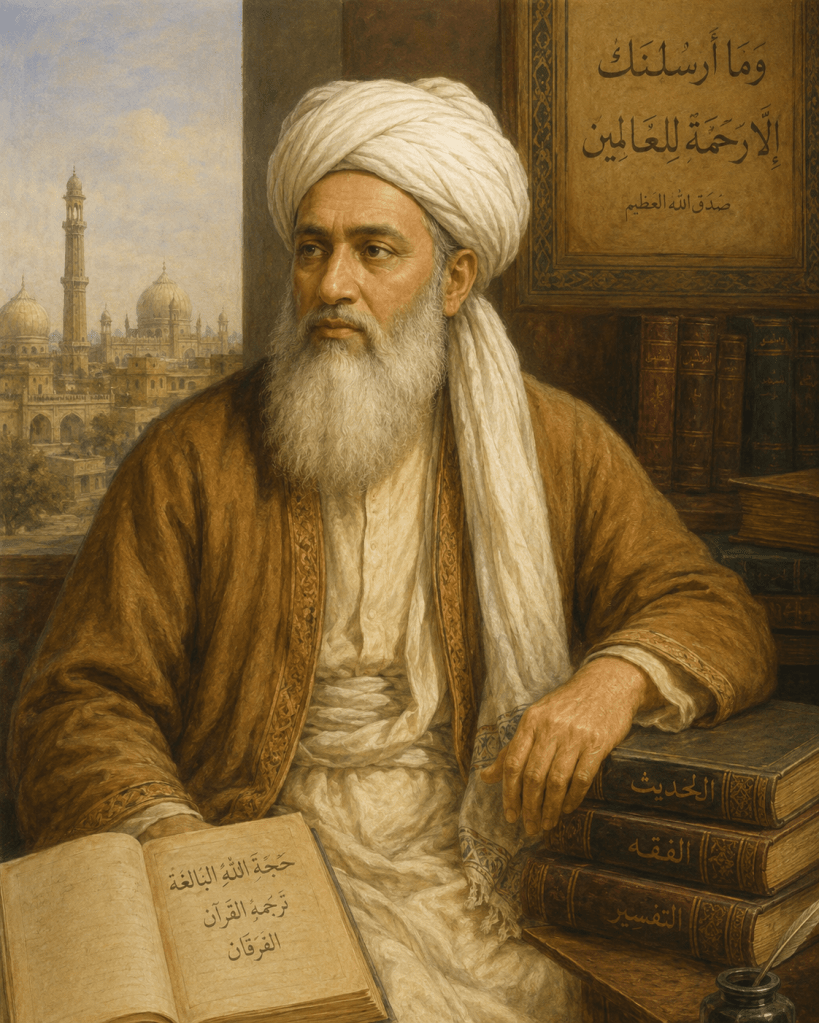
Few intellectual figures from eighteenth-century South Asia have drawn as much scholarly attention as Shah Waliullah of Delhi (1703–1762). He is remembered as a theologian, a traditionist, a Sufi, a social critic, and a reformer, and each generation has rediscovered him through its own concerns. Muslim revivalists have often seen him as the architect of Islamic renewal. Nationalist historians have sometimes presented him as a defender of a fading Muslim political order. And modern academic historians have used him as a window into the social, intellectual, and political changes that came with the collapse of the Mughal Empire.
The historiography of Shah Waliullah, then, is not just a record of changing interpretations of one thinker. It reflects larger shifts in how Indian history has been written, from the intellectual and institutional histories linked to the Aligarh school, to Marxist social history, and from religious biography to the study of networks, knowledge systems, and political cultures. The works of Khaliq Ahmad Nizami, Syed Athar Abbas Rizvi, Irfan Habib, Aziz Ahmad, Francis Robinson, Barbara Metcalf, and others show how different methods have produced very different understandings of the same historical figure.
The real Shah Waliullah lived through the long crisis of the Mughal Empire. By the time he came into his own as a scholar, the empire built by Akbar and strengthened under Aurangzeb had begun to fragment. Regional states were emerging across the subcontinent. The Marathas were pushing into northern India. Nadir Shah’s invasion in 1739 laid bare Delhi’s vulnerability. Afghan incursions and the growing autonomy of provincial rulers further weakened imperial control. This political instability came with economic dislocation and social uncertainty. It was in this atmosphere that Shah Waliullah developed his vision of religious reform and social revival.
His writings show remarkable intellectual range. He translated the Qur’an into Persian, promoted the study of Hadith, tried to reconcile the legal schools of Sunni Islam, reflected on social order and political authority, and sought to harmonize jurisprudence with mysticism. His Hujjat Allah al-Baligha remains one of the most sophisticated attempts by an eighteenth-century Muslim scholar to explain the social rationale behind Islamic institutions.
Yet modern scholars have disagreed sharply about what these activities really meant.
The earliest substantial academic treatment came from Khaliq Ahmad Nizami. Nizami belonged to a generation of scholars trained in the traditions established by Mohammad Habib and the Aligarh school. His work on Sufism, religious institutions, and medieval intellectual history was marked by vast learning and mastery of Persian and Arabic sources. His writings on Shah Waliullah, including editions of his political letters, made important materials available to later researchers.
That said, Nizami’s approach was mostly descriptive and reconstructive rather than analytical. His main concern was to recover what historical actors thought and intended. He rarely subjected those ideas to sustained social or structural analysis. His Shah Waliullah comes across mainly as a mujaddid, a religious reformer trying to restore moral order and revive Islamic learning. The political letters addressed to rulers like Ahmad Shah Abdali are explained in terms of the instability of the time, but they are not treated as evidence of larger social or ideological forces.
This is not to say Nizami lacked historical sophistication. Rather, his generation of historians generally saw their job as reconstructing intellectual traditions from primary sources and placing them within political events. Questions about class interests, social structures, ideological functions, or discourse analysis were not yet central to Indian historiography. So Nizami’s writing often shows great empathy for his subjects and a real reluctance to question their assumptions. In that sense, his work is less analytical than that of later scholars like Athar Abbas Rizvi or Irfan Habib. It belongs to an older generation of historians trained before Marxist social history and later social science methods had fully influenced Indian historiography. Compared with Rizvi, Habib, Athar Ali, Satish Chandra, or Nurul Hasan, Nizami’s writing tends to be rich in sources, narrative in style, and empathetic rather than problem-driven. His strength lay in recovering texts, institutions, and intellectual traditions; Rizvi’s lay in contextualization; Habib’s in structural explanation. So you could say that Nizami provided much of the documentary groundwork on which later, more analytical historians built their interpretations.
Syed Athar Abbas Rizvi represented a clear step forward. While sharing Nizami’s deep knowledge of Persian and Arabic sources, Rizvi adopted a more contextual and historically grounded approach. His Shah Wali-Allah and His Times remains the most thorough study of the scholar and his world. Instead of focusing only on theology or intellectual history, Rizvi reconstructed the whole social and political environment in which Waliullah lived and worked.
Rizvi moved beyond the older style of intellectual biography. He explored educational institutions, sectarian conflicts, scholarly networks, Sufi orders, and political developments. The result was a much richer sense of how ideas and circumstances were connected. Waliullah emerged not just as a religious thinker but as an intellectual responding to the collapse of imperial power and the breakup of established social structures.
Unlike Nizami, Rizvi gave serious attention to the political implications of Waliullah’s thought. He analysed the famous letters to rulers and military leaders and examined their place in contemporary debates about sovereignty and order. Yet Rizvi avoided simple conclusions. He did not portray Waliullah as a proto-nationalist or reduce him to a sectarian ideologue. Instead, he stressed the complexity of his engagement with the crises of eighteenth-century India.
The most radical reinterpretation came from Irfan Habib. Working within a Marxist framework, Habib shifted attention from intellectual history to social history. For him, ideas could not be understood apart from the material conditions that produced them. Religious thought was examined not just as theology but also as ideology.
Habib saw the eighteenth century as a time of deep contradictions within Mughal society. The weakening of central authority, the growing power of regional elites, and the erosion of older patterns of patronage created anxieties among sections of the Muslim scholarly and administrative classes. Shah Waliullah’s reform programme emerged from this context.
In Habib’s reading, Waliullah’s calls for social discipline, religious renewal, and political intervention reflected the worries of a social order under strain. His appeals to Ahmad Shah Abdali cannot be understood simply as religious exhortations; they were also attempts to restore a political balance that seemed to be falling apart. The emphasis on unity, order, and moral renewal corresponded to a perceived need to defend a threatened social and political structure.
Habib’s approach has been hugely influential because it connects intellectual developments to broader historical processes. But it has also been criticised for tending to privilege structural explanations over theological ones. Some scholars argue that this kind of interpretation risks reducing complex religious ideas to mere expressions of social interests. Even so, Habib’s work fundamentally changed the terms of the debate by insisting that intellectual history must be linked to social history.
A different angle came from Aziz Ahmad. His concern was with the evolution of Islamic modernism and reformist thought. Aziz Ahmad saw Shah Waliullah as an important link between classical Islamic scholarship and later revival and reform movements. He highlighted Waliullah’s efforts to return to foundational texts, his critique of blind imitation, and his focus on intellectual renewal.
Unlike Habib, Aziz Ahmad concentrated on the internal development of Islamic thought. Yet unlike Nizami, he examined these developments within a larger comparative framework that included the Ottoman Empire, Safavid Iran, and the wider Islamic world. His Shah Waliullah was not just an Indian scholar but part of a broader eighteenth-century pattern of Islamic revival.
Francis Robinson and Barbara Metcalf then pushed the discussion in new directions. Their work on Muslim intellectual networks and religious institutions brought out the long-term influence of Waliullah’s ideas. Robinson, in particular, stressed the importance of scholarly lineages, educational networks, and the circulation of texts. He argued that the intellectual traditions associated with Waliullah helped shape important strands of nineteenth-century Muslim thought.
Metcalf’s work on Deoband likewise showed the lasting influence of Waliullahi traditions. Yet both scholars warned against simple genealogies. They cautioned against portraying Shah Waliullah as the direct founder of later movements. Instead, they highlighted processes of reinterpretation and adaptation through which later generations made his legacy their own.
Recent scholarship has grown more critical of teleological readings that treat Shah Waliullah merely as a forerunner of modern reformism. Such approaches risk reading nineteenth- and twentieth-century concerns back into the eighteenth century. Today, historians increasingly stress the need to understand him within his own intellectual universe, not just as a stepping stone to later developments.
This shift has also brought fresh attention to aspects of his thought that earlier scholars neglected. His engagement with Sufism, his theories of social organisation, his understanding of history, and his attempts to reconcile reason and revelation have all drawn new interest. Historians now recognise that Shah Waliullah cannot be neatly labelled as either a conservative traditionalist or a revolutionary reformer. He was deeply rooted in inherited traditions and remarkably innovative in how he engaged with them.
The historiography of Shah Waliullah therefore mirrors the evolution of modern historical scholarship itself. Nizami represented a tradition of intellectual history grounded in close textual reading and sympathetic reconstruction. Rizvi introduced a more contextual and analytical framework that linked ideas to historical circumstances. Habib brought social structures and material conditions to the centre of the discussion. Aziz Ahmad placed Waliullah within broader currents of Islamic intellectual history. Robinson and Metcalf highlighted the importance of networks, institutions, and transmission.
Each of these approaches illuminates a different side of Shah Waliullah’s life and work. Yet none is enough on its own. Taken together, they reveal a figure who was at once a theologian, a Sufi, a social critic, an educational reformer, and a political thinker. The ongoing debate over his significance reflects not just the richness of his writings but also the lasting importance of the questions he addressed: the relationship between religion and power, the causes of social decline, the possibility of reform, and the role of intellectuals in times of political crisis.
Perhaps the most important lesson from this historiography is that Shah Waliullah resists being claimed by any single ideological tradition. He cannot be reduced to a proto-nationalist, a proto-Islamist, a defender of orthodoxy, or an agent of class interests. He was all of these things in part, and none of them entirely. The historian’s task is not to recruit him for contemporary causes, but to recover the complexity of a thinker who lived at a moment when one world was passing away and another had not yet been born.


