The Mughal-Safavid relations, as we have already mentioned, go back at least to the reign of Babur and Shah Ismail, the founders of these respective dynasties and empires. Shah Ismail had extended a helping hand to the young Babur when he had tried to wrest Samarqand from the hands of Shaibani Khan. We have also seen that Babur had not been averse to act a Shia and have the name of Shah Ismail announced after Friday prayers and mint coins bearing the Shi’i kalimaand the names of the 12 Imams. He had then been subsequently under their obligation when the Iranians, after the defeat of Shaibani Khan at their hands, honourably returned his sister who had been forcibly taken away by the Uzbek Khan. After Babur and Shah Ismail’s death, the Mughal-Safavid relations had still flourished. It was to Shah Tahmasp, that Humayun had turned for help. Zainab Begum, the sister of Tahmasp, out of her friendship for Hamida Bano Begum, recommended Humayun’s case to her brother who then provided Humayun the means and men to re-conquer his territory from the Surs. Apparently the relations between the two ruling families were also cemented through marriage ties which continued up till the time of Shahjahan. The type of relations enjoyed between the Safavids and the Mughals is articulated in a letter of Shah Abbas I who in a couplet expressed: “Between us and you there cannot be trouble. There can be naught but love and trust”.
But then, there were certain points of tension as well between the two Empires: which, too, were as old as the founders of the empires.
There were certain tensions which were due to ideological reasons: the dynasty of the Safavids was a staunch Shi’i, who sometimes, would go to the extremes of persecution in the name of religion, and would seldom leave a chance to assert their Shi’i identity. We have already seen how they had manipulated Babur when he re-occupied Samarqand. There are accusations that Humayun too was manipulated to a certain extent, when he went to Iran as a refugee. But then this point cannot be stressed to much extent as the attitude of the Mughals, contrarily, was quite flexible. Babur had had no problem at Samarqand in donning the Shi’i mantle. The attitude of Akbar in this regard is also quite clear, and we have seen it in his replies to Abdullah Khan Uzbek.
The real tension between the two, however, was on the question of Qandahar. We have already remarked on the greatly important position of this fort, both from the defence and economic point of view. It lay on the routes by which men and merchandise could pass between India, Persia and beyond. In the hands of India, it was a ‘steel door’ which hindered any entry into India from without; in the hands of Persia, it was the entry to the riches and merchandise of the East, and a lifeline to economic and commercial prosperity.
Babur, according to Riazul Islam, had an eye on Qandahar since he had conquered Kabul in 1504. He had almost captured it in 1507, but had lost it due to the pressure of the Uzbeks. He had again thought of doing so in 1517. It was around 1519-20 that, according to Hasan-i Rumlu, that he laid another siege of Qandahar. For three years he tried hard only to succeed, if we believe Hasan-i Rumlu and Khwandamir, in 1522. After its capture, it was assigned to Mirza Kamran. It remained in his charge at least till 1525.
This confrontation between the Safavids and the Mughals was the first of many conflicts over the wealthy and strategically located city.
At the time of Humayun’s accession, Kabul and Qandahar remained in the hands of Mirza Kamran. Though technically a governor, he was an independent ruler for all practical purposes. Thus for a decade after Babur’s death, the Persians had Kamran as their immediate neighbour and it was with him that they were dealing, instead of Humayun. In 1534-35, the governor of Khurasan, a brother of Shah Tahmasp, suddenly decided to move against Qandahar. This attempt was however foiled by Mirza Kamran who rushed to its defence from Lahore. The Safavids officially maintained that the attack on Qandahar had been launched without the official sanction and permission. In spite of this posturing, Tahmasp did not take the Persina failure in Qandahar lightly and took it as an affront to his authority and decided to personally move to take Qandahar and the adjoining regions. This expedition was launched in 1537. Mirza Haidar Dughlat informs us that the Mughal governor of Qandahar surrendered the fort to Tahmasp and retreated to Thatta. But then, very soon Kamran recovered the fort and Tahmasp was constrainted from retaliating due to troubles which he faced elsewhere (Azarbaijan). Humayun when he visited the Safavid court as a fugitive after 1540, apologised for this behaviour of Kamran and his folly in fighting against the Persians. But then while returning from Persian in 1544-45 with a Persian army, Humayun marched to Qandahar and after a six month siege forced Mirza Askari holding the fort to surrender it to him. Thus in 1545 Qandahar was wrested from Mirza Kamran. It was on 3rd September 1545 that Qandahar surrendered to Humayun. After its surrender, as per the understanding with the Safavids, Qandahar was handed over by Humayun to the Persians. The Persians now appointed Shah Murad, an infant son of the Shah as its governor with Budagh Khan as his deputy.
Qandahar had been wrested by Humayun with the help of the Persian army and now after handing it over to the Safavids, Humayun stood to gain nothing: Qandahar was with the Safavids, Kabul and Ghazni with Mirza Kamran. Humayun still had no place to turn to. And then, after the takeover of Qandahar the Safavid army also left him and returned back. He was left to fend for himself.
It was in this situation that Humayun was advised to seize the fort of Qandahar. Bayazid bayat informs us that Humayun was advised to take the fort on the pretext that as Kabul and Ghazni had not yet been taken, he had no place to leave his family. On top of it, the situation was also conducive: most of the Persian army had left Qandahar and Budagh Khan had very few forces left with him and was thus in no position to resist Humayun. Abul Fazl adds a further reason: Budagh Khan was quite oppressive and the people of Qandahar appealed to Humayun for succour. Fortunately for Humayun, the infant prince, Shah Murad died. It was then that, according the the Mughal sources (Jauhar Aftabchi, Nizamuddin Ahmad, Bayazid Bayat), Humayun decided to take over Qandahar. But then he wrote to the Safavid king that he was taking Qandahar fort from Budagh Khan as the later had been acting against the Shah’s orders, and handing it over to Bairam Khan, a Turkoman, a person acceptable to the Persians. He also re-itirated “the fort remains a dependency of the Shah”. Tahmasp was presented with a fait accompli.
Thus this was the situation of the fort at the time of Akbar’s accession. Qandahar was under the Mughals, but under a promise that it would be handed over back to the Safavids. At this time the relations between Persia and the Mughals can best be defined as a low phase: when the Safavids were feeling disappointed and let down by Humayun’s action of wresting Qandahar from them. The Shah, in fact, after Akbar’s accession is said to have sent an embassy which tendered not condolence on the death of Humayun but also reminded Akbar of his father’s promise to hand back Qandahar to the Persians. No mention of this embassy is however found in the Mughal sources, it being mentioned by the anonymous author of Afzal ut Tawarikh – a history of Shah Tahmasp’s reign.
Around the same time, in 1558 another incident occurred: Bahadur Khan, the Mughal Governor of Zamindawar suddenly decided to attack Qandahar. The governor of Qandahar, Shah Muhammad, in panic appealed to the Safavids for help, reminding them of Humayun’s promise. But then when Bahadur Khan was repelled, Shah Muhammad refused to hand over the fort to the Persians. There is some controversy amongst the Persian sources and the Mughal sources regarding who actually offered help to the Persians. However the end result was that a large Persian army laid siege and ultimately occupied Qandahar. Abul Fazl in his typical way claims, it was Akbar who ordered the governor not to oppose the Persians and hand over Qandahar to them!
All this thus led to further worsening of relations between the two otherwise friendly empires. In 1562 another Persian embassy arrived at the court of Akbar. From a letter of the Shah sent through this embassy it appears that Tahmasp had soon after the occupation of Qandahar despatched another embassy under Shah Ghazi to Akbar’s court. It also appears that Bairam Khan too had despatched an embassy to the safavid court during this period.
The embassy of 1562 appears to have been an attempt by Tahmasp to resume cordial relations with the Mughals. According to Abdul Rahim, Akbar’s friendship was necessary to Tahmasp at this juncture due to the rise of Abdullah Khan Uzbek. We have already seen Abdullah Khan’s attempts to form an alliance of Ottomans, Uzbeks and Mughals against the heretic Safavids.
Akbar, it appears, did not respond: he was being wooed by two superpowers of the time, the Safavids and the Uzbeks. The Safavids at the moment had also taken over his fort at Qandahar.
Abul Fazl informs us that, undeterred by Akbar’s non-response, another ambassador, this time with a letter of recommendation for Sultan Mahmud of Bhakkar to be made a Khan-i Khanan. But this embassy was dismissed with suitable replies and no response.
Tahmasp ultimately died in 1576 and between 1565 and 1576 there were no further official embassies – except perhaps the embassy which the governor of Khurasan and eldest son of Tahmasp. Sultan Muhammad khudabanda sent to Akbar’s court. But this probably was just to seek Akbar’s support in succeeding his father as the next Shah.
After Tahmasp’s death, Persia was in turmoil for a few years with first Shah Ismail II (the second son of Tahmasp) succeeding to the throne and then by Sultan Khudabanda (who was blind) in 1577. In 1587 his son Shah Abbas became the Shah after father’s abdication.
It was in 1591 that the first embassy of Shah Abbas arrived: it was the first with a purely political objective – to seek Akbar’s help against Abdullah Khan Uzbek. We have seen that by this time Abdullah had occupied the territories of Khurasan and had entered into some sort of alliance with Akbar about Qandahar and Herat. On hearing of Yadgar Sultan being despatched by Shah Abbas, Abdullah Khan Uzbek also sent his own embassy to the court of Akbar. According to Abul Fazl, Akbar held a council to consider the question of help to the Persians in liberating Khurasan from the Uzbeks. He was advised against it in view of his relations with Abdullah Khan: probably an allusion to the agreement on frontier at Hindukush. We have seen he had come to an understanding with Abdullah Khan on Qandahar in 1587.
The recapture or re-conquest of Qandahar had been on Akbar’s mind since long. In fact in 1574-75 Abul Fazl enumerated Qandahar as one of the unrecovered provinces of the empire.
Now in 1591 Abdur Rahim Khan-i Khanan was ordered to lead an expedition against Qandahar. If we believe Abul Fazl, then this task had been assigned to the Khan-i Khanan in 1589 itself. He was ordered first to win over the Baluch and Afghans of the region between Qandahar and the Mughal Empire. This attempt at diplomacy rather than outright military action was due to the presence of the Uzbeks in the Khurasan region. The sons of the late Sultan Husain Mirza Safavi (the governor of Qandahar who died the same year as Tahmasp), who were now holding Qandahar, on the other hand were also aware that they could not get any help from the Safavids due to the internal turmoil there. Thus one of them, Rustam Mirza, opened negotiations with the Mughals and in 1593 came to the court. Akbar awarded him the rank of 5000 and the subahdari of Multan. The other brother, Muzaffar Mirza, was also tempted to join the Mughal service, which he ultimately did in 1594. He was given an equal rank and appointed the governor of Sambhal. Thus without a war or siege, Akbar through diplomacy was able to enter Qandahar in 1595. The Mirza’s had in a way surrendered to Mughals due to their fear of Uzbeks.
The question of Qandahar was raised by the Persians not at this time but only when they had recovered Khurasan from the Uzbeks in 1598. The Persians were encouraged to take up Qandahar only in the last year of Akbar’s reign. The revolt of Salim had provided this opportunity to the Persians. However, as testified by the embassy of Mir masum sent to the Safavid court in his last years by Akbar, and its reception in Persia, it appears the relations between the two remained cordial. Mir Masum returned back only after the death of Akbar.
We have seen that preceding the formation of the Mughal rule in India, there were three other great empires which were founded in Central Asia. These were the Ottoman Empire founded by Mehmet II at Constantinople in 1453; the Safavid Empire by Shah Ismail around 1501 in Persia; and the Uzbek Khanate by Shaibani Khan around the same time in the region of Trans Oxiana.
The Safavids and the Uzbek Khanate were immediately to the north and west of the Mughal Empire. The Safavids were not only a powerful dynasty but they posed a sectarian problem also: they were Shi’ites in the midst of the Sunni world, keen to export their views and creed. They controlled the whole of Iran as well as Khurasan, knocking at the doors of Kabul and Qandahar, the latter being a bone of contention between them and the Mughals. Immediately to their northeast was the Uzbek Khanate in the region of Mawra-un Nahr, comprising the modern states of Uzbekistan, Turkmenistan and Tajikistan. Bu the time that Babur had established his empire, they were posing a serious threat to the Timurids. A part of Khurasan and Timurid centres like Herat and Samarqand had already been overrun by them. They were a threat not only to the Persians in Khurasan but also a real danger to the Mughals, even threatening Kabul.
The territory immediately to the northwest of the Mughal Empire, which bordered these two great empires was given to high mountain ranges and passes like the Karakoram and Khyber pass in the Hindukush, which acted as a natural doorway to the Indian sub-continent.
Another considerable importance of this region was that it was through these passes that much of the medieval trade routes passed. The overland route from Kabul through the Khyber Pass and Peshawar fed the markets of Punjab with horses from Central Asia; fruits, silks and porcelain from China, and precious metals as well as other valuable commodities from elsewhere. Indian spices, textiles and other goods travelled through these routes taking Indian merchants to the markets in Central Asia and Iran. The scale of this business traffic can be gauged from a reference by Nizamuddin Ahmad in Tabaqat-i Akbari. When an accidental fire broke out in Peshawar fort in 1586, it destroyed one thousand camel-loads of merchandise of those who had taken temporary shelter there due to a blockade of route.
These passes not only acted as passages for mercantile activity but also controlled other traffic to India as well. Thus the Hindukush was supposed to be the natural boundary and entry point to India.
The North West frontier for the Indian empires had always been problematic and kept on changing from beyond the Oxus to river Beas. During the Delhi Sultanate, the North West frontier generally lay across one part or another of the Punjab and its rivers. Under Shershah, it was in the Salt Range with the Rohtas Fort as the key point.
As per the conditions of medieval warfare, none of these was a satisfactory or viable frontier. The Punjab Rivers, although acted as a natural defence when inundated could otherwise be forded. The Salt Range too was deficient being a low range of hills that could easily be surmounted and crossed. The Sulaiman Range, to the west of the Indus, which the British made their frontier, could not be made a frontier in our period. The Afghan tribes infesting the region made a regular garrisoning in this area impossible.
According to M. Athar Ali, a truly ‘scientific frontier’ could be secured only if an Indian government held Hindukush Mountains with Kabul and Qandahar as the two great fortresses commanding the only two possible routes from the north-west to India.
This importance of Hindukush was realized by the Mughals, if we believe Abul Fazl. It was one of Akbar’s great achievements that he ultimately set his frontier at the Hindukush, shifting it from the Indus, where it had been placed by the Mughals earlier. Thus according to Tarikh-i Alfi [Ahmad Thattavi et.al.] compiled on the orders of Akbar, the Hindukush was considered as the northern boundary of India.
[A] Akbar and the Uzbeks:
The Hindukush at this time separated the Uzbek kingdom of Balkh from the Timurid kingdom of Badakhshan on the one hand and Mirza Hakim’s principality of Kabul on the other. Both these kingdoms of Balkh and Badakhshan were a buffer between the Uzbek Khanate and the Mughal Empire.
In 1585, more by design than by accident, both Abdullah Khan Uzbek and Akbar agreed that Hindukush should be the frontier of the Mughal Empire. The reason was that if Hindukush was the frontier of the Mughal Empire, then no army from outside could invade India without making preparations on a large scale. Thus the element of surprise would be taken away. And from the Indian side Hindukush could be effectively defended by a comparatively small force.
It was because of this strategic importance of Hindukush that Akbar was so keen to hold the frontier of the Mughal Empire there. Abul Fazl approvingly cites the wise of the ancient who declared Kabul and Qandahar as the twin gates of India: Kabul leading to Central Asia and Qandahar leading to Persia. Qandahar, a small city in itself, was by its location a place of real importance. Lying on the main trade route between India and Iran, it was a focus of all the direct routes converging from the western frontier of India towards Herat and Iran. In the hands of an Indian ruler, it would form an excellent base for an army of invasion. If in the hands of Iran, it would lend security from attacks by way of the South.
Sujan Rai Bhandari (Khulasat ut Tawarikh) a contemporary of Aurangzeb, goes one step further and says that whenever Kabul and Qandahar were not part of India, Punjab was constantly under attack from foreign powers. And once the invading army was in the Punjab, Delhi could be directly threatened as no natural barrier separated Delhi from Punjab. The rivers of Punjab are fordable most of the time in the year. With the only exception of two months (July & August), rivers could be crossed easily.
If we test this statement of Sujan Rai Bhandari, one finds that Kabul and Qandahar were not a part of India when Turks invaded under Muizzuddin bin Sam [Mohd Ghori]. They were not part of India when the Mongols invaded: whether under Iltutmish or his successors or under Alauddin Khalji. Similarly Kabul and Qandahar were not a part of India when Babur invaded or Humayun re-entered in 1545.With Akbar invasions from the North West stopped.
One should also remember that Hindukush could be kept only till it was flanked by both Kabul and Qandahar. Thus Akbar had made Bala Hisar Fort at Kabul. And that is why in 1586 the Attock fort was built by Akbar and it went on to strengthen India’s Northwest Frontier. Although the expenditure for the placement and maintenance of the army at Kabul exceeded the revenues collected there, it was a must. That is why Qandahar was so crucial and central to the Mughal policy. It is in this background that Mughal relations with Central Asia and Persia should be examined.
Let us also not forget the historical relationships which had existed in the past between the Mughal Empire and the Uzbeks on the one hand, and the Safavids on the other. We have seen that during the period of Babur, traditional rivalry existed between him and Shaibani Khan. In fact it was Shaibani Khan and the Uzbeks who had caused the loss of the homeland, Ferghana and Trans Oxiana. Not only Ferghana but Herat and Samarqand had also been lost by the Timurids. The desire to have these territories had been such that Babur had to ‘dissimulate’ and outwardly become a Shi’i to please the Iranians in order to win back these areas from the Uzbeks. Probably the desire to control these territories continued during the reign of Humayun. From a letter written by Abul Fazl to Hakim Hummam it appears that Akbar too burned with this ambition to re-occupy the ancestral lands of Central Asia.
The Mughal relations with Persia had been equally eventful and again dated back at least to the period of Babur – and even earlier. We know that Mirza Husain Baiqara, the senior Timurid prince whom Babur picks out for singular praise, had regulated his court as per Persian traditions. The first Safavid king Shah Ismail had not only entered into an alliance with Babur to free Samarqand from the clutches of Uzbeks under Shaibani Khan, but had also been instrumental in delivering back Khanzada Begum from the Uzbeks. Subsequently when Humayun was on the run, it was with the help of the Safavids that he was able to get back his lost empire. And these were the gratitude which the Mughals had towards the Persians: both Babur and Humayun held their territories due to the help of the Iranians.
Now at the time of Akbar’s reign, the whole of Mawra un Nahr , north of Kabul, was under the direct or indirect influence of the Uzbeks, while all the territories west of the Mughal borders (Qandahar) was with the Safavids. Qandahar itself was being held by the Mughals, but under a promise that it would be soon handed over to the Safavids.
Much work has been done on the North West frontier and the political problems which arose in that region due to the tensions between the Uzbeks, Persians and the Mughals. Some important works on this issue are those of Abdur Rahim [Mughal Relations with Persia and Central Asia, initially in the form of papers published in Islamic Culture, 1934-35], Riazul Islam [Indo-Persian Relations], A. Verma [Foreign Policy of the Mughals] and Mansura Haider [“Relations of Abdullah Khan Uzbek with Akbar”, Cahiers].
A reading of these secondary works along with the information contained in our sources points out two basic issues which dominated in Akbar’s response to emerging concerns in the North West: the rise of Abdullah Khan Uzbek in the 1580’s and the strategic centrality of the Qandahar Fort.
Born in 1533, Abdullah Khan Uzbek became the ruler of Bukhara in 1561. In the same year he proclaimed his father Iskandar Khan as the khaqan, the ruler of Turan. He steadily increased his powers: he seized Balkh in 1572-73. In 1583 when his father died, he proclaimed himself as the khaqan. Next year in 1584 he conquered Badakhshan; ultimately in 1588 he invaded and captured large areas of Khurasan.
In the early years of Akbar’s reign, till 1572, there was no interaction between the two contemporary rulers of Hindustan and Turan. The reason apparently was that till 1572 the kingdom of Balkh under Nazr Muhammad, and until 1583 Badakhshan under Mirza Sulaiman, existed between the two empires as buffer states. But then withAbdullah Khan’s expansion, these two small principalities were absorbed into the Turani Uzbek empire, which then went on to extend its influence over Khurasan. Kabul in the meanwhile was under Mirza Hakim, the half-brother of Akbar.
Thus by 1570’s the Uzbek Khanate and the Mughal Empire had common frontiers, which naturally gave rise to new tensions and speculations.
As far as the relations between them are concerned, it was Abdullah Khan Uzbek who took the first step and Akbar had to respond to these overtures. The relations between Abdullah Khan and Akbar can be easily divided into three distinct phases, viz., (a) 1572-77, (b) 1583-89, and (c) 1589-98. [It was in 1598 that Abdullah Khan Uzbek died].
The first phase was marked with Abdullah trying to engage Akbar who appeared more to rebuff than accept or acknowledge the overtures. In 1572, according to Abul Fazl, the first embassy from Abdullah Khan Uzbek arrived at the Mughal court. His emissary, Jahji Altamish, is said to have arrived with a letter from Abdullah Khan to Akbar. Although we do not know the exact contents of the letter, Riazul Islam and Verma cite circumstantial evidence and ‘subsequent developments’ to think that it was a letter which was directed against the Safavids. In fact Verma goes a step further to claim that the letter contained a scheme for the partition of Persia. According to Verma, the Iranian shah Tahmasp was growing old and civil war was imminent, providing an excellent opportunity to the Uzbeks to divide the Safavid Empire and occupy Khurasan. But then for this there was need to neutralize or take on board the other major player in the field, Akbar. Thus according to Verma and Riazul Islam, the letter contained a proposal to divide the empire between themselves, or atleast ask Akbar to tolerate the forward policy of Abdullah Khan.
Abdur Rahim and Mansura Haider, on the other hand believe the first embassy of the Uzbeks did not concern the Iranians. According to Abdur Rahim the probable reason was to make ‘an alliance against other rulers of Turan’. Abdur Rahim in this regard in fact goes on to quote Abul Fazl, who regarding the purpose of this letter writes:
“…to recall ancient relations and renew friendship in order that with the help of such divine glory, he might act vigorously against other princes of Turan. Another object was that he might repose in peace and be without apprehension of the strokes of world-conquering armies.” [AN, II, 534]
Mansura Haidar on the other hand feels that the basic reason for this embassy was the ‘internal circumstances’. She points out that when Abdullah Khan Uzbek decide to attack Balkh in 1572, the other Sultans of Mawra un Nahr became suspicious of his intentions and decided to collaborate with each other to thwart his designs. Further during this very time Khudabanda, the son of Shah Tahmasp also sent and envoy to Akbar. Both these things alarmed Abdullah of a possible Mughal involvement, thus his decision to send a friendship embassy to Akbar. This embassy would ensure the Mughal neutrality if not outright friendship.
Whatever Abdullah Khan Uzbek’s reasons for despatching this embassy, to us what is important to know is Akbar’s response to it. According to Abul Fazl Akbar received this embassy coldly and, in order to discourage further diplomatic relations, did not find it necessary to send a proper reply or a return embassy to the Uzbek Khanate.
In spite of lack of proper response or a return embassy from Akbar Abdullah Khan sent a second embassy to Akbar five years later in 1577. By this time his position had considerably enhanced and Shah Tahmasp of Iran was dead. He was also thinking in terms of expansion towards Khurasan. However, according to Abul Fazl this second embassy was sent by Abdullah Khan as his first ambassador Jahji Altamash ‘had been much impressed by the power of the Empire’. The embassy this time, we are informed by Abul Fazl, came with a letter with the purport that Akbar ‘should lead an expedition from India to Iran in order that they (Abdullah Khan and Akbar) may with united efforts release Iraq, Khurasan and Fars from the rawafiz (innovators).’ It also referred to the fact that the pilgrims also faced difficulty in going for Hajj due to the growth of the Safavids. Further the alliance was needed so that the Mughals may take hold of Qandahar. Although this actual letter does not survive, but its contents become apparent from a letter written as a reply to it by Akbar (Jami’ ul Insha, Munshi Bhagchand, MS BM). What appears is that the rapid increase in Abdullah Khan’s position was such that Akbar could not out rightly ignore him and his letter as he had done in 1572. However, in Akbar’s scheme of things, his friendship and alliance with Safavids was much more crucial that it could not be sacrificed at the altar of the Uzbeks. Further, according to Varma, this change in the attitude of Akbar which forced him to respond to the second embassy was that at this time Akbar was planning ‘to bring about a settlement about Badakhshan’ and apprehended an alliance between Mirza Shah Sulaiman of Badakhshan and the Uzbeks. It was during this time that Mirza Sulaiman had been overthrown by his grandson Mirza Shahrukh and in 1577 at around the same time as the embassy of Abdullah Khan, the embassy of shahrukh had reached Akbar’s court. But then Mansura Haider sees no such connection. According to her the danger of the emergence of a triple alliance between Mirza Sulaiman, Mirza Hakim of Kabul and the Safavids forced Akbar to respond to Abdullah Khan’s overtures. It was the dangers of the north-western frontiers which forced Akbar to act thus. But still his response was quite ambiguous and could be interpreted in any way.
Akbar thus sent a return embassy under Mirza Faulad with a letter to Abdullah Khan. In this letter Akbar politely but firmly reminded Abdullah Khan Uzbek that the Safavids were ‘specially connected with the family of the Holy Prophet, and that on this ground he could not regard a difference in law and religion as sufficient reason for conquest. He [i.e. Akbar] was also withheld from such an enterprise by old and valued friendship’. As to the question of opposing the ‘infidels’, Akbar contended that he was already engaged in fighting the Europeans (Portuguese). Akbar also wrote that with the conquest of Gujarat, a new route for Hajj had also opened and there was thus no hindrance due to the Persians.
According to Uzbek sources like Abdullahnama of Hafiz Tanish, akbar’s return embassy reached the court of Abdullah Khan in July 1578.
According to Abdur Rahim also, the contents of this letter were not dictated by ‘friendly feelings’ towards Iran, but more due to alarm at the growing power of Abdullah Khan and to avoid being a party to his ambitious designs. The object of the return embassy was to assess first-hand the real power. The rebuff to Abdullah Khan would also be cushioned through this embassy: Mirza Faulad was a known anti-Shia noble. In fact later he was put to death for murdering a Shia, Mulla Ahmad Thattavi, one of the authors of Tarikh-i Alfi. In this way you diplomatically say a no which was not vehement enough and may be changed to yes, if need arose and if Safavid-Mughal relations soured.
From this period onwards a shift is noticed in the respective positions of Abdullah Khan and Akbar which is reflected in a change of policy towards each other. By 1583 Abdullah Khan had conquered all of Mawra un Nahr and had emerged as the Uzbek chief of Turan. In this year he had not only assumed the title of the khaqan but by next year, in 1585 he captured Badakhshan. This very year Mirza Hakim died.
Mirza Muhammad Hakim (1554-85) had been more or less an independent and sovereign ruler of the Kabul region till his death. He had maintained close relations with the rulers of Turan, especially Abdullah Khan Uzbek. From late 1560’s his court had also been a hotbed of Naqshbandi activity, with prominent members of this Sufi order even holding high state positions. The elimination of this kingdom was crucial from the Mughal viewpoint for several reasons: (a) Since the period of Babur and Humayun, Kabul had been an alternate centre of political power, drawing the Mughal centre of gravity away from Hindustan; (b) Mirza Hakim was able to to portray himself, in contrast to Akbar, as the pillar of an orthodox Sunni state, building an alliance, for example, with the short-lived Sunni ruler of Iran, Shah Ismail II (c. 1576-77). (c) Mirza Hakim had on at least two occasions (in late 1560’s & early 1580’s) posed an explicit threat to Mughal territories in the north-west, and also had significant support amongst the so-called Turani nobles of Akbar’s court. Thus the death of Mirza Hakim and the absorption of the territory of Kabul into Akbar’s empire was a great boost for the Mughals.
In 1586 Balkh was captured by Abdullah Khan and its ruler Nazr Muhammad along with his sons fled to Akbar’s court. According to Abdur Rahim, at this juncture Akbar decided to save Badakhshan from falling into Uzbek hands. The road to Khybar Pass which was fit for wheeled traffic was also constructed for this purpose. In retaliation, in order to thwart Akbar’s endeavours to create road blocks for the conquest of Badakhshan, Abdullah Khan Uzbek took two steps: firstly he occupied Qandahar before Akbar could move , and secondly he tried to stir trouble in Akbar’s backyard: he stirred up the Raushaniyya leader Jalala to foment trouble in the northwest frontier’s tribal regions. According to Abdur Rahim, Jalala was in the pay of the Uzbeks. And in the expeditions against Jalala, Akbar lost Raja Birbar, one of his personal friends. Probably the fort of Attock was also constructed in view of the Uzbek threat at this time.
While Akbar was at Attock Fort, in 1586, that Abdullah Khan sent his third embassy. It was headed by Mir Quraish. He came with a letter and some presents for Akbar.
Mansura Haider debunks the thesis of Abdur Rahim and says that neither did Akbar attempt to ‘save’ Badakhshan from Abdullah Khan nor did the later try to ‘foment’ trouble through Jalala. She says that during this time the boundaries of Akbar and Abdullah Khan had come closer and the pressure of Abdullah Khan’s growing powers were being felt by Akbar. Abdullah Khan was trying to adopt a bolder and demanding attitude whereas Akbar had turned conciliatory. There were troubles for Akbar in not only the north-western tribal regions in Kabul, Zabulistan and Bajaur but also in Kashmir and Gujarat. To ensure safety in the northwest Akbar had to personally move to Punjab move on to Kabul after the death of Mirza Hakim. It was also a time when the Safavids under Khudabanda (1577-88) were quite weak and completely shattered by the invasions of the Ottomans as well as internal rebellions. And thus in these situations it was necessary to maintain a more conciliatory attitude towards the Uzbeks. Akbar, due to these political upheavals was also anxious to occupy Qandahar and save Kabul from the designs of Abdullah Khan.
The contents of the letter sent by Abdullah Khan in 1586 are given in Majma’ul Insha [MS BM]. In this letter Abdullah Khan tried to justify his occupation of Badakhshan and blamed Mirza Shahrukh for attacking his territory while he was away and that ‘this faqir had acted out of friendship’. He also refers to the delay in sending this embassy due to his own problems and not due to any lack of regards for Akbar.
Abul Fazl while referring to this letter of Abdullah Khan says that it was sent as Abdullah Khan Uzbek ‘feared’ that Akbar would march against him and thus it was a letter of supplication which pulled at the chain of friendship.
The Uzbek sources on the other hand cited by Mansura Haider, on the other hand point to a different story: Abdullah Khan Uzbek wrote this letter as a proposal for an alliance against the Shi’i Iran and their religious tyranny and to safeguard the Sunnis. It was a duty of all the Muslims to do so.
‘So it was decided that early in spring we should proceed with the extermination of that misguided group and try our utmost to destroy them. If Emperor Akbar could extend material or moral support in this venture, it would be better. In case, however, this was not possible, protection must not be given to those who fled from our sword to your side.’[Abdullahnama]
Another similar letter was sent by Abdullah Khan Uzbek to Akbar through Nazr Be. In this also the Uzbek ruler talked of an alliance against the heretical Shias of Iran and the opening of the Hajj route for the Sunnis. But then it also contains the information that Abdullah Khan Uzbek had also entered into an alliance in this regards with the Khwarizmian ruler.
The purport of both these letters was not to form an alliance for an attack on Iran but in order to gain the neutrality of Akbar and stop him from sending any help to the Safavids.
In reply to these letters and the embassy, Akbar now decided to send a return embassy. This time it was headed by Hakim Humam with a letter to the Uzbek chief. Through this letter Akbar tried to address not only the chief concerns of the Uzbeks but also depicts his own diplomatic skills. He again re-iterated that the Safavids though not Sunnis but were still Saiyids and hereditary friends of the Mughals. In the light of repeated invasions of the Ottomans he felt duty bound to go for the help of the Iranians and requested Abdullah Khan to proceed to Khurasan so that they could meet there and jointly devise appropriate measures to assist the Safavids!
This was diplomacy and an attempt to disquise a plan to accommodate rival interests in Iran. The fact is he wanted the possession of Qandahar and had no problem if Abdullah Khan took some parts of Iran.
Both Riaz ul Islam and Abdur Rahim hint that the embassy of Hakim Hummam led to some sort of alliance between the Mughals and the Uzbeks. Mansura Haider on the other hand provides documentary evidences from both the Mughal and Uzbek sources for this ‘alliance’ between 1588-90. According to her this alliance took place on the proposal put forward by Abdullah Khan Uzbek. To quote one of her evidences: in 1591 Akbar wrote a letter to Raja Ali Khan of Khandesh in which he conveyed that his plans for the conquest of Badakhshan were being postponed because of the ‘envoys of Abdullah had come to his court’ and that for him ‘nothing was more important than sincerity and friendship’. According to this pact, the boundaries between the two were fixed at the Hindukush. Badakhshan and Khurasan were given to Abdullah Khan and Kabul and Qandahar to Akbar. The agreement also involved an undertaking not to interfere in each other’s affairs.
This agreement became effective most probably with the despatch of the yet another embassy by ~Abdullah Khan Uzbek under Ahmad Ali Ataliq, who, as Abul Fazl’ s letters point out was sent to ‘strengthen peace and to purify the foundations of concord and make this Hindukush the boundary between us’.
We know that between 1588-89 Akbar was personally present at Kabul and thus Abdullah Khan feared of a possible invasion of Badakhshan. Akbar alludes to this himself through a letter written by him to Raja Ali Khan in Sept 1591 that on reaching Kabul in 1588 he proposed to recover Badakhshan and to assign it to Mirza Shahrukh.
On top of this the fluid situation was fast improving in Iran from 1589 onwards. And this forced Abdullah Khan to maintain good relations with Akbar. In 1590-91 he sent an army to occupy Qandahar. But in order to save their territory, the Mirzas of Qandahar decided to show their alliance with Akbar and iterated that Qandahar belonged to the Mughal Empire and they were holding it as the governor of Akbar. And only if Abdullah Khan wanted to begin a war with Akbar that he should attempt taking Qandahar. Abdullah now had to send a clarification to Akbar through Maulvi Husain Khurasani. This embassy was in fact to assess Akbar’s intentions on Qandahar. Akbar by now had decided to take action. He did not send a reply to the embassy of Abdullah Khan but in Feb 1591 asked the Khan-i Khanan to occupy Qandahar.
In 1595 Qandahar was conquered and then started an armed conflict with the Uzbeks on the possession of the regions of Garmsir and Zamindawar. Further tensions were created with the Ottoman-Uzbek relations getting better with a letter written in 1594 by Sultan Murad III to form an alliance against the Persians.
Thus after the occupation of Qandahar Akbar realised the urgency of sending an embassy under Khwaja Ashraf Naqshbandi to Abdullah Khan to show his willingness to accept Hindukush as the border. This embassy reached the Uzbek court in 1597. Before it could return back along with an envoy of the Uzbeks, Abdullah Khan Uzbek died.
The 8th century was a time of struggle for control over the central Ganges valley—focusing on Kannauj—among the Gurjara-Pratihara, the Rashtrakuta, and the Pala dynasties. The Pratiharas rose to power in the Avanti-Jalaor region and used western India as a base. The Calukyas fell about 753 to one of their own feudatories, the Rashtrakutas under Dantidurga, who established a dynasty. The Rashtrakuta interest in Kannauj probably centred on the trade routes from the Ganges valley. This was the first occasion on which a power based in the Deccan made a serious bid for a pivotal position in northern India. From the east the Palas also participated in the competition. They are associated with Pundravardhana (near Bogra, Bangl.), and their first ruler, Gopala (reigned c. 750–770), included Vanga in his kingdom and gradually extended his control to the whole of Bengal.
Vatsaraja, a Pratihara ruler who came to the throne about 778, controlled eastern Rajasthan and Malava. His ambition to take Kannauj brought him into conflict with the Pala king, Dharmapala (reigned c. 770–810), who had by this time advanced up the Ganges valley. The Rashtrakuta king Dhruva (reigned c. 780–793) attacked each in turn and claimed to have defeated them. This initiated a lengthy tripartite struggle. Dharmapala soon retook Kannauj and put his nominee on the throne. The Rashtrakutas were preoccupied with problems in the south. Vatsaraja’s successor, Nagabhata II (reigned c. 793–833), reorganized Pratihara power, attacked Kannauj, and for a short while reversed the situation. However, soon afterward he was defeated by the Rashtrakuta king Govinda III (reigned 793–814), who in turn had to face a confederacy of southern powers that kept him involved in Deccan politics, leaving northern India to the Pratiharas and Palas. Bhoja I (reigned c. 836–885) revived the power of the Pratiharas by bringing Kalanjara, and possibly Kannauj as well, under Pratihara control. Bhoja’s plans to extend the kingdom, however, were thwarted by the Palas and the Rashtrakutas. More serious conflict with the latter ensued during the reign of Krishna II (reigned c. 878–914).
An Arab visitor to western India, the merchant Sulaymān, referred to the kingdom of Juzr (which is generally identified as Gurjara) and its strong and able ruler, who may have been Bhoja. Of the successors of Bhoja, the only one of significance was Mahipala (reigned c. 908–942), whose relationship with the earlier king remains controversial. Rajashekhara, a renowned poet at his court, implies that Mahipala restored the kingdom to its original power, but this may be an exaggeration. By the end of the 10th century the Pratihara feudatories—Cauhans (Cahamanas), Candellas (Chandelas), Guhilas, Kalacuris, Paramaras, and Caulukyas (also called Solankis)—were asserting their independence, although the last of the Pratiharas survived until 1027. Meanwhile Devapala (reigned c. 810–850) was reasserting Pala authority in the east and, he claimed, in the northern Deccan. At the end of the 9th century, however, the Pala kingdom declined, with feudatories in Kamarupa (modern Assam) and Utkala (Orissa) taking independent titles. Pala power revived during the reign of Mahipala (reigned c. 988–1038), although its stronghold now was Bihar rather than Bengal. Further attempts to recover the old Pala territories were made by Ramapala, but Pala power gradually declined. There was a brief revival of power in Bengal under the Sena dynasty (c. 1070–1289).
In the Rashtrakuta kingdom, Amoghavarsa (reigned c. 814–878) faced a revolt of officers and feudatories but managed to survive and reassert Rashtrakuta power despite intermittent rebellions. Campaigns in the south against Vengi and the Gangas kept Amoghavarsa preoccupied and prevented him from participating in northern politics. The Rashtrakuta capital was moved to Manyakheta (Andhra Pradesh), doubtlessly to facilitate southern involvements, which clearly took on more-important dimensions at this time. Sporadic campaigns against the Pratiharas, the Eastern Calukyas, and the Colas, the new power of the south, continued (see below The Colas). Indra III (reigned 914–927) captured Kannauj, but, with mounting political pressures from the south, his control over the north was inevitably short-lived. The reign of Krishna III (reigned c. 939–968) saw a successful campaign against the Colas, a matrimonial alliance with the Gangas, and the subjugation of Vengi. Rashtrakuta power declined suddenly, however, after the reign of Indra, and this was fully exploited by the feudatory Taila.
Taila II (reigned 973–997), who traced his ancestry to the earlier Calukyas of Vatapi, ruled a small part of Bijapur. Upon the weakening of Rashtrakuta power, he defeated the king, declared his independence, and founded what has come to be called the Later Calukya dynasty. The kingdom included much of Karnataka, Konkan, and the territory as far north as the Godavari River. By the end of the 10th century, the Later Calukyas clashed with the ambitious Colas. The Calukyas’ capital was subsequently moved north to Kalyani (near Bidar, in Karnataka). Campaigns against the Colas took a more serious turn during the reign of Someshvara I (reigned 1043–68), with alternating defeat and victory. The Later Calukyas, however, by and large retained control over the western Deccan despite the hostility of the Colas and of their own feudatories. In the middle of the 12th century, however, a feudatory, Bijjala (reigned 1156–67) of the Kalacuri dynasty, usurped the throne at Kalyani. The last of the Calukya rulers, Someshvara IV (reigned 1181–c. 1189), regained the throne for a short period, after which he was overthrown by a feudatory of the Yadava dynasty.
On the periphery of the large kingdoms were the smaller states such as Nepal, Kamarupa, Kashmir, and Utkala (Orissa) and lesser dynasties such as the Shilaharas in Maharashtra. Nepal had freed itself from Tibetan suzerainty in the 8th century but remained a major trade route to Tibet. Kamarupa, with its capital at Pragjyotisapura (near present-day Gawahati), was one of the centres of the Tantric cult. In 1253 a major part of Kamarupa was conquered by the Ahom, a Shan people. Politics in Kashmir were dominated by turbulent feudatories seeking power. By the 11th century Kashmir was torn between rival court factions, and the oppression by Harsha accentuated the suffering of the people. Smaller states along the Himalayan foothills managed to survive without becoming too embroiled in the politics of the plains.
The Rajputs
In Rajasthan and central India there arose a number of small kingdoms ruled by dynasties that came to be called the Rajputs (from Sanskrit raja-putra, “son of a king”). The name was assumed by royal families that claimed Kshatriya status and linked their lineage either with the Suryavamshi (solar) or the Candravamshi (lunar), the royal lineages of the itihasa-purana tradition, or else with the Agnikula (fire lineage), based on a lesser myth in which the eponymous ancestor arises out of the sacrificial fire. The four major Rajput dynasties—Pratihara, Paramara, Cauhan, and Caulukya—claimed Agnikula lineage. The references in Rajput genealogies to supernatural ancestry suggest either an obscure origin—perhaps from semi-Hinduized local tribes who gradually acquired political and economic status—or else a non-Indian (probably Central Asian) origin.
The Caulukyas of Gujarat had three branches: one ruling Mattamayura (the Malava-Cedi region), one established on the former kingdom of the Capas at Anahilapataka (present-day Patan), and the third at Bhrigukaccha (present-day Bharuch) and Lata in the coastal area. By the 11th century they were using Gujarat as a base and attempting to annex neighbouring portions of Rajasthan and Avanti. Kumarapala (reigned c. 1143–72) was responsible for consolidating the kingdom. He is also believed to have become a Jain and to have encouraged Jainism in western India. Hemacandra, an outstanding Jain scholar noted for his commentaries on political treatises, was a well-known figure at the Caulukya court. Many of the Rajput kingdoms had Jain statesmen, ministers, and even generals, as well as Jain traders and merchants. By the 14th century, however, the Caulukya kingdom had declined.
Adjoining the kingdom of the Caulukyas was that of the Paramaras in Malava, with minor branches in the territories just to the north (Mount Abu, Banswara, Cungarpur, and Bhinmal). The Paramaras emerged as feudatories of the Rashtrakutas and rose to eminence during the reign of Bhoja. An attack by the Caulukyas weakened the Paramaras in 1143. Although the dynasty was later re-established, it remained weak. In the 13th century the Paramaras were threatened by both rising Yadava power in the Deccan and the Turkish kingdom at Delhi (see below The coming of the Turks); the latter conquered the Paramaras in 1305.
The Kalacuris of Tripuri (near Jabalpur) also began as feudatories of the Rashtrakutas, becoming a power in central India in the 11th century during the reigns of Gangeyadeva and his son Lakshmikarna, when attempts were made to conquer territories as far afield as Utkala (Orissa), Bihar, and the Ganges–Yamuna Doab. There they came into conflict with the Turkish governor of the Punjab, who briefly had extended his territory as far as Varanasi. To the west there were conflicts with Bhoja Paramara, and the Kalacuris declined at the end of the 12th century.
The Candellas, whose kingdom comprised mainly Bundelkhand, were feudatories of the Pratiharas. Among the important rulers was Dhanga (reigned c. 950–1008), who issued a large number of inscriptions and was generous in donations to Jain and Hindu temples. Dhanga’s grandson Vidyadhara (reigned 1017–29), often described as the most powerful of the Candella kings, extended the kingdom as far as the Chambal and Narmada rivers. There he came into direct conflict with the Turkic conqueror Maḥmūd of Ghazna when the latter swept down from Afghanistan in a series of raids. But the ensuing battles were indecisive. The Candellas also had to face the attacks of the Cauhans, who were in turn being harassed by the Turks. The Turkish kingdom at Delhi encroached into Bundelkhand, but the Candellas survived until the 16th century as minor chieftains.
The Gahadavalas rose to importance in Varanasi and extended their kingdom up the Gangetic plain, including Kannauj. The king Jayacandra (12th century) is mentioned in the poem Prithviraja-raso by Candbardai, in which his daughter, the princess Sanyogita, elopes with the Cauhan king Prithviraja. Jayacandra died in battle against the Turkish leader, Muʿizz al-Dīn Muḥammad ibn Sām (Muḥammad of Ghūr), and his kingdom was annexed.
Inscriptional records associate the Cauhans with Lake Shakambhari and its environs (Sambhar Salt Lake, Rajasthan). Cauhan politics were largely campaigns against the Caulukyas and the Turks. In the 11th century the Cauhans founded the city of Ajayameru (Ajmer) in the southern part of their kingdom, and in the 12th century they captured Dhillika (Delhi) from the Tomaras and annexed some Tomara territory along the Yamuna River. Prithviraja III has come down both in folk and historical literature as the Cauhan king who resisted the Turkish attacks in the first battle at Taraori (Tarain) in 1191. Prithviraja, however, was defeated at a second battle in the same place in 1192; the defeat ushered in Turkish rule in northern India.
The Deccan and the south
In the northern Deccan the decline of the Later Calukyas brought about the rise of their feudatories, among them the Yadava dynasty (also claiming descent from the Yadu tribe) based at Devagiri (Daulatabad), whose kingdom (Seunadesha) included the broad swaths of what is now Maharashtra state. The kingdom expanded during the reign of Simhana (reigned c. 1210–47), who campaigned against the Hoysala in northern Karnataka, against the lesser chiefs of the western coast, and against the Kakatiya kingdom in the eastern Deccan. Turning northward, Simhana attacked the Paramaras and the Caulukyas. The Yadavas, however, facing the Turks to the north and the powerful Hoysalas to the south, declined in the early 14th century.
In the eastern Deccan the Kakatiya dynasty was based in parts of what is now Andhra Pradesh state and survived until the Turkish attack in the 14th century. The Eastern Calukyas ruled in the Godavari River delta, and in the 13th century their fortunes were tied to those of the Colas. The Eastern Gangas, ruling in Kalinga, came into conflict with the Turks advancing down the Ganges River valley to the delta during the 13th century.
The Colas
The Colas (Cholas) were by far the most important dynasty in the subcontinent at this time, although their activities mainly affected the peninsula and Southeast Asia. The nucleus of Cola power during the reign of Vijayalaya in the late 9th century was Thanjavur, from which the Colas spread northward, annexing in the 10th century what remained of Pallava territory. To the south they came up against the Pandyas. Cola history can be reconstructed in considerable detail because of the vast number of lengthy inscriptions issued not only by the royal family but also by temple authorities, village councils, and trade guilds. Parantaka I (reigned 907–953) laid the foundation of the kingdom. He took the northern boundary up to Nellore (Andhra Pradesh), where his advance was stopped by a defeat at the hands of the Rashtrakuta king Krishna III. Parantaka was more successful in the south, where he defeated both the Pandyas and the Gangas. He also launched an abortive attack on Sri Lanka. For 30 years after his death, there was a series of feeble reigns that did not strengthen the Cola position. There then followed two outstanding rulers who rapidly reinstated Cola power and ensured the kingdom its supremacy. These were Rajaraja I and Rajendra.
Rajaraja (reigned 985–1014) began establishing power with attacks against the Pandyas and Illamandalam of Sri Lanka. Northern Sri Lanka became a province of the Cola kingdom. A campaign against the Gangas and Calukyas extended the Cola boundary north to the Tungabhadra River. On the eastern coast the Colas battled with the Calukyas for the possession of Vengi. A marriage alliance gave the Colas an authoritative position, but Vengi remained a bone of contention. A naval campaign led to the conquest of the Maldive Islands, the Malabar Coast, and northern Sri Lanka, all of which were essential to the Cola control over trade with Southeast Asia and with Arabia and eastern Africa. These were the transit areas, ports of call for the Arab traders and ships to Southeast Asia and China, which were the source of the valuable spices sold at a high profit to Europe.
Rajaraja I’s son Rajendra participated in his father’s government from 1012, succeeded him two years later, and ruled until 1044. To the north he annexed the Raichur Doab (the interfluve between the Krishna and Tungabhadra rivers in Karnataka) and moved into Manyakheta in the heart of Calukya territory. A revolt against Mahinda V of Sri Lanka gave Rajendra the excuse to conquer southern Sri Lanka as well. In 1021–22 the now-famous northern campaign was launched. The Cola army campaigned along the east coast as far as Bengal and then north to the Ganges River—almost the exact reverse of Samudra Gupta’s campaign to Kanchipuram in the 4th century CE. The most spectacular campaign, however, was a naval campaign against the Srivijaya empire in Southeast Asia in 1025. The reason for the assault on Srivijaya and neighbouring areas appears to have been the interference with Indian shipping and mercantile interests seeking direct trading connections with southern China. The Cola victory reinstated these connections, and throughout the 11th century Cola trading missions visited China.
The Hoysalas and Pandyas
The succession after Rajendra is confused until the emergence of Kulottunga I (reigned 1070–1122), but his reign was the last of any significance. The 12th and 13th centuries saw a gradual decline in Cola power, accelerated by the rise of the Hoysalas to the west and the Pandyas to the south.
The Hoysalas began as hill chieftains northwest of Dorasamudra (modern Halebid), feudatory to the Calukyas. Vishnuvardhana consolidated the kingdom in the 12th century. The Hoysalas were involved in conflict with the Yadava kingdom, which was seeking to expand southward, particularly during the reign of Ballala II (reigned 1173–1220). Hostilities also developed with the Colas to the east. The armies of the Turks eroded the Hoysala kingdom until, in the 14th century, it gave way to the newly emerging Vijayanagara empire. In the 13th century the Pandyas became the dominant power in the south, but their supremacy was brief because they were attacked in the 14th century by Turkish armies. Information on the dynasty is supplemented by the colourful account of Venetian traveler Marco Polo, who visited the region in 1288 and 1293.
Society and culture
Apart from the political events of the time, a common development in the subcontinent was the recognizable decentralization of administration and revenue collection. From the Cola kingdom there are long inscriptions on temple walls referring to the organization and functioning of village councils. Villages that had been donated to Brahmans had councils called sabhas; in the non-Brahman villages the council was called the ur. Eligibility qualifications generally relating to age and ownership of property were indicated, along with procedural rules. The council was divided into various committees in charge of the different aspects of village life and administration. Among the responsibilities of the council was the collection of revenue and the supervision of irrigation. References to village bodies and local councils also occur in inscriptions from other regions. A more recent and much-contested view held by some historians holds that the Cola state was a segmentary state with control decreasing from the centre outward and a ritual hierarchy that determined the relations between the centre and the units of the territory. The nature of the state during this period has been the subject of widespread discussion among historians.
In the Deccan the rise and fall of dynasties was largely the result of the feudatory pattern of political relationships. The same held true of northern India and is seen both in the rise of various Rajput dynasties and in their inability to withstand the Turkish invasions. There is considerable controversy among historians as to whether it would be accurate to describe the feudatory pattern as feudalism per se. Some argue that, although it was not identical to the classic example of feudalism in western Europe, there are sufficient similarities to allow the use of the term. Others contend that the dissimilarities are substantial, such as the apparent absence of an economic contract involving king, vassal, and serf. In any event, the patterns of land relations, politics, and culture changed considerably, and the major characteristic of the change consists of forms of decentralization.
The commonly used term for a feudatory was samanta, which designated either a conquered ruler or a secular official connected with the administration who had been given a grant of land in lieu of a salary and who had asserted ownership over the land and gradually appropriated rights of ruling the area. There were various categories of samantas. As long as a ruler was in a feudatory status, he called himself samanta and acknowledged his overlord in official documents and charters. Independent status was indicated by the elimination of the title of samanta and the inclusion instead of royal titles such as maharaja and maharatadhiraja. The feudatory had certain obligations to the ruler. Although virtually in sole control administratively and fiscally over the land granted to him, he nevertheless had to pay a small percentage of the revenue to the ruler and maintain a specified body of troops for him. He was permitted the use of certain symbols of authority on formal occasions and was required, if called upon, to give his daughter in marriage to his suzerain. These major administrative and economic changes, although primarily concerning fiscal arrangements and revenue organization, also had their impact on politics and culture. The grantees or intermediaries in a hierarchy of grants were not merely secular officials but were often Brahman beneficiaries who had been given grants of land in return for religious services rendered to the state. The grants were frequently so lucrative that the Brahmans could marry into the families of local chiefs, which explains the presence of Brahman ancestors in the genealogies of the period.
The economy
Cultivation was still carried out by the peasants, generally Shudras, who remained tied to the land. Since the revenue was now to be paid not to the king but to the samanta, the peasants naturally began to give more attention to his requirements. Although the samantas copied the life-style of the royal court, often to the point of setting up miniature courts in imitation of the royal model, the system also encouraged parochial loyalties and local cultural interests. One manifestation of this local involvement was a sudden spurt of historical literature such as Bilhana’s Vikramankadevacarita, the life of the Calukya king Vikramaditya VI, and Kalhana’s Rajatarangini, a history of Kashmir.
The earlier decline in trade was gradually reversed in this period, with trade centres emerging in various parts of the subcontinent. Some urban centres developed from points of exchange for agrarian produce, whereas others were involved in long-distance trade. In some cases, traders from elsewhere settled in India, such as the Arabs on the Malabar Coast; in other cases Indian traders went to distant lands. Powerful trading guilds could enjoy political and military support, as was the case during the Cola monarchy. Even the rich Hindu temples of southern India invested their money in trade. Pala contacts were mainly with Srivijaya, and trade was combined with Buddhist interests. The monasteries at Nalanda and Vikramashila maintained close relations. By now eastern India was the only region with a sizable Buddhist presence. The traditional trade routes were still used, and some kingdoms drew their revenue from such routes as those along the Aravalli Range, Malava, and the Chambal and Narmada valleys. Significantly, the major technological innovation, the introduction of the sāqiyah (Persian wheel), or araghatta, as an aid to irrigation in northern India, pertains to agrarian life and not to urban technology.
Social mobility
Historians once believed that the post-Gupta period brought greater rigidity in the caste structure and that this rigidity was partially responsible for the inability of Indians to face the challenge of the Turks. This view is now being modified. The distinctions, particularly between the Brahmans and the other castes, were in theory sharper, but in practice it now appears that social restrictions were not so rigid. Brahmans often lived off the land and founded dynasties. Most of the groups claiming Kshatriya status had only recently acquired it. The conscious reference to being Kshatriya, a characteristic among Rajputs, is a noticeable feature in post-Gupta politics. The fact that many of these dynasties were of obscure origin suggests some social mobility: a person of any caste, having once acquired political power, could also acquire a genealogy connecting him with the traditional lineages and conferring Kshatriya status. A number of new castes, such as the Kayasthas (scribes) and Khatris (traders), are mentioned in the sources of this period. According to the Brahmanic sources, they originated from intercaste marriages, but this is clearly an attempt at rationalizing their rank in the hierarchy. Many of these new castes played a major role in society. The hierarchy of castes did not have a uniform distribution throughout the country. But the preeminent position of the Brahman was endorsed not merely by the fact that many had lands and investments but also by the fact that they controlled education. Formal learning was virtually restricted to the institutions attached to the temples. Technical knowledge was available in the various artisan guilds. Hierarchy existed, however, even among the Brahmans; some Brahman castes, who had perhaps been tribal priests before being assimilated into the Sanskritic tradition, remained ordinary village priests catering to the day-to-day religious functions.
Religion
The local nucleus of the new culture led to a large range of religious expression, from the powerful temple religion of Brahmanism to a widespread popular bhakti religion and even more widespread fertility cults. The distinctions between the three were not clearly demarcated in practice; rites and concepts from each flowed into the other. The formal worship of Vishnu and Shiva had the support of the elite. Temples dedicated to Vaishnava and Shaiva deities were the most numerous. But also included were some of the chief deities connected with the fertility cult, and the mother goddesses played an important role. The Puranas had been rewritten to incorporate popular religion; now the upa-puranas were written to record rites and worship of more-localized deities. Among the more-popular incarnations of Vishnu was Krishna, who, as the cowherd deity, accommodated pastoral and erotic themes in worship. The love of Krishna and Radha was expressed in sensitive and passionate poetry.
The introduction of the erotic theme in Hinduism was closely connected with the fertility cult and Tantrism. The latter, named for its scriptures, the Tantras, influenced both Hindu and Buddhist ritual. Tantrism, as practiced by the elite, represented the conversion of a widespread folk religion into a sophisticated one. The emphasis on the mother goddess, related to that expressed in the Shakti (Śakti) cult, strengthened the status of the female deities. The erotic aspect also was related to the importance of ritual coition in some Tantric rites. The depiction of erotic scenes on temple walls therefore had a magico-religious context.
Vajrayana Buddhism, current in eastern India, Nepal, and Tibet, shows evidence of the impact of Tantrism. The goddess Tara emerges as the saviour and is in many ways the Buddhist counterpart of Shakti. Buddhism was on the way out—the Buddha had been incorporated as an avatar of Vishnu—and had lost much of its popular appeal, which had been maintained by the simple habits of the monks. The traditional source of Buddhist patronage had dwindled with declining trade. Jainism, however, managed to maintain some hold in Rajasthan, Gujarat, and Karnataka. The protest aspect of both Buddhism and Jainism, especially the opposition to Brahmanic orthodoxy, had now been taken over by the Tantrists and the bhakti cults. The Tantrists expressed their protest through some rather extreme rites, as did some of the heretical sects such as the Kalamukhas and Kapalikas. The bhakti cults expressed the more-puritanical protest of the urban groups, gradually spreading to the rural areas. Preeminent among the bhakti groups during this period were the Lingayats, or Virashaivas, who were to become a powerful force in Karnataka, and the Pandharpur cult in Maharashtra, which attracted such preachers as Namadeva and Jnaneshvara.
Literature and the arts
It was also in the matha (monastery) and the ghatika (assembly hall), attached to the temples, that the influential philosophical debates were conducted in Sanskrit. Foremost among the philosophers were Shankara (8th–9th century), Ramanuja (d. 1137), and Madhva (13th century). The discussions centred on religious problems, such as whether knowledge or devotion was the more effective means of salvation, and problems of metaphysics, including that of the nature of reality.
Court literature, irrespective of the region, continued to be composed in Sanskrit, with the many courts competing for the patronage of the poets and the dramatists. There was a revival of interest in earlier literature, generating copious commentaries on prosody, grammar, and technical literature. The number of lexicons increased, perhaps necessitated by the growing use of Sanskrit by non-Sanskrit speakers. Literary style tended to be pedantic and imitative, although there were notable exceptions, such as Jayadeva’s lyrical poem on the love of Radha and Krishna, the Gitagovinda. The bhakti teachers preached in the local languages, giving a tremendous stimulus to literature in these languages. Adaptations of the Ramayana, Mahabharata, and Bhagavadgita were used regularly by the bhakti teachers. There was thus a gradual breaking away from Sanskrit and the Prakrit languages via the Apabhrahmsha language and the eventual emergence and evolution of such languages as Kannada, Telugu, Marathi, Gujarati, Bengali, and Oriya and of the Bihari languages.
The period was rich in sculpture, in both stone and metal, each region registering a variant style. Western India and Rajasthan emphasized ornateness, with the Jain temples at Mount Abu attaining a perfection of rococo. Nalanda was the centre of striking but less-ornate images in black stone and of Buddhist bronze icons. Central Indian craftsmen used the softer sandstone. In the peninsula the profusely sculptured rock-cut temples such as the Kailasa at the Ellora Caves, under Calukya and Rashtrakuta patronage, displayed a style of their own. The dominant style in the south was that of Cola sculpture, particularly in bronze. The severe beauty and elegance of these bronze images, mainly of Shaiva and Vaishnava deities and saints, remains unsurpassed. A new genre of painting that rose to popularity in Nepal, eastern India, and Gujarat was the illustration of Buddhist and Jain manuscripts with miniature paintings.
Temple architecture was divided into three main styles—nagara, dravida, and vasara—which were distinguished by the ground plan of the temple and by the shape of the shikhara (tower) that rose over the garbhagrha (cubical structure) and that became the commanding feature of temple architecture. The north Indian temples conformed to the nagara style, as is seen at Osian (Rajasthan state); Khajuraho (Madhya Pradesh state); and Konarka, Bhubaneshwar, and Puri (Orissa state). The Orissa temples, however, remain nearest to the original archetype. South Indian temple architecture, or dravida, style—with its commanding gopuras (gateways)—can be seen in the Rajarajeshvara and the Gangaikondacolapuram temples. The Deccani style, vasara, tended to be an intermixture of the northern and the southern, with early examples at Vatapi, Aihole, and Pattadakal and, later, at Halebid, Belur, and Somnathpur in the vicinity of Mysore. The wealth of the temples made them the focus of attack from plunderers.
The question that is frequently posed as to why the Turks so easily conquered northern India and the Deccan has in part to do with what might be called the medieval ethos. A contemporary observed that the Indians had become self-centred and unaware of the world around them. This was substantially true. There was little interest in the politics of neighbouring countries or in their technological achievements. The medieval ethos expressed itself not only in the “feudatory” attitude toward politics and the parochial concerns that became dominant and prevented any effective opposition to the Turks but also in the trappings of chivalry and romanticism that became central to elite activity.
It has been generally held that the medieval period of Indian history began with the arrival of the Turks (dated to either 1000 or 1206 CE), because the Turks brought with them a new religion, Islam, which changed Indian society at all levels. Yet the fundamental changes that took place about the 8th century, when the medieval ethos was introduced, would seem far more significant as criteria.
The amount of Persian literature composed in the Indian subcontinent up to the 19th century is larger than that produced in Iran proper during the same period (Schimmel, p. 1). From the very beginning of the Muslim invasion of northern India, Persian, as the language of the Ghaznavid court, gradually achieved the status of the most prestigious language of an increasingly large region, whose subjects were mostly Indian and the rulers predominantly Turkish. The reputation of the Ghaznavid court in Lahore (or “little Ghazna” as it was sometimes referred to) as a literary center shifted, after the Ghurids’ (q.v.) territorial successes, to the new capitals of Multan and Delhi (1192). After the foundation of the Delhi Sultanate (q.v.) in 1206, the munificence of its rulers attracted many poets and scholars from Persia and Central Asia. Persian literary trends were thus assimilated and refashioned in the complex and intricately multi-layered cultural milieu of India. The mystical brotherhoods (esteemed by the population and influential within the court, especially the Češtiya, q.v., which supported music and poetry) and a hub of syncretistic beliefs had a strong impact on the way Persian developed as a literary medium in the different regions of India. With Moḥammad Toḡloq’s decision to transfer Delhi’s cultural elite to his second capital, Daulatabad (the medieval Deogiri, 1327), the influence and prestige of Persian culture spread further south. Under enlightened sovereigns and governors, like the Bahmanid (q.v.) minister Maḥmud Gāvān (1411-81), the Muslim courts that flourished in the Deccan (q.v.) between the 14th and 17th centuries became flourishing centers of cultural production in Persian as well as in Arabic. After Timur’s invasion (1398), which marked, especially for northern India, a deep hiatus in cultural activity, the age of the first six Mughal rulers (1525-1707) represented the heyday of Indo-Persian literature; it was replenished by fresh waves of talented émigrés from Safavid Persia and by increasing Hindu participation in Persian writing, particularly with the advent of Lōdi (Lodi) rule (1451-1526), when the knowledge of Persian language and literature began to filter through to the Hindu administrative class.
Akbar’s (q.v.) reign, besides being the apogee of literary production, was also, thanks to his own munificence as well as the patronage of ministers such as ʿAbd-al-Raḥim Ḵān-e Ḵānān (q.v.), the most significant period of cultural and literary exchange between the Muslim and Hindu worlds, with a remarkable number of works being translated from Sanskrit into Persian and vice versa. With Awrangzēb (q.v.)—who suppressed the last great syncretistic experience when he put his elder brother Dārā Šokuh (q.v.) to death (1659)—the anti-Hindu and even anti-literary attitude of the empowered, orthodox Naqšbandi order found its political arm, thus progressively undermining the basis of cultural production. Later, a dearth of patronage and discontinuity of contacts between India and Persia led to the decline of Indo-Persian literature. After contributing enormously to the birth of Urdu language and literature, Persian, which had been the official language of the empire from 1582 to 1835, was ousted by English.
For about eight centuries Persian represented “the strongest factor in the unity and coherence of the Muslims of the subcontinent” (Bausani, p. 65) and, one may add, even of the entire elite taken as a whole. Every branch of Persian literature was present in India, with a remarkable proclivity for new experiments and innovations in new literary genres producing original contributions, both in content and form. The profusion of traditions and beliefs in India provided a fertile ground for poets and writers who used the potentials of Persian and its range and malleability to the full in exploiting these initially discordant features. The Persian work of one of the first masters, Amir Ḵosrow of Delhi (q.v.; 1253-1325)—who referred to himself as a Turkish Indian (Tork-e hendustāni), as indeed he was—covers almost all the literary genres with a stamp of ingenuity and originality with few equals in all Persian literature.
Indian book production and publishing activity deserve a special mention. Indo-Persian ateliers rapidly achieved high standards, bringing forth numerous innovations in the arts of calligraphy, manuscript illumination, and bookbinding. Moreover, with the introduction of lithography in the 19th century, India became the main center for the production of Persian books and journals.
Lyrical poetry. The court poetry in India was, as it had been in earlier decades in Iran itself in such courts as those of the Samanids and the Ghaznavids, characterized by the preeminence of the qasida (panegyric ode). The first renowned master in this form was Abu’l-Faraj Runi (q.v.; d. 1091), who spent most of his life in Lahore as the panegyrist of Sultan Ebrāhim b. Masʿud and Masʿud III. His divān influenced Anwari’s (q.v.) art. His younger rival, Masʿud Saʿd-e Salmān (b. Lahore, 1046; d. Ḡazni ca. 1121), was a great innovator, inaugurating the genre of ḥabsiyāt (prison poems), of which there are many later examples in Indo-Muslim literature; prison also appeared as a theme in the poems of Ḡāleb and many writers of the British period (Schimmel, p. 11). Masʿud also introduced the Sanskrit genre of the bārāmāsa, poems describing the seasons and the months of the year. Of Indian origin were both Tāj-al-Din Reżā (d. after 1265), the panegyrist at the court of Iltutmeš (1210-36), and Šehāb-al-Din Maḥ-mera, the panegyrist of Rokn-al-Din Firuzšah (1236) and an acknowledged influence on Amir Ḵosrow. Šehāb was the first to introduce spiritual themes within the spectrum of the qasida. The qasida still found original interpreters in the various courts, such as Badr Čāči (q.v.; d. 1346), renowned for his abstruse and recondite style, which was much appreciated by Sultan Moḥammd b. Toḡloq and highly prized by the subsequent literary tradition. However, it is in the art of the ḡazal (lyric) that Indo-Persian poets produced their most subtle innovations. Ḥasan Sijzi (ʿAlā-e Sanjari, d. 1336) and Amir Ḵosrow, both very close to the Češti circle of Neẓām-al-Din Awliāʾ in Delhi, are counted among the founders of the Indo-Persian ḡazal. Whereas Ḥasan was called “the Saʿdi of India,” because of his sweet, monothematic lyrics, the creation of a didactic style in which an entire proverbial phrase or sentence is encapsulated within each verse of a ḡazal may be ascribed to Amir Ḵosrow. More generally, in Ḵosrow’s lyrical work one can detect the first traces of what would later become the typical Indian Style (sabk-e hendi). As well as lyrical poetry, he also wrote excellent panegyrics for many of the sultans and governors under whose rule he worked.
It is not surprising that the conceptual and refined Indian Style found its first home and produced its finest products in a land where a widespread and highly recondite, mystical background was combined with typically courtly literary activity. Through Ḥasan-e Dehlavi passes a more mystical line in Indo-Persian poetry, which can be considered apart, including names like Qoṭb Jamāl-al-Din Aḥmad Hānsawi (d. 1260), Šāh Bu ʿAli Qalandar (d. 1323), and the later Masʿud Beg (d. 1397), a former courtier of Firuzšāh Toḡloq who later devoted himself to Sufism and a life of meditation, and Moḥammad Gisuderāz (q.v.; d. 1422), the Češti holy man of Golconda, close to the Bahmanid court. On the other hand, there were numerous poets belonging to the courtly line, particularly in the heyday of the Mughal empire with the great inflow of poets from Persia. At the munificent court of Akbar (1556-1605), Ḡazzāli of Mašhad (d. 1572) was the first poet-laureate (malek al-šoʾarāʾ), followed by Fayżi (q.v.; Abu’l-Fayż, also known as Fayżi Fayyāżi, 1547-95), who introduced historical themes into his lyrical works and was, like Abu’l-Qāsem Kāhi (d. 1580), an ardent follower of the din-e elāhi (Divine faith). Fayżi’s impeccable but cold and somewhat impersonal technique was often contrasted with the more emotional and personal style of the qasidas of ʿOrfi of Shiraz (d. 1591), as the two antithetic but co-existing components of Mughal poetry. During this age many Hindu poets writing in Persian earned great fame, such as Rājā Manohar Dās and Bhupat Rāʾi Sawāʾi Biḡam (Gorekar, pp. 76-77). Among the great and renowned poets of Jahāngir and Šah Jahān’s courts, Ṭāleb of Āmol (d. 1626), Qodsi of Mašhad (d. 1656), and Abu Ṭāleb Kalim (d. 1650) deserve to be mentioned, as well as Sāʿeb of Tabriz, (d. 1677), who spent six years in India. In this lively context, the so-called Indian Style consolidated its main features into the light lyrical structure: a new kind of imagery, more free in abstractions and connections; a more open poetical language, filled with new coinages, popular expressions, and even foreign words, especially from Hindi; a wider sphere of subjects conveying moral themes, social criticism, philosophical and theological arguments (Šafiʿi-Kadkani, pp. 151-64). Close to Dārā Šokuh’s circle were Čandra Bhān Barahman (q.v.; d. 1661), the Hindu author of simple verses, far from the vogue of the Indian Style, and Sarmad (d. 1659), a Jewish convert to Islam and the author of numerous mystic quatrains. After the austere reign of Awrangzēb, who abolished the title of the poet-laureate, poetry took refuge either in an increasingly abstract world of recondite imagery, or adopted a more personal and introspective mood. The Indian Style reached its peak with Ḡani Kašmiri (q.v.; d. 1661) and his highly polished gnomic poetry, with Nāṣer ʿAli Serhendi (d. 1697) composing intensely spiritual Sufi poems, as well as ʿAbd-al-Qāder Bidel (q.v.) of Patna (d. 1721), among the most celebrated authors in Persian literature, enlivening his vast poetical oeuvre of lyrical works with an original philosophy based on the combination of modern naturalistic queries and a deeply personal attitude to mystical experiences and meditation (Bausani, 1958, pp. 59-61, 76-86; Šafiʿi-Kadkani, 1988, passim). At the end of the emigration period, Moḥammad ʿAli Ḥazin Lāhiji (d. 1766) was the last renowned poet to leave Persia for India. With the arrival of the British and the growing need for a native response to the encounter with European culture, Indo-Persian poetry gradually left its role, which passed into the hands of Urdu literature, by that time more popularly rooted in the new social context. Mirzā Asad-Allāh Khan Ḡāleb (q.v.; d. 1869), “the last classical poet of India” (Gorekar, p. 82), whose work is an “uninterrupted elegy on the end of the Mogul power in India” (Marek, p. 731), wrote both in Persian and Urdu, as did the progressive thinker Moḥammad Eqbāl (q.v.; Muhammad Iqbal, d. 1938), the incarnation of the final phase with his deeply political poems.
Narrative and didactic literature. It was in India that a new development of great significance in the history of Persian narrative poetry first appeared: Amir Ḵosrow’s response (jawāb) after about a century (1298-1301) to Neẓāmi of Ganja’s Ḵamsas (five narrative poems), there-by establishing a vogue which lasted until the dawn of the 20th century. The five poems of Amir Ḵosrow drew on Neẓāmi’s themes with a high degree of refashioning. The two ḵamsas were often regarded as an organic pair, as the manuscript tradition shows; in many codices they are presented together, one written on the margins of the other. The two ḵamsas gave birth to a line of literature that was most widespread in the subcontinent, as well as in Timurid and Safavid Persia (see Ḵān, passim). Amir Ḵosrow’s Hašt Behešt, was, moreover, the first Persian book to be directly translated into a modern European language (Italian, Venice, 1557; see Piemontese, pp. 143-61). Most of the Indo-Persian poets wrote some maṯnawi besides their lyrical divāns. The didactic maṯnawi was drawn on many times, in imitation of Neẓāmi’s Maḵzan-al-asrār and Amir Ḵosrow’s Maṭlaʿ-al-anwār, as was the romantic maṯnawi, in the wake of Leyli o Majnun and Ḵosrow o Širin. The epic of Alexander the Great (Eskandar-nāma) was rarely taken up (in the Mughal age by Ḥosayn Sanāʾi Mašhadi, d. 1588, and Badri [Badr-al-Din] Kašmiri, q.v., as a section of his immense Rosol-nāma, about 1580). It was usually replaced by poems in praise of later or contemporary sovereigns, in the same way that Ferdowsi’s Šāh-nāma often was imitated; that is, writing was directed towards the legitimization of new dynasties by praising their deeds and forging lineages connecting them to great monarchs of the past. Such works therefore fall more under the rubric of historiography than of literature.
As a result of cultural exchange on Indian soil, many an author composed Persian maṯnawis based on folkloristic Hindu subjects. Among the early ones, Ḥasan-e Dehlavi wrote the Ešq-nāma, or Ḥekāyat-e ʿašeq-e nāgōri, based on a tale from Rajasthan. There are numerous examples in the Mughal age: Nal o Daman by Fayżi, taken up from a theme in Mahābhārata, Suz o godāz by Nawʿi Ḵabušāni (d. 1610), written for Ḵān-e Ḵānān in Borhān-pur, and Rat padam by ʿAbd-al-Šokur Bazmi of Kanauj (d. 1662). From Sanskrit literature many collections of stories were translated into Persian. The Persian model of this genre had, moreover, already appeared in India four centuries earlier: the Jawāmeʿ-al-ḥekāyāt wa lawāmeʿ-al-rewāyāt, completed by Moḥammad ʿAwfi (q.v.) at Iltut-meš’s court in Delhi (1228). The Ṭuṭi-nāma or Jawāher al-asmār, of Ẓiāʾ-al-Din Naḵšabi Badāʾuni (d. 1350) collected 52 cyclic stories on morality arranged on the basis of Sanskrit text. Under Akbar Persian versions of the two great Indian epics were made: the Mahābhārata (Razm-nāma), and the Rāmāyana. Fayżi (Fāʾeżi) was probably the translator of Kathāsaritsāgara (The ocean from the rivers of storytelling), by the Kashmiri poet Somadeva; and the popular Singhāsan battisi (Thirty-two throne stories) had several versions. In the late Mughal age the didactic tradition of maṯnawi acquired a new philosophical and scientific dimension in Bidēl’s works (ʿErfān, Ṭelesm-e ḥeyrat, and Ṭur-e maʿrefat) and later went through Ḡāleb’s religiosity (a maṯnawi on the Prophet Moḥammad’s prophethood), culminating finally in Eqbāl’s maṯ-nawis, explicitly inspired by Rumi’s Maṯnawi-e maʿnawi, as well as by European literature. His most celebrated work is Jāvid-nāma, a journey of initiation into the other world in the form of a maṯnawi interspersed with ḡazals.
Historiography. As this topic is treated at length in its own entry (see xvi. below), only a brief sketch will be given here to delineate the relationship between historiography and literature. Indian traditional culture was lacking in the concept of historiography. This genre was introduced by the Muslim conquerors; under the patronage of the rulers who were themselves Turkic in origin, it flourished in Persian and produced in India an enormous amount of historical chronicles. As for universal histories, the Ṭabaqāt-e nāṣeri of Menhāj al-Serāj Juzjāni (d. 1260) is one of the earliest Persian universal histories, compiled for Sultan Nāṣer-al-Din Maḥmud of Delhi (1246-1266), narrating events from the Creation to the Mongol invasion. The Tāʾriḵ-e Moḥammadi was composed by Moḥammad Behāmād Ḵāni for the Kālpi sultans in the 15th century. From the Mughal age it is worth mentioning the Tāʾriḵ-e ilči-e neẓāmšāhi, written by Ḵur-šāh b. Qobād al-Ḥosayni, ambassador to Shah Ṭahmāsp’s court, covering the years up to 1562, and the Tāʾriḵ-e alfi, commissioned by Akbar for the year 1000 of the Hejra (1591-92) from a group of savants, among whom ʿAbd-al-Qāder Badāʾuni (q.v.; d. 1615) was the most distinguished. It is in local histories that Indo-Persian historiography offered its most significant contributions, in the wake of the Ghaznavid and Ghurid traditions. A favorite Indo-Persian contribution was the chronicle in verse, probably the outcome of an extension of eulogistic qasida or of commemorative epigraphs. Comprehensive histories of Muslim India were written in this form, such as two works composed for the Deccan’s Bahmanid dynasty: ʿEṣāmi’s (q.v.) Fotuḥ al-salāṭin (1351) for the first ruler ʿAlā-al-Din Ḥasan (1347-58), concerning the period from the Ghaznavids to the time of the Bahmanid defection from the Toḡloqs (middle of the 14th century), and the Bahman-nāma by Āḏari of Esfarāʾen, for Aḥmad I Wali (1422-36). A Šāh-nāma was written for Moḥammad Toḡloq and is ascribed, somewhat doubtfully, to Badr Čāči. The tradition of historical chronicles in verse lasted to the early 19th century and the Jārj-nāma (The book of [King] George) by Mollā Firuz b. Kāus. The five historical maṯnawis of Amir Ḵosrow, by contrast, were dedicated to single figures, and they are often interspersed with lyrical verse to break the sequence of the double-rhymed verses. Besides the Āšeqa on ʿAlāʾ-al-Din Ḵalji’s son, and the Toḡloq-nāma on Giāṯ-al-Din Toḡloq, the Noh sepehr was also an original amalgam of historical, ethnological, and scientific speculations. Many epic poems dedicated to Mughal emperors, such as the Jahāngir-nāma of Ṭāleb of Āmol, and the Šāhjahān-nāma of Abu Ṭāleb Kalim, followed the same pattern.
In prose, relevant general histories of India were written in Akbar’s time: the Ṭabaqāt-e akbari of Neẓām-al-Din Aḥmad of Herat (d. 1594), which began with the Ghaznavids, and ʿAbd-al-Qāder Badāʾuni’s Montaḵab al-tawāriḵ, which was strongly critical of Akbar’s religious policy. The famous Golšan-e ebrāhimi was composed by Ferešta for Ebrāhim ʿĀdelšāh of Bijāpur in the period 1606-23. As an example of a history in prose devoted solely to a single dynasty, one could mention the important Tāʿriḵ-e firuzšāhi, written by Żiāʾ-al-Din Barani (q.v.; d. after 1360) for Firuzšāh III Toḡloq (1351-88), which deals with the history of the Sultanate from 1265 to 1357. Following the author’s death, it was completed by the Fotuḥāt-e firuzšāhi of Šams-e Ṣerāj ʿAfif, devoted entirely to Firuz’s reign. Abu’l-Fażl ʿAllā-mi (q.v.; d. 1602), Fayẓi’s (Fāʿeżi) brother and intimate friend and supporter of Akbar, wrote two important historical works, the Akbar-nāma on his emperor’s life and reign and the Āʾin-e akbari, on the socio-economical and institutional situation of the empire. After Mir Ḡolām-ʿAli Āzād’s numerous works (d. 1786), the last relevant historical text is usually considered to be the Siar al-motaʾḵḵerin of Ḡolām-Ḥosayn Ḵān Ṭabāṭabāʾi, covering the period from Awrangzēb’s death to 1781. A particular sub-genre in Indo-Persian historiography is that of autobiography, to which belong the memoirs of Bābor (written in Turki but translated soon afterwards into Persian by Ḵān-e Ḵānān), and that of Jahāngir. Also to this genre one may ascribe some original philosophical, naturalistic, or literary treatises filled with notes and accounts on the authors’ lives, such as Čandra Bhān Barahman’s Čahār čaman, or ʿAbd-al-Qāder Bidel’s Čahār ʿonṣor. Many actual autobiographies were composed between the 18th and 19th centuries, including the Taḏkerat al-aḥwāl of Ḥazin Lāhiji (q.v.; 1742). As to the genre of taḏkera dealing with brief biographies of poets with selections from their poems, the first extant example comes from India: ʿAwfi’s Lobāb al-albāb, composed (1220) at Uččh at the court of Nāṣer-al-Din Qabāja, for his vizier, ʿAyn-al-Molk. There was subsequently a great proliferation of the genre in all regions where Persian was the main literary language. Several taḏkeras were composed in India especially after the beginning of the decline of the role of Persian poetry in the 18th century. While the heart of Indo-Muslim literary production gradually shifted from Persian to Urdu, scholars took it upon themselves to preserve a historical record of a literary tradition on the wane. A Hindu author, Lakšmi Narayān Šafiq (d. 1745), composed two important biographical anthologies of poets: Gol-e raʿnā, dealing with the poets of Indian origin writing in Persian, and Šām-e ḡaribān, about poets of Persian origin who had settled in India.
Belles-Lettres. Critical analysis of the Persian language and literary styles in India began early, and its development there was unequaled. As an important branch of literary as well as administrative style, epistolography also flourished. Amir Ḵosrow’s Eʿjāz-e ḵosravi is a masterpiece in this genre, and can be described as a wide-ranging treatise on the rhetorics of prose literature. Collections of letters by eminent figures were very common, for example the Riāz al-enšā by the Bahmanid minister Maḥmud Gāvān. With the institution of the Mughal chancellery, Indo-Persian epistolography achieved a particularly high status, at the crossroads of Persian, Turkish, and Indian administrative traditions (Mohiuddin, passim). The Badiʿ al-enšāʾ of Maulānā Yusofi, munshi (monši) to the emperor Homāyun, became very popular, and a noteworthy collection of documents redacted for Akbar by the historian Abu’l-Fażl was published by his nephew as Mokātabāt-e ʿallāmi (1606). In later Mughal times, when Persian emigration was over, epistolography became an almost exclusive prerogative of the Hindu eclectic community of the Kāyasthas (Ahmad, 1969, p. 87). However, the greatest legacy of India in the field of linguistic inquiry into Persian was the production of dictionaries. This commendable activity was already flourishing in peripheral regions during the 15th century. At that time the ʿAdāt al-fożalāʾ (1419), which arranged Persian words in alphabetical order with sentences quoted from earlier poets, was compiled by Badr-al-Din Moḥammad of Delhi for the sovereigns of Dhār, and the more wide-ranging Šaraf-nāma-ye ebrāhimi (1448) was redacted by Ebrāhimi Qawām Fāruqi for the king of Bengala, Bārbakšāh. Increasing Hindu interest in Persian under the Lodi reign led to the realization of some important new dictionaries. The Toḥfat al-saʿādat (or Farhang-e sekandari), a work of Żiāʾ-al-Din Moḥammad, registered many compounds for the first time (1510). The Muʾayyed al-fożalāʾ (1519), a work by Šeyḵ Moḥammad b. Šeyḵ Lād of Dehli, was divided according to the derivation of words from Arabic, Persian, and Turkish. From the Mughal era, the Farhang-e jahāngiri, a benchmark in this genre, had actually been commissioned by Akbar from Jamāl-al-Din Ḥosayn Inju but was completed only in 1612. By the middle of the 17th century the Borhān-e qāṭeʿ (q.v.) of Moḥammad Ḥosayn b. Ḵalaf of Tabriz, dedicated to ʿAbd-Allāh Qoṭbšāh of Golconda, appeared, as did the Farhang-e rašidi, of ʿAbd-al-Rašid Tattavi, which “constitutes the first essay of a critical nature in Persian philology” (Tauer, p. 431). In the 18th century, the increasingly complicated poetical style made new lexicographic works necessary, like Monši Moḥammad Bādšāh’s Farhang-e ānandrāj, and the enormous work, Tek Čand Bahār’s Bahār-e ʿajam.
Religious literature. Indo-Persian originality in the religious literary field was due to the convergence of two different factors. On the one hand India had been a favorite destination of Muslim Sufis and missionaries from early times, with some important brotherhoods taking root there. On the other, the Muslim conquerors constantly had to face different religious identities: Hinduism, Buddhism, Jainism, as well as Christianity and Zoroastrianism. So, although the traditional orthodox (Sunnite or Shiʿite) theological literature was produced there, it is in the mystical and syncretistic literature that India made its greatest contribution to religious thought and literature. The most ancient Persian treatise on Sufi doctrine was written on Indian soil, the Kašf al-maḥjub by Hojviri (q.v.; popularly known in India as Dātā Ganjbaḵš), who was born in Ḡazni but settled and died in Lahore (ca. 1071). The Sufi literature in India was usually more pragmatic than theoretical in substance: the malfuzāt (collected sayings of the saints) compiled by Ḥasan-e Dehlavi (fawāʾed al-fuʾād); the maktubāt (letters of guidance on mystical doctrines and practices); and the numerous hagiographical lives of Sufi masters, particularly from Moḥammad Toḡloq’s reign onwards. Court intellectuals were also involved in these literary undertakings, such as Sekandar Lodi’s poet Jalāl Ḵān Jamāli (d. 1536), author of the collection Siar al-ʿāre-fin, which started with Muʿin-al-Din Češti and ended with his spiritual teacher, Samāʾ-al-Din Kambuh. At Mughal courts some important Sanskrit texts were translated into Persian, such as the Yoga Vāsiṣṭha and the Bhagavadgītā (by Abu’l-Fażl). Fifty chapters from the Upaniṣad texts were translated by Dārā Šokuh, with the title Sirr-e Akbar (The greatest secret or The secret of Akbar). Aiming at the unification of Islam and Hinduism, Dārā left numerous writings on Sufi subjects, from the Ḥasanāt al-ʿārefin, belonging to the malfuzāt line, to the Safinat al-awliyāʾ and the Sakinat al-awliyāʾ, basically collections of hagiographies. His most important book is the Majmaʿal-baḥrayn, a comparative essay that strives to find points of contact between Hinduism and Islam. Of later theologians, the works of the Naqšbandi leader Aḥmad Serhendi (d. 1624), and those of the reformer Šāh Wali-Allāh of Dehli (d. 1762), author of the most celebrated Persian translation of the Koran, were in different ways original and very influential also out of India.
Sciences. It was particularly in India that Persian language became widely used as a means of scientific transmission—a role that in the Muslim world was traditionally given to Arabic. According to a first partial survey of the manuscripts concerning scientific issues conserved in the Indian libraries, 1,671 works are in Persian, whereas 1,219 are in Arabic. Between the 16th and 18th centuries, India witnessed a renaissance of scientific studies, by that time declining elsewhere in the Muslim world. More than innovative research, these studies were rather the reorganization of the existing Muslim scientific heritage, in part compared with the contribution of the Hindu tradition. A main result was the production of important Sanskrit-Persian technical dictionaries (Casari and Speziale, 2001). For mathematics, apart from some relevant commentary on classic texts, the most significant effort is represented by the translations of Lilāvāti (1587, on arithmetic, by Fāʾeżi) and Bijagaṇita (1635, on algebra, by ʿAṭāʾ-Allāh Rašidi), both Sanskrit works by Bhāskara (12th century). For astronomy, more important than a handful of translations from Sanskrit was the zij literature. The oldest Indo-Persian zij (Zij-e nāṣeri written for Sultan Nāṣer-al-Din Maḥmud, 1246-1265) was even earlier than the renowned Zij-e ilḵāni compiled by Naṣir-al-Din Ṭusi’s group of scholars (1271). However the most famous Indian zij was the later Zij-e moḥammad-šāhi (1728), drafted under the guidance of Amber’s Maharaja Jay Singh, and widely diffused in Central Asia. In medicine too a remarkable amount of literature in Persian was produced. The first known text of the so-called yunāni (Greek) medicine was the Persian translation of Biruni’s pharmacopoeia Kitāb al-ṣaydana, by Abu Bakr ʿOṯman of Kašān under Iltutmeš. The medical texts in verses of Yusof b. Moḥammad, working under Bābur and Homā-yun, were well known. The greatest development was reached under Šāh Jahān. The Ṭebb-e dārā-šokuhi, the last important medical encyclopedia realized in the Islamic world, was dedicated to the king’s son by the author, Nur-al-Din Moḥammad of Shiraz. Great systematic treatises were also later written by the famous doctor Akbar Arzāni (Ṭebb-e akbari, 1700).
The knowledge and analysis of Indo-Persian literature is still severely limited by the difficulties of access to the enormous amount of manuscripts conserved in the Indian libraries. Moreover, only a relatively small number of studies have been devoted to Indo-Persian literary topics, particularly when compared to the magnitude of the literature itself. However, the originality and importance of Indian contribution to the history of Persian literature, which is to be seen in almost every branch of literary production, deserves further and more thorough researches.
Non Persian Literature
14th C saw the gradual disappearance of Apabhramsha.
However two works of this period stand out: Abdur Rahman’s Sandesharasaka 12thC)
And
Thakkar Pheru was an author of books on mathematics, coins, and gems in Delhi. He was active between 1291 and 1323.
Alauddin Khalji recruited Ṭhakkura Pherū, a Shrimal Jain from Kannāṇā (modern Kalpana) in Haryana, as an expert on coins, metals and gems.[2] For the benefit of his son Hemapal, he wrote several books on related subjects including Dravyaparīkṣa in 1318 based on his experience at the master mint, and the Ratnaparikṣa (Pkt. Rayaṇaparikkhā) in 1315 “having seen with my own eyes the vast collection of gems … in the treasury of ʿAlāʾ al-Dīn Khaljī.” [3] He was continuously employed until the rule of Ghiasuddin Tughluq.[4] He is also known for his work on mathematics Ganitasārakaumudi.
Prithviraj Raso of Çhand Bardai
Kabir
Nanak
Tulsi
Surdas
During the Mughal period kāvya literature continued to be popular
Prājya BHATTA and Shuka’s Rājāvalipatājā late in Akbar’s reign
Ballālasena (16c) Bhojaprabandha a collection of witty legends about Raja Bhoj
17th C: Narayana, Svāhāsudhākarachampū: loves of firegod Agni’s wife Svāha and the Moon
Kalyānamalla, Anañgarañga (16c) in the tradition of Kamasutra
Scientific literature
Astronomer Nilakantha, Tājikanīlakanthī
(1587) an astronomical treatise
A Persian Sanskrit glossary
Vedāñgarāya, Pārasiprakasha (1643)
Bibliography:
Sayyed Moḥammad ʿAbd-Allāh, Adabiyāt-e fārsi dar miyān-e hendovān, tr. Moḥammad Aslam Khan, Tehran, 1992.
S. S. Abdur Rahman, “Glimpses of Indo-Persian Literature,” in Indo-Iranica 10/2, 1957.
S. A. H. Abidi, “The Influence of Hindi on Indo-Persian Literature in the Reign of Shah-Jahan (1628-1658),” Indo-Iranica 13/2, 1960, pp. 1-18.
A. Ahmad, Studies in Islamic Culture in the Indian Environment, London, 1964.
Idem, An Intellectual History of Islam in India, Edinburgh, 1969.
Muzaffar Alam, Françoise ‘Nalini’ Delvoye, and Marc Gaborieau, The Making of Indo-Persian Culture. Indian and French Studies, Delhi, 2000.
A. Bausani, Storia delle letterature del Pakistan, Milan, 1958.
Mario Casari and Fabrizio Speziale, “La scienza islamica in India,” in S. Petruccioli, ed., Storia della Scienza II, Rome, 2001, pp. 908-28.
Stephan Conermann, Historiographie als Sinnstiftung Indo-persische Geschichtschreibung waerhend der Mogulzeit (932-1118/1516-1707), Wiesbaden, 2002.
Stephen Frederic Dale, “A Safavid Poet in the Heart of Darkness: The Indian Poems of Ashraf Mazandarani,” Iranian Studies 36/2, 2003, pp. 197-212.
N. Devare, A Short History of Persian Literature at the Bahmani, the Adilshahi, and the Qutbshahi Courts, Deccan, Poona, 1961.
H. M. Elliot and J. Dowson, The History of India as told by its own Historians, 8 vols., London, 1867-77.
Carl W. Ernst, “Muslim Studies of Hinduism? A Reconsideration of Arabic and Persian Translations from Indian Languages,” Iranian Studies 36/2, 2003, pp. 173-96.
M. A. Ghani, A History of Persian Language and Literature at the Mughal Court, 3 vols., Allahabad, 1929-30.
Idem, Pre-Mughal Persian in Hindustan: A Critical Survey of the Growth of Persian Language and Literature in India . . . , Allahabad, 1941; repr., Gurgon, 1994.
N. S. Gorekar, “Persian Poets of India,” Indo-Iranica 16/2, 1963, pp. 66-85.
Idem, Indo-Iran Relations: Cultural Aspects, Bombay, 1970.
Idem, “India as a second home of Persian Studies during the Medieval Period,” Islam and the Modern Age 21, 1990, pp. 223-36.
A. B. M. Habibullah, “Medieval Indo-Persian Literature relating to Hindu Science and Philosophy, 1000-1800 A.D.,” Indian Historical Quarterly 14/1, 1938, pp. 167-81.
Nabi Hadi, Dictionary of Indo-Persian Literature, New Delhi, 1995.
I. Husain, The Early Persian Poets of India (A.H. 421-670), Patna, 1937.
A. K. Husaini, Persian Language in the Deccan, Hyderabad, 1934.
M. S. Khan, “Arabic and Persian Source Materials for the History of Science in Medieval India,” Islamic Culture 62/2-3, 1988, pp. 113-39.
N. M. Ḵān, Jostāri dar nofuḏ-e Neẓāmi dar šabh-e qārra, in M. Ṯarwat, ed., Majmuʿa-ye maqālāt-e kongera-ye bayn-al-melali nohomin sade-ye tawallod-e ḥakim Neẓāmi-e Ganjawi, vol. 3, Tabriz, 1993, pp. 373-99.
Paul E. Losensky, Welcoming Fighani: Imitation and Poetic Individuality in the Safavid-Mughal Ghazal, Costa Mesa, 1998.
J. P. Losty, The Art of the Book in India, London, 1982.
D. N. Marshall, Mughals in India: A Bibliographical Survey, I, Manuscripts, Bombay, 1967.
J. Marek, “Persian Literature in India,” in J. Rypka, History of Iranian Literature, Dordrecht, 1968, pp. 711-34, 832-38.
M. Mohiuddin, The Chancellery and Persian Epistolography under the Mughals: Babur to Shah Jahan, Calcutta, 1970.
M. L. Rahman, Persian Literature in India During the Time of Jahangir and Shah Jahan, Baroda, 1970.
Sarhang Ḵwāja ʿAbd-al-Rašid (Lt. Col. K. A. Rashid), Taḏkera-ye šoʿara-ye Panjāb, Karachi, 1967.
Francis Robinson, “Perso-Islamic Culture in India from the Seventeenth to the early Twentieth Century,” in Turko-Persia in Historical Perspective, ed. R. L. Canfield, Cambridge, 1991.
H. I. Sadarangani, Persian Poets of Sind, Karachi, 1956.
Qāsem Ṣāfi, Bahār-e adab, tāriḵ-e moḵtaṣar-e zabān o adbiyāt-e fārsi dar šebh-e qāra-ye Hend o Pākestān, Tehran, 2003.
Annemarie Schimmel, Islamic Literatures of India, Wiesbaden, 1973.
Moḥammad-Reżā Shafiʿi-Kadkani, Persian Literature from the Time of Jāmi to the Present Day. 2. The Safavid Period, in History of Persian Literature from the Beginning of the Islamic Period to the Present Day, ed. G. Morrison, Leiden and Cologne, 1981, pp. 145-65.
Shriram Sharma, A Descriptive Bibliography of Sanskrit Works in Persian, ed. Muhammad Ahmad, New Delhi, 1982.
Sunil Sharma, Persian Poetry at the Indian Frontier: Masʿûd Saʿd Salmân of Lahore, New Delhi, 2000.
H. Siddiqi, “Historical Significance of the Farhang Literature of Delhi Sultanate Period,” Indo-Iranica 32/3-4, 1979, pp. 9-21.
Idem, ed., The Growth of Indo-Persian Literature in Gujarat, Baroda, 1985.
C. A. Storey, Persian Literature, A Bio-Bibliographical Survey, London, 1927- .
F. Tauer, “Persian Learned Literature to the end of the 18th century,” in J. Rypka, History of Iranian Literature, Dordrecht, 1968, pp. 419-82.
Ehsan Yarshater, Šeʿr-e fārsi dar ʿahd-e Šāhroḵ yā āḡāz-e enḥeṭāṭ dar šeʿr-e fārsi, Tehran, 1955.
Idem, “The Indian Style: Progress or Decline,” in Persian Literature, ed. E. Yarshater, Albany, pp. 405-21.
Ishtiyaq Ahmad Zilli “Development of Inshā Literature till the end of Akbar’s reign,” in Muzaffar Alam et al., eds., The Making of Indo-Persian Culture, pp. 309-49.
In the previous classes we have seen the rise of what is called”feudalism”, rise of “clan monarchies” (term used by UN Ghoshal – Contributions to the History of the Hindu Revenue System, 1929), i.e., Gurjara-Pratiharas, Gahadwalas, Chahamanas, Palas, Senas, Chalukyas, Rashtrakutas etc. We have also seen the developments and churnings in philosophical thoughts – Shankara, Ramanuja, and the rise of “Bhakti”.
Let us now deal briefly with some other developments of this period: society, technology, science, and literature. In the end we will also go through the developments in the field of Art and architecture.
Works of Simon Digby (War Horses & Elephants), as well as a series of papers by Irfan Habib on technology have shown that one of the direct results of all this, especially setting in of feudalism, was that by 7th C, cavalry started emerging: it became quite important. We will come to this in some details later. But along with this, the period saw the emergence of a new social category, the horsemen, the rajaputras. Their emergence was facilitated not only by the land grants, the tamapatras etc, but also due to the coming of a new technology.
One of the first source of information for this development is the Chachnama, the chronicle detailing the conquest of Sind. When the Sind ruler, Dahar, was defeated by the Arabs in 712-13 AD. It mentions that Dahar was surrounded by 5000 ‘ibnul muluk’, son of kings – a direct translation of the term rajaputra of Sanskrit. Another term used for them is rauta (Prakrit) and they were mounted lancers.
They bonded together to carve territories which were semi-independent. They held villages / territories which were hereditary possessions.
The Lekhapadhiti Documents (9th-13th C Gujarat) as well as Arabic and Persian texts from 8th C onwards mention Samantas, thakkuras, ranakas, nayakas, etc as those who were hereditary class of potentates above them. Similarly mentioned are khuts, muqaddams, and chauduries. The raja / raya (kings) were mere heads of a confederacy of such chieftains.
Similarly in the South, as per the researches of Burton Stein (Peasant State and Society in Medieval South India) “segmentary states’ gave rise due to a primitive peasant society marked by a 2-varna system of Brahmins and Shudras. There were no kshatriyas or Vaishya class there.
During this period, the caste system too became very rigid. This is gleaned from a number of primary sources like Rajataringini of Kalhana, Chachnama (13th C Persian tr. Of the account by Ali Kufi) and Alberuni (esp. Kitab ma’al Hind). It appears that a Brahman dynasty was established in Sind. And it suppressed the pastoral communities like Jatts, by imposing rules from Manusmriti.
Alberuni mentions the rigid caste system and mentions 8 antajya communities who were outcastes, living outside towns and villages. Basing strictly on Smritis, he places weavers amongst antajyas. A contrary information however, comes from Pancatantra: weavers were shown as Vaisyas.
Harsher rules were imposed on woment – and there is mention of sati.
According to AS Altekar (Position of Women in Hindu Civilization, 1956) the first ritual widow burning is reported from 316 BC when a widow of an Indian captain was burnt in Iran. Bana Bhatta criticizes this practice in 7th C AD. But by 11th C it appears to be quite widespread amongst women of rulers, nobles & warriors.
From Lekhapadhiti Docs, we come to know of women sold in slavery. And when so sold, they lost their caste status, as well as family ties. They were made to do all types of work, both in house and fields and were in constant threat of violence and torture.
However, from Kalhana (1151) we come to know of Jayawanti, a dancer, who kept changing partners, and ultimately ended up as a queen of the king of Uchcha in Kashmir (1101-11) and became famous for her benevolence and wisdom. We also have a sculpture of a woman from Khajoraho (10-11th C) with a slate and a pen: education, writing and wisdom.
By 11th C, Kaivartas, an outcaste jati in Manusmriti (1st C BC) rose in rebellion under the Palas and gained recognition as a clean caste under Ballalasena of Bengal (1159-85). [RD Banerji, The Palas of Bengal, 1973]
Similarly Jatts who were considered out castes, gathered enough power in 11th C to fight Sultan Mahmud (998-1030). They were now considered Sudras. [Irfan Habib, “Jatts of Punjab & Sind”, Essays in Honour of Ganda Singh, ed. H Singh & NG Barrier, 1976).
Technological Developments, 700 -1200
The period was earlier thought to be a stagnant period – not only as far as economy was concerned – with land-yield falling (DD Kosambi), or at most static (Burton Stein, S India). Recent works however have shown that the period, contrary to these pessimistic projections, was a period of some progress, at least in the field of technology.
One area where development is encountered is the field of irrigation technology, which must have led to some improvement in the cultivation of crops and yields.
Between c.600 – 1500, tank irrigation started in a big way. Remains of at least two great reservoirs survive: one from 11th C, the reservoir of Raja Bhoja; and the other from 15th C, a reservoir at Madang in Karnataka. At Karnataka, one of the earthen embankments was 240 m thick, 30 m high, and designed to fill a lake 16-24 Km long. According to the Gazetteer of Bombay Presidency, it had gigantic sluices.
Water was drawn using leathern buckets tied to a rope over pulley wheel. There is a mention of noria or arghatta (pot on wheels). By 6th C, a mala (potgarland) was added. Epigraphic evidences, plus references in Bana’s Harsha Charita.
We also have the Mandor Frieze (12th C) where manual labour is shown turning the wheel. The frieze also depicts a cart drawn by camels.
The rotary handmills make an appearance during 5th C : Kunal monastery, Tazila.
Lallanji Gopal in an article [‘Technique of Agriculture in Early Medieval India, c700 – 1200 AD] published in an Allahabad University journal in 1963-64, mentions literary references to bullocks used in threshing (bullocks going round and round) – in dictionaries Abhi dhāna ratnamala (c.950) and Vijayanti (11th C) etc
In crafts, we find the introduction of two devices:
1) Indian Cotton gin for separating seed from fibre: rollers. We have it is a fresco from Ajanta. It does not have a crank handle
2) Bow scutch for separating fibres: Jatakas & Milindapanho (early C AD)
Military Technology
By 7th C the horse drawn chariots as prominent vehicles of war decline and disappear. Now emphasis is much more on Cavalry horsemen.
Saddles took time to appear. Stray ref is found in Khajoraho sculpture
Iron stirrup too is not encountered
A broad wooden stirrup at Khajoraho (10th C) and possibly a leather (?) ring stirrup at Konarak (c 1250).
No iron shoe as well. However one isolated eg from Hoysala sculpture at Karnataka
Catapult too was probably not known. First use encountered by the invading Arabs who came in 712-14 to Sind: Greek Fire (naphtha) & mangonels (manjaniq)
Sciences
In mathematical sciences, Bhaskar II (b. 1114) wrote Lilavati (arithmetic) & Bijaganita (algebra)
During 6th C Varahamihra wrote Pancasidhhantika and Brihatsamhita
By 628 AD Brahmagupta wrote Brahmasphuta Siddhant which was an astronomical and mathematical treatise.
Alberuni:
Abu Raihan Alberuni
Alberuni appears to appreciate the Indians for their knowledge of the sciences. For example at one place he exclaims: ‘The Greeks, though impure, must be honoured, since they were trained in sciences, and therein excelled others. What, then, are we to say of a Brahman, if he combines with his purity the height of science?’
On arithmetic Alberuni observed that the Indians do not use the letters of their alphabet for numerical notation, as against the Muslims who use the Arabic letters in the order of the Hebrew alphabet. The use of Arabic letters for numerals must not have been in wide use when Alberuni wrote in AD c.1030, for these have been communicated to the Arabs in the eighth and ninth centuries a fact which he goes on to accept that ‘the numeral signs which we use have been derived from the finest forms of Hindu signs’. Having observed the names of the orders of the numbers in various languages he had come in contact with, Alberuni found that no nation goes beyond the thousand, including the Arabs. Those who go beyond the thousand in their numeral system are the Indians who extend the names of the orders of numbers until the 18th order.
Pulisa has adopted the relation between the circumference and diameter of a circle to be 177/1250 which comes out to 3.1416. While ancient Puranic traditions about Earth and the heavens and their creation still existed, these were in direct opposition to the scientific truths known to Indian astronomers. While it is not possible to mention all the theories and concepts prevalent at the time, let it suffice to say what some of the ideas of Hindu astronomers that Alberuni found interesting were. Quoting Brahamgupta, Alberuni wrote:
“Several circumstances, however, compel us to attribute globular shape to both the earth and the heaven, viz. the fact that the stars rise and set in different places at different times, so that, e.g. a man in Yamakoti observes one identical start rising above the western horizon, whilst a man in Rum at the same time observes it rising above the eastern horizon. Another argument to the same effect is this, that a man on Meru observes one identical star above the horizon in the zenith of Lanka, the country of demons, whilst a man in Lanka at the same time observes it above his head. Besides all astronomical observations are not correct unless we assume the globular shape of heaven and earth. Therefore we must declare that heaven is a globe, and the observation of these characteristics of the world would not be correct unless in reality it were a globe. Now it is evident that all other theories about the world are futile.”
Quoting Varahmira, he further continues:
“Mountains, seas, rivers, trees, cities, men, and angels, all are around the globe of the earth. And if Yamakoti and Rum are opposite to each other, one could not say that the one is low in relation to the other, since low does not exist…. Every one speaks of himself, ‘I am above and the others are below,’ whilst all of them are around the globe like the blossoms springing on the branches of a Kadamba-tree. They encircle it on all the sides, but each individual blossom has the same position as the other, neither one hanging downward nor then other standing upright.”
He further emphasized: ‘For the earth attracts that which is upon her, for it is the below towards all directions, and heaven is the above towards all directions.’
There was no consensus about the resting or movement of the earth. Aryabhatathought that the earth is moving and the heaven resting. Many astronomers contested this saying were it so, stones and trees would fall from earth. But Brahamgupta did not agree with them saying that that would not happen apparently because he thought all heavy things are attracted towards the center of the earth.
On the topic of ocean tides, Alberuni wrote that the educated Hindus determine the daily phases of the tides by the rising and setting of the moon, the monthly phases by the increase and waning of the moon; but the physical cause of the both phenomenon is not understood by them.
The Hindus have cultivated numerous branches of science and have boundless literature, which with his knowledge, he could comprehend. He wished he could have translated the Panchatantra, which in Arabia was known as the book of Kalila and Dimna.
Hindu laws, Alberuni observed are derived from their rishis, the pillars of their religion and not from the prophets, i.e. Narayana.
“Narayana only comes into this world in the form of human figure to set the world right when things have gone wrong. Hindus can easily abrogate their laws for they believe such changes are necessitated by the change of nature of man. Many things which are now forbidden were allowed before.”
Pilgrimages, Alberuni noted, are not obligatory for the Hindus, but ‘”facultative and meritorious’. Most of the venerated places are located in the cold regions round mount Meru. About the construction of holy ponds, let me quote his own words:
“In every place to which some particular holiness is ascribed, the Hindus construct ponds intended for the ablutions. In this they have attained to a very degree of art, so that our people (the Muslims), when they see them, wonder at them, and are unable to describe them, much less to construct anything like them. They build them of great stones of enormous bulk, joined to each other by sharp and strong cramp-irons, in the form of steps (or terraces) like so many ledges; and these terraces run all around the pond, reaching to a height of more than a man’s stature. On the surface of the stones between two terraces they construct staircases rising like pinnacles. Thus the first step or terraces are like roads (leading up and down). If ever so many people descend to the pond whilst others ascend, they do not meet each other, and the road is never blocked, because there are so many terraces, and the ascending person can always turn aside to another terrace than on which the descending people go. By this arrangement all troublesome thronging is avoided.”
No discussion of India would be complete without observation of the contemporary caste system. Alberuni provides much insight on this theme as well.Socially he describes the rituals as prescribed in the Dharmasastras, and while he criticizes the rigours of these rituals, he also points out that such inequalities are shared by other cultures as well. It is arguable though, that his views are influenced by his being a Sanskritist, i.e. based on the textual sources rather than ground realities.
He describes the traditional division of Hindu society along the four varnas and the antyaja—who are not reckoned in any caste but ‘only as members of a certain craft or profession’. The antyajas, according to Alberuni, were divided into eight classes (i.e. fuller, shoemaker, juggler, basket and shield maker, sailor, fisherman, hunter of wild animals and birds and weaver) according to their professions (guilds) who freely intermarry with each other except with the fuller, shoemaker and the weaver. The antyajas however according to him ‘lived near the villages and towns of the four castes, but outside them’.
He further mentions hadi, doma, candela and badhatau(?) who were outside the pale of the castes and guilds and were ‘occupied with dirty work, like cleansing of the villages and other services’ and were taken to be illegitimate descendants of a shudrafather and a brahmin mother.
On the eating customs of the four castes, he observed that when eating together, they form a group of their own caste, one group not comprising a member of another caste. Each person must have his own food for himself and it is not allowed to eat the remains of the meal. They don’t share food from the same plate as that which remains in the plate becomes after the first eater has taken part, the remains of the meal.
Alberuni also mentions the dresses worn by the Indians. He says:
“They use turbans for trousers. Those who want little dress are content to dress in a rag of two fingers’ breadth, which they bind over their loins with two cords; but those who like much dress, wear trousers lined with as much cotton as would suffice to make a number of counterpanes and saddle-rugs. These trousers have no (visible) openings, and they are so huge that the feet are not visible. The sting by which the trousers are fastened is at the back.
Their sidar (a piece of dress covering the head and the upper part of breast and neck) is similar to the tousers, being fastened at the back by buttons.
The lappets of the kurtakas (short shirts from the shoulders to the middle of the body with sleeves, a female dress)have slashes both on the right and left sides.
They keep the shoes tightvtill they begin to put them on. They are turned down from the calf before walking(?).”
A major formulator of the reinvigorated Hindu thought was Shankara, a brahman who combined philosophical adroitness with impressive organizational acumen. To oppose what he castigated as blasphemy, he returned to the ancient Upanishads (from which Buddhist doctrines had also evolved), and offered explanations of salvation as compelling as those of the hegemonic heterodoxies of his time and earlier. Besides incorporating and transcending Buddhist doctrines, he mimicked their institutions by establishing the monastery (matha) as a key institution in a number of sites. Four of these held special status as major missionary centres, each under a successor-teacher (sankaracharya).
The religious reforms were not wholly intellectual. In addition to borrowing and incorporating Buddhist and Jaina institutions, Shankara adopted a popular song form to compose praises to Shiva. These hymns of devotion became the foundation for the new and popular worship, one that has endured to the present throughout India under the name of Hinduism.
The religious devotionalism called bhakti which first took shape in Tamil country during the sixth century was anticipated earlier by the Krishna devo- tionalism found in the Bhagavad Gita, composed around the first century ce and incorporated into the Mahabharata around a century prior to Shankara’s time. Further developments of the Tamil bhakti religion were the work of later poet devotees and theologians. According to tradition, between the sixth and tenth centuries, sixty-three Shiva- and twelve Vishnu-worshipping poets created a large corpus of Tamil devotional songs, and all are now revered as saints. Nor did theology lag far behind. Shankara’s work in providing an intel- lectual base for popular worship of Shiva was also intended to maintain and strengthen brahman leadership, and this feature was imitated by the Vishnu cult as well.
Religious developments spurred the development of first Tamil and subse- quently other languages between 1000 and 1300 ce. In the twelfth century, bhakti hymns were composed in Bengali by the saint Jayadev and in what is now called Hindi by Nimbarka of Mathura. Nimbarka was originally a south Indian brahman whose devotion to Krishna inspired him to a missionary voca- tion that helped to make Mathura the centre of the Krishna cult. In the same period, literary works, along with such technical auxiliaries as grammars and dictionaries, were written in Marathi, Bengali and several other languages.
Languages and literatures underwent a regionalization that made possible the spread and particularization of popular devotion to Vishnu, Shiva and the goddesses. Everywhere devotees imitated the Tamils, the first of the devo- tional worshippers to create a corpus of hymns in their own language. These compositions launched the development of all the modern languages of the subcontinent, those based on Sanskrit throughout the north, and others based upon a mix of Dravidian and Sanskrit words and grammatical forms in the south.
In addition to the bhakti songs, two other literary projects assumed special importance. One genre preserved or invented myths about the gods who were the divine objects of the songs and theology and were installed in temples devoted to their worship. These temples, along with the mathas, gave insti- tutional focus to the religious reformation.The other stimulus to the literature of the early medieval age was the chronicles of ruling families of the time.
•
The new systems of Indian philosophy
The history of Hinduism in the second half of the first millennium was influ- enced by two tendencies which seemed to contradict each other but whose synthesis actually led to the emergence of the kind of Hinduism which still exists today. On the one hand this period witnessed the rise of the great philosophical systems which were formulated in constant debates with Buddhists and Jains in the course of what has been termed a ‘Brahmin counter-reformation’; on the other hand the same period produced the great popular movements of the Bhakti cults which often explicitly rejected Brahmin orthodoxy and monist philosophy and aimed at salvation by means of pure devotion to a personal god. There were six classical philosophical systems of which the Karma Mimamsa, which addressed itself to the the- ory of right conduct and the performance of sacrifices, and classical Sankhya, which postulated a duality of mind and matter, were of particular significance. But the most influential of these systems was Vedanta (the end, i.e. anta, of the Vedas) which was greatly emphasised by the Neo-Hindu thinkers of the nineteenth and twentieth century and which is therefore often regarded as the very essence of Indian philosophy.
The great philosopher Shankara (788–820) renewed and systematised Vedanta philosophy by stressing its main principle of monism (kevala- advaita, or absolute non-duality). Shankara is regarded by some of his followers as an incarnation of Shiva. He was born the son of a Nambudiri Brahmin of Malabar (Kerala), composed his main work, the commen- tary on the Brahmasutras at Varanasi (Benares) and, according to later tradition, travelled throughout India in order to engage Buddhist and Jain scholars in debates. It is said that he defeated many of them by the power of his arguments. He also tried to unify the different rites and traditions of various groups of Brahmins. Four holy sees (matha) were established in the four corners of India, perhaps by Shankara or by his followers wh attributed their foundation to him. These holy sees were then occupied by 1 the Shankaracharyas who propagated his doctrines after his death and continue to be important to Hindus today. The Shankaracharya of Shringeri in Karnataka enjoys special reverence; one of his predecessors is supposed to have played an important role in the establishment of the Vijayanagar empire.
Shankara formulated an impressive theory of knowledge based on the quintessence of the philosophical thought of his age. He referred to the philosophical teachings of the Upanishads about the unity of the indi- vidual soul (atman) and the divine spirit (brahman). He taught that the individual soul as embodied in a living being (jiva) is tied to the cycle of rebirths (samsara) because it believes that this world is real although it is only illusion (maya). This belief is due to ignorance (avidya) which prevents the soul (atman) from realising its identity with the divine spirit (brahman). Only right knowledge (jnana) leads to the realisation of this identity and to salvation (moksha) from the cycle of rebirths.
Shankara’s philosophy was in many ways akin to Buddhist thought in highlighting the need to overcome the attachment to the cycle of births by self-realisation. He contributed to the elimination of Buddhism by evolving a Hindu philosophy which could account for everything which the Buddhists had taught in an equally systematic way. But he also provided some scope for popular Hinduism by allowing for a ‘lower truth’ which embodies the manifold appearance of the world and implies the existence of a divine creator (ishvara). In this way he reflected similar ideas of the Upanishads and of Mahayana Buddhism and was able to combine popular Hinduism with orthodox Brahmanism in a lofty philosophical system. Everybody could find his own level in this magnificent synthesis of ‘lower’ and ‘higher’ truths.
Sankara calls his philosophy by the name as Advaita.
By advaita Sarikara meant “NO-TWO” or “NON DUALITY”. To him
Reality is non-dual (Advaita) or expressed positively One Only Without a Secoi.d (Ekam Eva Advitiyam). He summarises his philosophy in just half a verse which runs thus:
“Brahman is Real, the world is illusroy and the so called individual self is non-different from Reality”.
In the Philosophy of Sankara, three concepts stand out predominently thus distinguishing other philosophies. They are:
i) Reality
ii) Maya
iii) Jivan Mukti
According to Sankara, Reality is referable by the term Atman aXso, in addition to being called Brahman, As Reality is beyond the senses, the mind and the intellect from the transcendental stand point. Reality alone is ultimately real. It is the Self of everything.
Maya is a veil that covers the reality. It conceals avarana and acts as the screen to hide. It is of the nature of superimposition (adhyasa).
Maya is not only the absence of knowledge, but is also positive wrong knowledge. It is neither real nor unreal (satyanrte mithuml krtya). It is indescribable (anirvachanlya). It is not existent for the existent is only the Brahman. It is not non-existent for it is responsible for the appearance of the Brahman as the world.
To denote illusory nature of the world, Sankara makes use of the term ‘Mithya‘, which in English is translated as illusory.
According to Sankara, Moksa does not mean cessation of the body, but the extinction of ignorance, which clearly shows that liberation can be attained even while one is alive (Jivan Mukti). Just as the wheel of potter remains moving even after the pot is made, similarly the realised individual goes on living even after attaining liberation, because of its Prarabdha. There is nothing to stop the earlier continuity of life. Even though he lives in the world he is not of the world. He is like a water on a lotus leaf as all his activities centre round Reality that is SELF.
After Sankara, the cultural history of South India records a triangular fight among the Vaishnavas, the Saivas and the Jainas and whoever succeeded in winning over, often indulged in persecuting the members of the other two sects in that territory. The social life gradually deteriorated. The caste system was gradually hardening. Great emphasis was laid on the purity of Varnas in the social orders. The Brahmanas became a well organised priestly class with special duties and privileges. In power and prestige, the Kshatriyas were closest to the Brahmanas. The social status of the Vaisyas had gradually deteriorated and wide gulf separated them from the others.
Philosophic enquiry and study became the monopoly of a few and religion and religious worship also came under the sway of a choosen few. This rigidity in social stratification widened the gulf between people, so much that disharmony, disunity and dissension became the order of the day.
People were thus so much confused that it required somebody to propound a Philosophy suited to their temperament. At this point of time appeared Ramanuja who by propagating the Philosophy of 0rganismal non-dualism (visistadvaita) catered to the needs of nis age and stabilised the Indian Culture.
Ramanuja tried to combine the Absolutism of Sankara with the theism of the Upanishads. In this attempt, he also took into account the theism of Vaishnavism. In the process he endowed Reality with all auspicious attributes and enhanced It to the status of an Absolute and named, It “NARAYANA” and regarded Maya as the lila of God. Reality being personal, the relationship between Reality and the individual also is Personal. So, to realise that Reality, one has to have an intimate persoral relationship with him which is possible only through self surrender and devotion (Bhakti).
Ramanuja
Ramanuja
Ramanuja, also called Ramanujacharya, or Ilaiya Perumal (Tamil: Ageless Perumal [God]), (born c. 1017, Shriperumbudur, India—died 1137, Shrirangam), South Indian Brahman theologian and philosopher, the single most influential thinker of devotional Hinduism. After a long pilgrimage, Ramanuja settled in Shrirangam, where he organized temple worship and founded centres to disseminate his doctrine of devotion to the god Vishnu and his consort Shri (Lakshmi). He provided an intellectual basis for the practice of bhakti (devotional worship) in three major commentaries: the Vedartha-samgraha (on the Vedas, the earliest scriptures of Hinduism), the Shri-bhashya (on the Brahma-sutras), and the Bhagavadgita-bhashya (on the Bhagavadgita).
Philosophy And Influence
Ramanuja’s chief contribution to philosophy was his insistence that discursive thought is necessary in humanity’s search for the ultimate verities, that the phenomenal world is real and provides real knowledge, and that the exigencies of daily life are not detrimental or even contrary to the life of the spirit. In this emphasis he is the antithesis of Shankara, of whom he was sharply critical and whose interpretation of the scriptures he disputed. Like other adherents of the Vedanta system, Ramanuja accepted that any Vedanta system must base itself on the three “points of departure,” namely, the Upanishads, the Brahma-sutras (brief exposition of the major tenets of the Upanishads), and the Bhagavadgita, the colloquy of the deity Krishna and his friend Arjuna. He wrote no commentary on any single Upanishad but explained in detail the method of understanding the Upanishads in his first major work, the Vedartha-samgraha (“Summary of the Meaning of the Veda”). Much of this was incorporated in his commentary on the Brahma-sutras, the Shri-bhashya, which presents his fully developed views. His commentary on the Bhagavadgita, the Bhagavadgita-bhashya, dates from a later age.
Although Ramanuja’s contribution to Vedanta thought was highly significant, his influence on the course of Hinduism as a religion has been even greater. By allowing the urge for devotional worship (Bhakti) into his doctrine of salvation, he aligned the popular religion with the pursuits of philosophy and gave bhakti an intellectual basis. Ever since, bhakti has remained the major force in the religions of Hinduism. His emphasis on the necessity of religious worship as a means of salvation continued in a more systematic context the devotional effusions of the Alwars, the 7th–10th century poet-mystics of southern India, whose verse became incorporated into temple worship. This bhakti devotionalism, guided by Ramanuja, made its way into northern India, where its influence on religious thought and practice has been profound.
Ramanuja’s worldview accepts the ontological reality of three distinct orders: matter, soul, and God. Like Shankara and earlier Vedanta, he admits that there is nonduality(advaita), an ultimate identity of the three orders, but this nonduality for him is asserted of God, who is modified (vishishta; literally “qualified”) by the orders of matter and soul; hence, his doctrine is known as Vishishtadvaita (“qualified nonduality”) as opposed to the unqualified nonduality of Shankara. Central to his organicconception of the universe is the analogy of body and soul: just as the body modifies the soul, has no separate existence from it, and yet is different from it, just so the orders of matter and soul constitute God’s “body,” modifying it, yet having no separate existence from it. The goal of the human soul, therefore, is to serve God just as the body serves the soul. Anything different from God is but a shesha of him, a spilling from the plenitude of his being. All the phenomenal world is a manifestation of the glory of God (vibhuti), and to detract from its reality is to detract from his glory. Ramanuja transformed the practice of ritual action into the practice of divine worship and the way of meditation into a continuous loving pondering of God’s qualities, both in turn a subservient to bhakti, the fully realized devotion that finds God. Thus, release is not merely a shedding of the bonds of transmigration but a positive quest for the contemplation of God, who is pictured as enthroned in his heaven, called Vaikuntha, with his consort and attendants.
Ramanuja’s doctrine, which was passed on and augmented by later generations, still identifies a caste of Brahmans in southern India, the Shrivaishnavas. They became divided into two subcastes, the northern, or Vadakalai, and the southern, or Tenkalai. At issue between the two schools is the question of God’s grace. According to the Vadakalai, who in this seem to follow Ramanuja’s intention more closely, God’s grace is certainly active in man’s quest for him but does not supplant the necessity of man’s acting toward God. The Tenkalai, on the other hand, hold that God’s grace is paramount and that the only gesture needed from man is his total submission to God (prapatti).
The site of Ramanuja’s birthplace in Shriperumbudur is now commemorated by a temple and an active Vishishtadvaita school. The doctrines he promulgated still inspire a lively intellectual tradition, and the religious practices he emphasized are still carried on in the two most important Vaishnava centres in southern India, the Ranganatha temple in Shrirangam, Tamil Nadu, and the Venkateshvara temple in Tirupati, Andhra Pradesh.
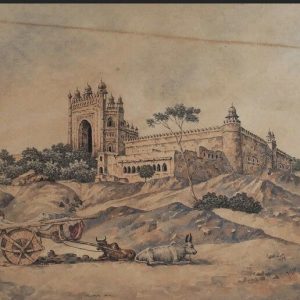


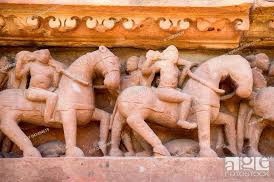

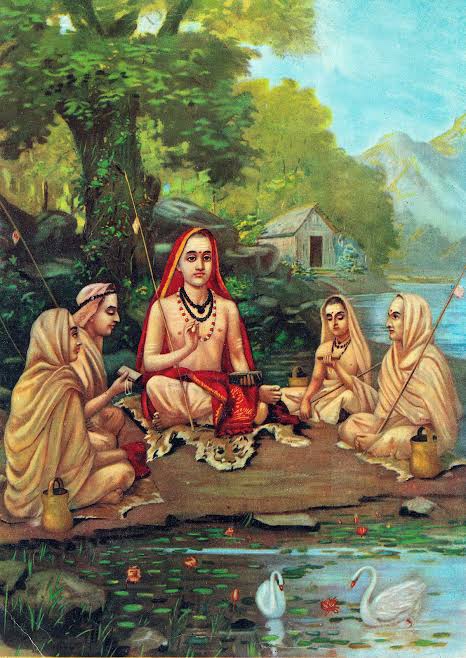
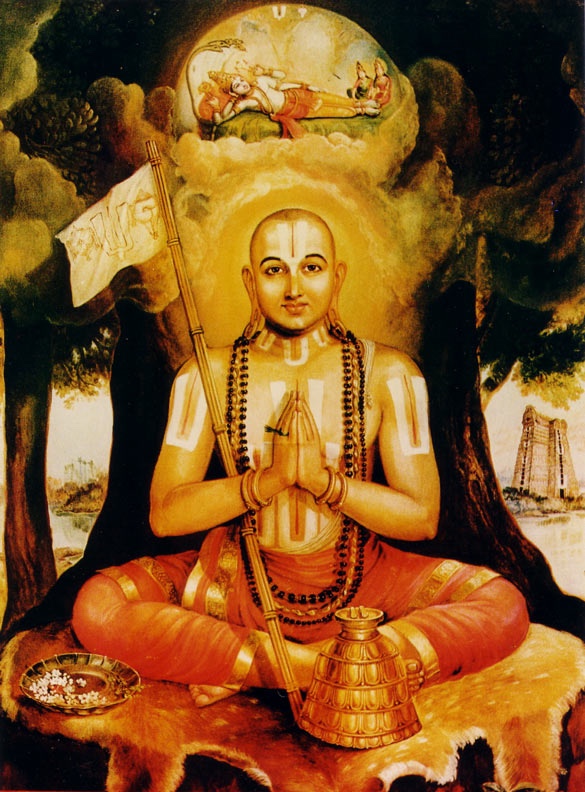
 ASHA: Blast From The Past