The revenue assignments made by Babur to his nobles are generally referred to as wajh. There are some other terms which we hear about: wajh-i istiqamat, wajh wa istiqamat, wajh-i ulufa and wajh wa ulufa which were inter-changeable. The holders of these revenue assignments were known as wajhdars.
The earliest mention of the term wajh in a fiscal context is found in the Tarikh-i Firuzshahi of Shams Siraj Afif. Under the Lodis this term was probably an equivalent of iqta.
Under Babur, however, the term wajh had a different connotation, as compared to iqta: the iqta could be sub-assigned. Under Babur, wajh appears to have been fixed sums out of the total jama of a territory. The rest amount (out of the territory assigned) was to be treated as khalisa. Thus Babur’s wajhdars were not granted specified lands but specified sums of money out of the revenue of the territories. These territories were, unlike the jagirs, assigned by the Mughals later on.
In the wajhdari system, various territories were put in overall charge of various nobles, who were assigned a fixed sum out of the revenues of their respective charge for their maintenance. This was known as the wajh.
A wajhdar, therefore, was an overall in-charge, both fiscal and administrative, of a territory assigned to him by the emperor and could claim only a fixed sum for his maintenance as specified by the emperor.
But then, there being no check on the authority of the wajhdar, there was every possibility that he could misappropriate the state dues.
We also find cases that sometimes individual parganas, with their total jama could also be assigned as wajh to a person.
Thirdly, sometimes the wajh of the assignee in the pargana could also exceed in amount the wajh of the assignee of the whole territory. Thus a territory might be held by a noble in wajh, but inside the same territory, a pargana could be assigned to another noble as wajh. But this assignment was directly by the emperor; and a wajhdar was not empowered to sub-assign his territory to any one else as was the case in iqta.
Further, we also encounter cases where there were nobles whose wajh had been fixed but who were not given any pargana or wilayat (territory). These were obviously paid their istiqamat or ulufa from the Imperial territory.
It appears that the wajh / wajh-i istiqamat was an administrative charge and not of revenues. This is highlighted from the example of Alwar. We are informed that Alwar was offered to Khusrau with his ‘wajh wa istiqamat’ fixed at 50 lakhs. When he declined, it was offered to Tardika, who had his wajh fixed as 15 lakhs. Thus this assignment could never have been against, or in lieu of, his wajh. The wajh kept varying while the jama of Alwar remained static. The wajh would thus vary as per the status of the noble and was not in relation to the jama of the territory bestowed on him.
From the above it appears that
a) The terms wajh, wajh-wa istiqamat and wajh-i istiqamat were inter changeable.
b) Assignment of a territory (pargana or wilayat) generally followed the fixation of wajh.
One can say that in the wajhdari system of Babur, the emperor fixed the wajh or salary in terms of cash. The wajh so fixed was generally granted in the form of revenue assignment of a territory or pargana. In case the wajh or salary of the noble was less than the jama of the territory, the wajhdar would collect his amount of wajh as well as the other amount which was for khalisa. In case his wajh and jama were equal, the wajhdar was simply an assignee of the total revenues against his wajh.
Thus we can say that there were three types of wajhdars under Babur:
1) Those entrusted with additional responsibility (e.g., wajhdars of Sirhind, Alwar, Tijara, Bayana, Qannauj)
2) Those who were assigned parganas specifically against their wajh
3) Those who were not assigned any territory but were paid in cash.
The amount sanctioned as wajh was probably sanctioned for both personal maintenance as well as maintenance of military contingents (which consisted of naukaran and biradaran wa khweshan. Failure to render service could result in the resumption of the status and confiscation of pargana or wilayat sanctioned against their wajh.
Another salient feature of the wajhdari system was that the wajhdars were not normally subjected to transfers. However, one should remember the time span of Babur’s rule.
Finally, on the death of a wajhdar, it was the privilege of the emperor to dispose of the retainers of the wajhdar.
Thus it was a system which had its roots in the iqta system on the one hand and on the other, it contained the seeds of the mansabdari and jagirdari system as developed by Akbar.
Khalisa
In the administration of Babur we find that the whole empire was divided into two
wajh
khalisa
There are instances, in fact two, where Babur reserved parganas for khalisa. For example, Bahlolpur in trans-Sutluj area, and Dholpur near Agra.
The revenues of Lahore, Delhi & Agra were also earmarked for khalisa and were not given out as wajh. We hear of two officers appointed at Lahore: Abdul Aziz mir akhur as darogha and Khwaja Husain as diwan-i khalisat-i Lahore. The posts of diwan and shiqdar were associated with the administration of the khalisa.
Further, there is a reference in Baburnāma that when dak-chaukis were prepared to be established between Agra & Kabul, it was specified that they would be maintained from the expenses borne by amirs if they were in the parganas held by them, but if it lay within the jurisdiction of khalisa, the expenses would be borne through the income from the khalisa. This suggests that parganas of khalisa were spread over between Agra & Kabul.
In addition to the normal ordinary share of the khalisa, which used to stand around 10-15 % of the revenues, Babur says that in 1528 he made a general reduction from the assignments of the nobles to the extent of 1/3rd of their value. If, keeping in mind these figures, a calculation is made, it is possible to establish, that, under Babur, after 1528, the revenues of the khalisa came upto 38.6% ~ which was something unprecedented.
In Baburnāma is given a list of sarkars and the expected revenues from them. The total revenues are calculated as Rs. 52 crores. Out of this, Babur says, 8 to 9 crores used to come as peshkash, while the rest was from Imperial revenues.
We know on the authority of the sources of the Sultanate as well as the 17th C, that in the normal course, khalisa revenues would be up to 15% of the total revenues.
Thus to begin with, it was 8 crores. But then 30% of the revenues, which were given out to nobles as wajh, was transferred to khalisa in 1528. Then, additional 5% revenue was reserved from grants (wajh-i ma’ash), as was the case under Sultanate.
Now if we calculate: 5% of 52 crores would be in the range of 3 crores. Thus 8 crores + 3 crores = 11 crores. Thus the revenues passed out as wajh to the nobles would be in the range of 40 crores. 30% of this 40 crore would be 12 crores. And this in 1528 was transferred to khalisa.
Add 12 to 8 crores, and we get 20 crores! This 20 crores was reserved in khalisa after 1528. And this is a very high share reserved for khalisa under Babur. This continued down to the time of Akbar. According to Irfan Habib, under Akbar the revenues from khalisa stood at 25%.
In this way, Babur tried to bring centralization. In 1528-29, or perhaps still later date, Babur appears to have made an attempt to further augment the khalisa revenues by imposing ushr, i.e., 1/10th of the produce of the land, on the madad-i ma’ash holders. Ordinarily, these grants were revenue-free grants to ulama, intellectuals, relations of soldiers killed in action, officers, ladies of distinguished families and Saiyids. But throughout there was a debate amongst the ulama regarding the nature of these rights as far as this grant was concerned. Whether this land would be milkiyat (property) or just held it at the pleasure of the king. Ulema held that they were milkiyat as these lands were taken from the non-Muslims. Whether ushr should be imposed or not depends on the position of the land. If the land belonged to the state, then there could be no ushr. But as soon as state accepts it as property of men, then ushr is applicable.
This whole theoretical debate is given by Shaikh Jalaluddin Thanesari in his Tahqiq-i Arazi-i Hind.
Thus when Babur applied ushr on madad-i ma’ash, he was giving concession to the ulema. On the other hand, he was also wanting to increase the income of the state exchequer. Evidence on which we can make this deduction is actually a letter written by Shaikh Abdul Quddus Gangohi to Babur in a harsh resentful language. One specific demand made in this letter is to immediately withdraw the ushr. He taunts Babur by saying “Begging from a needy person is not wise, how you can justify taking something from a faqir?”
This gets significance by another evidence, which is an early farman of Babur confirming a grant established by the Lodi kings in the Punjab region. In this farman Babur prohibits his administration from realizing ushr from the grantees.
If we put these two evidences together, what we get is that Babur introduced this and nobles were resentful. In the beginning, Babur did not impose ushr and went out of his way in prohibiting it in the early period. But sometime later, he decided to impose the tax on the grantees. We don’t know whether ushr was again abolished or not. But what Babur was trying was to centralize the state finances.
An Attempt to Assassinate Akbar, Jagan, Bhawani Kalan & Madhav, 1564, Akbarnāma, V&A Museum, London
In May 1662 a senior Turani noble Mirza Sharfuddin revolted against Akbar. This is important to note as this revolt set the pattern for a number of revolts that took place during the subsequent period of 3 years. In 1564 an attempt to assassinate Akbar was made outside the Madrasa of Maham Anaga by a man associated with Mirza Sharfuddin. In all these revolts, one finds nobles concerned took initiative in starting hostilities against the central authority without ostensible or immediate provocation from the other side. These revolts may thus be interpreted as the manifestation of the disaffection of a powerful section of nobility against Akbar. One could also say that they are a manifestation of a wide struggle between Akbar and an influential section of his nobility.
That these revolts in a short period of three years were not ordinary revolts but a reflection of a deep conflict growing, is borne out by their unusual frequency: in 3 to 4 years period, 5 or 6 major rebellions covering the entire empire and its different regions is not something to be regarded as part of an ordinary process.
Turani Revolts?
All those involved in these revolts were Turanis: it was basically a struggle between the central authority and the Turani nobles entrenched in different regions and important positions. The only exception to this was the revolt of Asif Khan.
Let us also remember that in each and every revolt, the initiative was taken by rebel nobles: These revolts were not a result of any specific complaints but a result of general alienation and disaffection of a particular section of the nobility. Again, from the history of these revolts, it also seems that throughout this time, Akbar was defensive, trying to save his neck, though Abul Fazl paints him to be composed and secure. Though he had given concessions to these rebellious groups and was defensive under the heavy pressure when Abdullah Khan Uzbek rebelled – he tried to dissuade him through negotiations via Munim Khan. Even in the case of Ali Quli, Akbar knew six months in advance but he did nothing. Instead he sent emissaries to negotiate but to no avail.
Turani vs Irani?
Another feature of these revolts was that amongst the Turanis, the dissatisfaction was much more widespread than what was reflected in the act of actual defiance of the nobles. Even those who co-operated with Akbar, by and large, were also not very happy with him. A lukewarm attitude was followed by them. We find that during Mirza Sharafuddin’s revolt, when expedition was sent to suppress him, the Turani officers included in this expedition did not fully co-operate with some of the Irani nobles whom Akbar had appointed as the commander of the army. For example, Abul Fazl tells us that during this campaign, some of the Turani nobles turned against their own Irani commanders and killed them. It was in this manner that Ahmad Beg and Sikandar Beg were killed. Similarly were killed Husain Quli, a nephew of Bairam Khan and his younger brother.
Abul Fazl also states that there was wide spread dissatisfaction among ordinary Turani nobles that the expeditions were being commanded by the Iranis.
Another case of Turani dissatisfaction was the attitude adopted by Munim Khan, who was still a formal wakil. We know that after Asif Khan deserted his post, command of the army against the Uzbeks in the east was given to Munim Khan. When he took up the command a problem arose: While the Irani officers in the government adopted a belligerent attitude – they were in favour of a military solution to the conflict – the attitude of Munim Khan was different. He persisted that as far as possible, direct hostility be avoided. He had called Ali Quli Khan to negotiate and Akbar had agreed. When negotiations dragged on for months, the Khurasanis alleged that he was by talking; employing a delaying tactics and that he was in sympathy with the rebels. It was alleged that his co-operation with Akbar was slightly tainted and was in fact taking side of the other party in negotiations.
Abul Fazl also quotes that on one occasion when Ali Quli Khan was staying at Muhammadabad near Ghazipur, Akbar tried to surprise him there. Akbar was at Ghazipur. He ordered the royal forces to capture the rebels. Munim Khan deliberately delayed the march from Ghazipur by a few hours and sent message to Ali Quli to leave Muhammadabad and he was saved from being captured. Abul Fazl says, this came to Akbar’s notice immediately but he did not take any action against Munim Khan as he did not mean any harm to the person of Akbar but thought that the proper course would be reconciliation.
So one can say, that, the behaviour of Turani nobles in general was such that dissatisfaction amongst them was almost universal.
As a corollary of the Turani revolts, it is quite understandable for Akbar to depend increasingly on non-Turanis – particularly the Irani nobles. Thus we find that during this time all important offices in the central government were held by the Khurasani officers.
In 1564 Muzaffar Khan was appointed wakil-i kul. The central government at this time was controlled by a set of Irani officers including persons like Khwaja-i Jahan (Khwaja Amina), Muizzul Mulk, Khwaja Ghiyasuddin (Asaf Khan) etc. A few Turanis who were allowed to continue were however not given much power: for example Munim Khan was without much power or influence.
Similarly in appointment to high positions and high commands in the army, it was the Iranis who were preferred over Turanis.
In the 1563-64 expedition against Mirza Hakim and Abul Ma’ali, Iranis were appointed. Against Ali Quli, an Irani, Abdul Majid was sent as commander.
So a feeling of rivalry between the Turanis and Khurasanis was bound to develope.
The initial cause for this dissatisfaction, as we have seen, was the drastic measures initiated by Akbar to eliminate the influence of Maham Anaga’s influence: this is borne out by Mirza Sharafuddin’s rebellion.
But then Maham Anaga died 40 days after Adham Khan’s execution. Still in these rebellions different factions of Turani origin kept on participating. So factors which led to this situation were much deeper than just measures against Maham Anaga faction.
Economic and Administrative Reasons
Some tentative explanations which can be put forward for explaining this phenomenon is as follows:
The scrutiny of the jagirs of the nobles with the aim of ascertaining the arrears of the khalisa revenues was perhaps a very important factor leading to the general dissatisfaction of the more powerful groups of nobility.
At this time, the nature of jagirs was different from that which was given in the latter half of Akbar’s reign, or the jagirs as we find under Jahangir and Shahjahan. At this time entire sarkars would be placed under the control of a particular officer and the revenues of the same sarkar would be given under his jurisdiction with the only condition that a fixed portion of the revenue be treated as khalisa revenue which the noble after collection had to deposit in the central treasury. The jagirs and administrative charges were concomitant and the khalisa revenue was specified only in quantity and not in terms of parganas or mahals. The responsibility of its collection was on the jagirdar: and thus he was having the opportunity to usurp them if he wished so. That is why the scrutiny would be needed: the total collection from the region was placed under his charge as his administrative-cum assignment charge.
Secondly the problem was further accentuated owing to the existence of inflated jama’. Ain-i Nuazdeh sala shows inflated rates. Natural consequence of inflated jama’ would be considerable hardship to the nobles. The actual income would be much less than that indicated on paper. Thus to collect the revenues that would be assigned to them in the form of jagirs given against individual parganas and mahals, these nobles would have the tendency to usurp the khalisa revenues which was also their responsibility. It was unavoidable thus that the noble would fail to deposit khalisa share to the state. So if the aim of the state would be to calculate khalisa arrears, everyone would feel panicky and threatened. They would also feel the hardship involved in this endeavour.
In addition, from 1564 onwards, Akbar had adopted an administrative policy which was again bound to create discontent amongst the Turani nobles who were the most established and powerful group of nobles at this time.
One of the policy matters of Akbar after 1564 was the dispersal of the nobles belonging to the same clans to different areas and sarkars. So a deliberate policy was initiated, of not allowing nobles of the same clan to have jagirs in contiguous areas. Till this time the established practice was that a senior noble would be assigned a jagir, say in Punjab; others of the same clan would be given territories around it. The entire military command of that area would be thus with this senior officer. This was a great leverage for the senior officers with the central authority. There were many such clan clusters during this time. For example, the nobles of the Atka Khail led by Shamsuddin Muhammad Atka had their jagirs concentrated in the Punjab region till 1567. Similarly the Uzbeks were concentrated in the Awadh and Jaunpur region. The Qaqshal clan was in and around the sarkar of Kara Manikpur. The Mirzas were concentrated in the region of Sambhal.
This was a general pattern till 1564, when onwards Akbar followed a deliberate policy of breaking these ties and concentrations. Incidentally all these clans named above were Turani tribes and clans. The Atkas were a Turkish clan.
That such a policy was deliberately followed and that it was not liked by the nobles, isa got from Bayazid Bayat, who records a conversation which took place between Akbar and Munim Khan. The import of this conversation was that Akbar boasted of scattering Atka Khail all over the empire deliberately. Perhaps this policy was being pursued over a long period since Akbar took effective control of running the administration in his hands. And perhaps this became yet another factor which provoked the Turani nobles to rebel one after the other. Atleast some like Munim Khan and Majnun Khan Qaqshal nursed this as a grievance against Akbar.
Bifurcation of Military & Administrative Responsibilities
Another point is that from 1564 onwards, Akbar’s policy was to exclude important military officers from the working of the central government altogether. They were given charges of different regions and not allowed to stay and interfere in the working of the local administration. This job was handed over by Akbar to a set of Khurasani officers who had no following of their own: their only qualification was that they were competent persons in respective fields and were always prepared to implement policies imposed by Akbar without bothering about the consequent reaction of the nobility.
It is actually quite intriguing that Zahiruddin Muhammad Babur, who came to India with such a small band of followers (not more than 8000 or 10,000 fighting hands and 125 or 150 military commanders) was able to worst armies which were more than 1 lākh strong!
A number of historians have tried to assign a number of causes for this brilliant success. Broadly speaking these reasons can be divided into two:
(a) The internal weaknesses (both political and economic) of the Indian states; and
(b) The strengths of the invaders: military, technological as well as tactical
Some textbook writers have tried to argue that it was the knowledge of guns and gunpowder which gave Babur’s forces an edge over his rivals. In a separate blog, we have already grappled with this and concluded along with scholars like Iqtidar Ālam Khan that Indians had a knowledge of both these things much before Babur entered the scene.
Let us first deal with what was the condition prevalent in India prior to Babur’s entry, which helped in strengthening his position and facilitated his success.
In spite of the large social base of the Afghans in Hindustan, the hostility of the population towards the Mughals who had come to be identified as uncouth, barbarian and hostile for at least 200 yrs, made the task of Babur and the Mughals difficult.
The Muslim population of India was also very hostile as against what Rushbrooke Williams says. Some passages in Lataif-i Quddusi go to suggest that Abdul Quddus & his relations were greatly apprehensive of the situation and were against Babur. The ashraf (of the Karnal area left their houses & shifted to a place in the rear of the Lodi army. After the Lodi defeat at Panipat, even Abdul Quddus Gangohi was taken prisoner & dragged behind a horse up till Delhi. Babur, we are informed by Lataif, attacked a dargah & burned a library. The Lataif-i Quddusi has certain letters depicting the oppressive nature of the Mughals, atleast in the initial stages. Babur in fact, did not command any support amongst the local Muslim population.
The Lodi Empire and Its Drawbacks:
The Lodi Empire was an Afghan Empire. The majority of the officers and nobles were from the Afghan regions. The Afghan identity gave it an advantage as there existed a large number of Afghan populations in N. India as a result of the continuous process of migration throughout the Sultanate period. By Tughluq period two Afghan rebellions against Mohd Tughluq had occurred. Then in 1441 Bahlul captured power with large Afghan following. He made a direct to Afghan tribal sentiments. The text of Bahlul’s announcements and farmans have been quoted by Abbas Khan and other Afghan history, the Tarikh-i Khan Jahani. Mushtaqi also wrote that he made an appeal to the Afghan tribals.
To quote Abbas Khan: ‘God in his goodness has granted kingdom of Delhi to Afghans….whatever be conquered shall be shared with us’.
Thus RP Tripathi calls it the Afghan Confederacy. But then, not withstanding the Declaration, not all Afghans were given a share in the empire. Distribution was made between the favoured and the privileged on the one hand and those not important to be given position. For example, nobles under Bahlul and Sikandar Lodi were recruited from the clans of Lodis, Sarwanis, Lohanis and Farmulis (the Shakhzadas of Ghazni). The others were ignored and totally excluded. For example the Niazis, who were supposed to be the uncouth people and not fully fit even for the army. Similarly ignored were the Surs and the Kakkars etc.
Thus one can say that the Lodi Empire, which Babur replaced, was not an empire with Afghans having equal share.
Let us also be clear that from the very beginning, in the Lodi Empire the non-Afghan section was given a considerable share. Thus it was not exclusively an Afghan concern. The Indian Shaikhzadas were recruited in large numbers in the nobility. Thus for example, Shaikh Ghuran of Koil, the Syeds of Amroha, the Shaikhzadas recruited from the Gangetic plain and the Punjab. Then there were also incorporated a large number of Rajputs under Sikandar Lodi.
So by Sikandar’s time, the Lodi nobility was divided into two groups: (1) the Privileged Afghan clan groups; and (2) People of Non-Afghan origin, some of whom were non-Muslim and Rajput chieftains. This made the social base of the Lodi state very wide, in fact much wider than the early Mughals.
There was a large Afghan population. It has been roughly estimated in the range of 80 lakh families, i.e., 4 crore Afghans. Afzal-ut Tawarikh gives this number to explain Humayun’s defeat at the hands of Sher Shah. In addition to this, a very large section of Hindu chiefs were given a share in the Empire. The Lodis could rally the population paying allegiances to these groups.
This is reflected in the hymns of Guru Granth Sahib (tr. Macaulay in Sikh Religion vol.I) which suggests that the overthrow of the Lodis was a loss to the people. But in spite of the large social base behind them, the Lodis were not able to throw back the Mughal challenge. This can be explained if we keep in mind the contradictions in the Lodi state between the Lodi aspirations and centralization on the one hand and the decentralization of aspirations of the Afghan nobility. The history of the struggle between the two date back to the period of Sikandar Lodi. He gave up many of the policies and measures of Ibrahim Lodi pacifying nobles of equal position. This was altered and resulted in wide-spread discontent. Sikandar had no alternative but to depend on the section comprising the non-Afghan nobility in order to deal with the dis-satisfied Afghan nobles. The kind of autonomy which the Afghan nobles enjoyed till that time, and sought to be curbed by Sikandar Lodi, can be gauged by going through Abbas Khan Sarwani’s section on Sher Shah’s early career and his description of Sher Shah’s administration of his father’s jagir at Sahsaram.
Now what impression does this account of Abbas Khan create as far as the position of the Afghan noble’s are concerned?
1. That the nobles were free to decide the mode of assessment and mode of collection from their iqtas: ghallabakhshi or measurement. This indicates that there was no policy laid out by the centre. This is a situation of autonomy.
2. Any extra collection from the iqta or the assignment was pocketed by the noble himself. This was a laxity of the administration. In strong administration, this had to be deposited with the state. But this was not being done so during the reign of Sikandar. Sher Shah talks of ‘extra revenue’ being a boon to his iqta.
3. The noble’s were free to wage a war against local chiefs. They had assumed authority to create jagirs and zamindars to uproot established chief. The job of creation of new zamindars was never allowed or given to a noble, before or after this reign.
4. Afghan nobles in some cases were holding iqtas practically (not in theory) on hereditary basis. When Hasan Khan Sur died, a tussle arose in which Sher Khan won over his brother to hold over his iqta.
5. The principle of transfer of iqta followed under the Khanljis was conspicuous by its absence at this time.
During the reigns of Sikandar and Ibrahim Lodi revolts became more accentuated. For eg. Daulat Khan Lodi who controlled Punjab revolted and invited Babur to come to Hindustan. Alauddin Khan Lodi also turned against Ibrahim. The revolt of the Farmuli nobles was also a result of this situation.
The contradiction between the king and the nobles further accentuated and differences sharpened due to yet another factor. This was the shortage of precious metals which eventually resulted in the minting of smaller number of silver and gold coins during the Lodi period. This is borne out by the surviving collection of the silver and gold coins of this country. The surviving coins from the pre-Lodi period as well as those from the Mughal and Sur period is quite large. The surviving gold and silver coins of the contemporary states are also considerable. Their number is quite large indeed. This for the first time is noticed by John F.Richards, ‘Economic History of Lodi period’, JESHO, Aug’65
This paucity would naturally affect the position of the nobles. Further on account of slowing down of the pace of the money economy, resulting from the absence of silver and gold currency would promote the custom of collecting revenues in kind and not in cash. Naturally this would lead to paucity of money to raise troops. Absence of ready cash would also affect the ostentatious pretences.
Most probably the shortage of precious metals was due to short supply due to coming in existence of independent states on the coast. Lodi Empire had become land-locked, says Moreland. Edward Thomas, ‘Economy of Pathan Kings’, says this short supply was a result of Timur’s plunder of 1498. Richards has however pointed out that if this was the result of land-locked nation, then why the other land-locked states not experienced the same shortage? In case of Kashmir or Mewar or Malwa, we don’t observe this phenomenon. Richards also points out that Timur’s plunder is also not a good explanation. His explanation is that Bahlul paid lip-service to the nobles as the brothers wanted to curb their independence and power by withdrawing gold and silver currency deliberately.
Whatever the cause, the nobles were hurt due to this. During Ibrahim’s reign this situation became almost unbearable for the nobles. Under Ibrahim, for several consecutive years, there were very good rains, and thus bumper crops. This resulted in a sharp fall in the prices of food grains and especially influenced the general price index. Side by side to this, before Ibrahim Lodi, there was the introduction of a new coin. Bahlul had introduced this coin which came to be known as the Bahluli Tanka. This was different from the tanka of the Sultanate period. It was of copper (tanka-i siyah) and had a ratio of 1:20 with earlier coins. Thus this was a debased tanka and this was a further catastrophe. The result was that the peasants were not in a position to make payments or submit revenue to the nobles in cash or in the new copper tanka. And whatever revenue was collected in kind was almost entirely valueless as there was no market for it. Thus the income of the nobles was further adversely affected by this. Thus we encounter widespread revolts during Ibrahim’s reign. Thus the fiscal policy was partly responsible for the extinction of the Lodis.
Handheld Guns and Manoeuvrability
Still we can not deny that the kind of fire-arms used by Babur was something new for the Indians. It also cannot be denied that the way and manner in which he used them was also new. The novelty of fire-arms and the tactics employed for use was something which gave him military and strategic advantage.
One very great advantage was that by the time Babur invaded the Lodi Empire, the rulers & common people had not yet become familiar with the handguns: they were familiar with the canons but Babur’s soldiers were equipped with some kind of handguns, the arquebuses & matchlocks. The arquebus was a gun which fired by putting the burning object in touch with the hole in the barrel held in the hand.
Thus the new innovation brought by Babur was not the gun & gunpowder, but the use of handguns in open battles. This was an innovation which in Hindustan had not yet become common outside Gujarat in 1526. It seems that the arquebus was not fully known outside Gujarat & certainly not in the North-western region. Babur in the siege of Bajaur describes the reaction of the local garrison to his use of handguns in a manner which goes to indicate that most probably the Bajauris were not familiar with this particular kind of firearms:
“As the Bajauris had never before seen tufung, they at first took no care about them; indeed they made fun when they heard the report and answered it by unseemly gestures. On that day Ustad Ali Quli shot at, and brought down five men with tufung; Wali the treasurer, for his part, brought down two; other matchlock men (tufungchis) were also very active in firing and did well shooting through shields, through armour, and brought down one man after another. Perhaps seven, eight or ten had fallen to tufung fire (zarb-i tufung) before night. After that it so became that not a head could be put out because of the fire.”
This account dates back to 1519, around the same time that Barbosa says that handguns were used in Gujarat.
These tufungs were evidently matchlocks whose use had spread rapidly east from the Ottoman-Iranian borderlands. Venetians sent firearms to north-western Iran to the Turkic Aq Quyunlu enemies of the Ottomans in the late 15th Century. They may have spread further east then – and perhaps with even greater speed following the Ottoman use of firearms when they shattered the Safavid army at the Battle of Chaldiran in 1514.
At Bajaur Ustad Ali Quli twice used a weapon which was called “Farangi”. Babur says the weapon used fired farangi tāshi (farangi stones). The Safavids use the term top-i farangi for the weapon they used in a battle in 1528-29.
The second point is that Babur introduced the handgun in the open battle where it was used by infantrymen who would fire their guns while standing on the ground. Other on the coast, were used to firing from the back of the elephants. In the case of Babur, the handgun wielders were made to stand on the ground & fire: this was a great advance in the technique.
Thirdly, it seems, Babur not only brought with him the most advanced guns which he borrowed from the Ottomans, but he also, for the first time utilized them in an open battle. Before this all reference in Hindustan which we have are either for the use of canons as shore battery against ships or their use in siege operations from fixed positions. We don’t come across the use of canons or handguns before 1526 in an open battle.
Such deployment would need proper kind of carriages to take them swiftly from one place to another. Such a technique was yet to evolve. Secondly it was not possible for the gunners to change the direction of the guns swiftly: they could be fired from fixed positions in one direction. Thus the cavalry would be in a position to capture it – almost half an hour was needed to fire one piece. In this half an hour, the rival cavalry could overcome it thus making the use of heavy canon useless in an open battle. But once fired from the ramparts of a fort, this fire could be effective: the danger of the artillery being over-run by cavalry would not be there.
The genius of Babur lay in the manner in which he used his artillery, his handgun-men, the tufungchis at Panipat and Kanwa. He ensured their safety of his canons & tufungchis to the same extent to which it would be ensured from the ramparts of fortifications. It also did not hamper the movement of his cavalry.
The Tactics: Tulughma and Use of Araba
There were 10,000 troops along with Babur. The whole army was divided into tulughma formation of three units, the right wing (maimana), the left wing (maisara) and the centre (hashm-i qalb).
It was in 1507 at the Battle of Qandahar that Babur had used the battle order (yasal) which came to be known as the tulughma formation. Mentioning this with the fact that he commanded very few men, Babur writes:
“I prepared an excellent battle order. Never before had I arranged things so well. In the khāsah tābīn, the imperial troop, for which I selected all proven warriors, I appointed commanders of tens and fifties, [after] dividing them up into [sections] of tens and fifties. Each [section] of ten and each [section] of fifty stationed at the right and left, were prepared: they knew their positions, their orders and were ready for the onset of battle. Right and left flanks, right and left wings, right and left sides, right and left, mounted, formed up without difficulty and without the help of a tovachii, an adjutant, each [section] was properly positioned and so forth.”
In an elaborate note Babur carefully explains these divisions of his force. He identifies three major subsections: irawul / harawal or vanguard, the ghol / qalb, the centre, and the two wings, the baranghar / maimana or right wing and the javanghar / maisara or left wing. The qalb / ghol itself was subdivided into two principal sections: the khasa tabin, the imperial troops, and the two sides: an ong qol, or right arm and a sol qol or left arm.
Tulughma Formation
He further divides the khasa tabin into five subdivisions, the boy or inner circle with its ong, right, and sol, left, and its ong yan, right side and sol yan, left side. However, when describing actual battles, Babur rarely identifies all these subsections but usually only names leading members of the vanguard, the centre and the right and left wings.
Yasal
Placement of Araba before the canons
The araba formation was also preferred. He deployed ordinary carts tied with raw hide as a barricade. Between each column of the cart he left space for 100 troopers to pass in one row. Behind these carts he deployed mantelets (turah) which were stands giving protection to individual gunners & support for his handgun. Then, behind he deployed his advance guard under Khusrau Kokaltash. On one side of the advance gaurds were the firangis: i.e heavy mortars cast in bronze (from W.Eur). On the other side he deployed the zarb-wa-zan, the light artillery.
Behind the zarb-wa-zan he stationed his left wing (maisara) of the army. Behind the firangi he stationed the right wing (maimana) commanded by Humayun. Then behind these columns were the large central reserve, again divided into centre (hashm-i qalb), right (maimana) & left (maisara). Babur himself was in the centre. Then on the flanks were placed two flanks of the central reserve: the turning party of the left and the turning party of the right. These were for delivering the charge. The turning parties would issue away from the enemy, turn abruptly & deliver charges on the flanks of the advancing enemy.
This was the battle plan of the ghazis of Rum. He resorted to tulughma tactics which he had experienced with the Uzbeks.
He divided his army into different flanks which were to wheel around and surround the enemy. On three sides he had complete defence: he dug ditches on two sides and on the third the the town of Panipat. The only course left was to charge from the front where Babur had placed the carts. But this was not hampering the movement of Babur’s party as there were sufficient spaces left in the front line for them to move.
On the Afghan side, the battle plan was conventional. It spread on a large track. Ibrahim’s troops had to compress to launch an attack on the enemy. Babur says that Ibrahim Lodi was a young man of no experience and was negligent of his movements.The crowd became dense, and when they reached close range to Babur’s artillery, they were pressed and pushed from the behind. The confusion increased. At this point Babur’s effective use of artillery fire slaughtered them. They could neither advance nor withdraw. They had no option but to be slaughtered.
Thus the artillery and the tufungchis played a decisive role due to the novel battle plan drawn by Babur which he had borrowed from the ghazis of Rum. Salim the Terrible had used it in the Battle of Chalderan against Ismail Safawi of Iran.
At Kanwa, the only difference was that side by side with the cavaly, the tufungchis were also moving: the tripods on which the canons were mounted had had wheels to move them; and the chains tying the carts were now iron chains. The effect of the araba & tulughma war tactics in this battle was also same: the Rajput soldiers were demoralised & badly defeated.
Maham Anaga with Akbar in the court. Akbarnāma, Victoria & Albert Museum (detail)
One common feature which marked the administration after Bairam Khan’s dismissal was the tussle between Akbar and an influential section of his nobility. Down to 1564 it seems that the struggle was mainly confined within the central government.
Nature of Central Authority
Let us see what happened during this period. The question is: what was the nature of the central administration that came into existence immediately after Bairam Khan’s dismissal? Was this government after the coup of Bairam, under the full control of the king or did it represent consensus of factions of nobles fighting Bairam Khan in the preceding 4 years? An answer to this will depend on another question: How do we characterize the coup d’ etat that resulted in Bairam’s ouster? Do we characterize it as a victory of the king over a consensus of nobility? Or was it basically the victory of the nobles in general over the centralizing trend within the state, as represented by the regent, Bairam Khan?
So far as the evidence which we have regarding the character of the change-over of March 1560, it is true that sometime an impression is created that, perhaps, for the ouster of Bairam, and the developments which took place afterwards, initiative was taken by Akbar himself, giving an impression that all fighting against Bairam were in fact Akbar’s tools. Maham Anaga, Adham and others on Akbar’s initiative itself, followed the emperor to secretly leave Agra and then announce at Delhi the dismissal of Bairam Khan.
But then we have some other evidence also giving entirely different impression, indicating that the entire process and the moves were initiated by the group of nobles led by Maham Anaga and Mirza Sharafuddin and that these noble were actually using Akbar for building their own authority in the Central government. In fact Akbar being in this scenario only a tool in their hands!
If one reads Badauni, an impression is created –re-enforced by Abul Fazl to some extent – that throughout the period when the tussle was going on between Akbar and Bairam Khan, the real authority was being held in the hands of Maham Anaga.
Abul Fazl informs us that after reaching Delhi, it was Maham Anaga who contrived for her close relative, Shahabuddin Ahmad Khan to be the new wakil. Then after some time to widen the support amongst those nobles who had organized the coup, high positions were awarded to certain nobles at the instance of Maham Anaga. At her insistence wakalat was transferred to Bahadur Khan Uzbek, the younger brother of Ali Quli Khan. It was a subtle move of Maham Anaga as Ali Quli had sided with Bairam Khan. This was done to create a rift between Bairam Khan and those who were still considered close to him. It also remains a fact that the move was conceived and implemented not by Akbar but by Maham Anaga. Thus from Abul Fazl we come to know that power rested in Maham Anaga’s hands and Akbar was doing her bidding.
So this was the nature of the central authority in March 1560. Now let us turn to the new tussles which were arising within this structure.
The Tussle Between Different Groups
To begin with, the coup d’ etat was organized by Adham Khan, Mirza Sharafuddin, Shahabuddin Khan and others. But a few days later, they were also joined by a powerful noble having a considerable following – Shamsuddin Muhammad Atka. His arrival and joining the group at Delhi had a significance. He was very close to Akbar and could influence his mind. As soon as he arrived a rift started within the group, broadly between Maham Anaga and her followers on the one hand, and Shamsuddin Atka and his relations within the nobility, on the other. Then a third dimension was added as a result of the arrival of a number of nobles at Delhi who were actually erstwhile supporters of Bairam Khan, but had just pretended to have broken with him. Abul Fazl clearly states that these people were advised to go to Delhi and stay there by Bairam Khan himself. They included people like Bahadur Khan Uzbek, Qiya Khan Gung, Sultan Husain Jalair, and Muhammad Amin Diwana.
The arrival of this group at Delhi added one more faction into the large body of nobles who had rallied around Akbar of different interests.
So far as they were concerned, they were hostile both to Maham Anaga and Shamsuddin Atka. This group and that of Maham was competing for the control of central government; as to who should be the wakil us saltanat. Maham Anaga transferred wakalat from Shahabuddin Khan to Bahadur Khan indicating that she was coming to terms with this group by giving it the highest office in the state and thus using them against Shamsuddin Atka and thus creating a real rift between this group and Bairam Khan.
Rift between Maham and Atka was on the issue on who was to be appointed as the commander of the army that was being mobilized at Delhi for an expedition against Bairam Khan who was still at large and actively mobilizing nobles’ sympathies for his endeavour to ‘liberate’ the king from the clutches of people who had illegally taken him away to Delhi.
So on both the sides, the formal pretext was of fighting for the king. An expedition was being organized at Delhi for a military showdown with Bairam. Atka staked his claim for this position; Anaga stoutly opposed him. Thus a tussle arose on this issue.
Shamsuddin Muhammad Atka
The one serious setback which Maham received at this time was that the final decision taken was the appointment of Atka to this position. This was a decision taken not by Akbar but through a consensus of the nobles. Many nobles of different persuasions took an independent stand and the decision was taken to appoint Shamsuddin Atka as the commander of this army. This is borne out by a letter that was written by Atka sometime in 1561. Actually in this letter Shamsuddin Atka expresses much disappointment on the fact that after Bairam Khan’s defeat near Machchiwara in Punjab by him, the high office of the wakil us saltanat was denied to him. He not only registers his disapproval of this decision to exclude him from wakalat but he also alleges that he believes that this was done at the suggestion of Maham Anaga, who he points out was against him from the very beginning. And in this context makes the allegation that even at that time of the appointment as commander of the expedition, Maham Anaga had tried her best to frustrate his chances and many did not fully co-operate with him due to this. In spite of this handicap, he was able to defeat Bairam Khan single handedly. (AN, II)
We know that after his defeat at Machhiwara by Shamsuddin Atka, Bairam withdrew towards the Siwalik Hills and took shelter with a local chief and finally he was forced to surrender before Akbar who then sent him to Mecca for Hajj.
Subsequently Munim Khan, Khan-i Khanan, who till then was the governor of Kabul, was appointed as the wakil us saltanat. It is known that Munim Khan was very close personally to Maham Anaga as well as to Shihabuddin Ahmad Khan. Result was that after Munim Khan was appointed to wakalat, the new central administration that emerged, tended to pass almost completely under the influence of Maham Anaga.
Shamsuddin Atka left the court and went to Lahore with his entire clan. On the other hand, so far as the erstwhile followers of Bairam Khan were concerned, their position eclipsed after Bairam Khan was exiled, and thus only Maham Anaga’s faction remained as the only organized group. Though the new wakil was not a follower of Maham Anaga, but he was quite close to her.
“Petticoat Government”?
This was the situation in post-1560 period which represented the domination of the group led by Maham Anaga at the Mughal court. It is also known that side by side with Maham Anaga, Hamida Bano Begum was also taking interest in the running of the administration. So to a certain extent, she was also party to this faction controlling the Central administration. That is why Vincent Smith is tempted to characterize the Central government during this period as the “Petticoat Government”.
There are a number of statements in the Akbarnama which go to substantiate this characterization to some extent. There is a clear statement in the Akbarnama that while Munim Khan was the ostensible wakil, the de factowakalat rested with Maham Anaga.
A Hadīs
Or for that manner, Badauni corroborates this information in an indirect manner when he quotes the comment of one of the contemporary alim, Mir ‘Abdul Hai on the nature of the central administration of this time.
According to Badauni, commenting on the influence of Maham Anaga, Adham Khan and Itimad Khan, a Khwaja sara of Hamida Bano on the administration, Mir Abdul Hai is reported to have quoted on one occasion the following hadith – a weak one at that – which can be seen as a pointer towards the situation:
‘A time will come on men when none will become favourites, but the profligates (awaragard) and none will be thought witty, but the obscene. And none be considered weak, but the just; and when they shall count alms as a heavy imposition and the bond of relationship and reproach; and the service of God shall be a weariness unto them. Then the government shall be by the council of women, and the rule of boys and the management of the eunuchs.’
What is important is that this hadith quoted by Abdul Hai to offer his comments. The last few lines describe the situation, indicating that the powers were being perceived to be with Maham Anaga nad her servants.
Then there is another passage where we find Abul Fazl asserting that Maham Anaga had all powers with her till December 1560 when she took leave from Akbar for arranging the marriage of her son.
Smith and Beveridge both cite those passages which try to characterize that the central government was dominated by Maham Anaga, Hamida Bano and other ladies of the haram while Akbar was a mere tool in their hands.
Tripathi on the other hand, tries to base on two sets of evidences, one, the evidence presented by Akbarnama where Abul Fazl tries to give the impression that Bairam’s dismissal was engineered by Akbar, and Hamida Bano and others were allowed to play the role stipulated for them by Akbar. Tripathi also stresses on the statement of Abul Fazl that in Dec 1560 Maham sought ‘leave’ [actually rukhsat should mean ‘permission] from Akbar for arranging the marriage of her son Baqi Khan. And thus suggests that from this date onwards, and after the appointment of Munim Khan, Maham Anaga was eased out of the position she was enjoying.
Episode of Diwānkhāna
But then we have considerable evidence, say from Bayazid Bayat, that down to April 1561 Maham Anaga continued to play a vital role. Bayazid says that in April 1561, on one occasion Maham was sitting in the Royal diwankhana when she got a chit from Akbar requesting money for personal expenditure. So this much becomes obvious that Maham did not go on ‘leave’ in 1560: she was transacting business in the diwankhana, and till much later, she continued to play an active role.
From Bayazid we come to know that Munim Khan on many issues adopted a policy course which was not approved by Maham anaga and her followers; she in fact stoutly opposed him. For example, the policy which Munim adopted towards erstwhile supporters of Bairam Khan, Ali Quli and Bahadur Khan. The impression which one gets from Bayazid Bayat’s account is that Munim wanted reconciliation between the establishment and the Uzbek nobles who were alienated after Bairam’s defeat. Maham, Shihabuddin Khan, Adham Khan etc tried to create a situation that efforts of Munim Khan would be made futile.
It also become clear that Munim did not play the role of a stooge of Maham anaga, he had his own views and policies which clashed with the interests and aspirations of the dominant Maham anaga’s group.
The view that there was a ‘petticoat government’ does not appear to be true. It is also not true that Maham Anaga was ‘ousted’ or that Munim Khan was only the ‘ostensible’ wakil.
If we take the total evidence then the reality appears to be somewhere between these two extreme views. From a letter written by Shamsuddin Muhammad Atka, it becomes clear that the administration at this time was functioning in a manner that the interests of the members of the faction in power were protected. The members of the dominant faction were able to corner most of the income from their jagirs. The Central Diwani, administered by Khwaja Jahan and Itimad Khan would not insist on payment of central revenues by the local commandants-cum-assignment holders.
So the benefit of this ‘lenient’ policy went to the nobles in general, and the main dominant group in particular.
This is clearly borne out by Bayazid Bayat’s description as well. We come to know that by April 1561, the Central treasury had almost become empty. When Akbar asked Maham Anaga to send him a small amount of ` 18 / – , the Royal treasurer expressed his inability to meet the demand. And Akbar was constrained to remark: ‘From whose jagir shall I take this money?’
This was a direct result of the non-functioning of the central diwani during this period. The administration was dominated by nobles who wanted a loose policy which would undermine the centralization of the finances. Subsequently when the central administration was tightened and pressed the nobles for arrears, treasures started coming and the treasury again overflowed with gold and silver.
Reports of Discrimination
The other aspect of the working of the administration was that it was positively trying to discriminate against those nobles who were regarded by the dominant section as their rivals. This is borne out by Bayazid’s information regarding the transfer of Bahadur Khan’s jagir from Etawa. After his removal from there he was not assigned any other jagir. So there was harassment of those who were not in the good books.
Shamsuddin Atka too makes a similar complaint in his letter when he writes that after Bairam’s defeat, the authorities gave Yusuf Muhammad Khan (Atka’s son) an order for one crore, but it had no tan (or assignment). One crore were assigned to him out of which the authorities paid him only 40 lakhs at Firuzpur (a sarkar in Punjab).
So there are at least two complaints that the new administration did not assign jagirs for the payment that were due. The payment was there only on paper. Atka wrote this letter in April 1561 and it goes to support the view that the central administration was functioning in a biased manner.
One of the earliest move made in April 1561 was the issuance of the order transferring Munim Khan’s jagir from Hissar Firuza to a rather arid and less fertile territory of Alwar. This decision was conveyed to Munim Khan through Maham Anaga. Munim Khan was greatly perturbed and urged the order to be modified; it resulted in his jagir at Hissar Firuza being reduced considerably.
Move Against Adham Khan
Then soon after, we hear of a drastic move initiated by Akbar. This was against Maham Anaga. Akbar marched out of Agra with the aim of going for a hunt, leaving the city to be administered by Munim Khan. When he reached near Gwalior, he turned and advanced towards Malwa where Adham Khan was at the moment. Akbar had heard of Adham Khan’s attitude after his victory over Baz Bahadur and his ill-treatment of the late ruler’s haram. Without informing Maham Anaga, Akbar forced Adham Khan to give an account of the war booty which he had collected in the preceding one or two years. He also asked for the transfer of women of the haram of Baz Bahadur to the Royal officers.
After humiliating Adham Khan, and indirectly Maham Anaga, Akbar returned to Agra from where he then proceeded towards an easterly direction. Officers posted in this direction were greatly alarmed. Ali Quli Khan, who had been charged of withholding some amount from the treasury which he had accumulated as war booty, hurried to submit at Kara Manikpur a large ‘treasure’. Then accompanied with elephants and treasury, Akbar asked Shamsuddin Atka to come from Lahore and station himself at Agra. Thus through these moves, Akbar started asserting his position over the members of the clique running the central administration.
Shift of Power
Finally when Atka arrived, Akbar transferred many of the powers of the wakil to him, without formally announcing his appointment to the post. Officially it was Munim Khan who was formally holding that position, was reduced to a position of subordinate. This was bound to result in jealousies.
One move of Shamsuddin Atka, after becoming all in all, before formally becoming the wakil, was that he started scrutinizing the position of individual jagirs with the aim of assessing the questions of arrears of khalisa revenue pending against them. He did this with the assistance of Khwaja Phul Itimad Khan, who fully cooperated with him.
Secondly, Akbar removed Adham Khan from the position of the commander of the Mughal forces at Malwa without giving him any new position. This infuriated the nobility which was till then in power. Akbar also forced Munim Khan to now formally give charge to Atka.
Assassination of Adham Khan
In May 1562 that famous incident took place which resulted in Atka’s assassination and Adham Khan’s execution.
Throwing of Adham Khan from the ramparts by Akbar, Miskin, Akbarnāma, V&A Museum, London
On a minor issue scuffle started at the court between Adham Khan and Shamsuddin Atka. Adham had him killed in front of central ministers. When Atka after being attacked ran to Akbar’s apartment, Adham Khan followed and stabbed him to death and tried to enter the royal apartment. Akbar at this instance had a scuffle with him in which the emperor with his own hand struck Adham Khan with a sword and ordered him to be thrown to death twice from the terrace. This all is attested to by Abul Fazl, Bayazid Bayat and Badauni.
Thus in this manner the whole tussle was resolved. And from this time onwards an interesting situation developed. Akbar insisted the nobles to serve him as ministers, while people like Munim Khan were afraid that he suspected him of having a hand in Adham Khan’s ‘conspiracy’. At least Abul Fazl seems to be confirmed that these nobles tried to browbeat Akbar. Akbar on the other hand through this crisis tried to assert that he was the master of his own. He forced Munim Khan and others to stay and run the government under his direction. Munim Khan tried to flee, but was brought back and in semi-surveillance and was re-appointed as the wakil us Sultanat.
Further during this time Akbar tried to create a new team of officers, who were distinct from the Chaghtai officers. One such person was Khwaja Ali Turbati who was appointed to the department of Diwani. He had initially been appointed after Bairam’s death and by 1564 he emerged as the rival of Munim Khan. In 1564 he was appointed to the office of wazir-i kul with independent powers. Thus this was the situation from October 1560 to 1564 when Akbar gained a complete hold over the central government.
Akbar sits on the throne at Kalanore as Bairam directs the arrest of Shāh Abul Ma’āli
In this discussion we shall be mainly concerned with the political history of the Timurid Empire in India from Feb 1556 to March 1560: in other words, this would be the political history of the period after Akbar’s accession for about four years when the Mughal empire was run and administered on behalf of the king by one of the senior nobles, namely Bairam Khan Khan-i Khanan. Hence, the term ‘Period of Regency,’ is used to identify this phase. Bairam Khan during this period acted as a regent.
The important developments of this period were two-fold. Firstly it was during this period of four years that the Mughals under the overall leadership of Bairam Khan were able to crush the Afghan resistance which was tending to become quite formidable from Dec 1555 onwards (due to the Battle of Chhaparghat in which Muhammad Khan Sur was defeated).
The second development of this period was that Bairam Khan, of course with the co-operation of the bulk of the nobility, was able to maintain the internal cohesion of the Mughal State in a time of very great strain partly caused by the external pressures, and partly also caused by the internal situations – developments within the Mughal Camp: minority of Akbar and the jealousies and series of rivalries amongst the senior nobles.
The Achievements of Regency
The real extent of these achievements of the period of regency would become evident to us fully only if we keep in mind that in January 1556 the Mughal sway in Northern India was limited to the regions immediately around Lahore in Punjab; and Delhi and Agra in the Gangetic plain. Towards further east, Sambhal and Badaun were the only two points up to which Mughals had extended their authority. The remaining part of the country eastwards was still in the hands of the Afghans.
Further, only two months prior to Akbar’s accession, the Afghans had succeeded in improving their position by eliminating from the scene two contenders against Adil Shah, viz. Muhammad Khan Sur and Ibrahim Shah Sur, and also thereby reconciling of many of the Afghan chiefs like Rukn Khan Nauhani or Haji Khan Sultani who had till the end of 1555 opposed Adil Shah. Thus the position of Afghan chiefs had considerably improved.
Let us also remember that even within the territory already over run by the Mughals, there still existed pockets of Afghan resistance which posed a serious threat to the stability of the Mughal hold even in this region. These pockets were in the Punjab centred round Mankot where Sikandar Sur had entrenched himself with the help of the local zamindars after his defeat at the Battle of Sirhind.
The other pocket of resistance was in the Badaun and Sambhal region where Rukn Khan Nauhani and Shaadi khan were confronting the Mughal local authority and had made it impossible for them to pacify the area.
The third pocket was located to the south-east of Mewar territory where Haji Khan Sultani was still entrenched and he was quite formidable because he had the support of some of the influential local chiefs including the Kachhwahas who later on joined Akbar’s service.
From this position, by the end of the period of regency, Mughal Empire had succeeded in totally stemming out all these pockets of resistance extending up to Jaunpur.
We know that the expansion towards Jaunpur resulted first from the Mughal victory in the Battle of Panipat fought in Nov 1556 and then resulted from the relentless pressure from the Mughal forces in the east under the command of Ali Quli Khan Uzbek and his brother Bahadur Khan Uzbek. As a result of this relentless pressure, by 1559 they succeeded in reaching up to Jaunpur.
The eradication of Afghan pockets of resistance in the Punjab rea was achieved in 1558 as a result of Sikandar Sur’s surrender to Akbar after a siege of Mankot which prolonged for several months.
So the extent of military achievement can be seen from this.
Again, the real extent of the achievement of Bairam Khan in keeping the Mughal nobility united and maintain the cohesion of the empire would become evident to us only if we remember that at the time of Humayun’s death, the Mughal nobility when called upon to control the situation during the minority of Akbar, who was 12 or 13 years of age in 1556, was sharply divided. It was really a difficult task to arrive at a broad consensus over the choice of the person who should assume the responsibility of running the state in his capacity as a wakil-us saltanat and as Akbar’s ataliq.
This problem tended to become more difficult owing to the presence in the Royal Camp of a number of senior nobles, each one of whom could put his claim for the coveted position on one or the other basis. For example, persons like Tardi Beg and Bairam Khan who could claim the offices of wakil and ataliq of the minor king on the basis of seniority. Both were continuing in service since a long time. In fact the position of Tardi Beg was much more stronger as he was already a noble of high rank even during early years of Humayun’s reign. Bairam Khan rose to prominence a few years later, but compared to other nobles he was also very senior. While Tardi Beg was very strong at the time of Humayun’s death by virtue of his being the commander of Delhi which was the headquarters of the empire, and also by virtue of the fact that many of his personal followers, mainly Chaghtais, for example Haider Muhammad Khan Akhtabegi and Tulaq Khan Quchin were controlling territory around Delhi and Agra. In addition to this Tardi Beg was the senior-most Chaghtai noble belonging to the Quchin clan of the Chaghtais, and in this capacity he was recognized widely as the undisputed leader of the most numerous racial group of the nobles.
On the other hand, we find Bairam Khan’s position also tended to become very strong from late 1555 when he was appointed by Humayun as Akbar’s ataliq and sent him with Akbar to Punjab just a few weeks before Humayun’s death. As it is well known, from Agra Bairam Khan went to Hisar Firuza which was Akbar’s jagir, then moved in a north-westerly direction, and at the time of Humayun’s death, he was at Kalanaur, proceeding towards Mankot where Sikandar Sur was entrenched.
So at the time of Humayun’s death, the heir-apparent was with Bairam |Khan. Secondly he had already been recognized as the ataliq of the prince by the late emperor himself. So Bairam Khan could put his claim and be taken seriously. He could become wakil without even asking other nobles.
The Contenders to the Office of Regent
But then in addition, there were several others also to put claim to this high position on the basis of their relationship with the royal family. As example one may name two persons, Khizr Khwaja and Khwaja Mu’azzam.
Khizr Khwaja Khan actually belonged to the ruling chaghtai dynasty of Kashgar, the dynasty created by Timur at Samarqand. He had also married Gulbadan Bano Begum, Babur’s daughter and step sister of Humayun and sister of Mirza Hindal. So he was a direct descendant of Chingiz, as well as the member of Timur’s family. He was stationed in Punjab with a large army. On account of family background and connected to the royal family as well as commanding a large contingent, he could emerge as a viable candidate.
Khwaja Mu’azzam, on the other hand was Hamida Bano Begum’s elder brother. Thus he was Akbar’s maternal uncle. Hamida Bano Begum, we know, was a direct descendant of Shaikh Ahmad Jam Zindapir, a well-known Sufi of Persia. So Khwaja Mu’azzam too had a distinguished family background.
Or for that matter, there were several others who could put forward their claim on the basis of their closeness to the person of the new king. Mention may be made of two persons. One of them was Shamsuddin Muhammad Atka. Although he belonged to a very ordinary Turkish family from Ghaznin and did not have any distinguished background, but he happened to be the husband of one of Akbar’s famous wet-nurse, Jiji Anaga. Akbar felt particularly close to Jiji Anaga and Shamsuddin as during the first four years of his life, he was entirely looked after by these two at Kabul while his parents were away in Persia. While fleeing to Persia Humayun had left Akbar with them, and he had remained with them till 1546. Thus Akbar considered Shamsuddin atka as his father and was attached to Jiji Anaga as her son.
The other person enjoying similar position was Khwaja Jalauddin Bujuq. [Bujuq means a person with a deformed nose]. He was one of the Khurasani officers who had joined Humayun’s service while in Persia. In Kabul in 1547 Bujuq was appointed by Humayun as his Mir-i Buyutat that is, a minister responsible for stores etc. He was also appointed a Akbar’s ataliq. He appears to have been much abler than Bairam Khan. It seems that during the period that he was an ataliq, he had influenced Akbar to a great extent and Akbar felt greatly attached to this person. So Khwaja Jalaluddin Bujuq could also put forward his claim by virtue of his proximity to the new king.
The task of selection of ataliq and wakil was not an easy job. There was every likelihood of a number of nobles to put forward their claim to this high position.
Mutual Tensions & Frictions
This task was rendered still more difficult owing to the fact that many of these high nobles holding high positions at the time of Humayun’s death, had hostile attitude towards each other. For example, we know that Bairam Khan and Tardi Beg had quarrelled with each other during the march of Humayun from Lahore to Sirhind. It was a very serious quarrel because Abul Fazl tells us that in fact one of the persons who carried a message from Tardi Beg to Bairam was beaten up by an enraged Bairam who was provoked by the message sent by his adversary. Serious quarrel was in the background of these two.
Abul Fazl has the following remark to make about Bairam and Tardi Beg’s relations:
Bairam Khan recognized Tardi Beg Khan as his rival and was always apprehensive of him. Tardi Beg too regarded himself as leader of the army and was lying in wait for an opportunity to overthrow Bairam Khan. Each two regarded points of bigotry as the essence of religion and made them additional reasons for watching for opportunities to ruin one another.
Similarly Bairam Khan’s relations with Khwaja Jalauddin Bujuq were far from cordial. Mutual dislike and hostilities existed between the two. This can be surmised from observations which Bayazid Bayat (Tazkira-i Humayun wa Akbar) and Abul Fazl have made on Jalaluddin Bujuq’s execution by Munim Khan, governor of Kabul, at the instigation of Bairam Khan. Both authorities tell us that Bujuq had the dangerous habit of coining cruel jokes on his opponents. And Bairam Khan had nursed a grievance against him for such jokes about him.
Then again, relations between Bairam Khan and Munim Khan were also not at all friendly from the time when Humayun had planned in 1553 to replace Bairam in Qandhar by Munim Khan because Humayun had come to suspect Bairam of having secret links with the Safavids. At that occasion Bairam had got the impression that these suspicions were created in the mind of the king as a result of Munim Khan’s misreporting and advice.
Munim Khan was the senior-most Chaghtai noble after Tardi Beg. He represented one of the most influential groups. He was controlling Kabul at this time, which was still serving as the base of military operations conducted by Mughals in Hindustan. The entire royal haram and the families of most of the officers were quartered in Kabul which gave a particular leverage to Munim Khan in this new situation. Anyone coming to helm of affairs could not afford to have strained relations with the governor of Kabul.
Then there was a serious rift between Bairam Khan and a certain noble, Shah Abul Ma’ali. Shah Abul Ma’ali was a Saiyyid hailing from Tabriz, who joined Humayun’s service sometime between 1545-53 and somehow Humayun developed very great affection for him. So much so that he was to be treated at par with members of the Royal family. Some say he was in love with Ma’ali: if a qasida was written on Humayun, a quartrain would be about Ma’ali also. But Abul Ma’ali was a short-tempered person who found it difficult to get along with the other nobles. He enjoyed extra-ordinary privileges. This man was leading a large army in Lahore region at the time of Humayun’s death. He was leading one of the contingents deputed for suppression of Sikandar Sur in Mankot territory.
According to Abul Fazl, when Akbar was sent to Punjab with Bairam Khan, Shah Abul Ma’ali came to visit him near Sultanpur on the eastern bank of river Sutlaj. But before coming to meet Akbar, Ma’ali sent a message to Bairam Khan that it should be ensured by Bairam that he be received by Akbar in the same manner as he was received and entertained by Humayun. He wanted Akbar to come out and welcome him and take him to the royal audience and ask him to sit on a raised platform – a privilege extended to him by Humayun.
Bairam sent a reply on behalf of of Akbar and it was conveyed that all these privileges are not advisable. And so far as Humayun was concerned, it was contended he showed favour due to personal affection – a rule not binding on other people. So Akbar was not bound to show same special favours.
Ma’ali was greatly enraged by this reply and refused to come.
So break had taken place already. At this time Shah Abul Ma’ali commanded a large contingent. So he enjoyed considerable leverage to manipulate the situation.
Thus Bairam Khan’a choice as a wakil was not a natural choice but a difficult choice made after considerable negotiations and mutual bickering amongst senior nobles. Once the choice was made it was possible for Bairam Khan to achieve the re-conquest of the country.
How Did Bairam Rise to Power?
Now the question is how could it be possible that Bairam was selected unanimously and then carried on as he did? How was it that Bairam achieved as much in so short a time and then his position was so greatly weakened that he was ousted?
As far as the standard interpretation is concerned – that is the interpretation included and put forward in the monographs of Smith and Tripathi (Rise & Fall of the Mughal Empire) – it seems to run on the following lines:
Smith suggests that Bairam Khan was able to become the wakil as he promptly seized the opportunity offered to him by the difficult situation faced by the Mughals in Hindustan. Once he succeeded in capturing power as a result of his prompt action, he then went on extending his power within the Timurid state by appointing his own favourites on important positions and giving important military command to his own men and promoting out of turn his personal followers in the nobility and also by eliminating from position of authority one by one most of his potential rivals. Then it is made out that this behaviour of Bairam Khan resulted in his total isolation not only from nobility but also from the young Akbar, who was, according to this interpretation, so provoked by Bairam’s over-bearing attitude that finally in March 1560, he decided to join hands with those opposed to Bairam in engineering his dismissal.
This interpretation was re-inforced by RP Tripathi who thought that Bairam’s isolation from the nobility had something to do with the Irani and Turani rift within the nobility. He thinks that the majority of the nobles who were Turanis turned against Bairam because he was an Irani. In addition to this, Smith gives yet another reason for Bairam’s isolation in the nobility and his final decline and eclipse: the Shia – Sunni divide. He makes out a case that Bairam Khan used to show excessive favours to his Shi’ite followers which provoked the Turani nobles who were predominantly Sunnis. Smith cites the case of Shaikh Gadai, who according to Smith was a Shia and who had been appointed sadr us sudur by Bairam Khan and was empowered to supervise the working of the Central government in general. According to Abul Fazl, Bairam Khan even sent orders that none of the royal orders pertaining to revenue or military affairs were to be enforced unless they carried the seal of Shaikh Gadai. Smith cites this to substantiate his point that Bairam was in the habit of strengthening powers in the hands of the Shi’ites which provoked the Turani Sunni nobility.
If one carefully examines this standard interpretation of Smith and Tripathi, one finds that it fails to answer many of the questions that arise regarding the history of this period when it is viewed in the background of all the detailed information which we have.
This interpretation fails to fully explain as to how it would be possible for Bairam Khan to become wakil when his position was weak at this time of Humayun’s death. What is not explainable is that he became wakil with the agreement of the entire nobility. How this consensus could be arrived at? What were the terms of this consensus? These questions are left un-answered in this interpretation.
An important question which arises, but is left un-answered is that how if Bairam Khan’s position was not so strong, what were the measures adopted by him which subsequently enabled him to become so strong that within six months, he was in the position to eliminate the most powerful noble of the empire – Tardi Beg – from the scene? What are the actual measures which resulted in this development?
Thirdly, whether Bairam Khan’s overthrow in March 1560, as is suggested by Smith and others, was the result of his growing unpopularity and isolation amongst the nobles for various reasons or are there evidence / evidences to suggest that the situation was not that simple? There were many retrogressions and regressions in Bairam’s position. What are the distinct phases in Bairam’s progress? One has also to ascertain whether Bairam’s downfall was brought about by nobles opposing him or was it as a result of a move initiated by Akbar himself?
Abul Fazl has gone out of the way to suggest that the initiative came from Akbar himself. All that happened and the events which took place were a result of Akbar’s own initiative. The others played side roles.
All those who opposed Bairam were Akbar’s tools. Therefore, according to Abul Fazl, Bairam’s dismissal was actually the victory of the crown over the regent. The question remains, if it was a victory of Crown over the Regent, that is, the centralizing forces over the nobility against centralization, or the success of the centralizing forces over decentralizing elements?
A Fait Accompli or Consensus?
Let us start with the first question: How was it possible for Bairam to secure the office of wakil without facing any opposition inspite of the fact that there existed factions within the nobility putting claim to the office: and in spite of Bairam’s relations with senior-most Chaghtai nobles like Tardi Beg, being far from cordial? Question to be answered is whether the assumption of wakalat by Bairam was a fait accompli or a result of a consensus arrived at amongst the nobles including those who were otherwise not very friendly towards Bairam Khan.
It is not very correct to suggest that Bairam Khan’s rise was simply to the fact that he was with Akbar at Kalanaur at Humayun’s death, or due to the fact that he happened to be Akbar’s ataliq at that time, or that he had the initiative to stall Akbar on the throne as soon as he heard of Humayun’s death, thus depriving his rivals of the opportunity to come out in the open for opposing him, because we find that while the news of Humayun’s fall from the stairs of Sher Mandal on 24th Jan 1556 and his death on 27th Jan 1556 was conveyed to Bairam and Akbar in quick succession. The news about these occurrences had reached them within 3 days of the actual happenings, but still we find that Bairam Khan did not take any initiative for placing Akbar on the throne till 14th Feb 1556. So there is a time gap of 14 days between the announcement of the death at Kalanaur, and Bairam Khan’s appointment.
Another point to be remembered is that the accession of Akbar was announced first, not at Kalanaur, and not by Bairam Khan, but at Delhi and by Tardi Beg.
In fact, Akbar’s accession was formally proclaimed on 11th Feb at Delhi when under Tardi Beg’s guidance and supervision; the khutba was read in Akbar’s name at Delhi. It was only after the news of proclamation of Akbar’s accession had been conveyed to Bairam Khan that four days later Bairam took steps for holding Akbar’s coronation at Kalanaur.
Then it is also worth remembering that after Tardi Beg’s announcement of accession, and before Bairam Khan’s appointment and coronation at Kalanaur after four days, Tardi Beg had gone out of the way in transferring the custody of Kamran’s son, Mirza Abul Qasim to Bairam Khan.
Lastly, on the occasion of Akbar’s ascending the throne on 14th Feb at Kalanaur, when Bairam Khan arrested Shah Abul Ma’ali in a surprise move, he was fully supported in this action by the nobles who were known to be very close to Tardi Beg, and also by the Chaghtai nobles in general.
This is borne out by the fact that Shaikh Abul Ma’ali on his arrival at Kalanaur on 14th Feb was actually over-powered by Tulak Beg Quchin, a close adherent and (also) a relation of Tardi Beg, who had just arrived at Kalanaur with Tardi’s message.
Then we also know that when news of Abul Ma’ali’s arrest and imprisonment reached Kabul, within a short time, according to Bayazid Bayat, Munim Khan, a Chaghtai, promptly acted by arresting Ma’ali’s younger brother Sh. Abul Hashim, who till then was still stationed in the sarkar of Kabul.
Both these evidences suggest that the harsh measures taken by Bairam Khan against Ma’ali had full support and endorsement of all the senior nobles including those Chaghtai nobles who otherwise were not very friendly to Bairam Khan.
What is the impression created by all this? One. That Bairam Khan became wakil after long deliberations. Delaying of accession meant delaying of who will be the wakil us sultanate? So if the announcement was delayed, it is obvious that there was a difference of opinion over the choice of the wakil. There was much debate for around 14 days. This rules out the theory of the fait accompli: Bairam was not in a position to take advantage of his position. Final decision arrived at after a consensus had been reached on the issue. This is borne out by the fact taht the accession was first announced at Delhi under Tardi Beg’s guidance.
Secondly, Tardi went out of his way of re-assuring Bairam of symbolic help by handing over a prince of the royal blood to Bairam. It is also borne out by Ma’ali’s case.
The Regency
It is obvious that the Regency which came about in Feb 1556 was by and large with the consensus of the nobles and represented their collected will. Bairam’s authority as the so-called Regent was greatly limited by the fact that he had come to power not by virtue of his position or strength, but with the support of the nobles, and depended on the co-operation and support he could secure from the nobles in general.
We can also imagine that the nobles accepted him because they thought that Bairam Khan was not very strong, having no large following, therefore, won’t be able to emerge as a very great authority who could try to discipline the aristocracy, which would be possible more in the case of Tardi Beg.
Bairam was a Turkoman from Iran, and his following was not very large. Perhaps the nobles thought that they could manipulate him. Thus he became the favourite choice.
But then the answer to the second question is important: How was it possible for him to strengthen his position so as to execute Tardi Beg without any repercursions? In the light of the first question, this gets important: We have seen it was the collective regime of the nobles. Now after 6 months, Bairam imposed discipline. Tardi Beg’s execution was one such measure.
We should take note of an isolated piece of evidence derived mainly from Akbarnama and Bayazid Bayat’s memoirs, which if put together go to suggest that immediately after assuming wakalat, while nobles in general, were still off-guard, Bairam started making surreptitious and cautious moves directed towards elimination of all those people in the Mughal camp in Hindustan whom he counted as his potential rivals.
Let us deal with these pieces of evidence:
Firstly, in the text of the Proclamation announcing Bairam Khan’s appointment as wakil us sultanat, it is mentioned that Bairam Khan in his capacity as the new wakil us sultanat would be controlling the working of the general administration, including that of the department of wizarat. In the light of what we know about the changes in the structure of the central government under Humayun, this seems to be a significant departure from the practice that had come to be established in the preceding decade that the department of diwani would be under the independent charge of the wazir, who would be responsible for it directly to the king and that the wakil would not be exercising any jurisdiction over wizarat.
This naturally meant drastic curtailment of Khwaja Sultan Ali, who was holding the office of wazir at the time of Humayun’s death. This curtailment was not liked by Sultan Ali. When Bairam Khan executed Tardi Beg, Sultan Ali was one of those who came out protesting against Bairam Khan’s arbitrary action. This is from Akbarnama.
We find within three days of Akbar’s accession, Bairam Khan, according to Sidi Ali Reis,(Mirat ul Mamalik, 1557) a Turkish admiral who came to Delhi just a few days before Humayun’s death and was present at the time of accession, and left Kalanaur for Kabul within three days of accession, tells us that while starting from Kalanaur, Bairam Khan sent a team of nobles for escorting him through the tribal regions. This party was strangely headed by no less a person than Bapus Beg, a senior Chaghtai noble who was holding the charge of the sarkar of Lahore till this time.
On the pretext of sending Bapus Beg from Hindustan, he is removed from the crucial administrative position holding in Punjab. It is significant that we know on Bayazid’s authority that Bapus Beg, from then on, lived in Kabul.
The Phases
From Feb 1556 to Nov 1556, Bairam Khan tried to consolidate his position. Shamsuddin Atka, Khwaja Jalaluddin Bujuq and several other senior Chaghtai nobles were asked to proceed to Kabul to help and accompany the Royal Ladies from Kabul to Delhi. All important nobles who could challenge Bairam’s position and authority were removed.
In addition to this, we find that Bairam Khan handled the situation at Kabul that developed in May 1556 as a result of Mirza Sulaiman’s invasion, in a manner which indicated that he wanted the governor of Kabul, Munim Khan and other nobles present there to remain pre-occupied indefinitely so that they may not be in a position to intervene in the Mughal Empire in Hindustan.
This appears in the manner in which he replied to Munim Khan’s appeals in May and October 1556 asking for re-enforcements as the total number of troops available in Kabul was very small and Munim Khan found it difficult to defend it from Mirza Sulaiman. In response to these appeals, Bairam Khan’s only reply was that the officers sent earlier for escorting the royal ladies to Hindustan would suffice for the purpose. Even when, as Abul Fazl says, Akbar readied to give financial help, Bairam refused it on the ground that it was not advisable to give substantial amounts for the rescue of Kabul when Hindustan itself was unstable.
The attack of Mirza Sulaiman came as a god sent to Bairam as it led to a situation in which Munim Khan and other nobles at Kabul were rendered helpless and were not in a position to interfere at the centre. This gave a chance to Bairam to consolidate his position.
A similar picture appears from the position at Delhi at the time of Hemu’s advance towards the Mughal capital. Bairam sent instructions to Tardi Beg that till the arrival of the main army no engagement should take place. When Tardi did engage Hemu in Tughluqabad, then Bairam’s personal envoy, Pir Muhammad Sherwani left the battlefield at a crucial juncture contributing greatly to the Mughal defeat.
So Bairam’s attitude was again of keeping Tardi Beg pinned down against the Afghan and not letting him achieve victory on his own initiative. He suspected that if Tardi succeeded, then he would become too strong to be tackled. So Tardi’s defeat, again, came as god sent to Bairam. This defeat weakened Tardi Beg to the extent that Bairam found it possible to seize him and execute him. Reaction was not wide spread enough to endanger his position.
Now once Bairam established his supremacy, for a subsequent period of seven months, i.e., from Nov 1556 down to April 1557, he got a free hand to build support for his authority within the Mughal nobility in a very flagrant manner without facing any worthwhile opposition.
After the Battle of Panipat, he singled out his personal followers and adherents for promotions and appointments to different military commands and high positions.
We find that all important military commands were given in post-Panipat period to nobles who belonged to the Uzbek clan, like Sikandar Khan and Abdullah Khan Uzbek, or persons like Ali Quli and Bahadur Khan Uzbek, who were under Humayun from 1545, or to some of Bairam’s personal staff, like Pir Muhammad Khan Sherwani, Qiya Khan Gang and Shaikh Gadai, who were installed on high positions in Central government.
With the help of his team of these military commanders and central ministers, Bairam Khan was able to administer with a very firm hand for the next seven months.
But then, there came about a visible shift from April 1557 onwards. From April 1557 to April 1558 it was apparently a period of sharp struggle between Bairam Khan and his followers on the one hand and the sections of the nobility who were becoming jealous on the other. They were prominently Chaghtai nobles who were jealous of Bairam’s growing power.
They were encouraged to come out in the open by the support they started receiving from April 1557 onwards from some of the ladies of the royal haram, particularly Hamida Bano Begum and Maham Anaga.
Hamida Bano arrived at Lahore while the Mughal camp was at Mankot in Punjab where Bairam Khan was bedieging Sikandar Sur. Hamida Bano’s presence in Hindustan and her interest in politics encouraged many nobles jealous of Bairam Khan to start opposing him in different ways.
Some incidents of this period were as follows:
As soon as Hamida Bano arrived at Lahore, a proposal was mooted for Akbar’s marriage with the daughter of a Chaghtai noble, Mirza Abdullah Mughal. The lady whose name was proposed, also happened to be a grand-daughter of Munim Khan.
This was an attempt to wean away Akbar from Bairam Khan’s influence by a marriage to a Chaghtai family. This proposal was opposed tooth and nail by Bairam Khan, but the marriage did take place soon after Hamida’s arrival at Lahore. This was the first serious set-back to Bairam Khan.
Bairam was greatly provoked – but was powerful enough not to be provoked! So attempts were made to placate him. So Bairam’s marriage with Salima Sultan Begum, (the d/o Gulrukh Khanum d/o Babur) was arranged. As a result of this, matrimonial ties between the royal family and Bairam Khan were established.
Then we find that in April 1558, according to Abul Fazl, it was decided that Bairam Khan would exercise his powers as the regent only in consultation with other leading nobles present at the court. This decision must have been a result and culmination of much give and take, a long tussle between Bairam Khan and his opponents – and it was necessarily a very great curb on Bairam Khan’s powers.
So this decision can be regarded as a turning point in the history of court-politics during the regency. This is borne out by a passage from the Akbarnama:
“At this time (April 1558) the Khan-i Khanan and all the officers and the pillars of the Empire, held a great assembly in the Shahanshah’s diwankhana twice a week. Whatever was fixed upon there with regard to political and financial matters, was humbly presented to the Shahinshah; and whatever his word obeying command directed, received the Royal signature.”
In this tussle the king was being alienated from Bairam. This was due to the influence of Hamida Bano Begum and Maham Anaga on Akbar.
The third phase (of Bairam’s regency) was from April 1558 to June 1559.
The Decline
The significance of the developments of this period was that during this period, it seems, Bairam Khan, was increasingly becoming helpless and was not in a position to execute even his ordinary powers and thus the administration was paralysed. Throughout this period of one year and after the fall of Mankot (where Sikandar Lodi was finally defeated by Bairam and Akbar), for no reason the Imperial camp remained at Lahore and many of Bairam’s personal servants and adherents started opposing him actively.
One of the persons of this category was Pir Muhammad Khan Shervani, who was the personal wakil of Bairam Khan who had been entrusted key responsibilities in the central administration.
By the end of 1558, the situation arrived a point that this man was actively opposing his own master. The famous episode which indicates the rift between Pir Muhammad and Bairam Khan relates to the treatment meted out to Ali Quli Khan Uzbek, the governor of Jaunpur. The envoy of Ali Quli was put to death by Pir Muhammad without referring to Bairam Khan.
So there was a persecution of those who were still loyal to Bairam. Ali Quli was humiliated primarily because he was still very friendly to Bairam Khan. And Bairam had almost become helpless to rectify the situation. By the middle of 1559, Bairam had been pushed to a point where he had no chance to act in a drastic manner to re-assert himself or even to abandon his post.
At this time, he made a last ditch attempt. Thus from mid-1559 to March 1560, is considered the last phase of his career, which is marked by determined efforts to regain his authority and retrieve his powers. This created a backlash and the tussle became very sharp and came to the forefront.
Bairam Khan dismissed Pir Muhammad and replaced him with Haji Muhammad Khan Sistani. Badauni says this appointment to a key position was greatly resented by the nobles and emerged as a point of agitation by the nobles and ordinary troopers. Badauni tells us that people composed sarcastic couplets about Bairam, Haji Muhammad and Shaikh Gadai, which they scribed on the walls of the houses of these people.
Bairam also executed a Chaghtai noble, Musahib Beg, on suspicion of planning to take his life. Two mahaots of royal elephants were also executed on same charges. This greatly provoked Akbar against him and in March 1560, as a result, he was sacked and dismissed.
Bairam Khan submits to Akbar after his defeat
The Religious / Sectarian Element:
Bairam Khan is alleged to have extended favour to adherents of Shi’i faith. Some modern scholars like Vincent Smith, SR Sharma, Ashibadilal Srivastave and others refer to the fact that to a certain extent religious factors did play a part in Bairam Khan getting isolated.
What is the evidence on which this premise is based? This premise appears to be based on two ‘sets’ of evidences:
1. An assumption, on the part of Blochmann and then subsequently Smith, that Shaikh Gadai and his appointment by Bairam Khan as sadr-us sudur in November 1556 was on the basis that he was a Shi’i. Some of the other nobles who were staunch supporters of Bairam too were Shias.
2. Evidences derived from one statement in the Akbarnama suggesting that the conflict between Tardi Beg and Bairam Khan arose out of religious differences between the two.
This assumption is also based on some evidences derived from later sources like Ma’asir-i Rahimi of Abdul Baqi Nahawandi, compiled in 1614 on the orders of Abdur Rahim Khan-i Khanan, the son of Bairam Khan; and the Muntakhab ul Lubab of Khafi Khan, an 18th Century authority.
These sources go to suggest that not only the differences between Tardi Beg and Bairam Khan, but the differences between Bairam and many other persons in the nobility, basically arose out of religious differences.
So far as the assumption that Shaikh Gadai was a Shi’ite, and that he was favoured as such due to these leanings, there does not exist any evidence whatsoever to suggest that Shaikh Gadai was a Shia. No source, contemporary or later, hint towards his Shi’i leanings. It is a puzzle as to where from Smith and H. Blochmann gathered this information.
In fact on the other hand, there does exist ample evidence which go to suggest very strongly that probably Sh Gadai was a Sunni!
This evidence is derived, for example, from Akhbar ul Akhyar, a collection of biographical notes on mashaikh and ulema of the 16th C compiled by Shaikh Abdul Haq Muhadis Dehlavi sometime towards the close of Akbar’s reign.
In the biographical notice on Sh. Gadai, Abdul Haq informs us that he was a son of the famous mystic of Delhi, Shaikh Jamali of Gangoh of the Suhrawardi silsila (order), who had also written a collection of biographical notices of Indian mystics. In this silsila, particular stress was on following the orthodox shariat. Gadai belonged to a family of this background. Abdul Haq never mentions that he was a Sunni, but family is indicative of his being a Sunni.
Further, in this connection, an assessment of Sh. Gadai’s character and status as a theologian made by Badauni is also to be mentioned: Badauni was quite intolerant, having a particular dislike for the Shi’ites. He praises his employer, Tukriya, for his prejudice against the Shi’ites. We find that he assesses Shaikh Gadai in his volume II, passing harsh observations about him – he calls him a very conceited person, humiliating ulema who would go to him; liking flattery, etc – but Badauni never accuses him of being a heretic.
This is quite significant. He reproduces a cruel and mean chronogram on Sh Gadai’s death: murd khūq-i kalā [You are dead! You great hog!]
But in this disapproval, we find Badauni never hints of his being a Shia. So an indirect evidence, which should be kept in mind.
Then there is the statement of Abul Fazl, according to which, difference of religious views contributed to difference between Tardi Beg and Bairam Khan. and when this passage was reproduced by Abdul Baqi Nahawandi in his Ma’asir-i Rahimi, a slight twist was given to make a lot of difference.
“Some (un-named persons) who regarded the bigoted adherence to the faith of this betrayer of faith as one of the requisites of their religion, were a party to attempt to overthrow Bairam Khan”
The term betrayer of faith is used for Tardi Beg. Bairam’s actions are justified. There were many who, like Tardi Beg, regarded bigotry as their religion, and turned against Bairam Khan.
Mention should also be made to a letter which is reproduced by Khafi Khan. this letter is allegedly written by Bairam Khan sometime after his dismissal in 1560. In this letter, Bairam Khan justifies his decision to advance upon Delhi with an army. Bairam Khan says that he had come to know about a fatwa issued by some of the ulema justifying action against him on religious grounds. He was condemned as a rafizi and therefore, his execution was recommended. Thus he had to protect his life.
If this letter is taken to be authentic, then religious controversy did play an important role. But this is very curious that such a letter surfaces only in a source compiled in the first half of the 18th C and there is no reference to this letter in any contemporary sources.
Abul Fazl does give a summary of one of Bairam’s letters sent on this occasion to Akbar. But its approach and language is at variance with this one reproduced by Khafi Khan. so the likely hood is that this letter is of doubtful provenance.
On the other hand, we do know that throughout the period of Regency, and after 6 months of dismissal, some of the Turani nobles who were quite well known for their staunch anti-Shi’ite sentiments, decided to side with Bairam Khan in his struggle to regain power.
Most conspicuous name amongst such was that of Husain Khan Tukriya – a Turani noble who was Abdul Qadi Badauni’s patron. He was a person who was very intolerant towards the non-Muslims and the Shi’ites. Tukriya had once issued an order in Lahore that all non-Muslims living within Lahore should wear a small piece of cloth on their person so that they could be distinguished from the Muslims. This would prevent the Muslims from inadvertently sending God’s grace and blessing towards them!
A man of this temperament sided with Bairam Khan down to the last moment and fought in the famous battle of Machhiwara in October 1560 where he was defeated by the Royalists.
So if religious differences did play an important role in the struggle, then it cannot be explained how Tukriya sided with Bairam.
It is obvious that so far as the contemporary situation is concerned, the contemporaries regarded religion as a minor factor. It was only in the late 17th or 18th C that it was attempted to show the struggle of Bairam Khan and the others in religious hues. It was in the background of heightened Shia-Sunni tensions from the reign of Jahangir onwards that some strength was given to such views.
With the arrival of Vasco da Gama at Calicut in 1497, the Cape of Good Hope route was discovered by sailing with ‘monsoons’ in summer months and the Portuguese established their trade in Malabar and tried to dislodge the Muslim merchants from the region. With the arrival of Vasco da Gama to Calicut, the Portuguese dominance of the Indian Ocean commenced. It was only with the capture of Goa in 1503 by Alfonso de Albuqurque from Bijapur that the foundation of the future Portuguese maritime empire in the Indies was laid; and with the conquest of Hormuz in the Persian Gulf in 1515, the Portuguese plan was completed. This maritime empire came to be known as ‘Estado da India’. It had a number of consequences. The traditional pattern of East-West trade was suddenly disrupted as a result of (a) the Portuguese policy of regulating the trade passing through the Red Sea; and (b) the policy of regulating the trade passing through the Persian Gulf.
Now it was for the first time that the Indian merchants were experiencing the policy of monopoly. Under the Portuguese developed the cartaze system – every Indian ship sailing from a place not reserved by the Portuguese for their own trade had to buy a pass from the Viceroy of Goa for the safe passage. The discovery of the Cape of Good Hope and the coming of the Portuguese in the Indian Ocean also resulted in the diversion of the bulk of trade with China, Japan etc through the sea route, which till 1498 was carried partly through sea and partly land route. The land route originated in North China at Nanking and Shanghai and entered West Asia at Samarqand, and was known as the ‘Silk Route’. From Samarqand it headed to Khurasan; passed on to Heart and then to Tabriz. From here it was divided into two routes: one would go to the Black Sea Coast and the other entered Anatolia and then passing through it entered Constantinople. Tabriz was also connected to Alleppo on the Mediterranean Coast.
The sea route of the East-West trade from India was through Calicut and the Gulf of Cambay towards to Persian Gulf and to Hormuz. At Hormuz this route would branch off: (a) some goods would go on land and join the Silk route at Tabriz; and (b) a part of the route continued to Basra by sea and then by land to Alleppo and the Mediterranean Coast. Some times from Basra it would enter Anatolia and ultimately terminate at Constantinople. Yet another channel was from South West Asia via India towards Red Sea and pass through the river Nile. From Alexandria it was taken over by the Venetian merchants.
All these regions were controlled by the West Asian and Indian communities; and the Arab merchants controlled the Persian Gulf. Another community in this region was that of the Ottoman Turks, known as Rumis. Persian merchants controlled Hormuz. But the trade beyond Alexandria, Alleppo and Constantinople was controlled by western powers like the Venetian Republic.
When the Portuguese arrived in the Indian waters, one of their set aims was to bring an end to the monopoly of the Venetian merchants on the Eastern Trade – particularly on trade in spices. Soon on arrival ar Calicut, they took steps to deploy war-ships in the Arabian Sea to check the flow of trade in the Red Sea and the Persian Gulf. Naturally in doing so they came in conflict with the Arab merchants who were dominating the trade on the eastern side and Asian waters. Thus the Portuguese Blockade of the Red Sea and the Portuguese policy of regulating the trade through the trade through Persian Gulf hit mainly the interests of two groups in the immediate context: Arab merchants controlling trade in eastern waters and the Venetians who carried this trade to the west from West Asia.
The Portuguese and the Venetian records indicate that for the first seven years, the flow of trade around Red Sea had dried up and stopped as a result of this blockade. On the other hand, the trade coming to Alleppo, although affected for some time, started increasing. This was partly due to the deliberate policy of the Portuguese to allow some of this trade to continue and partly also as a result of the fact that this trade was carried on by the Indian, as well as the Turkish merchants, in small ships which cruised along the coast, easily evading the Portuguese Blockade, and reaching Basra in a substantive quantum. By 1550 even the trade through the Red Sea was restored and the Portuguese attempts to thwart it failed.
The disruption of trade by the Portuguese had effect on the economic and military positions in the regions through which the traditional route passed through. One power that must have been effected directly was the Mamluk Empire of Egypt with its capital at Cairo. It was an oligarchy of Turkish slaves established after the decline of the Fatimids. They controlled the whole of Egypt, Palestine, Syria and the present day Jordan; as well as the Arabian Peninsula. This Mamluk Empire was hit as a result of (a) the displacement of Arab traders from the dominant position in the Eastern Trade; and (b) due to the loss of revenues that used to come through different kinds of levies and customs imposed on trade passing through Alexandria. Thus, Mamliks were one power most anxious to expel the Portuguese from the eastern waters. For this end they prepared to entr into military alliances with all other Asian powers.
The other important power which was affected was the Ottoman Empire with its seat of power at this time at Anatolia – Constantinople had by then been conquered. Part of the South Eastern tip of the Balkan Peninsula constituted the territory of Ottomans who were trying to extend their territory into Balkans, over-run Greece; and towards east, expand along the coast of the Black Sea. The loss of the Silk Route was a loss to the Ottomans. Their long-ranged interests were threatened. Thus they too were anxious to overthrow the Portuguese. In 1507 and 1510-11 efforts were made by the Mamluks, the Gujarati Kingdom and other Indian powers. The Ottoman rulers went out of their way to furnish material help to them against the Portuguese which was channelized through the Mamluk Empire.
Safavids appeared on the scene in 1503 with Shah Ismail Safavi establishing himself at Tabriz as the ruler and Imam of the entire Islamic world. By 1505-06 his rule was established over the whole of Persia, including Seestan. Soon they got involved in a deadly conflict with the neighbouring Sunni powers – especially with Shaibani Khan Uzbek over Khurasan. A conflict also arose with the Ottomans.
Shah Ismail actually inherited all the problems of the early Persian rulers. One serious problem was related with their route connecting Persian with Europe. It was a result of trade through it that Persia could take the precious metals, which it lacked; it entirely depended upon imports from Europe. Before the coming of the Portuguese, the Ottomans and the Mamluks were the powers which could block the route. Thus the Safavids came to regard the Portuguese as long term allies against the Mamluks and the Ottomans. This relationship was cordial and helped the Safavids in their attempts towards consolidation of their empire. Lastly, some of the powers on the western coast of India were also affected by the entry of the Portuguese and made attempts and moves for their eviction. One of these was the Kingdom of Gujarat, which depended for its prosperity and strength to a very great degree, on the ports located in the Gulf of Cambay. Bharuch and Khambayat were the two important ports, while Surat was quite minor at this point of time. The blockade considerably reduced the quantum of goods coming into Gujarat – though to an extent coastal trade in small vessels remained. This led to a weakening of the Kingdom of Gujarat for a brief period (to be revived under the leadership of Bahadurshah). Thus the statement of Pearson that for the Sultans of Gujarat the major source of income was through land revenue does not appear to be entirely correct.
Ahmadnagar under the Nizamshahi ruler on the Western Coast at Chaul near Bombay, Bijapur which had its ports at Dabul and Goa; the state of Calicut, whose raja allied with the merchants of Yemen and depended on trade in the Red Sea, were all affected. Calicut was in fact the most affected party due to the blockade. As a result, an alliance came about in 1506 between the Mamlukd, Gujarat, Calicut, Ahmadnagar and Bijapur. In April 1507, under the command of the Mamluk admiral Mir Husain of Jeddah, they attacked the Portuguese. The Gujarati forces were commanded by Malik Ayaz, the Ottoman general. This attack took place near Chaul, and resulted in the defeat of the Portuguese army and a very decisive and convincing victory by the Eastern allies, in spite of the fire-power superiority and superior vessels fitted with sails as against galleys used by the allies.
But soon after the victory, the tide turned in favour of the Portuguese. The Portuguese once again clashed with the allies in 1509, when they tried to enter the Gulf of Cambay against the joint forces of Gujaratis, Mamluks and Calicut. Under their commandant, al-Meida, the Portuguese succeeded. After this victory, their policy was to establish control on a number of strategic points all over the eastern waters, so that they may be able to effectively check and regulate the east-west trade on the high-seas with minimum efforts. The strategy was worked out by Albuqurque in 1510. Those places were chosen from where the Portuguese could guard one stretch of water to another. Thus Sakotra, which regulated entry into the Red Sea was stormed and captured in 1507. Goa was captured in 1510. The nest year, the Malaccan states, which controlled the entire sea traffic of China and Japan and the entire east-west trade, were captured. Hormuz, situated on the mouth of the Persian Gulf was attacked in 1509 and occupied in 1510. The only point that remained was Dieu.
The adverse effect on the different kingdoms on the western coast by the stoppage of trade, including the import of Arabian horses, led to their subservience to the Northern states, which got their horses from Kabul and Qandahar – the areas free from the Portuguese.
By early 16th C the Portuguese had come to settle and control the trade from the Gulf of Cambay in Gujarat. However, unlike the English East India Company or the French East India Company, who came later to India, the Portuguese were not a ‘company’ – they basically derived income from taxing the ships through their cartaze system.
It is also interesting to note that the Portuguese merchants, unlike the other foreign companies, carried out a parallel personal trade. In fact they derived ‘Tribute’ at the cost of trade and thus did not enlarge but restrict the trade from the Gujarati ports: Most of their gains came through indulgence in illegal trade of the private merchants. According to M.N.Pearson, thus, the Portuguese practices did not impact the Gujarat economy in any sizeable fashion.
Another important development and impact was that the Portuguese introduced on the western coast a new kind of artillery not known to India before. It is not wholly correct to think that fire-arms were not known in India at this time: we have evidence that almost all Indian states possessed very primitive guns atleast from the middle of the 15th C onwards. The term ‘kaman-i r’ad’ is used for a canon in use in the 15th C which is depicted in one of the paintings that is included in a manuscript of episodes from Mahabharat prepared during the reign of Sikandar Lodi. From this illustration we can see that it was a small artillery piece made of wrought iron with a very crude finish. But with the coming of the Portuguese we come across a different kind of artillaery piece not known before – the field gun – generally referred in the sources as zarb w zan, made or cast in bronze. They are referred to in the western coastal states. Some of these weapons were brought to Gujarat from the Mamluk Empire particularly, which were specially manufactured in Egypt to be used against the Portuguese. David Ayalon in his article “Fire-arms in Mamluk Kngdom”, quotes contemporary sources as testifying that different kinds of artillery pieces were being produced at this time with the help of material supplied by the Ottomans and sent to Gujarat to be used against the Portuguese. Some of these new fire-arms came through the Portuguese themselves. A Venetian traveller who came to India in 1506, Varthema, testifies that when he visited Calicut, he saw a number of Portuguese prisoners of war busy manufacturing different kinds of guns for the raja of Calicut. They were also made to instruct local gun-smiths in the art of casting bronze artillery pieces not known to India till this time.
In addition to this, another new fire-arm which was used and introduced was “arquebus”: a hand gun. There is no indication to suggest that in its army the soldiers were equipped not only with bows and arrows, but with arquebus. It was a small piece carried by individuals, who would sit on the back of an elephant and shoot.
However one should be cautioned that although Sher Shah got his artillery from the Portuguese, it came from the Portuguese at Hughly (Bengal), and not from Gujarat.
The introduction of these gave an edge of advantage to the Gujarat rulers in the long run over their adversaries. The Kingdom of Gujarat from the very beginning was having economic and military potential which was itself a very important factor creating an urge in this stte to adopt, if not an expansionist, then a forward policy, with regard to the neighbouring powers. This is borne out by the Gujarat’s relations with Malwa, Ahmadnagar and Mewar.
The Khalji Kingdom of Malwa during the 15th C was invaded by Gujarat on five occasions: first by Muzaffar Shah I in 1407; then by Ahmad Shah in 1438; thrice by Muzaffar Shah II between 1507-11. the frequency of Gujarati invasions increased with the passage of time. This can be explained (a) in terms of military machinery; and (b) on the basis of the economic resources which were a result of trade from the Gulf of Cambay. The percentage of the Gujarati urban population was very high due to the commercial activity as compared to other regions. Foodgrains were brought from the Narbada region, i.e., Malwa. Thus there was an urge in the Gujaratis to secure the Narbada Valley for themselves to ensure a steady supply of food grains. This would also ensure a connection with the Gangetic region.
After the arrival of the Portuguese, a new economic factor was added. This was the enhanced significance of the trade route connecting Gujarat with the Gangetic plains which passed through Rajputana; it originated at Agra, turned towards southeast via Bayana, Ajmer and then passed through the territory of Mewar and Marwar, then turned towards Gujarat near Patan, went on tho Ahmadabad and Kateher and then to Surat. This route was not new, but till the arrival of the Portuguese, the other route connecting the Gangetic plain with Gujarat was through Gwalior, Ujjain and Burhanpur. This was at that time more important, as it was easier to traverse except during the rainy season. It was also shorter. But after the arrival of the Portuguese, the schedule of Portuguese ships leaving for Europe was such that the merchants wanting to catch them had no option but to leave Agra during the rainy season. These ships started from Goa latest by the end of October. Thus if he had to catch the ship, the merchant had no option but to leave Agra sometime in August, otherwise they would be delayed by another year, as the monsoons started in June and they had a schedule in rounding the Cape of Good Hope before Monsoons, otherwise it would be impossible for them to proceed. It took 3-4 or even 5 months to reach the Cope of Good Hope. Thus now the merchants, starting in august from Agra had no option but to use the longer route through Rajputana which was traversable even during the rainy season as there were only a few water-channels to be crossed and as the nature of the soil was such that it would become muddy. Thus with the coming of the Portuguese the significance of the route through Rajputana, Marwar and Mewar was heightened. Thus the interest of the state of Gujarat in this area also steadily increased during this period. This would explain why under Bahadurshah there was a concerted move to extend precisely over this region.


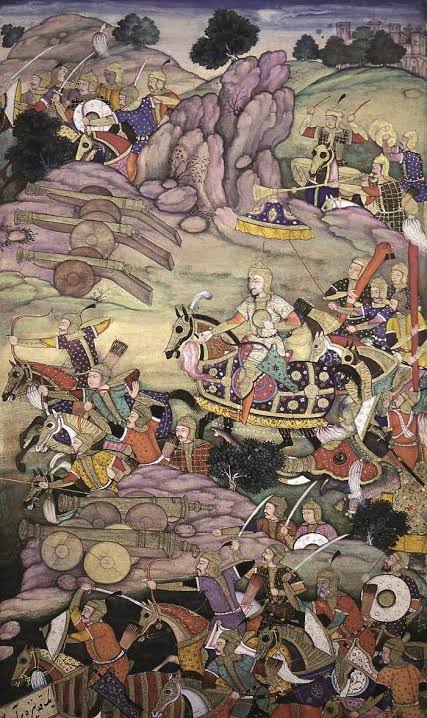
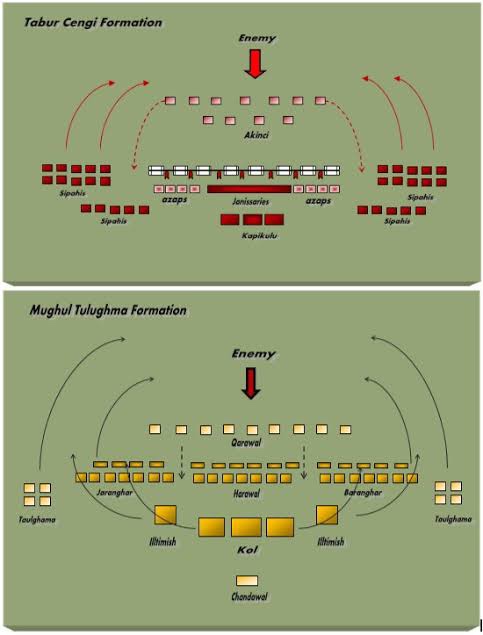

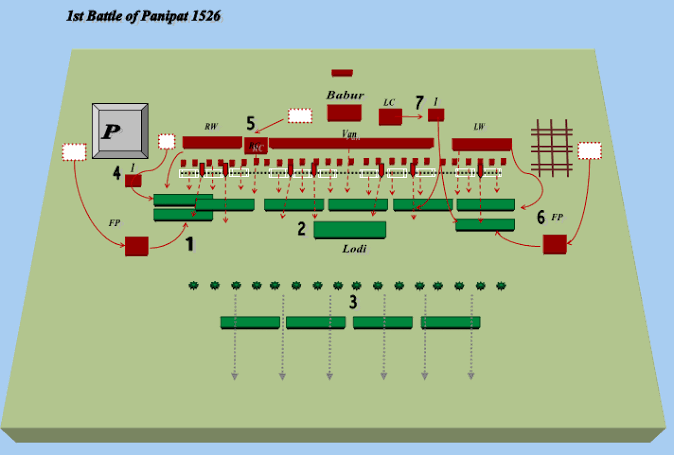

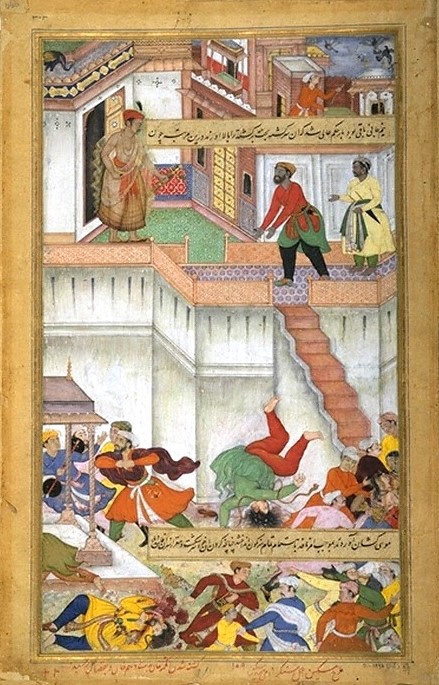


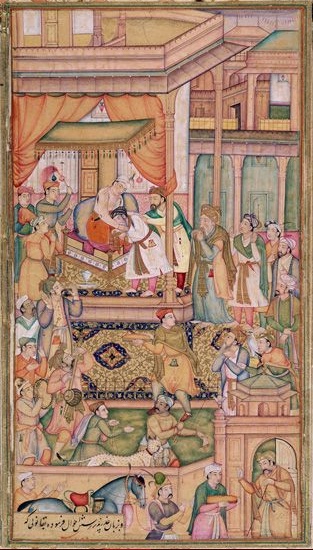


 ASHA: Blast From The Past