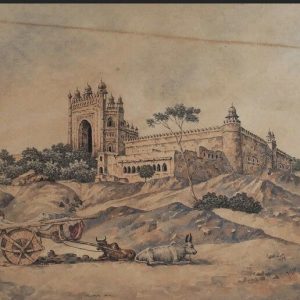
Religion and Aurangzeb: Religious Orthodoxy or Political Pragmatism?

Many modern historians have taken up the task to write on this aspect. From Sir Jadunath Sarkar and SR Sharma to M Athar Ali to ML Bhatia to Audrey Truchke many scholars have chosen to take up this topic. Some like Shibli Nomani, Sharma and Sarkar represented Aurangzeb as a bigot, while others, like Athar Ali, Bhatia and Truchke have put up a more nuanced picture of his before us.

Aurangzeb was never perceived as a hardcore religious zealot in his own time by his contemporary historians, including several Hindus amongst them, such as Bhimsen (Nuskha i Dilkusha) and Isardas Nagar (Futuhat i Alamgiri). This image began to grow in the late 18th century and after, finding a firm footing in the Colonial & Nationalist historiography of the 20th century.

As we have discussed earlier, the War of Succession was not fought either on communal considerations or on the basis of the ideological clash between the tolerant policies of Dara Shukoh and the so called anti-Hindu policy of Aurangzeb.

Aurangzeb never made a claim that he was going to defend Islam and at no stage he felt that Islam was being threatened either by Shahjahan or by Dara Shukoh. So just after the accession, we find that there was no discrimination either against the Hindus or against the Rajputs. As we have already discussed, Aurangzeb appointed Raja Raghunath Singh, a Khatri, as the diwan of the Empire. And one will recall that after the death of Raja Todarmal, no non-Muslim had been appointed as the diwan of the Empire. And after the re-call of Man Singh in 1606 by Jahangir, no non-Muslim had been appointed as the subahdar of any important province of the Empire either during the reign of Jahangir or during the reign of Shahjahan. Now Aurangzeb appointed two non-Muslims: Maharaja Jaswant Singh and Mirza Raja Jai Singh.

Jaswant Singh was appointed subahdar of Gujarat in spite of his opposition to Aurangzeb at the Battle of Dharmat and his treachery to Aurangzeb at the Battle of Khajua. Gujarat was the nerve centre of the Mughal economy.

Mirza Raja Jai Singh was appointed as the viceroy of the Deccan – the office to which only princes of Royal blood were entrusted. So if the term ‘discrimination’ is so indispensable to be used, it was used in favour of the Rajputs and not against them during the early years of Aurangzeb’s reign.

In the early years of the reign, Rajputs were given promotions which were not less than the promotions given to any other section of the nobility.

There was another check on the authority in the early years of Aurangzeb’s reign: that was that so long as Shahjahan was alive, Aurangzeb could not afford to incur the displeasure of any powerful section of the nobility. Why? Because an alternate candidate was available to the nobility to shift their allegiance to! So Aurangzeb proceeded very cautiously. He knew that by his own actions during the war of succession, he had weakened the very institution of monarchy. Now every successful rebel prince was justified in revolting against the sovereign and if possible, ascending the throne after imprisoning the emperor. Aurangzeb was conscious of the fact that the institution of monarchy had been compromised and had to be compensated. So he proceeded very cautiously vis-à-vis the nobility so long as Shahjahan was alive. He was also conscious of the fact that the promises made during the war of succession by him had to be translated into action and fulfilled.

The assertion of Aurangzeb that Shahjahan had ceased to be an effective ruler and as such he had no right to rule and that a vigorous policy had to be followed in all the directions for the expansion of the Empire was to be fulfilled as the fortunes of the nobility were closely connected with the expansion of the empire. That explains why just after the accession, he sent an expedition practically in all the directions. As we have discussed earlier, these military expeditions failed: Mir Jumla died fighting in Assam; Shaista Khan was attacked in his bed chamber in the Deccan by Shivaji; Mirza Raja Jai Singh succeeded in the treaty of Purandhar in 1665 but the fruits of the treaty were taken away when Shivaji fled from Agra.

And when the military expeditions failed, a chain reaction set in. Jat rebellion of 1669; the Satnami uprising of 1672; the Yusufzai revolt in 1667 and the Afridi revolt in 1674. In the meantime, Shivaji crowned himself as the king in 1675. So on the political front, to say the least, Aurangzeb was not a success.

He was convinced that the position of the institution of the monarchy had been compromised by his actions. Strength had to be provided from some other quarter when there was a failure on the political front. So just to compensate for the weakening, and just to provide against his political failure, Aurangzeb emphasized the Shariat law. But he did it so well and so excellently that not only the contemporaries were deceived, even the modern scholars were confused. He did it in such a finis and subtle manner that he branded together the Muslim elite. The fiasco of Prince Akbar’s rebellion is a proof for the consolidation of Muslim aristocracy behind the Mughal throne. It is in this background that Aurangzeb’s religious policy is to be seen.


Debating Aurangzeb’s leanings—religious orthodoxy or political pragmatism—one needs to ask: Did Aurangzeb really intend, as Jadunath Sarkar suggested, the establishment of dar-ul-Islam or a truly Islamic State in India, the conversion of the entire population to Islam, and the annihilation of dissenters? Or, as Ishtiyaq Husain Qureshi argued, was it the rigid adherence to the shari’a and undoing the damage caused by Akbar; or the triumph of Muslim theology, as Shri Ram Sharma asserted? If this was really the case, then the emperor’s personal valour, military skills, and single-minded commitment to achieving territorial expansion and consolidation would stand negated. The biased ideological portrayal of the emperor, regardless of historical accuracy, makes it difficult to explain the increase in the number of Rajput mansabdars in Aurangzeb’s administration as compared to Akbar’s period, and their rise from 24 per cent under Shahjahan to 33 per cent in 1689. Nor can Raghunath Ray Kayastha’s dominance as diwan-i kul be understood rationally. Raghunath Ray not only supported Aurangzeb but also participated in several expeditions of the period. Aurangzeb honoured him with the title of Raja and when Raghunath Ray died in 1664, the emperor, in his obituary written in Ruqa’at-i Alamgiri, remembered him as the greatest administrator he had ever known.

Relations with Ulema:

During his reign, Aurangzeb did increase the role of the ʿulamāʾ and promulgated laws that overtly conformed to the dictates of the sharīʿah. The Mughal historian Khāfi Khān notes, “the Emperor gave such extensive powers to the Qāḍis in the civil administration and general and detailed affairs of the state that it became a cause of jealousy and envy of the leading nobles of the Empire.” Prohibitions of the use of intoxicants, of extravagant pilgrimages to Hindu places of worship, and of music and dancing were decreed. The state systems of taxation were brought in line with the sharīʿah, and patronage of court astrologers ceased. As a result, subsequent generations of ʿulamāʾ as well as a number of modern scholars have declared Aurangzeb as a champion of orthodox Islam, arguing the triumph of the reforms of Sirhindī. Others have challenged that view, suggesting that the records indicate that Aurangzeb’s practice was more eclectic, especially later in his reign, and have argued that political considerations outweighed any commitment to religion.

While scholars continue to debate his motivations and how the legacy of Aurangzeb is to be portrayed, what is evident is that the ʿulamāʾ perceived his reign to enhance their influence in the imperial court.of court ulama under Aurangzeb.

From the time of his accession to the time when Shahjahan expired, Aurangzeb’s tenuous position as king was augmented by Qazi Abdul Wahhab. He provided the legal sanction to his disputed accession in 1658. Starting from the Shaikh ul-Islam and the chief imperial qazi in Delhi, this carried all the way down to the local level, including the vast chain of muhtasibs or censors of public morals. These ulema were, in effect, government employees, paid in cash as well as in the form of tax-free lands by the state. They manned the courts, acted as conduits for information to the Emperor and also served as an important source of legitimacy for the regime.

But was this elaborate hierarchy of religious specialists, trained in the shari’ah, truly able to function in the manner that is made out by pro-Aurangzeb propagandists? On the one hand we have the evidence that this apparent ascendancy of the theologians was resented by the general nobility. At a time when Shivaji had attacked the Mughal subahdar, Shaista Khan, who met with a humiliating defeat and was recalled, Aurangzeb tried to give the command to another noble, but the man retorted, “why appoint me or anyone else, ask the lashkar i dua to raise their hands in prayers!”

We also know that the system was riddled with corruption and inefficiency. Many qazis were indeed upright but many others were not, and some used their position to extort money from the public. One Qazi was caught drunk, another found in indulging in unethical acts. The muhtasibs were charged with enforcing Islamic laws and morality, but were often unable to do so, particularly when it came to local Muslim elites, many of who were given to a life of wanton luxury, including usury, drinking and music, which the “orthodox” Sunni ulema condemned. We have evidence that numerous Sufis protested against the harshness of the muhtasibs, particularly on the issue of banning music. Despite the ulemas’ insistence on the strict following of Islamic jurisprudence in matters related to revenue collection, the traditional revenue system remained intact. Likewise, local caste panchayats, even among local Muslim convert groups, continued to be allowed to function and decided disputes on lines that sometimes contravened the shari’ah as the court ulema understood it. Despite stern opposition from the “orthodox” ulema, partly for what these ulema saw as some of their unwarranted beliefs and practices but also because of jealousy owing to their mass support, popular Sufis, including those who preached the doctrine of wahdat al-wujud or the “unity of existence” and sought to stress the oneness of Hindus, Muslims and others, continued to flourish. Furthermore, the “orthodox” ulema, were unable to present a united front, were often at odds with each other and riddled with internal jealousies and rivalries.

Far from causing a radical break with the Mughal precedent, Aurangzeb’s religious policies, in particular his attitude towards the orthodox Sunni ulema, represent, in many senses, a continuation of it. As before, under Aurangzeb, sections of the ulema received generous royal support, and they, in turn, proved to be a major ideological pillar for the regime. Although Aurangzeb was certainly more generous with his patronage of the ulema than several of his predecessors, he did not allow them to dictate state policies. Though they were given prestige, the ulema remained, in the final analysis, subservient to the state and lacked an effective independent voice to enforce their views. While Aurangzeb sometimes sought their advice on matters of the shari’ah, he often dispensed with their views altogether, preferring his own opinions to theirs. As before, the shari’ah, in the sense of fiqh or historical Muslim jurisprudence, remained only one, although in some spheres major, source of law under Aurangzeb, and it was often supplemented, even supplanted, by imperial edicts and customary laws, some of which were directly in contravention of the shari’ah as the “orthodox” Sunni ulema viewed it.

Our sources provide many instances to substantiate this argument. Aurangzeb’s imprisonment of his own father and murder of his brothers, which brought him to power, were, of course, just two of these instances, but there were others as well. When the imperial qazi refused to read the khutba in his name, Aurangzeb had him summarily dis- missed, and, later, when the Shaikh ul-Islam refused to supply him with a fatwa legitimising his plans to invade the Muslim kingdoms of the Deccan, he caused him to meet with the same fate.

Aurangzeb did take certain other steps that were calculated to win the approval of the “orthodox” ulema. One of his major achievements in this regard was to commission the compilation of a code of Hanafi law, named after him as the Fatawa-e Alamgiri, the collective work of several ulema. Bhatia opines that in itself this did not represent a major development in Islamic law as it was simply a digest of secondary sources by earlier ulema for the guidance of the qazis or judges, and, despite it, the qazis continued to hand out judgments according to their own understanding and interpretations of the shari’ah.

Aurangzeb’s religious policies, in particular his attitude towards the orthodox Sunni ulema, represent, in many senses, a continuation of it. As before, under Aurangzeb, sections of the ulema received generous royal support, and they, in turn, proved to be a major ideological pillar for the regime. Although Aurangzeb was certainly more generous with his patronage of the ulema than several of his predecessors, he did not allow them to dictate state policies. Though they were given prestige, the ulema remained, in the final analysis, subservient to the state and lacked an effective independent voice to enforce their views. While Aurangzeb sometimes sought their advice on matters of the shari’ah, he often dispensed with their views altogether, preferring his own opinions to theirs.

Early Measures of Aurangzeb

There were a number of early measures initiated by Aurangzeb which have been interpreted as ‘religious measures’. Were they taken in order to pamper the Turani Hanafi Sunni Muslim orthodox elements? For example such practices as tuladan (weighing against gold & silver) as well as jharokha darshan were stopped. Khafi Khan informs that Aurangzeb ‘gave up sitting at the jharokha and ordered people not to assemble for the ceremony’. Prohibition was imposed on the consumption of wine. The usual way of saluting (the chahar taslim) was also discouraged. The science of astrology was also banned and the patronage to the astrologers was withdrawn: no almanacs were to be made heretofore.

Then in 1664, Surat was sacked by Shivaji. Around the same time, Aurangzeb ordered that the custom duties on goods imported by the Muslims should be half as compared to the duty levied on the goods imported by the non-Muslims. This enhancement of duty by100% on goods imported by non-Muslims as compared to their Muslim counter-parts was apparently a discriminatory action of Aurangzeb. But some historians have tried to give and extended interpretation to this obviously discriminatory measure: a compensation for the lack of Muslim commerce!            

After this measure, the Muslims started importing goods belonging to the Hindu merchants in their own name and divided the surplus customs duty. This resulted in a loss to exchequer. Ultimately Aurangzeb withdrew the customs duty from the Muslims altogether.

Just after the accession, Aurangzeb ordered that the nobles should not wear the coloured garments: colours which were prohibited in Islam. Then he banned music which was considered un-Islamic. Musicians protested against this, and when Aurangzeb was going to offer prayers riding an elephant, musicians carried a fake funeral, all the time weeping. When asked, Aurangzeb was told that music had died and they were carrying its bier. Aurangzeb retorted bury it so deep that it never comes out again!

Sir Jadunath is of the opinion that it was banned because of religious considerations. But RP Tripathi is of the opinion, that in the same year in which the music was banned, the allowances of the princes and princesses were also curtailed. As we have already discussed that the early years of Aurangzeb were marked with a financial crisis. Thus to Tripathi, ban on music was an economic device curtailing unproductive matters.

 But one of the most important and relevant action taken by Aurangzeb in this connection was the liberal attitude towards the madad-i ma’ash holders (revenue free grantees). Madad-i ma’ash was maintenance grant to ulema and mashaikh so that they may pray for the long life of the emperor and the prosperity of the empire without concern for their maintenance. 90% of the recipients of such grants were Muslims. Sole justification for this was only that they should concentrate undisturbed in their academic pursuits. This grant was only in the form of land; rozina or daily cash allowance was very rare. In 1670’s and 80’s, Aurangzeb was having political problems with the zamindars: as has been argued, the Jat rebellion, the Rathore rebellion, etc were all zamindar uprisings. Ninety percent of the zamindars were Hindus; and by and large (i.e., around 70%) of the Jagirdars were Muslims. That is why Sir Jadunath Sarkar defined it as a ‘Hindu Reaction’. Secondly, the zamindars were concentrated in the villages. What Aurangzeb did was that to counteract the growing influence of the zamindars in the rural areas, he (a) created Muslim zamindars at the village levels to counteract the growing influence of the Hindu zamindars; and (b) He made madad-i ma’ash holders permanent and in some places, hereditary – just at par with the zamindari rights.   

We have the evidence from Tarikh-i Aurangzeb of Abul Fazl Mamuri. Mamuri says that before his departure from Deccan (before 1681), Aurangzeb was faced with a Jagirdari crisis. Mamuri used the phrase: hama ālam bējāgīr mand.

Before his departure for the Deccan, Mamuri says, Aurangzeb exercised care and caution in granting promotions or fresh appointments to the Rajputs. And the jagirs so saved, by placing restrictions on promotions and appointments to Rajputs, became loaves and fishes which Aurangzeb gave to the Muslims to consolidate them behind the throne. It appears that Aurangzeb succeeded in his plans.

Jizya and Destruction of Temples

We have seen that the institution of the monarchy had been weakened by the way Aurangzeb ascended the throne. A new prestige had to be added to the institution of the monarchy if the same process was to be avoided: and that is why Aurangzeb made a deliberate attempt to attach religious sanctity to the institution of the monarchy. That is why Aurangzeb chose to be known as Alamgir and zindapir. He made a determined and deliberate attempt to prove his vigour and to emerge as a vigorous king by sanctioning military expeditions. He failed as natural geographical barriers had been reached during the reign of Shahjahan. And when he failed on the political front and a chain reaction started, he tried to conceal his failures behind the shield of emphasising on Shariat. Ultimately, the die was cast and the day of all precautionary measures dawned when in 1679, his youngest son Prince Akbar revolted and wrote a very nasty letter to his father in which he pointed out that ‘you are responsible for the death of Shah Shuja, Dara and so forth, and now it is you who are teaching morality…’. But the fiasco, with which the rebellion of Akbar ended with his flight to Persia, is the conclusive evidence that Aurangzeb had succeeded in binding the Muslim aristocracy behind the Mughal throne by emphasising the Shariat laws. It was in the same year that Jizya was imposed. Why did Aurangzeb not impose the jizya from 1658 to 1679? What was the sudden need now?

Bhatia points out, it was only 22 years after his ascent to the throne that Aurangzeb decided to impose the jizya on the Hindus, and this may have actually been a response to the outbreak of rebellions of the Marathas, Sikhs, Jats and others. Certain classes of Hindus, including government officials, were exempted from the jizya, while, at the same time, Aurangzeb made arrangements for the zakat to be collected from Muslims. Bhatia writes that “It is also stated that long before jizya was imposed, Aurangzeb had ordered the abolition of a number of unauthorized taxes which placed heavy burden on the Hindus” (p. 52). He admits that one of the aims of imposing the jizya, as the court ulema saw it, was to degrade the Hindus, and this naturally caused considerable ill-will and resentment among them. That the financial aspect of the jizya was not seen by the ulema as equally important as its symbolism is reflected in the fact that the total collection from the jizya was only slightly more than the money spent on collect- ing it, with much of the money collected going into the pockets of corrupt officials. And as for the resumption of tax-free land grants to Hindu priests and yogis, this was only a temporary measure in the wake of Hindu-led rebellions and that when these subsided the edict was allowed, for all practical purposes, to lapse.

Jizya was a discriminatory tax, alright. And of course it was humiliative, but then the Rajputs were exempted, the Brahmins were exempted and all those who were in the Mughal service were exempted! In terms of collection, the jizya was graded: the richest man was to pay Rs.12/= per annum, while the less prosperous was supposed to pay Rs.8/= per annum. According to Jadunath Sarkar, it was ` 3 ¼ , 6 2/3 and 3 1/3 per annum for the three classes.

 The most pinching aspect of the Jizya was that it was a tax on the poor, who had to pay an average of one month’s salary as tax.

As early as 1669 orders were issued (says JN Sarkar) to demolish all the schools and temples of the ‘infidels’. Thus for example, the Maasir-i Alamgiri notes, the Temple of Malarna in Jaipur was demolished.

It was, again in 1679, that the orders for the destruction of temples were given. Probably these orders were partly in retaliation of the Rathore rebellion, for a number of temples were demolished in Jodhpur. Some of the most famous shrines demolished were the Somnath (Gujarat), the Vashvanath (Varanasi) and the Keshava Rai (Mathura). In January 1680 Aurangzeb ordered the demolition of three temples standing on the edge of Udai Sagar. If we believe SR Sharma, at Udaipur 172 temples were broken. In Chitor the number stood at 63.

There are well-documented evidences of Aurangzeb’s patronage of various Hindu religious institutions, namely temples, maths, grants to Brahmins and pujaris:

Land grants were renewed to the temples at Mathura, Banaras, Gaya, Gauhati, and others, while the emperor is known to have donated ghee for the navadeep in a few temples, including the Mahabateshwar temple at Agra;

Gifts were offered to the Sikh gurudwara at Dehradun;

Madad-i ma’ash grants, as listed in the Rajasthan documents, were continued to a math of Nathpanthi yogis in parganaDidwana, sarkar Nagor;

Grants were also made to Ganesh Bharti faqir and his successors in pargana Siwana with the instructions that the faqir should not be disturbed so he could ‘pray for this sultanat’.

The Vrindavan document of 1704 referred to a parwana which sanctioned the rights of Chaitanya gosains who had founded Vrindavan and established pilgrimages in Braj Bhumi, and recognised the right of Brajanand Gosain to receive a fee from the followers of the sect on account of kharj sadir o warid, that is, expenses on guests and travellers from each village. In effect, it was a government levy for the benefit of Brajanand Gosain and his Vaishnavite followers.

From the above description, Aurangzeb’s patronage to temples appears without doubt. And yet some temples were attacked, while others were spared. This aberration in the emperor’s attitude can be explained by only one rationale: it was not iconoclasm, but reprisal for rebellion or political misconduct or disloyalty to the emperor. This exposition can be applied to understand the attack on the Vishwanath temple at Kashi, the Keshav Dev temple at Mathura, and several prominent temples in Rajasthan. In 1669, during a zamindar revolt in Banaras, it was suspected that some of them had assisted Shivaji in his escape from imperial detention. It was also believed that Shivaji’s escape was initially facilitated by Jai Singh, the great-grandson of Raja Man Singh, who had built the Vishwanath temple. It was against this background that Aurangzeb ordered the destruction of that temple in September 1669.

Around the same time, in a Jat rebellion that had erupted in the neighbouring regions of Mathura, a patron of the local congregational mosque was killed, leading to Aurangzeb’s order in 1670 to attack the Keshav Dev temple at Mathura. Temples in Marwar and Mewar were also attacked following the death of Maharaja Jaswant Singh to reprimand and crush the Rathor rebellion and the development of a Sisodia– Rathor alliance. These included temples in Khandela patronised by rebel chieftains; temples in Jodhpur maintained by a former supporter of Dara Shukoh; and the royal temples in Udaipur and Chittor patronised by Rana Raj Singh after the Rana entered into an alliance with the Rathors that signalled the withdrawal of loyalty to the Mughal State. It may be observed that the Rathor rebellion was not a reaction or a protest against the re-imposition of jizya. Instead, this re-imposition, as Abu’l Fazl Ma’muri observed in the context of the suppression of the Satnami revolt and prior to the emperor’s expedition to Ajmer, was meant for ‘the affliction of the rebellious unbelievers’.

Jizya and temple destruction were both discriminatory policies. But then we have evidence of grants to the temples as well. A number of documents published in the Journal of the Bombay Historical Society as well as the Pakistan Historical Society mention a number of such grants to hindu temples by Aurangzeb. These documents testify to a number of villages being sanctioned for the upkeep of the temples.[eg. The Vrindavan temples and the ‘Nonidhara Temple at Bahraich].

So was there a contradiction in the personality of Aurangzeb? It was not. There was a contradiction in the situation which reflected in the policies of Aurangzeb. Nothing can stay static and yet survive. Aurangzeb knew that change was called for. However, he committed the mistake that he forgot that the religious revival was not the solution for the Mughal problems.

Let us take contemporary evidence. Bhimsen is the author of Nuskha-i Dilkusha. His is an eye-witness account of the military expedition in the Deccan. He was the peshkar of Dalpat Rao Bundela, an outstanding officer of Aurangzeb and is extremely critical of Aurangzeb’s Deccan policy. According to him Aurangzeb followed a policy of qila’ giri while the Marathas controlled the lands. Because of this policy, the area from where formerly gold coins were realized, now not even copper was forthcoming. Thus Bhimsen was quite critical of Aurangzeb, but then what is important to mark is that never does he criticize Aurangzeb on religious ground. He mentions the imposition of jizya but without any rancour.

No Hindu writer of Aurangzeb’s period, whether it is Bhimsen, or Isardas Nagar, the author of Futuhat-i Alamgiri or Sujan Rai Bhandari are critical of Aurangzeb on the grounds of the re-imposition of jizya or the destruction of the temples. These contemporary historians are infact silent on the religious policy of Aurangzeb and from their rading it appears that neither the line taken by Hindu communal historians, headed by Sir Jadunath Sarkar, and followed by S.R.Sarma, and Ashirbadilal Srivastava, nor the line taken by Muslim communal historians headed by Shibli and followed by I.H.Qureshi and others satisfactorily explains the religious policy of Aurangzeb and the stresses and strains to which the Indian Society was subjected to during the second half of the 17th Century.

In fact both the set of arguments are not supported by the contemporary accounts of Bhimsen or the others. Prof. M. Athar Ali deals with this problem in his book as well as in one of his papers.

According to his general assessment, in order to assess the results of Aurangzeb’s religious policy, one should imagine, not the India of the 19th Century with a new national as well as religious consciousness, motivating the various sections of the people, but of a period when vital loyalties to one’s caste or master superseded to a considerable degree other claims upon one’s conscience. In so far as Aurangzeb was careful to respect some privileges, e.g., exemption of the Rajputs from jizya or to exempt temples commanding great devotion (e.g., Puri or Thanjavur Temples) or temples built by loyal officials, he on his own part, recognized that there was a limit beyond which it was impolitic to go.

But above all, according to Athar Ali, one should remember that Aurangzeb’s policy could not be implemented as rigorously as it could be prescribed on paper. This was particularly true in relation to the temple destruction. A few prominent temples could not be saved; but local shrines were often a matter of adjustment with local officials, as the official news-reports from Ajmer testify.

On the whole, while one might deplore the long term effects of Aurangzeb’s Religious policy, specially the way it echoes poison and embitter modern minds. Its short term effects were probably not very significant. To a writer like Bhimsen, who though loyal to the Mughal cause, is also capable of being a friendly critic, the real problem with Aurangzeb was the increasing economic pressure on the peasantry, in which connection he lists the jizya, and the way Aurangzeb was concentrating on taking forts while leaving the country to the Marathas. He does not seem to think that Aurangzeb’s religious measures by themselves had any role in his difficulties. So also Manucci, whose long discourse on the ills of the Mughal Empire in the last years of Aurangzeb’s reign, does not even once brings in the question of any popular hostility aroused against Aurangzeb on account of his religious policy.

One may, on the whole, say that given Aurangzeb’s personal inclination, his religious policy was framed to win some sectional support in a period of political difficulty. The support he won on this basis was probably limited; the support he lost was perhaps even more limited. But the ills of the Mughal Empire were far more deep rooted than to be cured by such measures, or for that matter, be made much worse.  


      • Syed Ali Nadeem Rezavi  

Mubāhila, Ghadīr and The Family of The Prophet

Both Mubāhila and Ghadīr are considered significant by Shia Muslims who consider them Eid and occasions which highlight the precedence of Ahlulbayt, and the Panjatan, the Holy Five.

Illustration from Al-Biruni, Athār Al-Bāqiyya: Mubāhila

Is it really surprising that most of those who profess to “follow” Prophet Muhammad, so much so that certain others started calling them “Mohammadan”, actually have forgotten some of his “actions” which are his interpretations of what was ordered in the Quran?

There are a number of well recorded “episodes” from the life of the Prophet, which along with a number of Quranic verses, throw much light on what he wanted from the believers: episodes like Mubāhila [Disputation with the Christians of Najran] and Ghadīr, the event of the sermon besides a pond of that name after his last Hajj: an occasion when the last verse of the Quran declaring the completion of the Message was revealed.

Let us F or example take Sura as-Shura, verse 23, known as Ayat i Muwaddat, which says:

ذَٰلِكَ ٱلَّذِى يُبَشِّرُ ٱللَّهُ عِبَادَهُ ٱلَّذِينَ ءَامَنُوا۟ وَعَمِلُوا۟ ٱلصَّـٰلِحَـٰتِ ۗ قُل لَّآ أَسْـَٔلُكُمْ عَلَيْهِ أَجْرًا إِلَّا ٱلْمَوَدَّةَ فِى ٱلْقُرْبَىٰ ۗ وَمَن يَقْتَرِفْ حَسَنَةً نَّزِدْ لَهُۥ فِيهَا حُسْنًا ۚ إِنَّ ٱللَّهَ غَفُورٌ شَكُورٌ

“That is (the Bounty) whereof Allah gives Glad Tidings to His Servants who believe and do righteous deeds. Say: “No reward do I ask of you for this except the love of those near of kin.” And if anyone earns any good We shall give Him an increase of good in respect thereof: for Allah is Oft-Forgiving Most Ready to appreciate (service).”

Who were these “near of kin” [ ajran illal muwaddat fil qurba] who’s love is demanded? His own relatives or humanity as kinship in general?

If it stands for kinship of humanity, that we should love all to recompense Muhammad for his efforts, as generally believed by Mohammadans (followers of Muhammad & his practices), we find that even this is actually not followed in practice. I need not give examples: History of Islam is a witness to all what the so-called Muslims did!

According to a translator, “qurba” could never mean some specific family members of the Prophet. but quite apart from the objection that such a “personal” demand would conflict with the preceding assurance, “No reward do I ask of you”, the deliberate ommission of any possessive pronoun in respect of the term al-qurba indicates, according to this interpretation, that it is not limited to any personal relationship but, rather, alludes to a relationship common to all human beings: namely, the fellowship of man – a concept which implies the fundamental ethical postulate to care for one another’s material and spiritual welfare.

Howsoever in the Quran we find a verse giving a contrary sense.

According to Sura 3, verse 61:

فَمَنْ حَآجَّكَ فِيهِ مِن بَعْدِ مَا جَاءكَ مِنَ الْعِلْمِ فَقُلْ
تَعَالَوْاْ نَدْعُ أَبْنَاءنَا وَأَبْنَاءكُمْ وَنِسَاءنَا وَنِسَاءكُمْ وَأَنفُسَنَا وأَنفُسَكُمْ
ثُمَّ نَبْتَهِلْ فَنَجْعَل لَّعْنَةُ اللّهِ عَلَى الْكَاذِبِينَ

“Should anyone argue with you concerning him, after the knowledge that has come to you, then say: ‘Come! Let us call our sons and your sons, our women and your women, our souls and your souls, then let us pray earnestly and call down Allah’s curse upon the liars’.”

▪ The Ayah said “Our children” : And Muhammad took Al‑Hasan and Al‑Husain;
▪ The Ayah said “Our ladies” : And Muhammad took his daughter Fatima;
▪ The Ayah said “Our selves” :And Muhammad took Ali as if Ali was the self of the Prophet.

And these four and the Prophet are known as Panjatan, The Five Chosen Ones! They are the same who were assembled by the Prophet below his mantle (Kisa) and for those the Aya-i Tatheer was revealed:

إِنَّمَا يُرِيدُ اللَّهُ لِيُذْهِبَ عَنْكُمُ الرِّجْسَ أَهْلَ الْبَيْتِ وَيُطَهِّرَكُمْ تَطْهِيرًا

Allah surely wants to keep the sin away from you, O People of the House! And to purify you an absolute purification.

Sura-i Ahzāb, verse 34

The Ayat i Mubāhila [3:61] quoted above, is with reference to an incident which took place in the year 10 A.H between the Prophet and the Christians of Najran and which is mentioned in all well-known books of traditions, tafsir (exegesis) and history by Muslim scholars. It is referred to as Mubāhila (mutual cursing).

On 24th Zilhijja, 10 AH, the appointed day of Mubāhila, how did the Prophet interpret “Our sons”, “Our women”, and “Our Souls”? He took with him his two grand sons, Hasan and Husain, Fatima and Ali! Surely the verse was in plural, and the order was for “our”. The Prophet interpreted it to mean his own immediate family: his daughter (and no wives), his cousin & son-in-law (no “uncles” etc) and the two infants! These were his kinsmen, his qurba, who were being shown to the public!

According to Sahih Muslim in Kitab Fadha’il Al-Sahaba, The Prophet (s) said, “The verse of purification was revealed concerning five people: myself, Ali, Hassan, Hussein, and Fatima.”

Is there any other woman about whom the Prophet declared: she was part of his Self. The Prophet (s) said, “Fatima is part of me. Whatever upsets her upsets me, and whatever harms her harms me.”

[Sahih Muslim, v. 5, p. 54; Khasa’is Al-Imam Ali of Nisa’i, p. 121-122; Masabih Al-Sunnah, v. 4, p. 185; Al-Isabah, v. 4, p. 378; Seir Alam Al-Nubala‘, v. 2, p. 119; Kenz Al-Omal, v. 13, p. 97; similar wording is related in Al-Tirmidhi, v. 3, Chapter on the Virtues ofFatima, p. 241; Haliyat Al-Awliya‘, v.2, p. 40; Muntakhab Kenz Al-Omal, in the margins of Al-Musnad, v. 5, p. 96; Maarifat Ma Yajib Li Aal Al-Bait Al-Nabawi Min Al-Haqq Alaa Men Adahum, p. 58; Dhakha’ir Al-Uqubi, p. 38; Tadhkirat Al-Khawass, p. 279; Yanabi^ Al-Mawadda, v.2, ch. 59, p. 478]

About Ali, suffice to remind what the Prophet said:

أنا مدينة العلم و عليّ بابها فمن اراد العلم فليأت الباب

I am the city of the knowledge and ‘Ali is its gate, thus whoever seeks the knowledge has to enter the gate.

This Saying is considered correct and true by Sunni scholars such as: Muhammad b. Jarir al-Tabari, Hakim al-Naysaburi, Khatib al-Baghdadi, and Jalal al-Din al-Suyuti; so that Allama Amini in his book, al-Ghadir, notes the names of twenty one Sunni hadith narrators who regarded this hadith as correct and true.

About Hasan and Husain, every source recorded Prophet’s preference for them. I will just quote two traditions of the Prophet: one his action, one his saying. Abu Buraidah, a narrator and Companion of the Prophet narrates:

“The Messenger of Allah (peace and blessings be upon him) was delivering a Khutbah to us when Al-Hasan and Al-Husain came, wearing red shirts, walking and falling down. So the Messenger of Allah (peace and blessings be upon him) descended from the Minbar and carried them, and placed them in front of him. Then he said: ‘Allah spoke the Truth: Indeed, your wealth and your children are a trial. I looked at these two children walking and falling down, and I could not bear patiently anymore until I interrupted my talk and picked them up.”

Anas bin Malik narrates that the Messenger of Allah was once asked: “Which of the people of your house are most beloved to you?”

He said: “Al-Hasan and Al-Husain.” And he used to say to Fatimah: “Call my two sons for me.” And he would smell them and hug them.

And then, Abu Sa’eed narrates that the Messenger of Allah said:

“Al-Hasan and Al-Husain are the leaders of the youth of Paradise.”

Is there then, as far as the traditions of the Prophet are concerned, any doubt as to who were his “kinsmen”, ahl lil qurba? On 24th Zilhijja 10 AH, he brought all of them together for all to see and remove their doubts?

The second occasion as mentioned at the beginning is the episode of Ghadīr, the day when the wilāyat of Imām ‘Ali was proclaimed by the Prophet of Islam. The term wilāyat is derived from the term wali, which means vicegerent, the successor, the next in command.

In the Sunni understanding of Islam, although the Prophethood of Muhammad was the last, there was no further arrangement to supervise its continuity. The message was delivered, the job was done. To the Shias, Allah after the Prophet, ensured that the believers were not left unattended. According to this belief, after the last Prophet, were a series of walis, vicegerents, appointed by Allah to ensure guidance known as the Imāms. And this declaration of continued guidance was made at a place known as Ghadeer i Khum, the pond of Khum.

Was Wilāya, only a spiritual succession, or was it a declaration of a physical succession? For the Party of Ali (Shi’ān i Ali) it was both: “man kunto maula fa hāza Ali un maula!” Of those whose maula I am, Ali is also the maula of those, said the Prophet! So in whatever sense you consider the Prophet to be the maula (master/friend/slave/etc etc), Ali is the maula in the same sense!

Prophet was not only a spiritual leader but also the head of the State established in the name of God. So if Mubāhila was an occasion for public declaration by the Prophet as to who were his qurba, kin, Ghadīr is the declaration of who is the leader after him! Thus all Sufi silsilas (schools) trace their spiritual lineage from him. So do the Shias. The word Shia means “friend” / “partisan”.

Thus both Mubāhila and Ghadīr are both quite significant to understand what the Prophet wanted. Both these occasions are celebrated by those who are devoted to Ahlulbayt as the two Great Eids: Occasions of great festivities!

• Syed Ali Nadeem Rezavi

Baqrīd or #Eid_al_Azhā: A Festival of ‘Sacrifice of Self’ or of Lamb?

Ibrahim’s (Abraham’s) sacrifice. Timurid Anthology, Shiraz, 1410-11, Gulbenkian Museum, Lisbon.

Today it is generally considered that the Muslims have three ‘major’ festivals: Eid, Baqrid and Muharram. However the fact is that amongst them ‘Baqrid’ is the only real occasion which can be labelled as a traditional festival. The first, to be exact, is only a thanksgiving day, the Eid al-Fitr, when after a month long fasting, the devout are required to give charity in the name of God and offer special prayers. The Muharram, on the other hand, is not a “festival” but a commemoration of a tragedy: its a mourning of a martyrdom- that of Prophet’s grandson by a tyrant.

Baqrid or Eid-i Azhā, on the other hand is a commemorative festival: it celebrates the victory of Divinity over self. It is the festival of sacrifice and total submission to the will of God: a feast through which we remember the pure confidence of Abraham in God! It is the day when the great Biblical Prophet through a series of dreams was asked by God to sacrifice his son. He readily agreed, albeit that he tied his eyes with a piece of cloth (in Islamic traditions) so that he may not see his son die. As he attempted to make the sacrifice, as per the Biblical tradition, God replaced his son with a ram! The Holy Quran only says that God proclaimed that He has replaced this sacrifice of Abraham with “The Zibhin Azeem“: the Supreme Sacrifice, which the Shi’i believe is the Sacrifice of Imam Husain of his entire family and friends at Karbala! The Quran, unlike the Bible, makes no mention of the ram. It asks us to remember the Great Sacrifice by offering a sacrifice ourselves.

Following the established Biblical traditions the Muslims started commemorating the event with animal sacrifice: thus the popular name in the Indian subcontinent, ‘Baqr Eid’.

Today the festival has been reduced to a ritual and an occasion of showing off power and wealth, a total negation of its original spirit. Today most do not sacrifice self for God, but celebrate it as an occasion of pelf and show off: whose sacrificial animal is costlier! It has been turned into a festival of self-projection and brutality rather than piety and self negation! In fact the spirit has been totally subverted and the festival is directly reverse of what it was intended to be: occasion of sacrifice and submission to the will of God!

Baqr Eid or Eid-i Azhā is, as pointed out, a commemorative festival which celebrates the victory of Divinity over self. Let us see what does the Qura actually says:

وَفَدَيْنَاهُ بِذِبْحٍ عَظِيمٍ

‘And We ransomed him with a momentous sacrifice’

[Quran, 37:107]

The next verse more revealing:

وَتَرَكْنَا عَلَيْهِ فِي الْآخِرِينَ

‘And We left (this test) for him to the last generations’

In fact there is a very well known saying of Imām Raza, as quoted by Shaikh Sudūq, that the “momentous sacrifice” which replaced the sacrifice of Abraham was that which was offered at Karbala in 61 AH

Biblical Tradition:

One day when Isaac was a boy, God came to Abraham and told him to sacrifice Isaac on Mt. Moriah. Though he loved his son dearly, he did not hesitate to obey the Lord. The very next day, Abraham saddled his donkey and began the journey, with Isaac, two servants, and wood for the sacrifice. As they neared the mountain, Abraham instructed the servants to stay behind, while he and Isaac ascended. Genesis 22:7-8 describes the conversation between father and son as they climbed the mountain:

Isaac spoke to his father Abraham. “Father!” he said. “Here I am,” he replied. Isaac continued, “Here are the fire and the wood, but where is the sheep for the burnt offering?” 

“My son,” Abraham answered, “God will provide the sheep for the burnt offering.” Then the two walked on together.

Genesis 22:7-8

They came to the place where God had told him to go and built an altar. Abraham bound Isaac, arranged the wood on the altar, and drew his knife. But at that moment, an angel stopped him. Genesis 22:11-12 describes:

But the angel of the Lord called to him from heaven, “Abraham, Abraham!” “Here I am,” he answered. “Do not lay your hand on the boy,” said the angel. “Do not do the least thing to him. For now I know that you fear God, since you did not withhold from me your son, your only one.”

Genesis 22:11-12

Abraham noticed a ram caught by his horns in the thicket nearby and offered it to the Lord instead. He called the place “Yahweh-yireh” meaning “the Lord will provide.” After the sacrifice, the angel spoke again to him, saying that he would be blessed for being willing to give all that he had to the Lord, as Genesis 22:16-18 relates:

“I swear by my very self—oracle of the Lord—that because you acted as you did in not withholding from me your son, your only one, I will bless you and make your descendants as countless as the stars of the sky and the sands of the seashore; your descendants will take possession of the gates of their enemies, and in your descendants all the nations of the earth will find blessing, because you obeyed my command.”

Genesis 22:16-18
Harmensz Rembrandt van Rijn (Dutch painter, 1606-1669), “Sacrifice of Isaac” (1635), oil on canvas, Hermitage Museum, St. Petersburg, Russia

Quranic Injunction:

The Quran, unlike the Bible, makes no mention of the ram. It asks us to remember the Great Sacrifice by offering a sacrifice of our Self. It was the sacrifice of his personal “self”, in lieu of which God granted him His Will: those who sacrifice and set aside their own ‘nafs’, for the wish of God, are in fact the chosen!

It is however surprising that the Muslims, believe what is not directly said in the Quran and hold dear what had been mentioned in the Bible. Surprisingly, though mentioned in the Biblical text and tradition, the sacrificing of a ram/ lamb on this occasion is neither practiced by the Jews nor the Christians.

Following the established Biblical traditions however, the Muslims started commemorating the event with animal sacrifice, a tradition which was quite popular since remote past all over the world. Being considered as an occasion of sacrifice, in the Indian subcontinent it became popular as ‘Baqr Eid’. As this day is the one when the believers perform Hajj, the circumambulation of the “House of God”, Kaaba, said to have been built by Prophet Abraham, and the pelting of stones at the three Satans and offering sacrifice to Allah, a tradition continued from pre-Islamic days, those who are unable to visit Kaaba also take part in the ritual of sacrifice. Directly the Quran makes no mention of a ram or a lamb, or any quadruped, including cows or camels, the name Baqr Eid stuck. Remember that it is only while performing the ritual of Hajj that sacrificing an animal is compulsory.

Baqr Eid is known by different names. Its actual name is Eid al-Adha (also pronounced as Eid uz Zuha): the Celebration of Sacrifice. It is also called as Eid-i Kabir, the Great Celebration. The popular name, however, in the sub-continent remains Baqrid, derived either from Arabic word “Baqar” (Cow) or “Bakr” (a youthful camel), two animals (and ram/sheep) which were traditionally sacrificed in Arabia. In India, the usual sacrifice is of goats (bakri) or sometimes, buffaloes. Thus many in India call it “Bakri-eid“, mistaking it to be a festival of sacrificing goats!

Today the festival has been reduced to a mere ritual and an occasion of showing off power and wealth, a total negation of its original spirit. Today most do not sacrifice self for God, but celebrate it as an occasion of pelf and show off: whose sacrificial animal is costlier! It has been turned into a festival of self-projection and brutality rather than piety and self negation! In fact the spirit has been totally subverted and the festival is directly reverse of what it was intended to be: occasion of sacrifice and submission to the will of God!

• Syed Ali Nadeem Rezavi

Sources of Aurangzeb’s Reign

Illustrations in Alamgirnama

Aurangzeb stopped the tradition of commissioning the official history writing at the end of the 10th RY of his reign. The reason appears to be that perhaps he wanted to suppress his political failures. Another reason which has been forwarded is the financial strain. Others hold his orthodoxy as the main reason for the order to stop writing the official history.

In spite of this, if the entire source material available for Aurangzeb’s reign in different archives of India and abroad is put together, collectively the reign of Aurangzeb is found to be rich in historical records as compared to all Mughal Emperors preceding him put together. From this point of view his reign is important both quantitatively and qualitatively.

The only official history written during this reign is the ‘Alamgirnama of Muhammad Kazim Shirazi. It is the history of the first 10 regnal years: i.e. from the period Aurangzeb started from the Deccan to contest the throne up to 1688. It is in 2 volumes. As with all official histories, Alamgirnama is very rich in details, its chronology is reliable. It provides all appointments and promotions of the mansabdars. Kazim Shirazi takes care to note the original rank as well as the promotion. All this is natural as being an official historian, the state archives were at his disposal. All the official records were available to him. He himself was associated with the court and experienced most of the events he describes. He records almost all the important events of the period which he covers

However it suppresses many facts as well. For example, it doesn’t mention that Surat was sacked by Shivaji in 1664. Thus there is a suppression of events not complementary to the ruler. Similarly there is no direct reference to the scarcity of food grains. Kazim suppresses it. He gives an interesting version of the causes of the War of Succession, placing the entire blame on Shahjahan and Dara Shukoh. He gives all the details of the moves of Dara, Shuja, Murad and Aurangzeb. In spite of all this he provides very useful and independent information which throws a flood of light on the causes of the WoS : Aurangzeb invoked the shariat law to justify the execution of Dara and not to take up arms against his father. Thus the bogey of Shari’ at was raised only when he had ascended the throne. Kazim Shirazi is not consistently objective: he gives the official version of almost all the controversial events and developments. The treatment meted out by Aurangzeb to Dara, Murad and other supporters of Dara has been justified in Alamgirnama on religious grounds; although we know from other sources that this slogan of religion was raised by Aurangzeb to justify his acts. Such subjectivity of the author of this work can be multiplied. However this shortcoming in no way undermines the importance of this source.

For the history of the first ten years, the Alamgirnama is reliable except at the places where he deliberately suppresses information. There can be no doubt about the value of Alamgirnama, even later historian tend to follow what Kazim Shirazi had written for the first 10 years. As much details as are contained in the Alamgirnama, are unfortunately not found in any of the other histories which were written in the next 40 years of Aurangzeb’s reign.

 The information contained in it regarding the WoS is corroborated by Aqil Khan Razi in Waqi’at –i ‘Alamgiri. It is an account of the WoS : Aqil Khan was not only a contemporary but a participant in the struggle on behalf of Aurangzeb. Thus his account is extremely rich in details and accurate in dates. It is very objective in the sense that it omitted the preamble of the ahadnama entered into between Aurangzeb and Murad Bakhsh in which it was stated that they were going to fight against the rais-i mulahida (chief of the heretics) i.e. Dara Shukoh. Aqil Khan Razi was a partisan of Aurangzeb and has effectively put forward the view of Aurangzeb regarding the WoS, yet even he avoids that it had religious overtones. He gives the impression that it was fought on political and personal considerations: Religion was not involved.

Another source for the period is the Nuskha-i Dilkusha of Bhimsen. He was born at Burhanpur in 1648-49 and served under Rao Dalpat Bundela at a time when Rao Dalpat was deputed to the Deccan. He took part in many wars in the Deccan during Aurangzeb’s reign. For a time he had been the commander of the fort of Naldurg. After the death of Prince Kambakhsh s/o Aurangzeb, in 1709, he left imperial service and settled down at Burhanpur where he compiled his work.

His work is an account of of Aurangzeb’s reign from his march from the Deccan in 1658 to contest the throne up to the defeat of prince Kambakhsh in 1709. His account is based on personal observations and recollections and is mainly a description of the military transactions in the Deccan. Bhimsen had close contacts with a number of officers, generals and nobles. He himself had taken an active part from 1670 onwards. He had also widely travelled in the empire and was an actual witness to the state of affairs. There can be no doubt about some of the information he provides, like the appointments, promotions, postings and transfers of many of the favourite officers and mansabdars. He has recorded the events with dates and accuracy. Nushkha-i Dilkusha is thus a work in the nature of a gazetteer of the reign of Aurangzeb. All this information is valuable for us as after Alamgirnama details are not found in any source of Aurangzeb’s reign. 

Another important source for the period is the Ma’asir-i Alamgiri of Saqi Musta’id Khan. It is also a gazetteer for the reign of Aurangzeb providing us the list of mansabdars, their promotions, appointments and transfers. It gives us inkling into the working of the administrative system. The author’s candid remarks on the character and working of the officers and nobles are of great value. Saqi Musta’id Khan was an objective writer. His observations give us an insight into the actual working of the official administrative machinery under Aurangzeb. At the end of his work he also appended a brief account of Aurangzeb’s reign and an account of his sons and daughters. As there is no comprehensive and complete account of Aurangzeb’s reign, Ma’asir-i Alamgiri is a very important source. It was compiled soon after the death of Aurangzeb, and though was not technically a contemporary account; it may be treated as a contemporary account: the author was a contemporary of Aurangzeb who had served as an officer under him; he had been close to the person of the emperor. Further this work is based on contemporary state archives and documents.

Saqi Musta’id Khan does not appear to be a great scholar of high calibre or a man who had any understanding of history as a science, his approach. In compiling his work, his approach appears to be that of an ordinary court official who recorded the dry and bare facts in strict chronological order with days and dates. There is no analysis of facts. He wrote as a true servant of His Majesty, the Emperor. He was an admirer of his master and extremely loyal to him. He presents Aurangzeb in his account as a devout Muslim: a king who set himself upon to establish the rule of Sharia and humiliate the infidels (viz. the Rajputs and the Marathas) and their supporters (Rathors, Sisodias, Bijapuris, Qutbshahis). Unlike Bhimsen and Khafi Khan, he found no fault in Aurangzeb’s policies and administration. Nor does he reflect or explain neither events nor their effects on the government or the people or the country. There is very little information in Ma’asir-i Alamgiri about the society and economic condition of the people of the period as may be found in the Nuskha-i Dilkusha of Bhimsen of Muntakhab ul Lubab of Khafi Khan.

In spite these short comings Ma’asir-i Alamgiri is an invaluable source of History for Aurangzeb’s period because we do not have any other such account for the last 40 years of his reign by a contemporary or semi-contemporary source. It is due to this that subsequent writers had depended upon it.

Muntakhab ul Lubab is written by Muhammad Hashim whose title was Khafi Khan. It is a very important source of Aurangzeb’s period and covers aspects not found in other works easily. It can be compared to Barani and Abul Fazl.

He was an eye witness to many events which he recorded and he claims that he based his narration on the privately maintained account of the events of Aurangzeb’s reign, as well as on personal observations and verbal account of men who had been witness to these events.

Muntakhabul Lubab is a complete, connected and a very detailed account of Aurangzeb’s period. Unlike Ma’asir-i Alamgiri or Nuskha-i Dilkusha, which mention just the grant of mansabs, promotions, appointments, transfers or despatch of nobles on expeditions and their military operation, Khafi Khan gives us a total and complete picture of the entire reign, providing us a sequence of events, interaction of political and economic developments, thereby giving us a correct and comprehensive understanding of this crucial period of Indian history. He gives very valuable details in much greater measure than Ma’asir or Dilkusha about the imperial policy towards the Marathas and the Deccani rulers. About the military operations there, actual condition of the two fighting parties (the Deccan & Imperialists) and their camps during prolonged campaigns of Aurangzeb is also discussed by him. He is perhaps the only historian who describes the influx of the Deccani nobles and its effects on the Mughal nobility, the mansabdari and jagirdari system which in time seriously affected the position and strength of the Mughal rule in India.

Muntakhab ul Lubab is an extremely valuable account for the history of Aurangzeb and in view of its importance we have separately dealt with it in another blog.

Another important source for the study of Aurangzeb’s period are the letters written by Aurangzeb, entitled Kalimat-i Taiyebat and Raqaim al Karaim. The letters contained in these collections are the letters written by Aurangzeb as emperor. These letters reveal the crisis with which the Mughal Empire was faced towards the close of Aurangzeb’s reign. But at the same time they depict the determination of the emperor to face the crisis. The letters also throw light on the relation of Aurangzeb with his sons and nobles.

The Factory Records are the reports sent by the factors to the Home government. They are a mine of raw material for the study of the economic condition of the Empire, especially the trade and commerce. The corrupt practises adopted by the Mughal officials, the functioning of the mint-houses, the rate of interest and the role of banias, as well as the hundis (the indigenous bills of exchange). For the study of the 17th Century trade and commerce and the commercial activity within the Mughal Empire, these Factory records are extremely useful and full of information.

Manucci was an Italian traveller and he has written the history and his experiences in the Mughal Empire. His work is entitled as Storia do Mogor which has been translated by William Irvine in four volumes. Sir Jadunath Sarkar describes Manucci as ‘gossipy Manucci’ but a careful study of the four volumes reveals that the observation of Sarkar cannot be sustained. Manucci has given the salary of different mansabdars which tallies with the dastur-ul amals. He has given the list of titles which were given to Hindu and Muslim nobles. He also mentions the titles given to the persons belonging to different professions, eg. Scribes, khushnavis, musicians, dancing girls, singers, elephants, elepant-drivers and so on.

He also mentions certain facts which provide important clue for an understanding of the functioning of the empire. His account is useful for the understanding the administrative apparatus and the functioning of the empire. Of course he has given certain scandals regarding the Imperial household, but they may be easily discarded and whatever is left is useful for the study of the second half of the 17th Century, especially for the reign of Aurangzeb. It is unfair to dispose his account as mere gossip.

Another important European traveller to India, who left behind an account of Aurangzeb’s reign, as well as the last years of Shahjahan’s reign is Francois Bernier. He came at the close of Shahjahan’s reign in 1656 and joined th service of Dara Shukoh. He was one of members of the French landed gentry. His account is basically in the form of letters to his overlords back home. One of the most detailed account is provided in his letter addressed to Lord Colbert. He elaborates on his views about the Mughal Empire, the causes of its decline, and the agrarian crisis which he witnessed. According to him this ‘decline’ was as result of the transfer system inherent in the mansabdari and jagirdari system. He looked at everything through tinted European glasses. He dedicates his account to the French emperor. He calls the war of succession as ‘The Tragedy’

• Syed Ali Nadeem Rezavi

Babur’s Early Career & Campaigns

Babur’s grandfather, Abu Sa’id Mirza was a great politician. He held Samarqand and had subdued Mawra-un Nahr. His rule extended up till Khurasan & Afghanistan. On his death his dominions were divided amongst his four sons & some others. His eldest son, Sultan Ahmad Mirza, secured the largest share viz. Samarqand & Bukhara. Mahmud Mirza got Badakhshan & the surrounding regions of Hindukush, Tirmiz & Hisar in the Amu Darya basin. The 3rd son Umar Shaikh Mirza, the father of Babur continued to rule the small kingdom of Farghana or Andijan, lying on both sides of the upper courses of Sair Darya. The last son, Ulugh Beg, got Kabul & Ghaznin. The fertile lands of Khurasan were taken up by Sultan Husain Mirza, another great grand-son of Taimur.

Babur says, his father’s nature was poetic & was a just ruler. Babur’s mother, Qutlugh Nizar Khanum was also a pious lady. Her father, Yunus Khan, the ruler of Tashkent was a descendant of Chingiz Khan. To these two, Babur was born in 1483. Zahiruddin Muhammad was named Babur (the Tiger) by his grandfather, Yunus Khan.

Till Yunus Khan was alive, Umar Shaikh Mirza would invoke his help in every expedition. After his death, Sultan Ahmad, the eldest brother of Umar Shaikh, and his brother-in-law, Sultan Mahmud of Tashkent, entered into an alliance to divide Farghana amongst themselves. In 1494 the two marched to Farghana, but an accident thwarted the attempt. Umar Shaikh Mirza died in an accident and at an age of 12 yrs Babur became the King of Farghana. News of this was sent to Sultan Ahmad with the message on behalf of Babur that Babur regarded himself as ‘his son & servant’ who would be glad to govern the country as Sultan Ahmad’s regent. However Sultan Ahmad continued his march. He was stopped by another accident: A bridge over a river collapsed killing many of his army & horses. Then an epidemic of distemper broke out among the animals & thus Sultan Ahmad was compelled to abandon his plans of attack over Farghana. While returning back, he himself fell ill & died.

With his death, the affairs of Samarqand fell into disorder.

In 1497, a 14yr old Babur led an army towards Samarqand and captured many towns & forts. The siege of Samarqand lasted for 7 months after which Baisunghar, the son of Sultan Ahmad fled from the city. Babur was welcomed by the Begs & chief townsmen of Samarqand.

However, after some time, when Babur could not bestow much on his officers & soldiers, he soon faced desertion from the Mongol soldiery. His own troops returned to Farghana & proclaimed his younger brother Jahangir as the ruler of Farghana.

On being apprised of the situation, Babur left Samarqand [‘Hundred days Rule’] with his small army. Now he was a homeless exile having lost both Samarqand & Farghana. Meanwhile Farghana came in the control of Syed Ali Mirza.

After sometime, with some help from his relatives (esp. Sultan Mahmud of Tashkent), he regained Andijan, the capital of Farghana.

In May 1497 Babur again decided to march towards Samarqand. In 1500 a siege of Samarqand was laid. But due to the intervention of Shaibani Khan, the leader of the Uzbeks, Babur had to make a retreat. After a short retreat, Babur again decided to attack the town which was now being held by the Uzbek chief. Babur’s party consisting of 240 men entered Samarqand and the Uzbeks in confusion fled to Bukhara. This second conquest of Samarqand was one of the most daring exploits of Babur which earned him much fame.

Shaibani Khan, after some time returned from Bukhara. Babur, aware of his preparations, tried to warn other Timurid princes of Central Asia, but none came to his side. Shaibani Khan’s army turning flank attacked Babur’s troops from rear & routed them.

The author of Tarikh-i Rashidi, Mirza Haider Dughlat, informs us that after 5 months siege of Samarqand, Shaibani agreed to accept Babur’s capitulation. He says that Babur’s eldest sister Khanzada Begum was married to Shaibani Khan as part of the treaty. Later Shaibani divorced her & married her to one of his chiefs.

In 1502 Babur went to Tashkent to the court of his maternal uncle Mahmud Khan. From here a confederate of Mahmud Khan, Ahmad Khan & Babur once gain attempted to take on Farghana. Andijan was to be captured but Mahmud Khan now intended to give Farghana to his younger brother Ahmad Khan.

Sultan Ahmad Tanbol of Farghana on seeing the army of Mahmud & others solicited the help of Shaibani Khan who marched to his aid & defeated the Timurid princes. The two Khans, Mahmud & his brother were however set free.

Babur somehow escaped the capture & for about a year went on wandering as fugitive along with his family. His band of followers also kept on diminishing day after day. The territories which he had once occupied – Samarqand, Bukhara & the Kingdom of Farghana was with the Uzbeks.

His sole hope now was Sultan Husain Baiqara, the Timurid ruler of Herat. He was also the most powerful Timurid ruler at that time. But he also reacted unfavourably to Babur. Babur now resolved to go towards Kabul which was separated from the other Timurid kingdoms by the Hindukush. The ruler of Kabul, Abdul Razzaq, a cousin of Babur also appealed to come to his aid. Babur soon captured Ghazni after Kabul.

After consolidating his rule at Kabul, Babur soon realized that his new kingdom was too poor to provide for his numerous relatives & followers. In the meanwhile, he received a message for help from Sultan Husain Baiqara of Herat who was now being threatened by Shaibani Khan. Babur positively responded to his appeal, & decided to go towards Herat. This was in 1506. Leaving Kabul & Ghazni in the charge of some of his untrustworthy officers he set forward. But while on his way, news came of the death of Sultan Husain. After his uncle’s death, Babur now considered himself as the senior-most Timurid prince.

After some times’ stay at Herat, Babur having heard of some disturbing news of Kabul, started for Kabul in December & attacked the rebels, most of whom were his own relatives.

In the meanwhile, the Uzbek ruler Shaibani suffered a debacle at the hands of Shah Ismail of Iran. This happened in 1510. In the battle of Merv, between the Uzbeks & the Persians, Babur’s sister, Khanazada Begum fell into the hands of Shah Ismail, who very honourably was sent to Babur.

Babur in return entreated Shah Ismail for assistance & support. In the meanwhile the territory of Farghana had also been cleared of the Uzbeks by Shah Ismail.

Babur was at Hisar when the Persian army reached to assist him. Thus along with 60,000 Persian troops Babur marched to Bukhara & then to Samarqand, which he entered in October 1511. According to Fazlullah Ruzbihan Khunji (Tarikh i Alam Ara, & Suluk ul Muluk) and Mirza Haider Dughlat (Tarikh i Rashidi), Babur this time was constrained to read the khutba & strike coins in the name of Qizilbashs which was not liked by the people of Samarqand.the coins, some of which survive till date [BM], gave Babur’s title merely as Sultan Babur Bahadur. His name was followed by the shi’i shahadat, ‘Ali Wali Allah’ and the names of the 12 Imams inscribed on the edges. Iskandar Beg Munshi in his Tarikh-i Alam Ara-i Abbasi gives a brief but matter of fact account of the re-occupation of Samarqand and the Shii khutba recited in Shah Ismail’s name. Dughlat claims this act of Babur as an ‘expediency’, which however led to betrayed.When an Uzbek army marched their in 1512, the lack of local support made Babur once again loose the area of Samarqand. Although another Persian army was sent to help Babur but to no avail.

By now Babur had realized the futility to try to hold any position of the Timurid Empire. He had occupied Samarqand thrice, but had failed to retain it each time. Yet he had full control of Kabul – but the resources of this country were not enough to sustain him. In order to augment his material resources, he had to turn towards India.

With this objective, he over-awed & in some cases reconciled the tribal belt between the mountainous country & Indus. During his stay in the region of Trans Oxiana, Babur had also come to the knowledge of gunpowder, which he now put to good use. It was in 1519, at the siege of Bajaur that he used the fire-arms for the first time. His gunner, Ustad Ali Quli used the matchlock with much effect. Babur mentions him in his memoirs as a Turkish gunner who used the farangi canon.

Babur appears to have obtained the European firearms from Turkey which included matchlocks & canons. Secondly Babur now no longer depended on the Mongol troops who had abandoned him time & again. He now depended on the Afghans whom he now freely recruited in this army. He followed a policy of reconciliation towards the Yusufzais & Afridis. He also tactically married Bibi Mubarika (later known as Haji Begum & Bega Begum) the daughter of Shah Mansur, the Yusufzai Malik. He thus became a son-in-law of that tribe and gained social acceptability to rule the Afghan tribesmen. He thus cleared his way to India.

After consolidating his position in Kabul, Babur undertook 5 expeditions to India: In 1504 he marched through Khyber Pass to Kohat. In Sept.1507 he came as far as Adinapur (Jalalabad). In 1519 after Bajaur Babur decided to cross the Indus and attack Bhera, a frontier district of the Lodi empire in the Punjab. Why did he decide to cross over to this side? There are 3 probable reasons: (1) After the conquest of Bajaur, he was in need of supplies; (2) in fact he had intended to do so since 1505, but got an opportunity now; (3) He was instigated to do so by Langar Khan Niazi, whose maternal uncles ruled the hill country near Bhera. As far as the attack at Bajaur was concerned, Babur had called it a chapqun (raid) and yurush (expedition). But now at Bhera he claimed sovereignty and stated having imperial ambitions (mulkgirliq) and calls this expedition as almaq – that is taking or seizing. He also wrote that he had a claim over this territory as it had ‘long been held by the Turks’!

His intentions further become clear from the fact that now in 1519 at Bhera he decided to tax rather than pillage. He ordered that no sacking or plundering should take place. This was in contrast to his treatment given to the people of Kabul region: towers of human skulls had been constructed there. Thus this may be considered as the first phase of the foundation of the Timurid-Mughal Empire in India.

Babur writes that it was after taking the fort of Bajaur and Bhera, he ‘devoted’ himself ‘particularly to the affairs of Hindustan’. The fact that he named his son Hindal [the taking of Hind] shows very much that Hindustan was on his mind. Abul Fazl too mentions Babur’s plans on India after his rule over Kabul.

Why did he decide so at this juncture? Was it the relative ease with which he subjugated the peasants and merchants on the flat alluvial Punjab plain? Or was it that the geography and population of this area resembled Ferghana, his home town?

Whatever the reason, he demanded 400,000 shahrukhis as māl-i amān (protection money). Bhera was a frontier town of the Lodis. It was from here that Babur sent a message to the newly enthroned Ibrahim Lodi through Daulat Khan Lodi, the governor of Lahore. He demanded all territories earlier held by Turks (read Timur) to be handed over. Ibrahim, Babur tells us, neither mobilized to oppose him nor attempted to establish friendly relations. In 1522-24 it was the same Daulat Khan who was to turn to Babur for an alliance against Ibrahim.

Bhera however could not be retained for long as in 26 April he got news from Hindu Beg, his governor, that Bhera was lost. In May he reports that Sultan Begim, Mirza Husain Baiqara’s eldest daughter arrived at Kabul: a sign that by now Babur and his rule at Kabul was beoming a haven for the Timurid Refugees. In July he mentions seeing pushkāl, the monsoon clouds – an allusion / evocative reference to the transition he was now making in 1519 from a Central Asian to a South Asian ruler.

Next year  he advanced to Sialkot. As the town submitted, it was not plundered. At Saiyyidpur resistance was offered & thus bloodshed occurred after which Babur returned back to Kabul. In 1522 he once again came to India. This time he came on the invitation of Daulat Khan Lodi of Lahore. It was a time when civil war had broken in India. Daulat khan Lodi wanted to overthrow Ibrahim in favour of his uncle Alauddin. Daulat Khan expected that Lahore would be bestowed upon him. However he was given some minor districts of Jullandar & Sulatanpur. Dipalpur was given to Alauddin. Daulat Khan thus fled to the hills only to return once Babur left for Kabul. He kept on pestering his uncle who now left for Kabul to seek Babur’s assistance.

  Finally the last expedition was launched in Nov.1525. Daulat Khan surrendered. In April 1526 he came face to face with the army of Ibrahim Lodi at Panipat. Ultimately the battle of Khanwa was fought between him and Rana Sanga on 16March 1527.

This victory was more significant than the victory at Panipat: the Rajput soldiers were demoralised & dispersed. Rana escaped but was badly wounded. Hasan Khan Mewati was slain & Sultan Mahmud Lodi took to flight. The result was the establishment of the Mughal Empire in Hindustan.

The fleeing Rajputs now assembled under Medni Rai of Chanderi. The fort of Chanderi was also taken. And with this the back of the Rajput resistance was broken.

Now Babur turned towards Awadh. Shamsabad & Kannauj were invested. Next to fall was Bihar. In May 1529 was fought the Battle of Ghagra in which Mahmud Lodi was defeated. The whole of Hindustan was now under Babur.

Syed Ali Nadeem Rezavi

Rules & Acts Governing the Ancient Monuments in India

Cultural renaissance of early nineteenth century witnessed enactment of the first ever antiquarian legislation in India known as Bengal Regulation XIX of 1810. This was soon followed by another legislation called as Madras Regulation VII of 1817. Both these regulations vested the Government with a power to intervene whenever the public buildings were under threat of misuse. However, both the Acts were silent on the buildings under the private ownership. The Act XX of 1863, was therefore enacted to empower the Government to prevent injury to and preserve buildings remarkable for their antiquity or for their historical or architectural value.  

The Indian Treasure Trove Act, 1878 (Act No. VI of 1878) was promulgated to protect and preserve treasure found accidentally but had the archaeological and historical value. This Act was enacted to protect and preserve such treasures and their lawful disposal.  In a landmark development in 1886, James Burgess, the then Director General succeeded in prevailing upon the Government for issuing directions: forbidding any person or agency to undertake excavation without prior consent of the Archaeological Survey and debarring officers from disposing of antiquities found or acquired without the permission of the Government.  

Ancient Monuments Act, 1904:

A new era was ushered in when The Ancient Monuments Preservation Act, 1904 (Act No. VII of 1904) was promulgated. This Act of 1904 was passed on 18 March 1904 by British India during the times of Lord Curzon. 

  It was a major step in the preservation of monuments in India. This Act provided effective preservation and authority over the monument particularly those, which were under the custody of individual or private ownership. As this Act has not been repealed, it is deemed to be still in force. 

However the provisions of this act applied only to those monuments which were brought under government control by proper notification.

In the case of privately owned buildings, the government could enter into an agreement with their owners for the proper maintenance of these buildings.

And if the owner refused to enter into such agreements, the district collectors could, if necessary, take suitable measures including their acquisition by government for their upkeep.

However the greatest lacuna of this act was that the buildings used for religious purposes were specifically left out of the provisions of this clause.

The act also prohibited the traffic in antiquities which were moveable, both from & to British India.

This applied also on princely states outside the British administration.

There was also a provision to keep the moveable antiquities in situ for preserving them in local museums. Compulsory purchase from their owners was also ordained if they had no objection on religious grounds.

The act of 1904 also empowered the government to regulate or prohibit the ancient sites by irresponsible persons.

Next Act was The Antiquities Export Control Act, 1947 (Act No. XXXI of 1947) and Rules thereto, which provided a regulation over the export of antiquities under a licence issued by the Director General and empowering him to decide whether any article, object or thing is or is not an antiquity for the purpose of the act and his decision was final. 

Act of 1951:

In 1951, The Ancient and Historical Monuments and Archaeological Sites and Remains (Declaration of National Importance) Act, 1951 (No LXXI of 1951) was enacted.  Consequently, all the ancient and historical monuments and archaeological sites and remains protected earlier under ‘The Ancient Monuments Preservation Act, 1904’ (Act No. VII of 1904) were re-declared as monuments and archaeological sites of national importance under this Act. Another four hundred and fifty monuments and sites of Part ‘B’ States were also added. Some more monuments and archaeological sites were also declared as of national importance under Section 126 of the States Reorganization Act, 1956.

Ancient Monuments Act of 1958:

In order to bring the Act on par with constitutional provisions and  provide  better and effective preservation to the archaeological wealth of the country, The Ancient Monuments and Archaeological Sites and Remains Act 1958 ( No 24 of 1958) was enacted on 28th August 1958. This Act provides for the preservation of ancient and historical monuments and archaeological sites and remains of national importance, for the regulation of archaeological excavations and for the protection of sculptures, carvings and other like objects. This Act was first amended in 2010,  Subsequently the Ancient Monuments and Archaeological Sites and Remains (Amendment) Bill, 2017 was introduced in Lok Sabha on July 18, 2017 by the Minister of Tourism and Culture, Dr. Mahesh Sharma which further amended the Ancient Monuments and Archaeological Sites and Remains Act, 1958. 

This was an Act which provided for the preservation of ancient and historical monuments and archaeological sites and remains of national importance, for the regulation of archaeological excavations and for the protection of sculptures, carvings and other like objects.

This Act ensures that no person or agency could conduct archaeological excavations without the permission of the Government. This measure saved wilful destruction of archaeological sites by untrained persons or clandestine digging. As a result of these measures it has been possible to protect and preserve ancientmonuments and archaeological sites which have been declared to be of national importance.

Preservation of heritage, however, does not end, by declaring a particular monument or archaeological site as protected. These have to be preserved in a manner so that these do not get damaged any further. Another important point to be borne in mind is that conservation of a monument is not one time affair. Since building is old and is in a state of decay, its condition has to be regularly monitored and remedial measures taken.

While taking up conservation of a monument, the uppermost fact that is to be kept in mind is that the building is repaired in a manner so that it retains its original look and condition. The central and the state governments carry out the work of conservation of monuments and sites.

In this Act, unless the context otherwise requires,—

 (a) “ancient monument” meant any structure, erection or monument, or any tumulus or place of interment, or any cave, rock-sculpture, inscription or monolith, which is of historical, archaeological or artistic interest and which has been in existence for not less than one hundred years.

The term included  (i) the remains of an ancient monument,  (ii) the site of an ancient monument, (iii) such portion of land adjoining the site of an ancient monument as may be required for fencing or covering in or otherwise preserving such monument, and  (iv) the means of access to, and convenient inspection of, and ancient monument.

 (b) The term “antiquity” used in this act includes  (i) any coin, sculpture, manuscript, epigraph, or other work of art or craftsmanship’; (ii) any article, object or thing detached from a building or cave;  (iii) any article, object or thing illustrative of science, art, crafts, literature, religion, customs, morals or politics in bygone ages; (iv) any article, object or thing of historical interest, and  (v) any article, object or thing declared by the Central Government, by notification in the Official Gazette, to be an antiquity for the purposes of this Act,  which has been in existence for not less than one hundred years.

Similarly the term“Archaeological site and remains” means any area which contains or is reasonably believed to contain ruins or relics of historical or archaeological importance which have been in existence for not less than one hundred years, and includes  (i) such portion of land adjoining the area as may be required for fencing or covering in or other wise preserving it, and  (ii) the means of access to, and convenient inspection of, the area.

According to this act ancient monuments, etc., deemed to be of national importance included  all ancient and historical monuments and all archaeological Sites and remains which have been declared by the Ancient and Historical Monuments and Archaeological Sites and Remains (Declaration of National Importance) Act, 1951 (71 of 1951), or by Section 126 of the States Reorganisation Act, 1956 (37 of 1956), to be national importance shall be deemed to be ancient and historical monuments or archaeological sites and remains declared to be of national importance for the purposes of this Act.

As per this act, if the Director-General apprehends that the owner or occupier of a protected monument intends to destroy, remove, alter, deface, imperil or misuse the monument or to build on or near the site thereof in contravention of the terms of an agreement under Section 6, the Director-General may, after giving the owner or occupier an opportunity of making a representation in writing, make an order prohibiting any such contravention of the agreement:

 Provided that no such opportunity may be given in any case where the Director-General, for reasons to be recorded, is satisfied that it is not expedient or practicable to do so.

 Secondly, any person aggrieved by an order under this section may appeal to the Central Government which such time and in such manner as may be prescribed and the decision of the Central Government shall be final.

Unlike the Act of 1904, the monuments of religious character were also covered by this act.

Thus this act provides for Protection of place of worship from misuse, pollution or desecration.

 A protected monument maintained by the Central Government under this Act which is a place of workship or shrine according to it, ‘shall not be used for any purpose inconsistent with its character’.

  Where the Central Government had acquired a protected monument under Section 13, or where the Director-General had purchased, or taken lease or accepted a gift or bequest or assumed guardianship of, a protected monument under Section 5, and such monument or any part thereof was used for religious worship or observances by any community, the Collector ‘shall make due provision for the protection of such monument or part thereof, from pollution or desecration—

 (a) by prohibiting the entry therein, except in accordance with the conditions prescribed with the concurrence of the persons, if any, in religious charge of the said monument or part thereof, of any person not entitled so to enter by the religious usages of the community by which the monument or part thereof is used, or

 (b) by taking such other action as he may think necessary in this behalf.’

The act also provided rules for Archaeological excavations.

Thus according to a clause  [Excavations in protected areas.] An archaeological officer or an officer authorized by him in this behalf or any person holding a licence granted in this behalf under this Act (hereinafter referred to as the licensee) may, after giving notice in writing to the Collector and the owner, enter, upon and make excavations in any protected area.

For Excavations in areas other than protected areas there were other provisions. Where an archaeological officer had reason to believe that any area not being a protected area contains ruins or relics of historical or archaeological importance, he or an officer authorized by him in this behalf may, after giving notice in writing to the Collector and the owner, enter upon and make excavations in the area.

The act also provided for compulsory purchase of antiquities, etc., discovered during excavation operations.— (1) Where, as a result of any excavations made in any area under Section 21 or Section 22, any antiquities are discovered, the archaeological officer or the licensee, as the case may be, shall,—

 (a) as soon as practicable, examine such antiquities and submit a report to the Central Government in such manner and containing such particulars as may be prescribed;

 (b) at the conclusion of the excavations, give notice in writing to the owner of the land from which such antiquities have been discovered, of the nature of such antiquities.

 (2) Until an order for the[compulsory acquisition] of any such antiquities is made under sub-section (3), the archaeological officer or the licensee, as the case may be, shall keep them in such safe custody as he may deem fit.

 (3) On receipt of a report under sub-section (1), the Central Government may make an order for the[compulsory acquisition of any such antiquities].

 (4) When an order for the [compulsory acquisition] of any antiquities is made under sub-section (3), such antiquities shall rest in the Central Government with effect from the date of the order.

Further, no State Government was to undertake or authorise any person to undertake any excavation or other like operation for archaeological purposes in any area which was not a protected area except with the previous approval of the Central Government and in accordance with the such rules, or directions, if any, as the Central Government may make or give in this behalf.

 PROTECTION OF ANTIQUITIES

Power of Central Government to control moving of antiquities.— (1) If the Central Government considers that any antiquities or class of antiquities ought not to be moved from the place where they are without  the sanction of the Central Government, the Central Government may, by notification in the Official Gazette, direct that any such antiquity or any class of such antiquities shall not be moved except with the written permission of the Director-General.

 (2) Every application for permission under sub-section (1) shall be in such form and contain such particulars as may be prescribed.

 (3) Any person aggrieved by an order refusing permission may appeal to the Central Government whose decision shall be final.

Purchase of antiquities by Central Government.— (1) If the Central Government apprehends that any antiquity mentioned in a notification issued under sub-section (1) of Section 25 is in danger of being destroyed, removed, inured, misused or allowed to fall into decay or is of opinion that, by reason of its historical or archaeological importance, it is desirable to preserve such antiquity in a public place, the Central Government may make an order for the  [compulsory acquisition of such antiquity] and the Collector shall thereupon give notice to the owner of the antiquity  [to be acquired].

 (2) Where a notice of[compulsory acquisition] is issued under sub-section (1) in respect of any antiquity, such antiquity shall vest in the Central Government with effect from the date of the notice.

 (3) The power[compulsory acquisition] given by this section shall not extend to any image or symbol actually used for bona fide religious observances.

Compensation for loss or damage.— Any owner or occupier of land who has sustained any loss or damage or any diminution of profits from the land by reason of any entry on, or excavations in, such land or the exercise of any other power conferred by this Act shall be paid compensation by the Central Government for such loss, damage or diminution of profits.

  Assessment of market value or compensation.— (1) The market value of any property which the Central Government is empowered to purchase at such value under this Act or the compensation to be paid by the Central Government in respect of anything done under this Act shall, where any dispute arises in respect of such market value or compensation, be ascertained in the manner provided in Section 3, 5, 8 to 34, 45 to 47, 51 and 52 of the Land Acquisition Act, 1894 (1 of1894), so far as they can be made applicable:

 Provided that when making an enquiry under the said Land Acquisition Act, the Collector shall be assisted by two assessor, one of whom shall be a competent person nominated by the Central Government and one person nominated by the owner, or in case the owner fails to nominate an assessor within such reasonable time as may be fixed by the Collector in this behalf, by the Collector.

For every antiquity in respect of which an order for compulsory acquisition has been made under sub-section (3) of Section 23 or under sub-section (1) of Section 26, there shall be paid compensation and the provisions of Section 20 and 22 of the Antiquities and Art Treasures Act, 1972 (52 of 1972) shall, so far as may be, apply in relation to the determination and payment of compensation for any antiquity or art treasure compulsorily acquired under Section 19 of that Act.]

Delegation of powers.— The Central Government may, by notification in the Official Gazette, direct that any powers conferred on it by or under this Act shall, subject to such conditions as may be specified in the direction, be exercisable also by—

 (a) such officer or authority subordinate to the Central Government, or

 (b) such State Government or such officer or authority subordinate to the State Government,

as may be specified in the direction.

Penalties.— (1) Whoever—

 (i) destroys, removes, injures, alters, defaces, imperils or misuse a protected monument, or

 (ii) being the owner or occupier of a protected monument, contravenes an order made under sub-section (1) of Section 9 or under sub-section (1) of Section 10, or

 (iii) removes from a protected monument any sculpture, carving, image, bas relief, inscription, or other like object, or

 (iv) does any act in contravention of sub-section (1) of Section 19

shall be punishable with imprisonment which may extend to three month, or with fine which may extend to five thousand rupees, or with both.

 (2) Any person who moves any antiquity in contravention of a notification issued under sub-section (1) if Section 25 shall be punishable with fine which may extend to five thousand rupees; and the court convicting a person any such contravention may by order direct such person to restore the antiquity to the place from which it was moved.

  Jurisdiction to try offences.— No court inferior to that of a presidency magistrate or a magistrate of the first class shall try any offence under this Act.

 Certain offences to be cognizable.— Notwithstanding anything contained in[the Code of Criminal Procedure, 1898 (5 of 1898)] an offence under clause (i) or clause (iii) of sub-section (1) of Section 30, shall be deemed to be a cognizable offence within the meaning of that Code.

Special provision regarding fine.— Notwithstanding anything contained in[Section 32 of the Code of Criminal Procedure, 1898 (5 of 1898)]  it shall be lawful for any magistrate of the first class specially empowered by the State Government in this behalf and for any presidency magistrate to pass a sentence of fine exceeding two thousand rupees on any person convicted of an offence which under this Act is punishable with fine exceeding two thousand rupees.

  Recovery of amounts due to the Government.— Any amount due to the Government from any person under this Act may, on a Certificate issued by the Director-General or an archaeological officer authorized by him in this behalf be recovered in the same manner as an arrear of land revenue.

Ancient monuments, etc., which have ceased to be of national importance.— If the Central Government is of opinion that any ancient and historical monument or archaeological site and remains declared to be of national importance by or under this Act has ceased to be of national importance, it may, by notification in the Official Gazette, declare that the ancient and historical monument or archaeological site and remains, as the case may be, has ceased to be of national importance for the purposes of this Act.

Power to correct mistakes, etc.— Any clerical mistake, patent error or error arising from accidental slip or omission in the description of any ancient monument or archaeological site and remains declared to be of national importance by or under this Act may, at any time, be corrected by the Central Government by notification in the Official Gazette.

Protection of action taken under the act.— No suit for compensation and no criminal proceeding shall lie against any public servant in respect of any act done or in good faith intended to be done in the exercise of any power conferred by this Act.

Power to make rules.— (1) The Central Government may, by notification in the Official Gazette and subject to the condition of previous publication, make rules for carrying out the purposes of this Act.

 (2) In particular, and without prejudice to the generality of the forgoing power, such rules may provide for all or any of the following matters, namely:

 (a) the prohibition or regulation by licensing or otherwise of mining, quarrying, excavating, blasting or any operation of a like nature near a protected monument or the construction of buildings on land adjoining such monument and the removal of unauthorized buildings;

 (b) the grant of licences and permissions to make excavations for archaeological purposes in protected areas, the authorities by whom, and the restrictions and conditions subject to which, such licences may be granted, the taking of securities from licensees and the fees that may be charged for such licences;

 (c) The right of access of the public to a protected monument and the fee, if any, to be charged therefore;

 (d) The form and contents of the report of an archaeological officer or a licensee under clause (a) of sub-section (1) of Section 23;

 (e) The form in which applications for permission under Section 19 or Section 25 may be made and the particulars which they should contain;

 (f) The form and manner of preferring appeals under this Act and the time within which they may be preferred;

 (g) The manner of service of any order or notice under this Act;

 (h) The manner in which excavations and other like operations for archaeological purposes may be carried on;

 (i) Any other matter which is to be or may be prescribed.

 (3) Any rule made under this section may provide that a breach thereof shall be punishable,—

 (i) In the case of a rule made with reference to clause (a) of sub-section (2), with imprisonment which may extend to three months, or with fine which may extend to five thousand rupees, or with both;

 (ii) In the case of a rule made with reference to clause (b) of sub-section (2), with fine which may extend to five thousand rupees;

 (iii) In the case of a rule made with reference to clause (c) of sub-section (2), with fine which may extend to five hundred rupees.

 (4) All rules made under this section shall be laid for not less than thirty days before each House of Parliament as soon as possible after they are made, and shall be subject to such modifications as Parliament may make during the session in which they are so laid or the session immediately following.

The Act defines a ‘prohibited area’ as an area of 100 meters around a protected monument or area.  The central government can extend the prohibited area beyond 100 meters.  The Act does not permit construction in such prohibited areas, except under certain conditions.  The Act also prohibits construction in ‘prohibited areas’ even if it is for public purposes.


The Bill introduced in 2017, referred above, amends this provision to permit construction of public works in ‘prohibited areas’ for public purposes.

Definition of ‘public works’: The Bill introduces a definition for ‘public works’, which includes the construction of any infrastructure that is financed and carried out by the central government for public purposes.  This infrastructure must be necessary for public safety and security and must be based on a specific instance of danger to public safety.  Also, there should be no reasonable alternative to carrying out construction in the prohibited area.

Procedure for seeking permission for public works: As per the Bill, the relevant central government department, that seeks to carry out construction for public purposes in a prohibited area, should make an application to the competent authority.

If there is any question related to whether a construction project qualifies as ‘public works’, it will be referred to the National Monuments Authority.  This Authority, will make its recommendations, with written reasons, to the central government.  The decision of the central government will be final.

If the decision of the central government differs from that of the Authority, it should record its reasons in writing.

This decision should be communicated by the competent authority, to the applicant, within 10 days of receiving it

Impact assessment of proposed public works: The Bill empowers the National Monuments Authority to consider an impact assessment of the proposed public works in a prohibited area, including its (i) archaeological impact; (ii) visual impact; and (iii) heritage impact.

The Authority will make a recommendation, for construction of public works to the central government, only if it is satisfied that there is no reasonable possibility of moving the construction outside the prohibited area.

Subsequent Legislations:

Subsequently, The Ancient Monuments and Archaeological Sites and Remains Rules 1959were framed. The Act along with Rules came into force with effect from 15 October 1959. This Act repealed The Ancient and Historical Monuments and Archaeological Sites and Remains (Declaration of National Importance) Act, 1951.

The Antiquities and Art Treasures Act 1972 (No. 52 of 1972) is the latest Act enacted on 9th September 1972 for effective control over the moveable cultural property consisting of antiquities and art treasures. The Act is to regulate the export trade in antiquities and art treasures, to provide for the prevention of smuggling of, and fraudulent dealings in, antiquities, to provide for the compulsory acquisition of antiquities and art treasures for preservation in public places and to provide for certain other matters connected therewith or incidental or ancillary thereto. This Act was also supplemented with The Antiquities and Art Treasure Rules 1973. The Act and Rules have been in force with effect from 5th April 1976. This legislation repealed The Antiquities Export Control Act, 1947 (Act No. XXXI of 1947).

Now once again the government is trying to tweak the AMASR Act of 1958, especially its provisions as amended in 2010 according to which 100 metre radius of an ASI protected monument is a “prohibited area” where no construction is allowed and next 300 metre area is regulated area where permissions are required before executing any structural change. This rule is something which the government wants to dilute. Henceforth, expert committees will decide on the extent of the prohibited and regulated areas around each monument and activities permitted herein.

Concerns which are thus raised due to these attempts:

  • Archaeological Sites across India have become commons for human and animal communities.
  • Altering land around ASI-protected monuments into industrial, commercial, or even residential plots will thus deprive human and animal communities of much-needed commons. 
  • Permitting construction work risks weakening the foundations of centuries-old edifices.
  • Also construction machines may disturb the art facets near the site, thus making the task of undertaking new research more difficult 
  • Domestic waste and greywater regularly seep into ancient sites any changes in protection status now will aggravate this problems.
  • In recent years, the Government has built new highways, metro-rail systems, and industrial parks without methodical archaeological impact assessments.
  • These projects have led to the shattering of an untold number of historical artefacts and the casual collection of many others. We cannot afford to lose more of our tangible heritage.