Aurangzeb’s War of Succession (1656-58): Causes, Interpretations, Course and Consequences

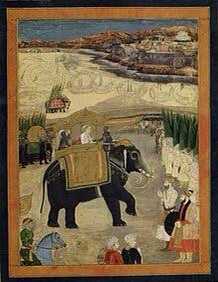
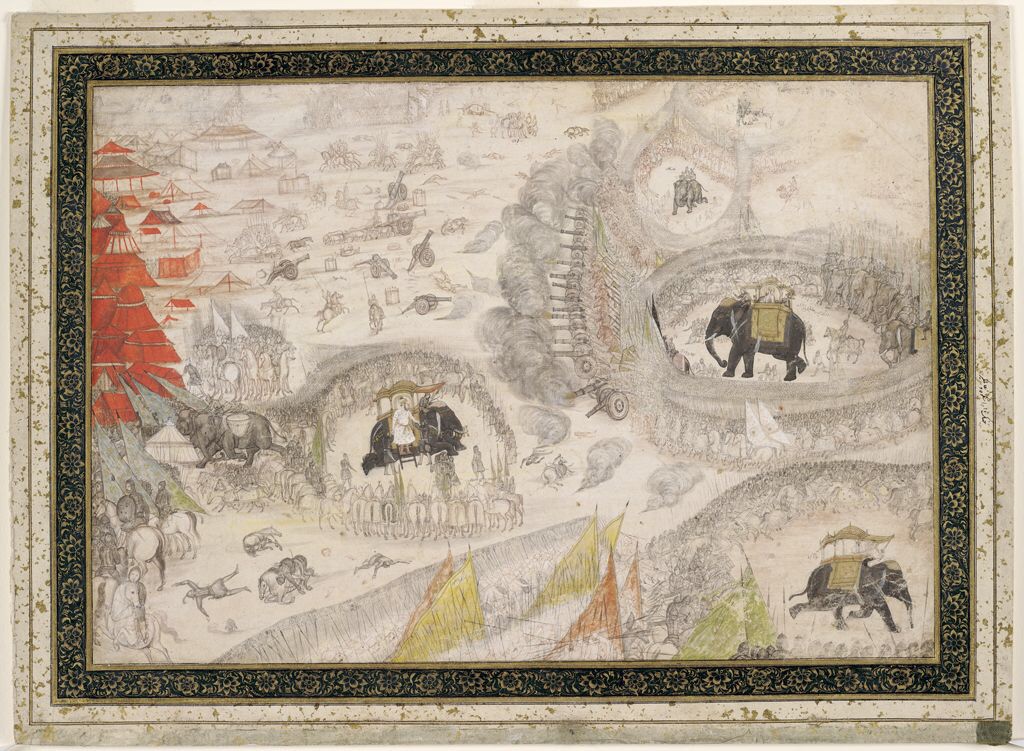
The Battle of Samugarh, c. 1658, artist Payag, 17th century Mughal period, 932-1274/1526-1858, Harvard Art Museums/Arthur M. Sackler Museum, Gift of Stuart Cary Welch, Jr. , 1999.298 Department of Islamic & Later Indian Art ,
Division of Asian and Mediterranean Art, c.1658

As one perhaps knows, Monarchy is not an Islamic institution. By the time the Mughals established there hold in India, the Muslim world had reconciled itself with the concept of monarchy. And the monarchy within the within the Islamic framework was being justified by the Muslim jurists by an extended interpretation of the Tradition of the Prophet.

The development of Islamic thought in India in respect of monarchy is beside the point here. Since it is not an Islamic institution, the law of succession is not there: but by the 17th Century it was established that ‘largest the sword, largest the claim!’. Thus the War of Succession was a constant feature of Timurids in India.

Interpretations

The War of Succession in 1658-59 took place at a time when the Mughal Empire was at its zenith: and naturally that attracted the historians’ attention. There are only few topics in medieval Indian history on which so much has been written as on the war of succession between the sons of Shahjahan! S. R. Sarma says in Aurangzeb the Sunni Orthodoxy triumphed.

Allama Shibli Nomani says that Aurangzeb essentially fought for the faith and not for the throne. In fact he says that the Hindus had benefited from the policy of tolerance of Akbar and were getting out of hand and even persecuting the Muslims. Dara Shukoh was a traitor within the Islamic political community who sought to open the gates fully to the Hindus. Aurangzeb, therefore, rallied the Muslims together and fought essentially for the faith rather than the throne.

For Ishtiyaq H. Quraishi also the war of succession was a tussle between the liberal policy of Akbar and the Orthodoxy. Orthodoxy triumphed!

To Ashirbadi Lal Srivastava, Aurangzeb represented the orthodox forces which emerged victorious while the tolerant policies enunciated by Akbar were reversed.

This lunatic phase of old histories had not come to an end when Iftikhar Muhammad Khan Ghori of Pakistan called this ‘wos’ an ideological conflict between the Sunnis and the Shi’as.

If we examine all these views, both Indian and Pakistani – or should we say, Hindu and Muslim – the arguments are essentially the same. Communal passions were raised to such an extent, that, even a ‘scientific historian’ like R. P. Tripathi was misled to declare that during the war of succession the slogan which was needed was ‘Religion in Danger’. This slogan of Islam in danger according to Tripathi was raised by Aurangzeb. To quote him:

“It was also deemed necessary to find out an effective slogan for the war and the cry that was raised was the defence of the law of Islam from the heresies of Dara, whether Shahjahan was alive or dead. Should the emperor be still alive, they would free him from the thraldom and tyranny of that idolator. They arrogated to themselves the honour of being the defenders of Islam.”

Aurangzeb’s Nishān to Rānā Raj Singh

Now let Aurangzeb speak what he fought for, whom he represented?

Aurangzeb issued a nishan to Rana Raj Singh.

…. [nishan means ‘princely order; farman is an order issued by the emperor; technical order issued by a noble was a parwana; while an order issued by a noble under the direction of the emperor is known as a hasb ul hukm].

So Aurangzeb issued a nishan to Rana Raj Singh just after the Battle of Dharmat and before the Battle of Samugarh, which was the real battle when Dara and Aurangzeb fought against each other.

This nishan discovered a few decades back is now incorporated in Kaviraj Shyamaldas’s Vir Vinod. If we take out the name of the emperor, it looks like the preamble of the constitution of India. In it Aurangzeb says that the king who discriminates on the basis of caste and religion is a rebel against God and must be punished. He says that sovereign is the shadow of God; while the khalqullah, i.e., the people, are the creation of God. The kings are the pillars of God’s court and are devoted to the act of non-interference and peace with men of various sects and creeds. Any King who does resort to intolerance, in reality harms God’s fabric as it brings ill-will and conflict amongst the people who are the trust of God. Aurangzeb promises that when he would come to the throne, he would follow the steps of his ancestors who are held in esteem and whose practises have cast lustre in the inhabited world. (Vir Vinod, II, pp. 419-20)

So this shows that Aurangzeb was fighting for the tolerant policy and that he promised to eliminate all traces of discriminatory policies. This was a public declaration: deviation from a tolerant policy was a sin. One can say that in this document or public declaration, Aurangzeb spelled out his policy on which he fought. [See M Athar Ali’s paper in JRAS, 1978]

Mamuri in his Tarikh i Aurangzeb informs that when Aurangzeb was coming from the Deccan, just to impress the followers, he sought an interview with Shaikh Abdul Latif, a mystic at Burhanpur, on the ground that he was going to fight a heretic. The mystic, however, wanted to avoid the Prince. But Aurangzeb came to the khanqah to get his blessings so that among his followers an impression be created that he is going to win. When Aurangzeb asked the Shaikh to pray for him as he was going to fight a mulhid, the mystic diplomatically replied, “Whatever wish of God, will be implemented”. The same information is supplied to us by Khafi Khan [II,ii].

Ahadnāma:

Then in the ahadnama or agreement concluded between Prince Aurangzeb and Murad Bakh, in the preamble it was written that they were going to fight the ‘prince of heretics’ (rais-i mulahida). Incidentally we should remember that before the Battle of Samugarh, the charges of heresy against Dara were not so freely used. Now he is being referred to as the ‘Prince of Heretics’!

Much has been made out on the basis of this reference in the preamble of the agreement between Murad Bakhsh and Aurangzeb to prove the point that the religious issue was involved. But then, Aqil Khan Razi, who was a firm supporter of Aurangzeb, belies this thesis. When he reproduces the text of the entire ahadnama in his Waqi’at-i Alamgiri, he does so minus the preamble, which he presumably thought not to be important enough to be reproduced! Nowhere throughout his account does he refer to Dara’s heresy as a cause for the war of succession.

Moreover, we should remember that if a person opposed the Mughal state, he was always defined as a ‘heretic’.

Ruqqāt:

Let us consider some other facts. We have a number of letters written by Aurangzeb. A letter written by Aurangzeb to Jahanara after the battle of Dharmat survives. It contains accusations against Dara. The only accusation with a religious colour is “his actions are always contrary to (the principles) of the country and the people”. For example, the withdrawal of Mughal contingents from Bijapur campaign in 1657 through which Dara had harmed the larger interests of the empire and exposed Aurangzeb and his troops to danger. (see Waqi’at-i Alamgiri; Manucci, I, 247-48).

Muhammad Kazim is the first who speaks of Dara’s heresy. His Alamgirnama gives a detailed account of Dara’s heresy not to explain Aurangzeb’s taking up arms against him, but to justify his execution.

Attitude & Perception of the Nobles:

Now the question is how did the nobles, who were participating in the war of succession on various sides, took this? Whether the support of the contending princes was divided on communal and sectarian considerations, or whether the supporters of different princes consisted of all sort of people cutting across religious considerations?

We find that among the supporters of Aurangzeb, the representation of the non-Muslim nobility was not inferior or less than the non-Muslims in the camp of Dara Shukoh. Mirza Raja Jai Singh frustrated all military attempts of Dara Shukoh and did not join before the Battle of Samugarh. Rana Raj Singh also did not come to the help of Dara Shukoh or Shahjahan. Amongst the followers of Aurangzeb were Iranis, Turanis, Rajputs and Marathas as under Dara. The support of nobles thus cut across religious and racial considerations. This was as the nobles were not under the impression that they were fighting for tolerance or intolerance; or that it was a struggle between Hindus or Muslims. They sided with one or the other due to their own estimates, political adjustments, likes or dislikes: the ideological view was not involved.

Champat Bundela pointed out a ferry to Aurangzeb, not guarded by Dara; Aurangzeb crossed the river and paralysed the artillery of Dara Shukoh.

According to Ishtiyaq Quraishi, “the Rajputs rallied around Dara”. It is held that Dara was supported by 22 Rajput and 2 Maratha chieftains. As against this Aurangzeb was supported by only 9 Rajput chieftains. Iftekhar Ghori opined that on the appeal of Aurangzeb “…20 Muslim commanders of the Imperial army decided to disobey the summons and joined hands with him”. He infact cites Manucci and Sadiq Khan for this contention. However it is Abul Fazl Mamuri, and he too speaks of only 20 ‘commanders’ and not ‘muslim commanders’!

These contentions of Quraishi and others are challenged by M.Athar Ali. To him the arguments of Shibli, Sarma, Srivastava, Quraishi and Ghori are too simplistic and erroneous. According to Athar Ali, the statistics that 24 Hindu chieftains were in support of Dara and 9 in favour of Aurangzeb is historically wrong. According to him Aurangzeb had the support of 21 non-Muslim chieftains. Thus a mere difference of only three. The support which Aurangzeb got was quite broad-based – both Hindus and Muslims supported him.

On the call given by Shahjahan, Mahabat Khan and Chhatarsal Hada came to the court. But Najabat Khan and Mir Jumla were with Aurangzeb. Shahnawaz Safawi had also been detained forcibly by Aurangzeb.

As Dara was in the capital, it was obvious that he would get the support of those nobles who happened to be at the court. But this support did not remain constant.

As Aurangzeb started from the Deccan, it was natural that he got the support of the 11Marathas. Ultimately Jai Singh and Jaswant Singh also came to support him. Both of them were very important Rajput nobles, who in fact represented the Rajput community. Aurangzeb had raised the slogan of Islam to justify his actions against his father. Had it been the real cause, or the cause believed by the contemporaries, Muslims should not have supported Dara, or the Hindus Aurangzeb.

Aurangzeb’s nishan to Rana Raj Singh of Mewar leaves us in no doubt that the head of the most illustrious house in Rajasthan was in sympathy with Aurangzeb. Mirza Raja Jai Singh was also a secret partisan of Aurangzeb, who sabotaged the whole military effort of Dara. Qanungo in his book on Dara Shukoh, infact goes on to quote Prince Akbar who in 1681 remarked:

“Perhaps it has not been brought to your notice that Dara Shukoh was in reality prejudiced against and hostile to, this race (i.e. Rajputs). He saw the results of this. If he had made friends with them from the first, he would not have fared as he did…” [R.A.S., London Ms. 173]

As far as the Shias are concerned, only Bernier and Manucci are the authority [the latter borrows from the former]. Mir Jumla and Shaistah Khan were with Aurangzeb; Shahnawaz Khan Safawi was with Dara.

If one looks at the break up provided by Athar Ali for the nobles having 1000 zat and above, the point would become clearer:

TABLE I

Thus we see that 23 Hindus were with Aurangzeb and Murad, while 24 were with Dara. Out of these, Jai Singh was the viceroy of the Deccan, Jaswant Singh was the governor of Gujarat, while Raja Raghunath was the Diwan. Thus in the light of the above evidence, put forward by Athar Ali, the religious issue was not at all involved in the War of succession. Further these figures of Athar Ali show that out of the 124 nobles of 1000 zat and above, who are known to have been supporting Aurangzeb uptil the Battle of Samugarh, 27 or 21.7 % were Iranis, 4 out of them holding rank of 5000 zat and above. As against this, 23 out of 87 of Dara’s Supporters, i.e., 26 % were Iranis.
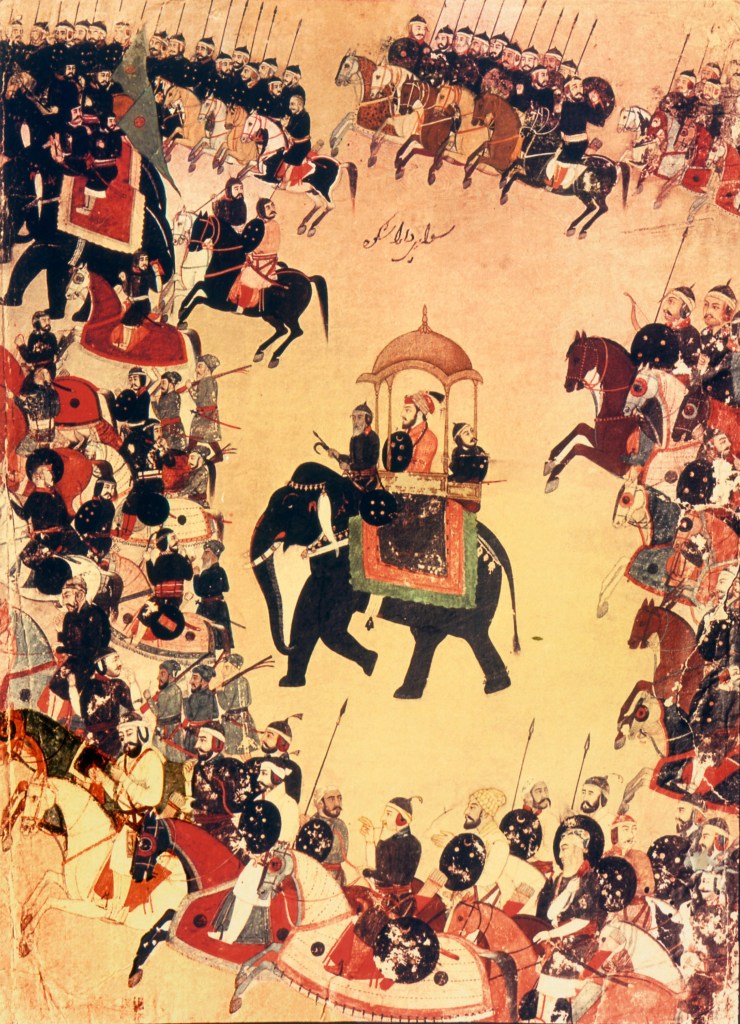
Dara Shukoh and his Army, Red Fort Museum, Delhi. Werner Forman Archive

Athar Ali further tells us that out of 486 mansabdars in 1658-78, 136, i.e., 27.3 % were Iranis, quite dwarfing the Turanis who numbered 67, i.e., 13.8 or 14 %. On the top rung of the ladder, 23 Iranis held the rank of 5000 and above in 1658-78; and 14 in 1679-1707. While the number of Turanis was only 9 and 6 respectively!

Now let us come to the question: why the confusion amongst the historians that religious slogan was raised by Aurangzeb in the War of Succession, which is factually incorrect. Why did this confusion arise? 

Aurangzeb raised the religious slogan to justify the execution of Dara after his enthronement. He could not be executed on any other charge. So just to justify this act, Aurangzeb raised the religious slogan that he being a mulhid should be executed. The religious bogey was not to justify the rebellion of Aurangzeb; it was raised to justify the execution of Dara. Historians confused the cause and attributed to the war of succession.

Murad had also to be executed. So a charge was brought that he had killed his diwan Ali Naq. His sons were made to petition Aurangzeb that the prince had executed their father. Thus he was executed on the charge of the murder of Ali Naqi diwan.

Course of the War

The Start of War:

Shahjahan fell ill at Delhi on 6th September 1657. His practice of jharokha darshan and appearing in the darbar stopped. Dara, being an experienced person, got the wakils (agents) of the princes arrested and imprisoned so that hey could not send news to their masters. Isa Beg, the wakil of Aurangzeb was also imprisoned. Due to this rumours spread that Shahjahan had died. Shahjahan was thus forced to appear at the jharokha on 14th September. Unfortunately the illness relapsed and he could not appear before the people till 15th October. Although his health improved but not quite satisfactorily. Dara made a servant, who resembled the emperor to appear on the jharokha, and took this opportunity to consolidate his own position. The rumours which could have been curtailed had the agents not been arrested, compounded the situation. Had Dara not arrested them, they would have written to their masters that the king was ill but alive.

Due to his ill health Shahjahan was constrained to nominate Dara Shukoh as his successor in the presence of the nobles. He further wished them to support Dara’s claim to the throne. Subsequently, he left Delhi for Agra on 18th October 1657. On reaching Agra on 25th he held the royal darbar on 5th December 1657. It was enough to make known that Shahjahan was alive. From September to October, Dara being in court, tendered and nursed his father and showed no haste to seize the crown. He exercised supreme authority but issued orders in the name of Shahjahan. Dara’s services to his ailing father naturally impressed Shahjahan who therefore bestowed upon him 1 crore cash, a promotion in his rank to 60,000, and a cavalry of 34,000. Shahjahan also promoted his sons to a rank of 15,000 and 10,000 respectively. The governorships of Bihar, Multan and Punjab were also bestowed on Dara. Simultaneously Mir Jumla was removed from the prime-ministership and orders were issued to Mir jumla and other nobles to come back to the capital.

These acts of Shahjahan were natural: there was nothing wrong in it. But when the news of the illness of the emperor reached the other princes, along with the favours done to Dara, their bitterness increased. Aqil Khan Razi, the author of Waqi’at-i Alamgiri, writes that the three brothers (Murad, Shuja & Aurangzeb) were inimical to Dara and had planned to strike against Dara when the circumstances appeared to be favourable. Thus when these developments were reported to them they started preparing for making themselves king and strike against Dara before Dara could consolidate his position. Aqil Khan Razi further says that the three brothers maintained contacts with each other for appropriate action. Thus on getting the news, Murad Bakhsh declared himself as King of Gujarat. When Ali Naqi of Gujarat asked him to desist and refused to cooperate, he was murdered by Murad. Shah Shuja declared himself in Bengal. Khutba in the name of these two along with coins struck in their names took place in the beginning of December 1657. Aurangzeb on the other hand did not declare himself as the king but declared his intention to proceed to meet his ailing father.

Shah Shuja proceeded by rapid marches from Bengal. Aurangzeb started from the Deccan while Murad converged from Gujarat. By the time these armies advanced towards Agra, Shahjahan was perfectly alright. Armies were converging on Agra from three directions. Miscalculation of Dara at this juncture was of considering Shah Shuja as the real threat and deputed Prince Sulaiman Shukoh to check the advance of Shah Shuja from Bengal. He sent the best troops of the Imperial force along with his son under the effective command of such renowned generals as Mirza Raja Jai Singh and Daler Khan. The nominal command of the army was with Sulaiman Shukoh. The result of this was that the position at Agra was weakened. Two other separate armies were mustered: one under the command of Maharaja Jaswant Singh and another under Qasim Khan. The army under Jaswant Singh was deputed to bar the passage of Aurangzeb coming from the Deccan; Qasim Khan was sent to obstruct the passage of Murad Bakhsh coming from Gujarat.

Aurangzeb wrote to Murad from the Deccan that he should not engage the imperial forces before Aurangzeb joins him. According to Aqil Khan Razi, an agreement was also signed between Murad and Aurangzeb through which they decided to oppose Dara. They agreed that after the victory they would occupy Agra and the two brothers would share the victory. Kabul, Kashmir, Lahore, Multan and Sind would go to Murad along with 1/3rd of the booty, while the rest of the territory of the empire will be shared by shuja and Aurangzeb; and this would also be the share of the treasury. The move against Shahjahan was to be justified and the support of the people was to be won. The slogan which was to be raised was that a heretic exercised all powers at court and so they were moving to free the emperor from the clutches of a heretic! The letter which Aurangzeb wrote to his brother to effect an alliance with him is cited by Bernier:

“I need not remind you, my brother, how repugnant to my real disposition are the toils of government. While Dara and Sultan Sujah are tormented with a thirst for dominion, I sigh only for the life of a Fakire. But, although renouncing all claim to the kingdom, I nevertheless consider myself bound to impart my sentiments to you, my friend, whom I have always tenderly loved. Dara is not only incapable of reigning, but is utterly unworthy of the throne, in as much as he is a Kafir – an idolator – and held in abhorrence by all the great Omrahs. Sultan Sujah is equally undeserving the crown; for being avowedly a Rafezy – an heretic- he is of course an enemy to Hindoustan. Will you then permit me to say that in you alone are to be found the qualifications for ruling a mighty empire? ….. With respect to myself, if I can exact a solemn promise from you that, when King, you will suffer me to pass my life in some sequestered spot of your dominions, where I may offer up my constant prayers to heaven in peace, and without molestation, I am prepared immediately to make common cause with you, to aid you with my counsel and my friends, and to place the whole of my army at your disposal…”

Aurangzeb arrested Mir Jumla: this act was a result of a conspiracy between Mir Jumla and Aurangzeb. Even if it was not it was quite strategic on the part of Aurangzeb – Mir Jumla had huge wealth and artillery. With him Aurangzeb got huge fiscal and military power. Mir Jumla was a clever but disloyal person, and Aurangzeb knew this very well.

Aurangzeb left Aurangabad on 5th February assuming royal prerogatives, i.e., distributing mansabs etc. He reached Burhanpur on 15th Feb, left Burhanpur on 20th March. Murad on the other hand left Ahmadabad on 25th February.

Both the armies of Murad and Aurangzeb joined at Dipalpur in Malwa on 14th April. The imperial orders were that if the two were to join, then Qasim and Jaswant Singh were also to join and give a combined fight. This was also a weakening of position at Agra: a strategic mistake and error.

The sensible policy would have been to let the entire army remain intact at Agra and then give the battle to the rebels in a combined manner. In that case, the position of Dara would have become sound: as the Emperor was alive and would have been present in the fort.

Mirza Raja Jai Singh defeated Shuja in a night attack during the battle known as the Battle of Banaras. But Jai Singh continued to pursue Shuja upto Bihar and evaded the orders of the emperor to return before the Battle of Samugarh. This was deliberate on the part of Mirza Raja as he was sympathetic to Aurangzeb and unhappy with Dara. Due to this, Dara was deprived of the best trained army which accompanied the Raja.

So Shuja was defeated and fled.

The Battle of Dharmat:

The first encounter between Aurangzeb and the joint imperial army under Qasim Khan and Jaswant Singh took place at Dharmat, a village near Ujjain in (15th) April 1658. The weakness in the Imperial forces was that neither Qasim Khan nor Jaswant Singh was a match to Aurangzeb in general ship. Secondly it was a well established convention that a prince could fight a Mughal prince. There was no prince in the camp of Jaswant Singh and Qasim Khan, and as such their position was weak.

Aurangzeb suggested to Jaswant Singh that he should not stop the princes from going to Agra and should abstain himself from bloodshed. But Jaswant Singh turned down the proposal. Qasim Khan also suggested to Jaswant Singh that it was futile to fight against the princes and that they should go back to Agra and seek further orders. This request was also turned down by Jaswant Singh.

So a clash of armies became in-evitable. Aurangzeb and Murad defeated the combined forces of Qasim and Jaswant Singh, who fled from the battlefield. The imperial forces were defeated at Dharmat and as a result of this, the prestige of the two princes enhanced and their morale became very high. The entire bag and baggage and the artillery of the vanquished came into the hands of Aurangzeb.

But then, the entire blame for this defeat of Dara at Dharmat does not rest with Raja Jaswant Singh. According to Ishwari Prasad, he had under his command an army which was a heterogenous mass without cohesion or common loyalty. The Rajputs, belonging to the different clans, were swayed by considerations of privilege and precedence, and did not render ungrudging obedience to the commands of their leader. The Hindus and Muslims had their own differences and their separatist tendencies destroyed the unity of command, which was essential to success. The Muslims scorned to fight under Hindu leadership and thus within a single army there were seen two co-ordinate authorities, which fatally hampered the plans of each other. Besides these inherent drawbacks, the imperial army was weakened by the intrigues which its own officers carried with Aurangzeb. Sarkar on the other hand points out that on the imperial side nearly 6000 men fell at Dharmat, most of whom were Rajputs. “Every clan of Rajasthan contributed its share to the band of heroes who sacrificed their lives in their master’s service (swami-dharma).”

 Due to this victory at Dharmat, nobles and soldiers started deserting the side of Dara and joined the party of Aurangzeb. They rapidly marched towards Agra. On 20 April Aurangzeb and Murad left Ujjain and reached Gwalior the next day. From Gwalior they moved towards Dholpur. Dara made all possible efforts to mobilize all the forces left at the capital and sent orders to Jai Singh to join him. But Jai Singh avoided receiving the orders and wasted his time in a fruitless pursuit. Shahjahan now ordered Rana Raj Singh to join him. But Aurangzeb sent a nishan to him. So he also did not move for the help of Shahjahan and Dara. 

The Battle of Samugarh:

Whatever Mughal force was left at Agra was now led by Dara Shukoh to Samugarh. He still had such renowned military commanders as Rustam Khan Dakkani, Chhatarsal Hada etc.

To reach Dholpur the army of Aurangzeb and Murad had to cross the river Chambal. Dara guarded all known ferries at Chambal so that Aurangzeb should be prevented from crossing the river. Artilleries were fixed on all known ferries. Champat Bundela, who was in rebellion against Shahjahan, was moving as a rebel in the ravines at this time. He approached Aurangzeb that in case pardon is granted to him, he would show an unguarded ferry around 40 miles away to the east. Aurangzeb promised the pardon, the ferry was pointed out and on 23rd May 1658 Aurangzeb crossed the river. The entire artillery of Dara became useless.

 Dara was at a place known as 9 miles south of Agra known as Samugarh. On getting this intelligence, Ibrahim Khan s/o Ali Mardan Khan Amirul Umara advised Dara that before the forces of Aurangzeb collected or discipline themselves this side of the river, attack should be launched immediately. Because once Aurangzeb takes position firmly, it would be difficult. However this sound advice was turned down and not heeded by Dara Shukoh. A contrary advice was given by Khalilullah Khan who being hostile to Dara and in favour of Aurangzeb, said that ‘we will defeat Aurangzeb in a pitched battle’. Thus Dara at this crucial juncture turned down the sensible suggestion. His artillery we have seen had already become ineffective.

Aurangzeb ordered rest for the whole day and Dara instead of making use of this opportunity just kept waiting in full battle array. It was the month of May. The forces of Dara stood exposed in the sun doing nothing. Next day the battle started. Thus the Battle of Samugarh was fought on 29th May. When the army of Aurangzeb appeared, Dara ordered his artillery to fire at it; but it was beyond range. When Aurangzeb fired it was with in range and thus created havoc in the ranks of Dara Shukoh. The Rajput contingent headed by Chhatarsal Hada galloped to capture the artillery of Aurangzeb and in the process Chhatarsal died. According to Alamgirnama, Chhatarsal was renowned for his bravery.

Rustam Khan Firozjung Dakkani on the other hand fell upon the forces of Murad and died fighting for Dara. He too was a general whose bravery was beyond doubt: Kazim Shirazi testifies to his bravery as well.

Before the battle when Shahjahan got the news of the advance of Aurangzeb and the defeat of Jaswant Singh, he discussed the issue with nobles like Shaista Khan (the brother-in-law of Shahjahan and the uncle of Aurangzeb), and decided to fight against Aurangzeb in person. Shaista Khan adviced him to the contrary: he said that the emperor’s health was not conducive to go to the battleground himself. Unfortunately Shahjahan heeded this advice and Dara led the army against his brothers. Thus on 29th May when the battle of Samugarh was fought, instead of it being a battle between the emperor and the ‘rebels’ it was a battle between princes. Initially Dara appeared to be on the verge of victory and the forces of Aurangzeb were scattering. At this juncture, Khalilullah Khan adviced Dara, who was mounted on an elephant to come down and shift to a horse. On finding their leader absent from the elephant, the winning army of Dara thought that their leader had either been injured or died. Thus confusion was created. The army of Aurangzeb too felt that Dara had been killed and started recollecting. The victorious army was defeated and the lost battle was won by Aurangzeb at Samugarh. It was this victory which bestowed the crown of the Mughal empire to Aurangzeb.

The loss of the two generals (Rustam Khan and Chhatarsal), and the reversal of fortunes during the coarse of the battle, Dara fled and the battle of Samugarh was lost and the fate of Dara was sealed.

Reasons of Aurangzeb’s Success Samugarh:

Among the reasons of the success of Aurangzeb, there appears to have been two prominent causes: the inexperience and ineptitude of his brothers and his own shrewdness and generalship.

 Now Aurangzeb proceeded to Agra and besieged the fort. The water supply to the fort from the Jamuna was cut. There was no Bikramajit Bhadoria or any one else to defend the emperor and his fort from the prince! Shahjahan was in the fort but no noble or zamindar sympathised with him. Compare this with the event of the siege of the same fort in 1622 when Shahjahan was the besieger and Jahangir, the emperor was in Lahore!  

The result was that the fort was captured and Shahjahan was imprisoned. All attempts by Jahanara Begum, the eldest daughter of Shahjahan, to bring about a rapprochement between her two brothers failed. Aurangzeb declared that Shahjahan had ceased to be an effective monarch and had no right to rule. He argued that as he himself was the most effective person he should ascend the throne, his father having been proved a weak ruler.

After the Battle of Samugarh a new situation had arisen. So long as a common enemy was there, Murad and Aurangzeb were united. Now Aurangzeb had no use for Murad. During the battle of Samugarh Murad had been badly injured. He also started behaving independently. In pursuit of Dara he left for Delhi with 20,000 soldiers and followed Aurangzeb at a distance of 12 miles to give an impression that he was independent of him. By treachery Aurangzeb got Murad arrested and ultimately imprisoned him at Gwalior. His army was alswo taken over by Aurangzeb.

Dara fled to Punjab and then to Gujarat. Shahnawaz Khan Safawi, the subahdar provided him money and soldiers while Jaswant Singh asked him to come over to Ajmer and promised him all help. Dara believed and along with Shahnawaz Khan left Gujarat for Ajmer. When he reached Ajmer, Jaswant Singh did not come forward to help him. Perhaps Mirza Raja Jai Singh also had a part to play in this game. At this stage the Mirza Raja intervened and warned that if Jaswant Singh supported Dara Shukoh, his clan would be ruined. Thus Jaswant went out of his province and no contingent was sent to Dara, inspite of repeated requests made by the latter.

Now Aurangzeb immediately left for Ajmer and at Deorai a battle was fought. In this battle fought in 1659 Dara was once again defeated and his fate was sealed. Dara fled. Shah Shuja at this juncture again made an attempt to contest the throne. Previously he contested against Dara. But this time his contest was with Aurangzeb. He wrote letters to the qiledar of Allahabad to hand over the fort to him as he was coming from Bengal. Jaswant Singh had joined the forces of Aurangzeb by this time. So at the battlefield of Khajua (near Allahabad), Shah Shuja encamped himself and being an intelligent person adopted a new technique of warfare. Discarding the usual formation of the army, he arranged his armed forces in one line – vanguard, left, right, and centre were avoided. This was done as his army was numerically inferior to the army of Aurangzeb. Jaswant Singh, as a supporter of Aurangzeb, had been given the command of the Rajpur wing of Aurangzeb’s army. Shah Shuja entered into a conspiracy with him and an agreement was reached between the two that before the battle actually starts, in the late hours of the night, around 3 AM Jaswant would attack the army of Aurangzeb. Jaswant Singh thus launched a sudden attack on the army of Aurangzeb at the appointed time; a great hue and cry arose in the camp of Aurangzeb as the attack was unexpected. Unfortunately Shah Shuja thought it to be a trick of Aurangzeb and did not launch a simultaneous attack as was expected. He desisted to do anything when confusion reign in the ranks of the enemy. Aurangzeb on his part assured his soldiers that Jaswant had run away before the battle.

The Battle of Khajua:

The next day the battle started at Khajua. It was a hotly contested battle. The army of Shah Shuja, especially his artillery, created havoc and at one stage it appeared as if the army of Shah Shuja would emerge victorious. Aurangzeb was also perhaps not sure of victory. Once faced with artillery fire, Aurangzeb’s elephant on which he sat was the main target. Aurangzeb ordered the feet of the elephant to be chained so that it may not flee. At one point, if Manucci is to be believed, Aurangzeb thought to leave the elephant and instead ride a horse. Mir Jumla persuaded him not to do so as it would lead to confusion – as at Samugarh with Dara. But then, this might be a gossip.

Ultimately Shah Shuja was defeated and he fled. Aurangzeb became the undisputed king of India.

Murad was arrested; Dara and Shuja were defeated. Four battles – Dharmat, Samugarh, Khajua and Deorai ot Deoragarh – which shook the Mughal Empire which was at that time at its zenith.               

Now let us come to the question: why the confusion amongst the historians that religious slogan was raised by Aurangzeb in the War of Succession, which is factually incorrect. Why did this confusion arise? 

Aurangzeb raised the religious slogan to justify the execution of Dara after his enthronement. He could not be executed on any other charge. So just to justify this act, Aurangzeb raised the religious slogan that he being a mulhid should be executed. The religious bogey was not to justify the rebellion of Aurangzeb; it was raised to justify the execution of Dara. Historians confused the cause and attributed to the war of succession.

Murad had also to be executed. So a charge was brought that he had killed his diwan Ali Naq. His sons were made to petition Aurangzeb that the prince had executed their father. Thus he was executed on the charge of the murder of Ali Naqi diwan.

Reasons of Aurangzeb’s Success:

If we carefully examine the account given by Sadiq Khan, the irresistible conclusion is that Shahjahan was unpopular vis-à-vis the nobles which became the main reason for the success of Aurangzeb.

Shahjahan became unpopular due to his stringent financial measures and his ruthless policy in realising the arrears. This made Shahjahan unpopular vis-à-vis the nobility.

Dara was unpopular as he was the spoiled child, very arrogant and discourteous to the nobles. He was quite ill-mannered and ill-tempered. Dara had neither the qualities of a general nor an administrator: he had no experience of warfare. He made strategic mistakes. For example he made a mistake of dispatching 3 armies from Agra because as such it weakened the situation at Agra.

Further, the Afghans as a class were hostile to Shahjahan and whole heartedly opposed Shahjahan and supported Aurangzeb. Professor M. Athar Ali has shown that out of the 124 nobles of 1000 zat and above, who supported Aurangzeb up to the battle of Samugarh, 23 were Afghan; while there was only one Afghan among 87 nobles of this status on the side of Dara. 

In contrast to Dara, Aurangzeb had a vast and rich military experience. He also had the best Deccani generals who were accompanying him. Aurangzeb played his cards well: each section of the nobility was kept satisfied. He had also acquired a fine pack of artillery belonging to Mir Jumla and that proved of immense use in the war of succession.

The Bundelas too were hostile to Shahjahan. It was Champat Bundela who pointed out the ferry to Aurangzeb at Chambal.

The intellectual movement at the court of Shahjahan under the patronage of Dara Shukoh had been aimed at religious reconciliation of Hinduism and Islam: and because of this Dara had incurred the displeasure of Hindus and Muslims alike.

Dara was pitted against a person who had experience of fighting the Persians at Qandhar, against the Uzbeks in Balkh, against the powerful states of Golcunda and Bijapur in the Deccan. Hardly there was any serious problem with which the empire was faced and with which he was not acquainted and for which he had not been criticised unnecessarily by Shahjahan. The result was that he was brought up in adverse circumstances. That is why he became mature: He governed himself, while Dara governed through deputation. Thus the personal factor was also involved. Aurangzeb was the best framed person among the sons of Shahjahan.

Thus among the causes of the War of Succession, one can say that firstly, the religious issue was not one of the causes.

Secondly there was an absence of the rule of succession, the monarchy being not an Islamic set-up.

Thirdly. The excessive inclination of Shahjahan towards Dara, who was designated heir-apparent created suspicion in the minds of other princes.

Fourthly, the Deccan problem separated Aurangzeb and Shahjahan. Further, all the princes were grown up and held the resources of atleast one province at their disposal so that they could contest with reasonable chance of success.

And when Shahjahan fell ill, Dara committed a mistake by arresting the wakils of all the princes with the result that there was strong suspicion that Shahjahan had died.

Lastly but not the least there was strong antagonism against Shahjahan himself due to his economic policies and the fact that he himself had opened the door of rebellion against a living emperor.

Effect of the War of Succession

It was for the first time after the establishment of the Mughal rule in India that the reigning sovereign was arrested and imprisoned. This means that Aurangzeb by his own action weakened the very concept of monarchy. The institution of the monarchy as such was weakened. This was the direct consequence of the War of Succession. And there were far reaching consequences of this. Aurangzeb was aware of this.

Secondly, so long as emperor Shahjahan was alive, there was a choice left before the nobility. Nobility could have reversed the situation if Aurangzeb had antagonized the nobles. Thus as long as Shahjahan was alive, Aurangzeb was not in a position to incur the displeasure of his nobility. This imposed a restriction on the policy of Aurangzeb in dealing with the nobles. Aurangzeb thus tried to placated all the powerful sections of the nobility and it was perhaps having in view this consideration that he appointed both Jaswant Singh and Jai Singh to the highest rank of 7000/7000. This was probably to pacify the Rajput nobility. Jaswant was twice appointed as governor of Gujarat in spite of his being a traitor. After coronation, Jai Singh was given an inam worth 1 crore dams.

Raja Raghunath Singh was appointed as the Diwan of the Empire. After the death of Todarmal, no non-Muslim had been appointed as the Diwan of the Empire. He was a Khatri. And his appointment was again a concession to the Hindus and the Rajputs.

Aurangzeb also gave promotions to different sections of the nobility. Rewards were given to all who had come to the side of Aurangzeb. Thus the rank of Mir Jumla was enhanced to 7000/7000 along with an inam of Rs. 10 lakh and the title of sipah salar was bestowed upon him before he was sent in pursuit of Shah Shuja. Similarly Shaista Khan was also awarded the mansab of 7000/7000 du aspa sih aspa, a title of Amir ul Umara and an inam of 2 crore dams. He was first assigned the charge of the Agra fort where Shahjahan had been confined and then he was sent to pursue Sulaiman Shukoh and given the charge of Balkh. Another noble, Khalilullah Khan was raised to 6000/6000 du aspa sih aspa and then made the governor of Punjab. Such examples can be multiplied.

 The manifesto which he issued during the war of succession proclaimed that Shahjahan had ceased to be an effective ruler and had no right to rule while Aurangzeb being a more rigorous person was entitled to ascend the throne. So the promise which he gave to the nobles was that the declared policy had to be translated into action. This was just to placate the nobility at a time when Shahjahan was still alive. So if he had to prove this fact of being more vigorous than Shahjahan, the only way to do it was to pursue a policy of expansion and annexations. Few decades in the 17th Century have seen such hectic campaigns as the first 10 years of Aurangzeb’s reign! The expansion was practically in all the directions: towards the Deccan, Assam, Kuch Bihar etc.

But as the natural geographical barriers had been touched during the reign of Shahjahan, further expansion was not possible unless vast military resources were concentrated, that too with serious political effects. Thus the attempt made by Aurangzeb for expansion was bound to be a failure. This had far reaching consequences for the subsequent policies of Aurangzeb.

Another consequence was that Aurangzeb became suspicious of his own sons, and that is why he exercised care and caution in placing the vast resources with his sons. The sons were also not as well trained as the sons of Shahjahan: the sanctity of the monarch had been compromised.

All this was naturally going to strain the economic resources of the empire and lead to scarcity.
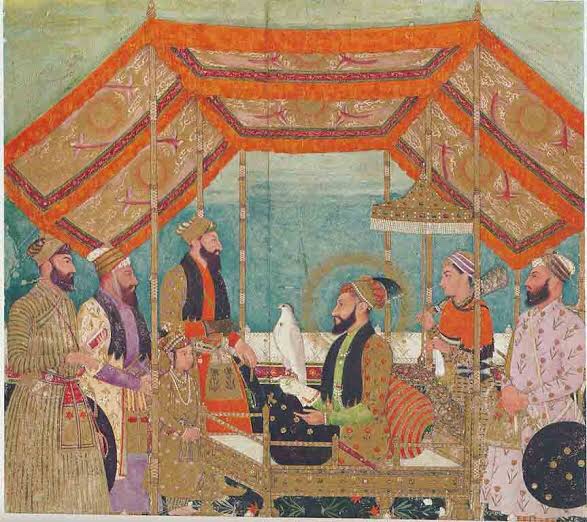
Mughal Nobility and Aurangzeb

An Introduction to Mughal Nobility:

The unique feature of the Mughal Empire was that the Mughals had an international ruling class. Chandra Bhan Brahman, a contemporary of Shahjahan in his book Chahar Chaman ( or Guldasta) observed that the Mughal nobility was composed of various races, people of various nationalities, various countries, and of various faiths. He further emphasised that the Mughal nobility consisted of the Irais, Turanis, Tajiks, Turks, Arabs, Abbysinians, Afghans, Shaikhzadas, Rajputs, Armenians etc. He is of the opinion that it was an important feature of the Mughal Empire that the Mughals had an international ruling class where the entry of different groups into the aristocracy cut across religious, racial and geographical considerations.

For the countries of Iran and Turan, India was considered the El Dorado, where fortunes could be made. The Safavid Empire and the Uzbek Khanate were places where the beaurocrats were trained as administrators or financiars or military generals, and then migrated to India and absorbed in the Mughal nobility. So in that way the Safavid and Uzbek Khanate were the training ground for the Mughal aristocracy. Most of the begs and bahadurs of Babur were of Turani origin. And after the death of Babur, Humayun was faced with a difficulty of facing or dealing with a comparatively independent and hostile aristocracy. Most of the difficulties with which Humayun was faced were the creation of his nobles because the tribal outlook of the Afghan nobility during the reigns of Babur and Humayun had influenced the central outlook of the Mughal nobility to the extent that the Mughal nobles were not so obedient to Humayun as they should have been: More so at a time when the empire was faced with a serious crisis.

After the re-establishment of the Mughal Empire in India and the accession of Akbar in 1556, at the initial stages, the nobility of Akbar also consisted of mostly the Turanis, with a small sprinkling of Iranis. Akbar being an intelligent person realised the danger to the empire in the light of an exclusive presence of the Turanis and Iranis. If the empire solely depended on these two elements, it was not a healthy sign for the expansion and consolidation of the Mughal Empire: the moment support was withdrawn by them, it could endanger the very existence of the empire. The aggressive attitude of a section of nobles during the early years of Akbar’s reign was also an eye-opener. Thus to counterbalance the growing influence of this foreign element in the nobility Akbar started a new policy of recruiting the Rajputs and the Shaikhzadas into the Mughal aristocracy. One thing which we should remember is that the Rajputs started being recruited in 1562, that is much before the initiation of his new religious policy. Thus these recruitments were not a result of his tolerant policy. Till now he was not a tolerant king. The recruitment of the Rajputs was in view of administrative necessity. Once recruited in service, the religious attitude was bound to change. Precisely this was also the period when the Shaikhzadas – the Syeds of Baraha, the Syeds of Amroha, the shaikhzadas of Delhi and Hisar Firuza etc were all promoted to counterbalance the growing power of the Iranis and Turanis. Akbar was hostile to the Afghans that is why no Afghan officer worth the name was recruited or promoted. He could not forget that they had expelled his father from Hindustan. So during the reign of Akbar there was a predominance of Turanis, Rajputs and Shaikhzadas. Jahangir promoted the Khurasanis on a large scale mainly because of the political compulsions. He also promoted the Shaikhzadas as he had a very high opinion about the Syeds of Baraha. He used to cite a saying of Mirza Aziz Koka that the Syeds of Baraha are responsible for warding off evil against the empire. Jahangir said that the Baraha Saadat were brave by birth and there was no important engagement in the empire in which they did not distinguish themselves. He also promoted the family members of Shaikh Salim Chishti of Fathpur Sikri. He also promoted the Bundelas and the Hill Rajput rajas. That is why Mirza Aiz Koka wrote in a very strong letter to Jahangir (surviving in the collection of letters of Sh. Jalal Hisari) in which he alleged that Jahangir was discriminating against the Turanis and the Rajputs, the two main supporters of the empire.

Whether this allegation is correct or not, we must not forget that the Bundelas and the hill rajas were Rajputs par excellence. What Mirza Aiz Koka was reflecting was the dominating opinion of the Sisodias and Kachhwahas that they were the real Rajputs.

There is nothing to deny the fact that Iranis were in a pre-dominant position in the Mughal court and the role of Nur Jahan Begum in promoting Iranis was also substantial.

When Shahjahan ascended the throne he was conscious of the fact that the Iranis occupied a pre-dominant position and some check was to be excercised on their recruitment to remove intolerance which was thus caused. So Shahjahan emphasised his Turani origins and was very proud of it. He also adopted the title of sahib qiran-i sani. In the early years of his reign he promoted the Turanis just to reduce the Iranis. Iranis were to be taught a lesson. Yet the fact remains that in spite of this over-emphasis of Turanis, the Iranis continued to occupy important positions as they were very competent as financiers and administrators. Their services could not be dispensed with without risking administrative efficiency of the Empire. They were extremely cultured. Anand Ram Mukhlis in his Mirat ul Istilah (compiled 1740) says that the Badakhshis were boorish and vulgar, while the Iranis were considered highly cultured.

Thus as they were highly cultured and experienced administrators, throughout the Mughal period they had a very prominent position at the Mughal court.

Nobility under Aurangzeb:

During the reign of Aurangzeb, the numerical strength of the Turanis declined as degeneration and decline had set in the Uzbek Khanate with the result that the trained bureaucrats were not available in the Mughal Empire from Central Asia. It was also precisely the period when decline also set in at the Safavid Empire. But the decline in the Safavid Empire was not so fast as in the Uzbek Khananate: The result was that although the Turanis continued to migrate, their number declined. The Iranis maintained their strength in the Mughal court even during this period because the nobles who came from Golcunda etc from the Deccan were mostly Iranis. So in spite of the sharp decline in Safavid Empire and the migration from Iran, the Iranis maintained their strength as those from Bijapur and Golcunda added to their strength.

Another reason for the decline of Turanis and the still continued direct recruitment of the Iranis was that unlike Shahjahan, Aurangzeb was not at all interested in the North West Frontier for expansion. He had reconciled himself with the loss of Qandhar. So their services were not a must. Aurangzeb was convinced that there was no threat from the Uzbeks. His hands were brimming with the affairs of the Deccan. He had spent about 27 years of his life in the Deccan in the process of trying to annex it. Now his policy was what Mirza Raja Jai Singh had advocated in 1666. and once the objective was to annex, the people their were to be given the status of the ruling class. Thus the Marathas were recruited on a large scale. The Deccani Afghans also joined at a large scale. These new entrants in the Mughal aristocracy were recruited obviously at the cost of the Turanis and the Rajputs. Thus both these groups resented the inclusion of Marathas and the Afghans as they considered the Mughal Empire as their reserve. Now there was competition which they faced in their turf.

The tremendous increase in the numerical strength of the Marathas and the Afghans led to an increase in the strength of the Mughal bureaucracy under Aurangzeb. Under him there were around 31% non-Muslims, while under Akbar there were only 22% – and yet the communal historians call him a bigot!

But at the same time, the inclusion of the Marathas in the second half of Aurangzeb’s reign must not be considered that he was following a secular policy or a more tolerant policy than that of Akbar: It was an administrative necessity which was needed to annex and consolidate the Deccan. The primary factor governing the policy of a Mughal emperor was his political necessity.

But the policy of Aurangzeb to pacilfy Marathas was not a success because unlike the Rajput society, the Maratha society was not clan based. Further, both these new recruits, the Afghans and the Marathas, were not loyal to the empire as such. In fact two disturbers to peace were promoted by no less a person than Aurangzeb himself.

Factional Struggle During the Second Half of Aurangzeb’s Reign & it’s causes:

One cardinal principle of the Mughal ruling class was that in spite of it having an international character, and consisting of, as Chandrabhan says, of many clans and nations, there was unity in diversity. There was unity on one point: loyalty to the ruler, which was taken for granted. And that is why the Mughals permitted that each group should maintain their cultural identity. But then sometimes the maintenance cultural identity provided a basis for factional struggle. There were two probable causes for this:

A) By convention the share in the usufruct of the land was fixed for each group: so much for the Iranis, that much for Turanis and so forth. The index of determination in the usufruct of the empire was award of mansabs. And whenever there was an imbalance in this conventional division of loaves and fishes, the section which was adversely affected in this division, resented the curtailment of the share. More often than not, the expression of this resentment was rebellion.

B) When the nobles lost confidence in the economic stability of the empire and when they were convinced that for their survival the pressure tactics were a must, so exercise pressure on the administrative machinery of the empire, the formations of the groups was a must and when the groups were to be formed there should be some basis for these formations. The cultural identity served as the basis for the formation of the groups.

When the groups were formed, each group would start thinking in terms of their group and not in the term of the Empire. Result was the dis-integration of the Empire. This group politics in the Mughal Empire originated from the Jagirdari crisis.

During the second half of Aurangzeb’s reign it became apparent that the groups were thinking in their own interests and not in terms of the Empire. Even before Aurangzeb we have seen a political crisis in which there were groups. At the death of Akbar, the Turanis and some Rajputs had supported Khusrau while the Shaikhzadas and a section of Rajputs were with Salim. Thus groups had formed even before on racial basis. But towards the end of Aurangzeb’s reign, there was a subtle change. Before whenever there was formation of groups, it was on cultural basis and due to personal equations. This was apparent not only on the accession crisis after the death of Akbar but also in 1658 during the War of Succession. On both the occasions, the guiding spirit was the personal loyalty to the fighting princes. That was not a dangerous development. Groups which were formed in the second half of Aurangzeb’s reign, and more so after Aurangzeb’s death assumed dangerous proportions with each group trying to consolidate their position at the expense of the Mughal Empire. It was this which sounded the death knell of the Mughal Empire.

Court Patronized Arts under Aurangzeb: Music and Paintings

A number of arts were actively given patronage by the Imperial Mughals. Amongst them the most prominent were music, paintings, calligraphy and architecture: no royal court, imperial or sub-imperial were without them.

We know that when Babur came to India, he was accompanied by painters, architects and musicians. However, distinct “schools” of Mughal Art and Architecture arose only during the reign of his grandson Akbar. Foundations of a Mughal Atelier of Miniature paintings as well as a distinct Mughal School of Architecture were laid during this period. Similarly in the other fields like music and literature new beginnings were made. The reign of Jahangir saw the growth in these courtly arts. Finally, the period of Shahjahan is supposed to be the period of zenith as far as most of these aesthetic arts, as well as literature were concerned. As per the general and popular understanding the reign of Aurangzeb however marked a decline of these arts. Here we will see whether this popular perception of “decline” under an “orthodox” Aurangzeb holds water or not. I have already dealt with the actual position of music under Aurangzeb separately, where, basing on the works of Katherine Schofield and others, we have seen that knowledge and practice of music actually percolated down to the non-imperial levels. Much more was written about music under Aurangzeb than before.

Here we will look at,m painting, architecture, as well as developments in the field of literature and the emergence of what today is known as Urdu/Hindi.

I. Painting: Aurangzeb’s reign is not known for its encouragement to painting. He is said to have forbade the art at the court and showed no interest in its developments. However, if we believe contemporaries like Bernier, the Royal Atelier was still in function – at least in the early years of his reign. Under Shahjahan, the depiction of court and the personality of the emperor had been transformed to visions of cosmic splendour. A case in point would be the Windsor Castle Padshahnama: highly accomplished self confident works of art, highly ritualized public life, formal settings, bright colours and use of gold, which heightens the scene’s opulence and grandeur.

Now under Aurangzeb, the quantity, quality and range of Mughal paintings is said to have considerably declined: still from whatever survives from this reign, it appears that the idealized tendencies of Shahjahan’s reign still continued. A case in point can be, according to Catherine Asher, the composition done by Hashim in c. 1658 preserved in Arthur M. Sackler Museum, Harvard University of Arts Museum, Cambridge. But then unlike Shahjahani works, its undefined background and inconsistent modelling seems somewhat simplified and flat.

Thevenot while giving a critical analysis of the paintings which he saw says that the ‘deficiency’ was not of the art per se but due to the fact that the artists ‘are not encouraged’ instead ‘these unhappy men are condemned, with harshness, and inadequately renumerated for their labour’.

As J.F. Richards in his New Cambridge History of India points out, during this reign a new moralistic and legalistic tone began to undermine the eclectic and inclusive Mughal Court Culture so brilliantly nurtured by Akbar and Jahangir. The Mughal paintings and style began to ossify by 1658: What had begun as an extra-ordinary burst of creativity under Humayun and Akbar, now slowly hardened into an officially accepted style with increasingly rigid representational and thematic conventions. The painters now simply followed established studio formulae, rather than invent new ones.

However, as Portraits were more politically useful, they continued to be produced especially in the early years of Aurangzeb’s reign.

During his lifetime, Aurangzeb was often represented in one of two ways: either as a warrior for Islam or as a devout Muslim ruler reading a Qu’ran. As compared to the lavish paintings of Shah Jahan’s period, the artistic style radically changed. Artists tended to paint simple individual portrait studies. The paintings were often painted in the nim-qalam (tinted drawing) technique with hints of and gold. Artists seemed to steer away from the developed backgrounds landscape settings. In fact, it was exceptionally rare for artists to paint historic scenes. Contemporary accounts do not offer a precise explanation for the decline in the painting traditions. Contributing factors may have included Aurangzeb’s curtailing of state expenditure, banning histories in praise of the emperor, forbidding music and dancing for pleasure at the court, and increased religiosity.

It is held that in 1665 Aurangzeb, whose interest in painting was on the decline, even went so far as to shut down the imperial studios. Artists, henceforth deprived of imperial favour and support, sought to place themselves in the service of new patrons, often chosen from among the nobles and major dignitaries. A brief pictorial revival characterised the turbulent and unhappy reign of Emperor Muhammad Shah (r. 1719–1748), which the sack of Delhi by the Persian Nadir Shah in 1739 would bring to a brutal and tragic end.

II. Architecture:

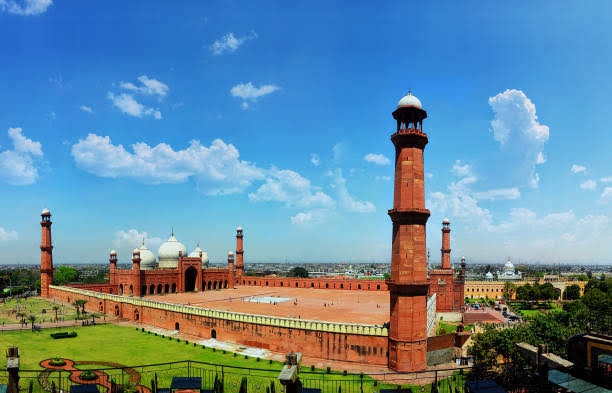
Aurangzeb’s Mosque, Lahore

As with other court sponsored cultural arts, during Aurangzeb’s reign there appears a sudden decline in architectural projects as well. As he was a staunch Sunni, he is said to have not only commissioned only religious buildings like mosques, he was also responsible for the destruction of many of the temples.

However, a look at modern works and explorations however reveal that Aurangzeb also commissioned structures like sarais, baths, gardens, tombs and fortified walls. Is this not true for other reigns as well? He is also credited to have repaired mosques built during earlier reigns and built many within captured forts.

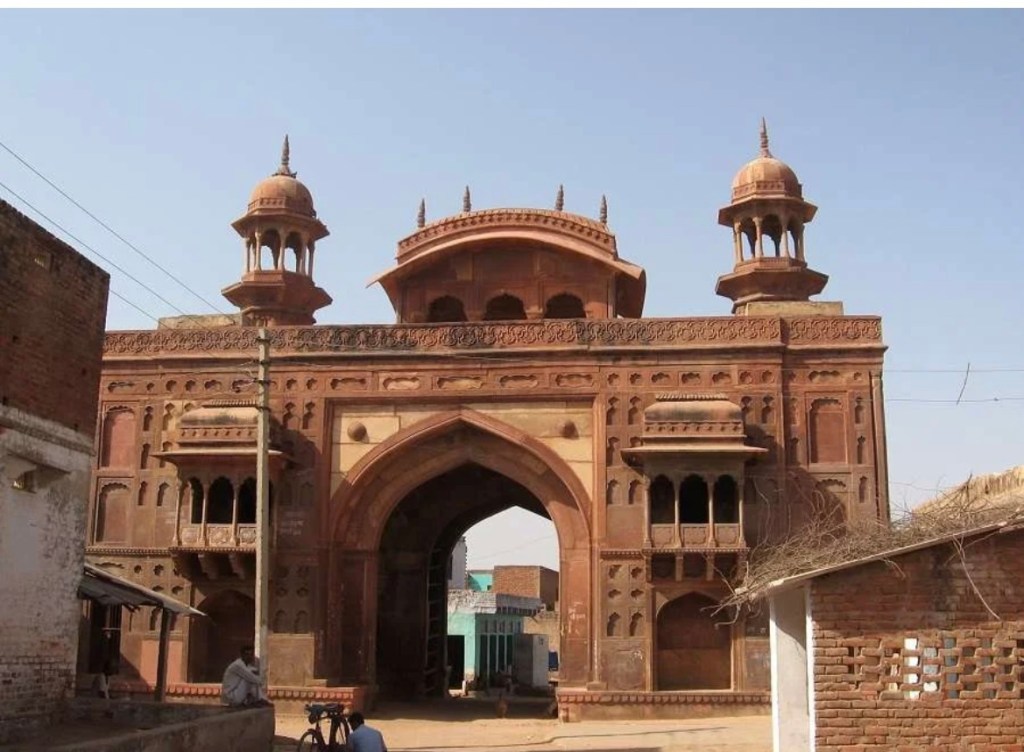
For example the Sarai at Jajau was constructed during this period according to an inscription of Aurangzeb put up on it and dated 1674.

Jajau Sarai of Aurangzeb

The best known mosques of Aurangzeb’s period include the Moti Masjid in the Delhi Fort, a mosque on the site of the Keshav Dev Temple at Mathura (destroyed 1669-70) and the Badshahi Mosque of Lahore.

The first and the last are very ornate structures: the Moti Masjid is a marble structure, while the Lahore mosque is a red sand stone structure with insertions of white marble. The Mathura Mosque is more austere and resembles the mosques built by royal ladies of Shahjahan’s reign.

Some of the architectural features which distinguish the mosques constructed during the reign of Aurangzeb are as follows:

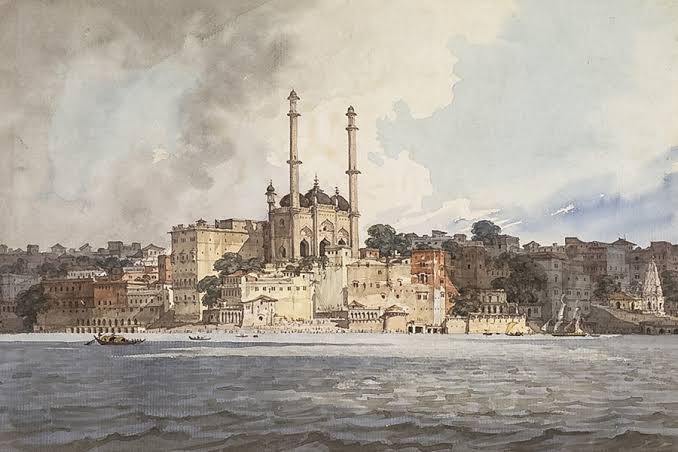
a. Most of these mosques stress their vertical elevation: they are all provided with minarets which provide them with the vertical perspective. This is true not only for the above mentioned mosques, but also for the Jami’ Masjids at Mathura, Merta and Varanasi.

Alamgiri Mosque, Varanasi

b. As pointed out by Ebba Koch, the ornamentation is richly organic, which not only reflects Aurangzeb’s lack of personal interest, but also that forms once appropriate for the palace architecture, such as the ornament on Shahjahan’s Delhi throne, were now utilized on palace mosques.

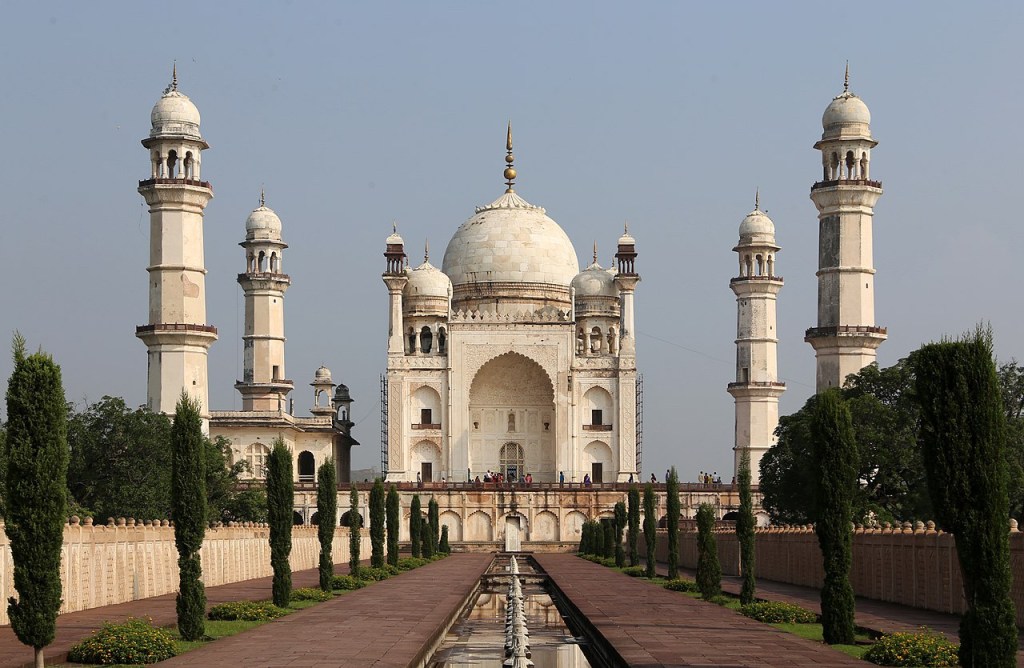
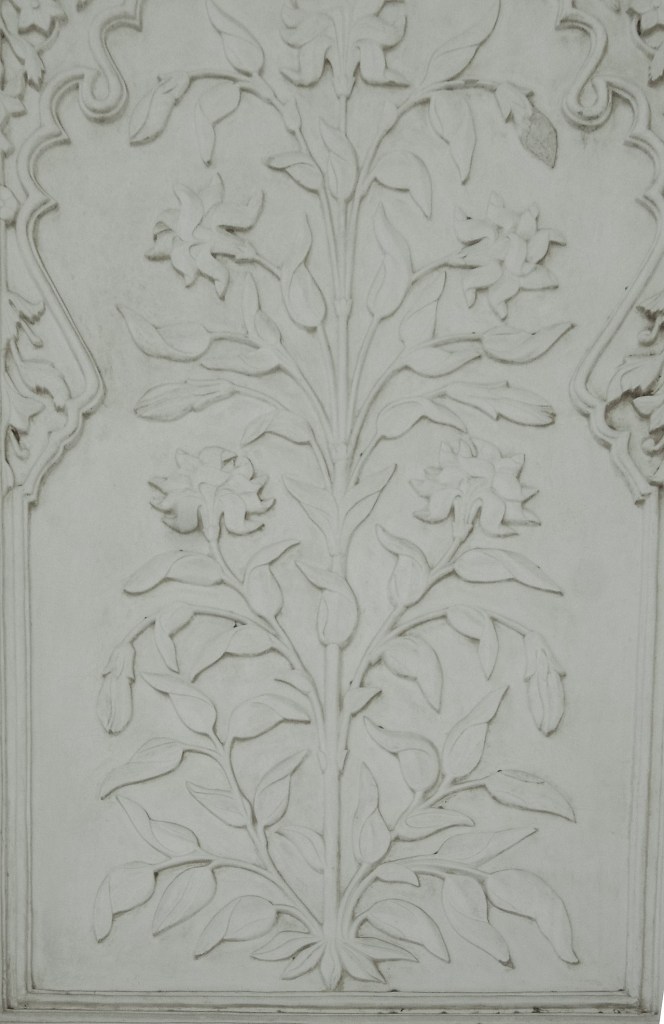
As far as the Tomb architecture under Aurangzeb is concerned, it is best represented by the Tomb of Rabia Daurani (who died in 1657) built in 1660-61. Although a rough copy of the Taj, it reflects a new aesthetic that developed in Aurangzeb’s reign. Just as in the case of mosques, instead of perfect balance of proportions which were a hall-mark feature of Shahjahan’s reign, there is an emphasis on verticality. Further, though generally discussed as evidence of ‘decline’, this tomb reveals a new spatial arrangement, as well as a highly naturalistic fine floral ornament, much of it in stucco, which according to Asher, renders it as quite innovative.

Tomb of Rabia Daurani (Bibi ka Maqbara)
Ceiling Decorations
Carvings at Bibi ka Maqbara

With this tomb also truly ends the long established imperial tradition of setting monumental mausolea within a chaharbagh: Now we find burials within courtyards of mosques or shrines with just a screen and a cenotaph – the grave of Jahanara, the tomb of Aurangzeb at Khuldabad. Was this just a full circle: from an open to sky tomb of Babur at Kabul to Aurangzeb’s tomb at Khuldabad? Probably where the resemblance ends is that the former is located within a garden, the latter within a Chishti shrine.

III. Evolution of Deccani Urdu and rekhta:

We have already seen the development of the vernacular languages under Akbar. We have also commented that in the initial stages when the Arabs and the Persian speaking people – as well as the Greeks – came into contact with the Indian sub-continent, they not only named the country on the river Sind – Hind, but also used the term Hindi or Hindvi for its inhabitants. Later on Amir Khusrau in his writings, especially Nuh Sipihr, uses the term ‘hindavi’ and then goes on to enumerate a number of vernaculars, meaning that to him the term actually meant and connoted ‘Indian languages’. When he himself wrote in hindavi, he actually uses [in Ghurrat ul Kamal] the term zaban-i dihlavi. It seems fairly clear that after the Ghurid conquest of Delhi, Persian and Punjabi words got interwoven with the language which was spoken there, which was a mixture of Khari Bholi, Brij, Rajasthani, and Hariani.

Now during the reign of Aurangzeb, the terms applied for this language were either hindavi / hindi or rekhta. In the Deccan when Vajhi (fl. 1600-1640) wrote his Sabras (1634) at Golkunda, he called the language as zuban-i Hindustan.

Technically the term rekhta means ‘mixed, poured’. The term initially was applied for a form of poetry in which hindavi and Persian were freely mixed in various proportions. Thus the language, as spoken, was generally called hindavi / hindvi / hindi; when applied for literary and poetical purposes, it was known as rekhta. When spoken and written in Bijapur and Golkunda, it was simply known as ‘Deccani’.

During the late 17th Century and early 18th Century there was a new term which was applied: Urdu. It derives from the Turkish Ördu – the camp / military camp. Although the term was there since 1150 in Persian, in India the term was first employed for camp by Babur. Thus the term Urdu stood for the language of the army. It was necessary to have a term to distinguish this pidgin of the military camp – zaban-i urdu-i mu’alla – which was a mixture of many languages and dialects, from the unmixed vernacular of the people and the Persian of the court.

The earliest known example of the employment of the term ‘Urdu’, standing by itself and meaning a language, is first encountered in the poems of Mushafi (1750-1824) [Tazkira-i Shu’ara-i Hindi]. Here in this collection as well the term Hidi in the title stands for the new emerging language of the Indians. The term zuban-i urdu (language of the camp) for the first time occurs in Tazkira-i Gulzar-i Ibrahim compiled in 1783 by Ali Ibrahim Khan.

If we look at the development of this language in the Deccan it is convenient to divide its evolution into three heads: (1) Literature in Golkunda or Haidarabad, connected with the Qutb Shahi court (1590-1687); (2) Literature in Bijapur, connected with the ‘Adil Shahi Court (1590-1686); (3) Literature in the Deccan during the time of Aurangzeb and his successors (1687-1730). There are two great names connected with the development of this ‘Deccani’ register is Shamsuddin Vali Aurangabadi (1667-1741) and Muhammad Faiyaz popularly known as Vali Dakani (active between 1690-1707). The later was the author of a romance, Qissa e Ratn o Padm, 8,000 lines long, based on Muhammad Jaisi’s Padmavat, which has been attributed to the other Vali, and of a collection of elegies, about 10,000 lines in all, called Rauzat ush Shuhada, 1707.

Vali Aurangabadi, probably the greatest name in Deccani Urdu at this period, was born and brought up in the Deccan. His actual birthplace was Aurangabad. Little or nothing is known of his family, but he is supposed by some to have been descended from Gujarat ancestors, and possibly connected with the famous saint Vajih ud Din. When he was about 20 he went to Gujarat to complete his education. While he was studying in Gujarat he became very much attached to a Sayyid called Abu’l Ma’ali, with whom he travelled to Delhi, perhaps in 1700. There he placed himself under the spiritual direction of Sa’d Ullah Gulshan to whom he showed his verses. He must already have written a considerable amount of  Dakhani verse, for he lived among Dakhani poets with a long line of nearly a hundred Dakhani poets behind him, whose works must have been familiar to him, but now probably his teacher, seeing how excellent his Dakhni verses were, advised him to give up Persian altogether.

He is said to have recited his Urdu poems before the poets of Delhi. These men whose vernacular was Urdu/ rekhta but were writing poetry solely in Persian, unaware of the fact that for nearly 400 years prose and verse had been written in Urdu; but they were immensely impressed by the facility with which Vali expressed his thoughts in that language. His verses became so popular that people began to sing them in the bazaar and he was everywhere received with honour. Vali’s visit to Delhi created a revolution in the poetry of north India. After a time he revisited his native land, but returned again in 1722 to Delhi, a city of which he was very fond. This time he took with him all his poems and his triumph was complete. He died in Ahmadabad in 1741.

 Vali’s writings may be divided linguistically into three sections, viz. pure Dakhni, about a third of the whole; ordinary Urdu but with many Dakhni words; pure Urdu. His lyrics number 422 and take up about three quarters of his collection; he wrote six odes dealing with religious subjects or eulogising saints; two magnavis, one being in praise of Surat; and a number of poems in other styles. He wrote no long poems, and he never wrote encomiums on earthly rank or greatness. One poem traditionally attributed to him, Dah Majlis or Rauzat ush Shuhada, is by the other Vali.

His style was simple and dignified, sometimes rising to real eloquence; he was essentially a religious man of a mystical cast of thought, and his writings present a vivid picture of the life of the time. He ranks probably in the first half-dozen Urdu poets, and his importance as being the man who induced the Delhi poets to write in their native language can hardly be over-rated. In the days when the wealth of early Dakhni poetry was not known, he received the title of Baba e Rekhta, Father of Urdu; and so far as his relationship to Delhi is concerned he almost deserves it.

In the north, the development of rekhta was under the influence of a number of scholars and writers, the chief of whom was the satirist Zatalli. Mir Muhammad Ja’far, who gave to himself the unlikely and self-mocking pen name of Zatalli (“babbler of nonsense”) was a phenomenon in many ways. Besides being the first Urdu writer with an uninhibited love for words, he was the first Urdu humourist and the first social and political satirist in Urdu, the first and the greatest Urdu writer of obscene and bawdy prose and verse, and the first Urdu prose writer in North India. He did all this almost entirely on his own. Doubtless, Persian with its great treasure house of the bawdy, the erotic, the pornographic, and the obscene, provided precedents of sorts. But there was no Persian writer who devoted himself exclusively to these modes.

Almost nothing is known of Zatalli’s life, except that he came from a good family in Narnaul, in modern day Haryana. His date of birth is tentatively placed in 1658. He put together his poetry and prose in perhaps 1685-6. Whatever he wrote later might not have been collected in his lifetime. The earliest known manuscript of his works dates from 1791/92.

Perhaps in his middle life, he was employed at the court of Kam Bakhsh, fourth son of Aurangzeb but was dismissed some time later when he composed a satire on the prince. Before this, he was employed at the court of Muhammad A’zam, Aurangzeb’s eldest son.

Zatalli died in 1713, most probably executed at the order of Farrukh Siyar (r. 1712-1719), the ruling Mughal king for whose coronation Zatalli had composed a scurrilous sikkah. It went as follows:

Sikka Zad Bar Gandam-Wa-Moth-Wa-Matar
Badshah Dazakasha Farrukh Siyar


He struck his coin on grains of wheat

And on coarse pulses, and peas:

Farrukh Siyar, that garrotter [grain gatherer] of a king.

This was a parody of a couplet written on a coin of Farrukh Siyar:

Sikka Zad Az Fazl-e-Haq Bar Sim Wa Zar
Badshah Bahr-Wa-Barr Farrukh Siyar


[Struck coin by the Grace of Truth, On Silver and Gold
Emperor or Sea and Land, Farrukh Siyar]


It must be remembered that the bulk of Zatalli’s admittedly small output is in Persian, or in Rekhtah. Rekhtah began as macaronic [Of or involving a mixture of two or more languages] verse in which Hindi/Hindavi (or Urdu, to give its modern name) and Persian were freely mixed in various proportions. There was no poetry or prose in main-line Hindi/Hindavi in Delhi before him. He also favoured the rekhtah mode oftener than the Hindi/Hindavi mode.

Literature in the rekhtah mode is regarded as Urdu literature because its impulse came from Hindi/Hindavi and it was written in the Perso-Arabic script and the conventions that it followed were largely Indo-Iranian.

There is not much to choose between Zatalli’s Persian, Rekhtah, and Urdu. He is equally inventive and equally vituperative and enthusiastically “wicked” in all the three.

What is Saracenic Architecture ?

According to a modern writer, Fergusson’s writings on the history of Indian architecture through his construction of religious and racial categories was entirely ‘in terms of the buttressing of a single, homogenous colonial project’1, and a ‘source of ideas for the improvement of architecture in England’.2 In this classification attempted by Fergusson, he was guided by the Rankean historicism and European susceptibilities. Taste was the measure of perfection against which the stylistic units were classified. In his schema of world architecture, there were two ‘dimensions’, one chronological and the other topographical on the basis of which to divide the various styles. In the first category, according to him, the world architecture could be divided into Christian and Non-Christian or ‘Heathen’. These two divisions, according to him were ‘very nearly equal in the importance of the objects described, and very easily distinguished from another.’3 Topographically, all architecture could be classified as either Eastern, or West Asian. According to him the two great styles however were the Christian and the Saracenic which sprang from the Roman which ‘was the great transitional style between the ancient and modern world’.4

It is interesting to note that although Fergusson employs the term ‘Saracenic’ to collectively designate the styles and traditions as they developed after the coming of the Turks, his attitude towards it is more positive. The ‘Saracenic’ or ‘Mahommadan’ started with ‘Ghazni’ style, which was a stepping stone by which the western architecture was introduced in India. In fact, the fusion of Islam in India, in the words of Fergusson, freed the Indian artists from the ‘trammells of Puranic mythology’.5

Fergusson’s sub-classification of Saracenic architecture of India shows it to be a mixture of Hindu and Muslim forms. His classification of architecture was thus aimed at propagating the colonial interests of projecting the ‘decaying’ nature of the Eastern Civilization and the superiority of the West. On the other hand, this scheme, as Juneja points out, was also an attempt to “assimilate the ‘other’.”6

A severe critique of Fergusson was ultimately made by E.B. Havell who faulted the former for a lack of “essential Indianness” in the use of racial or ethnic categories.7 Havell found fault with Fergusson’s ‘persistent habit of looking outside of India for the origins of Indian art’.8 According to him all “Saracenic symbolism in architecture” was borrowed directly or indirectly “from India, Persia, Byzantium or Alexandria”.9 To Havell, the mihrāb was a Buddhist loan of the niche to Islam. Even the term butkhāna used by the Arabs for the temples was a corruption of ‘Boud-khana’ or Buddha-house.10 In fact he went on to argue that the ‘Saracenic’ art which came to India had been Indianized before it crossed the Indus.11 Thus the bulbous dome, as at the Taj Mahal, was a derivation from the Buddhist Stupa tradition.12

The obsession with ‘Indianness’ and identification with Aryan philosophy pervades the entire work of Havell. His first chapter, in the form of an introduction, deals with ‘Hindu and Saracenic art’ and the ‘Pointed Arch’. The next chapter elaborates on ‘Hindu Symbolism’ and the indigenous origins of the Taj. The next three chapters are in a chronological treatment of various regional styles like Delhi, Gujarat, Gulbarga, Mandu, Sarkhej and Gaur. The sixth chapter focuses on architectural elements like Indian arches, brackets, capitals, domes and sikhara. The next eight chapters again have a chronological framework.

A perusal of Havell’s work brings out the sum total of all the prejudices of a colonial and communal approach. The term ‘Saracenic’ appears like an anathema with all its prejudices unhindered.

The term ‘Saracenic Architecture’ was used for the styles followed by the ‘Moors’ (Muslims). The term had a long pedigree going back to the period of Crusades fought between the Christians and the Muslims. It connoted an architecture of the followers of Islam who conquered Persia, Egypt, Palestine, Syria, Arabia and Spain. It was chiefly an architecture of temples and mosques. Amongst its characteristic features were counted the pointed or horse shoe arch, domes, minarets, coloured decorations with red, blue, green and gold geometrical patterns and designs, an emphasis on arabesque and a total absence of sculptures.

Having its origins in the Crusades, the term Saracenic was sometimes used in the pejorative sense. Fergusson, on the other hand, used the term as an all purpose name for the Muslim Architecture, whether in India or outside. Unlike Havell, Fergusson appears to be fairly aware and conscious of the term’s negative connotation and thus alternates the term with ‘Mahommadan’.

Even shorn of its pejorative sense, the term ‘Saracenic’ is still problematic: It borrowed heavily from two very diverse sources. On the one hand it included Persian tradition or style which was based on the vault; on the other it also included the Roman and Greek traditions from which it borrowed the true arch and the dome. Muslims joined both the streams to give shape to the ‘Saracenic’ or Muslim style.

The term ‘Saracenic’ is now out of use. The term in use presently is ‘Islamic Architecture’, and for India, Indo-Islamic. The term in any of its form further is consciously religious and thus still problematic.

The term Saracenic / Mahommadan or Islamic Architecture for the medieval period in India used in the way that Fergusson, or for that matter Havell used, would convey the pre-supposed use of arcuate: Arcuate being Islamic and Trabeate, Hindu.

Indo-Saracenic Architecture in the Colonial Period

The Indo-Saracenic style, also recognised as Indo-Gothic, was a style of architecture used by the British architects in the late 19th Century in India. It drew elements from native Indian architecture, and combined it with the Gothic revival style. In India, it was followed by a combination of different styles specific to the regions – Edwardian Baroque with Indo-Saracenic and a fusion with European architecture. 

In Edwardian Baroque with Indo-Saracenic style, the building designs were adopted from the Mughal and Rajputana styles of architecture. Key features of this category were use of Jalis – decorated stone screens – Chajjas, domes, and so on. This era also marked the accomplishment of two contrasting cultures, Indo-Saracenic Art or Indian -Islamic Art. 

The architecture of Syria and Egypt acquired a fundamental character of its own distinguished by standardised forms and concepts. The other side of Indo-Saracenic dealt with fusion with European Architecture. 

Many European architects who arrived in India took the elements of the Indo-Saracenic architecture and applied the same to the Gothic and Victorian architecture popular at that time and also to many buildings built during the 19th Century. The Palace in Mysore is a fine example of this style. IndoSaracenic architecture in India came into prominence during the latter part of the 19th Century. With the coming of the pattern, a majority of the patrons felt that they needed to be part of a particular style, which at times led to a highly inventive blend of Western and Oriental design. 

Characteristics of Indo Saracenic, which were considered for a majority of buildings of this style were onion (bulbous) domes, overhanging eaves, pointed arches, vaulted roofs, domed kiosks, pinnacles, towers or minarets, harem windows, open pavilions and pierced open archading. The chief historians of this style of architecture were Robert Fellowes Chisholm, Charles Mant, Henry Irwin, William Emerson, George Wittet and Frederick Stevens. Architecture of this era gave rise to grand public buildings, such as clock towers, courthouses, civic and municipal establishments, government colleges, town halls, railway stations, museums, and art galleries. Blend of Muslim designs and Indian materials developed by British architects in India during the late 19th and early 20th Centuries were perfect reflections of Indo-Saracenic architecture. Diverse Hindu and Mughal architectural elements were combined with Gothic cusped arches, domes, spires, tracery, minarets and stained glass, in a wonderful, almost playful manner in this epoch.

Indo-Saracenic architecture found its way into public buildings of all sorts, such as railway stations, banks and insurance buildings, educational institutions, clubs and museums. Chepauk Palace in Chennai designed by Paul Benfield is said to be the first Indo-Saracenic building in India, which incorporated elements and motifs of Hindu and Islamic precedents. Other outstanding examples are spread across the country – the Muir College at Allahabad, Napier Museum at Thiruvananthapuram, the Post Office, Prince of Wales Museum, University Hall and Library, and Gateway of India in Mumbai, M.S. University, Lakshmi Vilas Palace at Baroda, the Central Railway station, Law courts, Victoria Public Hall, Museum and University Senate House in Chennai, and the Palaces at Mysore and Bangalore.

Chatrapati Shivaji Terminus: Its majestic appearance best represents the architecture of colonial India. The combination of brick and stone along with various oriental elements enhances the appearance of CST. The domed roof is highlighted with designed ornamentation. CST is a blend of Victorian, Hindu and Islamic styles emphasising on buttresses, domes, turrets, spires and stained-glass windows. The Central Dome has eight decorated ribs highlighting Victorian elements. Adding to the station’s beauty are stained glass windows, colourful tiles and decorative iron grilles. Beneath the dome are brilliantly coloured stained glass windows, decorated with foliage. 

Engineering, Agriculture and Commerce are represented by the gaples crowned by sculptures. The Neo-Gothic vaulted roof with wooden ribs over the hall provides an impression of Victorian Gothic elements. Chatrapati Shivaji Terminus is the best example of Victorian Gothic architecture in India.


Syed Ali Nadeem Rezavi

Notes:

[1] For a detailed analysis on this see Monica Juneja, Architecture in Medieval India, Forms, Contexts, Histories, Permanent Black, Delhi, 2001, pp. 14-25

[2] Fergusson, History of Indian and Eastern Architecture, op.cit., pp.5-6

[3] Ibid, vol. I, p. vii

[4] Ibid, I, viii

[5] Ibid., pp.45-46

[6] Juneja, op.cit., p. 19

[7] E.B. Havell, Indian Architecture: Its Psychology, Structure, and History from the First Muhammadan Invasion to the Present Day, London, 1913, pp. 1-13

[8] Ibid., p. 2

[9] Ibid., p. 4

[10] Ibid., pp.5-6

[11] Ibid., p. 11

[12] Ibid., pp. 23-24

Administration under Shivaji

Our only contemporary source for the Maratha administration of this period is John Fryer: all others are later works. In the kingdom of Shivaji, the Brahmins were highly respected but they were always in chains as Fryer remarked. Because they were revenue officials, so whenever they could not realize the amount, they were imprisoned. Shivaji adopted extremely harsh measures against the Canarese, who were Maratha speaking people, as well as the Kundis who were agriculturists par excellence. They were exploited to the maximum limit. Three-fourth (3/4th) of the actual yield of the soil was taken in revenue. The whole agrarian system of Shivaji was based on tyranny and the exploitation was the rule and not an exception. In the military administration, Fryer says, the maxim was ‘No plunder, No pay!’ Fryer says that the army of Shivaji consisted of half-naked rascals. The army was not paid regularly. The soldiers were asked to plunder the area to meet their pay claims. Shivaji had an infantry and a comparatively strong navy.

On taking royal powers, Shivaji assumed the title of haindava dharmodhārak (protector of the Hindu faith). In spite of this he did not hesitate to plunder mercilessly the Hindu population of the area.

His system of administration was largely based on the administrative practices of the Deccani states.

The contention of the modern scholars that Shivaji had eight ministers is misleading. He had only eight secretaries who had no discretion in administrative affairs or matters. These were the eight ashtapradhānas, translated by Sarkar and others as ‘ministers’. Each of them was directly responsible to the ruler: thus, in other words, there was no ‘council of ministers’.

The peshwa were ministers who looked after the finance and general administration.

The commander of the army, senapati, also known as sar-i naubat held a post of honour. He was generally one of the leading Maratha chieftains. Majumdar was the accountant. The household affairs and intelligence were looked after by the waqi’a nawis. The office of Correspondence was looked after by chitnis or surunawis.

Like in other Muslim courts, the master of ceremonies in the court was the dabīr who also helped the Maratha ruler in his dealings with foreign powers.

The nyāyadhīsh and pandit rao were the incharge of department of Justice and Charitable Affairs (to give grants).

The Asthapradhans:

  • Peshwa or the Chief Minister- He looked after general administration.
  • Amatya or Majumdar– Accountant general, he later became revenue and finance mnister.
  • Sachiv or Surunavis– Also called Chitnis; he looked after the Royal correspondence.
  • Sumant or Dabir- Foreign affairs and the master of Royal ceremonies.
  • Senapati or Sari-i-Naubat- Military commander. He looked after the recruitment, training and discipline of army.
  • Mantri or Waqia Navis– Personal safety of the king, he looked after the intelligence, post and household affairs.
  • Nyayadhish- Administration of Justice
  • Punditrao- Looking after charitable and religious affairs of the state. He worked for the moral upliftment of the people.
  • Apart from the departmental duties, three of the ministers- Peshwas, Schiva and the Mantri were also given incharge of extensive provinces.
  • All ministers, except the Panditrao and the Nyayadish, had to serve in a war whenever necessary.

Minister was assisted by a staff of eight clerks

  • Diwan – secretary
  • Mujumdar – auditor and accountant
  • Fadnis – deputy auditor
  • Sabnis or Daftardar – office incharge
  • Karkhanis – commissary
  • Chitins – correspondence clerk
  • Jamdar – treasurer
  • Potnis – cashier

Shivaji strictly regulated the “mirasdars,” (mirasdarswere those who had the hereditary rights in land). Later mirasdars grew and strengthened themselves by building strongholds and castles in the villages. Likewise, they had become unruly and seized the country. He also destroyed their bastions and forced them to surrender.

Shivaji divided entire territory into three provinces, each under a viceroy. He further divided the provinces into Prants then Pargana and Tarafs. The lowest unit was the village which was headed by its headman or Patel.

The form of government was the worst type of dictatorship. The titles which were awarded by Shivaji to his officials were the mixture of Bijapuri and Mughal titles. High sounding titles were given to petty officials. The subadar under Shivaji was equivalent to the thanedar under the Mughals; and the faujdar under Shivaji was equivalent to chaukidars under the Mughals.so there were high sounding posts with small jurisdictions.

However the most distinctive feature of Shivaji’s administration was his organization of army and the revenue system. We come to know that under Shivaji, cash salaries were given to the soldiers. Some chiefs could also be given saranjām or revenue grants. The strict discipline in the army meant that no woman or dancing girl was allowed to accompany the army.

The regular army (paga) consisted of cavalry (30,000 to 40,000); then there were silahdārs (auxillaries) supervised by havaldars who received fixed salaries. The forts were put in the charge of three men of equal rank – to guard against treachery.

The revenue system was patterned on the system of Malik Ambar. In 1679 Annaji Datto completed the new revenue assessment. Shivaji further continued with the deshmukhi (zamindari) system and awarded mokasa (jagirs) to his officials.

Chauth: Origin & Significance

Revenue Administration:

Shivaji abolished the Jagirdari Systemand replaced with Ryotwari System, and changes in the position of hereditary revenue officials which was popularly known as Deshmukhs, Deshpande, Patils and Kulkarnis.

Shivaji strictly supervised the Mirasdarswho had hereditary rights in land.

The revenue system was patterned on the Kathi system of Malik Amber. According to this system, every piece of land was measured by Rod or Kathi.

Chauth and Sardeshmukhi were other sources of income: Chauth was amounted to 1/4th of the standard which was paid to Marathas as a safeguard against Shivaji’s forces plundering or raiding Non-Maratha territories. Sardeshmukhi was an additional levy of 10 percent demanded from areas outside from the kingdom.

Maratha Territory under Shivaji

Azad Bilgrami remarked in 1761 that the Marathas, in spite of attaining most brilliant success in the battlefields, were not like emperors or kings but like zamindars. Meaning thereby – that the horizon of the Maratha leaders was limited. The entire basis of the Maratha state was tyranny and the Marathas were a failure as an empire. They could not work out even a repository of a political authority. The Raja of Satara was reduced to the position of a puppet by the Peshwas; and the Peshwas in turn, were reduced to nothingness by Nana Fardnawis [Nana Phadnis]. So they could not work out even the repository of political authority: and this was an inbuilt defect.

Chauth was a customary tax which was realized by the zamindars. It was 1/4th of the assessed revenue. During the 17th Century, the Mughal Emperor used to pay chauth to the ruler of Kathiawar. That is it was an amount which a superior authority paid to a lesser authority. Likewise, the Portuguese paid chauth on western coast to some zamindars.

The chauth levied by Shivaji has been erroneously confused with the subsidiary alliance of Lord Wellesley. Under the scheme of Wellesley, if a state paid subsidy to the British, his protection was in the hands of the Britishers. But here the Marathas after realizing the chauth provided protection against none except themselves: that is, they undertook not to plunder that area themselves. So practically it was a system of blackmail. So after realizing chauth the Marathas undertook no guarantee for them. It was 1/4th of the assessed revenue. This signified the zamindar outlook of the Marathas: they theoretically never thought beyond that. So the origin of chauth was from the zamindari rights and the term existed before the emergence of the Marathas as a political entity.

Sardeshmukhi was 1/10 th of the assessed revenue. That also was connected with the customary claim on the usufruct of the land.

Military Administration

Shivaji organised a disciplined and efficient army. The ordinary soldiers were paid in cash, but big chief and military commander were paid through jagir grants (Saranjam or Mokasa).

The army consists of Infantry i.e. Mavali foot soldiers; Cavalry i.e. Horse riders and equipment holders; Navy.

Military Personnel 

Sar-i-Naubat (Senapati)-Incharge of army

Qiladars- Officers of Forts

Nayak- Head of the member unit of infantry

Havaldar- Head of five Nayaks

Jumladar- Head of five Nayaks

Ghuraw- Boats laden with guns

Gallivat- Rowing boats 40-50 rowers

Paik- Foot SoldiersThe army was effective instrument of policies of Marathas State where rapidity of movement was the most important factors. Only in the rainy season, the army get rested otherwise rest of the year was engaged in expeditions.

Pindaries were allowed to accompany the army who were allowed to collect“Pal-Patti” which was 25% of war booty.

Education under Aurangzeb

A Madrasa Scene: Mark the boys & girls studying together

Syed Ali Nadeem Rezavi

During the reign of Aurangzeb an attempt was made to introduce free education, but unfortunately the attempts were not successful. However as an experiment Aurangzeb ordered the opening of madrasas to cater to the Bohras of Gujarat. Teachers were appointed and a system of monthly examination was introduced. It was further ordained that the result of the students would be communicated to the emperor for his personal assessment.

Bernier, the French traveller who was in India during Aurangzeb’s reign, deplored the deficiencies of the educational system. To prove his point, he quoted Aurangzeb’s reproaches against his tutor for having wasted time on grammar and metaphysics, while ignoring geography, history, and politics. [Bernier pp. 155–57]

 No attempt was made to control education, even though the state gave large grants of rent-free lands to ulama for setting up madrasas. There were no regular examinations, and no organization for maintaining standards. Yet Mughal education had its special values, for Muslim education did not decay in the eighteenth century with the decline of Muslim political authority. The reduced calls made by the state employment on Muslim manpower left more men free to devote themselves to academic and literary work. A number of educational institutions and foundations, including the colleges established by Ghazi-ud-din Khan Firuz Jang, Sharaf-ud-daulah, and Raushan-ud-daulah in Delhi belong to this period.

        The standardization of the educational curriculum was accomplished in the eighteenth century. The Dars-i-Nizamiya, named after Mulla Nizam-ud-din (d.1748) provided instruction in grammar, rhetoric, philosophy, logic, scholasticism, tafsir (commentary on the Quran), fiqh (Islamic jurisprudence), hadith, and mathematics. This curriculum has been criticized for containing too many books on grammar and logic and in general for devoting too much attention to formal subjects, and too little to useful secular subjects like history and natural sciences or even religious subjects like tafsir and hadith. But it provided good mental discipline, and its general adoption was responsible for the widespread interest in intellectual and philosophical matters. In the period in which it was systematized it was perhaps reasonably adequate for the average student. Those wishing to specialize or pursue a particular branch of knowledge went to the experts in that subject. The needs of the students specially interested in religious subjects were better served at institutions like Madrasa-i-Rahimiya, the forerunner of the modern seminary of Deoband, where tafsir and hadith were the principal subjects of study, but for those needing a general education to qualify for the posts of munshis, qazis, or religious preachers, Dars-i-Nizamiya provided a satisfactory basis until modern times.

        Bernier, despite his criticism of the educational system, has left evidence that, at least two intellectuals of the Mughal court tried to learn about Western philosophy. One of them was Fazil Khan, the prime minister, whom Bernier taught

“the principal languages of Europe, after he had translated for him the whole philosophy of Gassendi in Latin, and whose leave [to depart] he could not obtain, until he had copied for him a select number of best European books, thereby to supply the loss he should suffer of his person.”

The other was Danishmand Khan, who supported Bernier for a number of years.

“My Nawab, Agha Danishmand Khan, expects my arrival with much impatience,” Bernier wrote. “He can no more dispense with his philosophical studies in the afternoon than avoid devoting the morning to his weighty duties as Secretary of State for Foreign Affairs and Grand Master of the Horse. Astronomy, geography, and anatomy are his favorite pursuits, and he reads with avidity the works of Gassendy and Descartes.”

[Bernier, pp. 352–53]

For the Hindus, Banaras was an important seat of learning. According to Bernier it could be considered as ‘the general school of the Gentiles’. He in fact compares it and calls it as the ‘Athens of India’. As he is comparing the Indian learning with Europe and fails to comprehend the indigenous method of teaching, he is constrained to comment that the town however ‘contains no colleges or regular classes, as in our universities’. He goes on to mention that the eminent teachers took their classes with ‘four disciples, others six or seven, and most eminent may have twelve twelve or fifteen’. These students would sit at the feet of their tutors ‘in different parts of the town in private houses’ and merchants’ gardens in the suburb of the town for ‘ten or twelve years’, during which time ‘the work of instruction proceeds but slowly’.

[Bernier, p. 334]

He further says that this pursuit of knowledge ‘entertains no hope that honours or emoluments’ may be awarded to them at the end. The scholars’ dietary wants were taken care of in the shape of ‘kichery, a mingled mess of vegetables’ supplied by the rich merchants.

[Bernier, p. 335]

Tavernier on the other hand describes a college established by Raja Jai Singh at Banaras near the Temple of Visvesvara. This college, he says, was meant for the education of the young men ‘of good families’. The medium of instruction was Sanskrit:

“I saw the children of the Prince, who were being educated there by several Brahmans, who taught them to read and write in a language which is reserved to the priests of the idols (i.e. Sanskrit) and very different from that spoken by the people.”

[Tavernier, II, pp. 182-83]

Tavernier while describing this institution further says:

“…throwing my eyes upwards, I perceived a double gallery which ran all round it (the building), and in the lower the two Princes were seated, accompanied by many young nobles and numerous Brahmans, who were making different figures like those of mathematics, on the ground with chalk.”

[Tavernier, II, p. 183]

It is also interesting to note that Tavernier mentions that the college teachers had in their possession two globes, presented to them by the Dutch. Tavernier says that when enquired where France was ‘I pointed out the position of France upon them’.

[Ibid]