Analysing Badauni and His Muntakhab ut Tawarikh

Mulla Abdul Qadir Badauni’s work is a history of the Muslim rule in India from the Ghorian invasion down to the end of Akbar’s reign written from a religious bias. Thus in this work, the history of Akbar’s reign is written from the orthodox Sunni point of view. Naturally it tends to become a critic of Akbar’s policies based on principles of Sulh i kul. This kind of version with such bias is important and useful in our study of the political history of the reign as it serves as a balancing narrative to the account furnished by Abul Fazl in the Akbarnama, which as we know, is an account written with a bias to justify Akbar’s policies that were framed in the light of the policy of Sulh i kul. It is also written from the point of view of projecting Akbar as an insan-i kamil whose mission was to establish peace amongst people, unity of purpose in the state, and extend state patronage to a large group of people.
This view forwarded by Abul Fazl stands corrected by the sharp criticism which Badauni offers for the policies of Akbar.
We know from the notings which Badauni had made in volume III that he completed the book in 1004 AH / 1596. But the work could come out in the public only around 1616. For about twenty years after its completion, the book was not released for circulation. It is understandable why Badauni was hesitant to have it circulated during his lifetime. He knew if the book went into circulation, it would attract hostility of the Mughal authorities. We may assume, it was not in circulation till 1614, at least on the basis of the fact that in the list of different sources available, say that of Abdul Baqi Nahawandi (Ma’asir-i Rahimi), the name of Muntakhab ut Tawarikh is missing – a significant negative piece of evidence pointing towards the fact that till 1614-16 this was not in circulation. Subsequently, when the book did come in circulation, Jahangir made enquiries about the hostile remarks against his father.
Thus it was not for the perusal of the King. His style as a result, is not constrained by any fear of punishment or reprisal.
So far as the structure of the book is concerned, it is divided into three volumes. The first volume deals with the history of the Muslim rule in North India from the Ghorian invasion down to the end of Humayun’s reign, i.e., 1556.
An internal examination of the book reveals that Badauni derived information from two sources: the Tarikh-i Mubarakshahi (Yahya bin Ahmad Sirhindi) and the Tabaqat-i Akbar. For the later Sur period, Badauni bases on personal information and partly on information available to him through other sources.
Badauni’s account of the Sur Empire, for the period between 1553-56 is very significant and original. This is the only detailed account we have which gives the political developments under Adil Shah Sur and others who put forward their claims to the Sur throne.
The second volume of the Muntakhab deals with the history of Akbar’s reign down to the 40th RY (1595). The last event which Badauni records in this volume is Faizi’s death which took place in 1595. He adds a cruel note to this event.
The third volume comprises a large number of biographies of the mashaikh, ulema, physicians and poets: he gives biographic details of 38 important mashaikh, 49 leading ulema, 15 reknowned physicians and 167 well known poets of his own time. For this he borrowed much material from the Tazkiras of the poets that were compiled by Alauddaulah Qazwini as part of his Nafais ul Ma’asir.
Badauni, as against what his name suggests, did not hail from Badaun: he hailed from Kota Bhim in Rajasthan, which at that time was included in the Kachhwaha principality of Amber. He was born in 1541. His father, Muluk Shah, shifted to Agra in early 1550’s and stayed there down to 1561. It was after 1561 that the family shifted to Badaun and settled there.
Abdul Qadir Badauni received his early education at Agra under Shaikh Mubarak, who was at that time, known for his learnings towards Mahdavism. For some time, he also studied with Miya Hatim Sambhali, an orthodox teacher of early ‘60’s.
Badauni had become accomplished in a number of arts and sciences. In a letter written by Faizi to Akbar regarding Badauni, it is stated that he was proficient in history, astronomy, art of qir’at, music – especially Indian music and was a player of bīn. He also had expertise in chess. So Badauni was not only an ālim but otherwise also he was an accomplished person. Badauni himself does not refer to his proficiency in chess and music while writing his book.
So far as the history of his service career is concerned, he took up service under Husain Khan Tukriya in 1564, in which he continued down to 1574. In 1574 Badauni entered the Imperial service as the imam of the army for one of the days of the week. He was appointed to this minor position simultaneously with the appointment of Abul Fazl who took up the same position.
In fact Badauni laments that while Abul Fazl used flattery and readiness to agree with superiors to rise to the position of a high noble – a position which Badauni did not, as he did not worry about worldly gains. His bitterness is obvious in this statement. It is obvious even in vol. III when he writes about Abul Fazl and Faizi.
So far as the significance of the Muntakhab ut Tawarikh as a source is concerned, the problem has been discussed in at least three modern writings:
a. Elliot’s Introduction on Badauni with his translation.
b. Prof Muhammad Mujib’s paper in the edited work of Prof Muhibbul Hasan published from Jamia.
c. Discussion of Badauni’s approach to interpret history of Akbar’s reign by S Athar Abbas Rizvi in two of his works, viz., Muslim Revivalist Movements and the Intellectual Life under Akbar.
Still, here one would like to highlight some aspects of Badauni’s approach in interpreting Akbar’s reign missed in the above mentioned works.
A serious contradiction seems to have run through the entire narrative of Badauni in volume II & III of his work. This contradiction is that he gives conflicting assessments of Akbar as well as his policies and the role played by persons close to Akbar. Such contradictions are found within different parts of volume II itself as well.
We find that while at most places in volume III – and in certain places in volume II – Badauni refers to Akbar with great respect. He calls him khalifat uz zamān. But then on the other hand, in the major part of volume II, from 1575 onwards, he seems to be so annoyed with Akbar that he does not refer to him with name. He is found levelling charges in this part and he seems to have forgotten his respectful attitude depicted elsewhere. He charges Akbar of prohibiting namaz of the Muslims – a charge which on face appears to be unsubstantiated. He also accuses Akbar of forcing ulema to shave their beards; of enslaving ulema and mashaikh in large numbers nd exchanging them with horses and donkeys in the markets of Qandahar and Bhakkar. He also alleges that Akbar tried to impose ban on the learning of Arabic language. In general, in this part, he shows his disrespectful attitude towards Akbar. So one can very well see that the author had described the same person as a khalifat uz Zaman and, as a heretic.
Then there are other specific cases of contradiction: for example, the manner in which he assesses the role of Shaikh Salim Chishti in volume II and then in volume III. In volume III, when he gives a biographical sketch of the Chishti saint, Badauni gives a positive assessment of Salim Chishti’s character from the Islamic point of view.
But then in volume II, Badauni says:
And such was the disposition of that paragon of excellence, His Grace, the Shaikh, that he allowed the emperor entry to all his most private apartments, and however much his sons and nephews kept saying ‘Our wives are becoming estranged from us’, the Shaikh would answer, ‘There is no dearth of women in this world, since I have made you Amirs, seek other wives, what does it matter?’
(verse) Either make no friendship with an elephant driver,
Or make a house fit for an elephant.
The assessment of Shaikh Mubarak and his beliefs is given in volume III and II.
In volume II Badauni says that at one occasion Shaikh Mubarak told Birbal:
‘Just as there are interpolations in your Holy Books, so there are in ours. Hence it is impossible to trust either’.
Could this be said even by a ‘bad’ Muslim?
But then in volume III, Badauni contrarily noted:
He (Sh. Mubarak) was one of the great sages of the age and was distinguished amongst men of his time for his piety, devotion and trust in God. In early life he observed many austerities and strove much in the way of holiness and was zealous in enforcing commands and prohibitions of the Holy Law that if any body present was wearing a gold ring, or silk clothing, or red hose or red or yellow garments, he at once made him remove them, and if anyone appeared with long breeches, descending below the hell, he immediately had them torn to proper length.
Badauni accuses him of joining heretics, but does not charge him of being an apostate. Thus he says:
…and the pity is that his love of the world with its pomps, concealed under the garment of hiding poverty, left no room for the love of faith of Islam. [III, 120]
Similar contradictions are there about Shaikh Faizi: In volume III he has abuses reserved for him. At one place he acknowledges that favours were done to him by Faizi by giving him letters favouring him and introducing him. But then at other places, he makes fantastic accusations against Faizi: says Faizi’s poetry was not appreciated by contemporaries and his books were not considered as worthy by literary people.
Lastly, let us quote one observation about Faizi which he made while giving the biography of Shaikh Abdul Haq Muhadis Dehlavi and his great affection for Faizi:
Glory be to God! Shaikh Faizi has passed away and become a by-word; and as far these, the mention of whom is still among us for a few days, or rather for a few hours, who are they that we waste time in addressing them where preparation is even now being made for our departure hence? All that remains to them is the wind of speech. How long shall we waste our time in measuring it?
From these examples, it becomes evident that (1) Badauni had more unbalanced views and assessments of contemporaries when writing volume II. (2) The nature of criticism in volume III is sometimes qualitatively different from the kind of accusations in volume II. (3) In the volume II the views are more balanced.
This goes to suggest that most probably Badauni compiled volume III at a time when he had not yet developed that kind of imbalanced view of the situation reflected in volume II.
At the end of volume III, treated by us as the final volume, Badauni says, it was compled in 1595. In the light of inferences drawn from the internal evidence, we would be justified in making the bold suggestion that the volume treated as volume II was compiled by Badauni after 1595 (that is, after volume III).
It is significant to note that at the end of volume I, Badauni actually has given an epilogue in which he states clearly that it was his plan to write the next volume comprising the biographies of contemporary poets:
Should this inconsistent and transitory life give (the author) a few days respite, and should the days in opposition to the usual habit afford assistance and should fate give its help, he (i.e., Badauni, the author) will make mention of poets of former times and of the contemporary poets of Hindustan, especially of those whom he had seen or heard or appreciated in his own lifetime together with extracts from their poems included in the tazkiras.
What, through these internal evidences we are trying to suggest and establish is that most probably, the volume which is now considered as volume II, containing the history of Akbar’s reign, was written sometime after the completion of History of Muslim Rule from earliest time in Humayun’s reign, and also after the penning of the biographical sketches of the contemporaries in volume III.
Perhaps Badauni compiled this second volume at a time when his assessment of the situation had undergone a considerable shift since the time he had completed the other two volumes.
This is borne out by the contradictory assessments that he gives of Akbar’s policies, Akbar’s character and the role of contemporaries in the two places ~ the second volume and the first and third volumes. It seems that by the time he started finalising vol II, his views had become rather extremist. By that he had come to the conclusion that the position of Islam in India had become untenable due to many factors including Akbar’s policy, and he was trying to put it straight by apportioning the blame of the catastrophe.
But then, in vol II as well, we find that in the first portion, he is not having an alarmist position which he has in the second half. In the portion relating to the post 1574-75 period, his views are most extremist.
In the first part of Vol II, he is calling Akbar as Khalifat al zaman, while in the second half, he charges him of heresy. This gives an impression that the account presented in Vol II is based on some journal which he maintained reflecting his changing assessment of the situation when he is becoming extremely critical.
His unbalanced attitude and state of mind is reflected in vol III also when he tries to revise and appends additional paras in individual biographies. To give an example: in the biography of Shaikh Mubarak, when he is beginning, he is praising and is not critical, as in the last paragraph which seems to have been added afterwards when his views had radically changed.
Then he also gives a number of chronograms giving dates of important events.
Thus in 1562, Pir Muhammad Khan Sherwani died during a campaign in Malwa by drowing in Narbada. Badauni writes: “ba rāh-i āb ba jahannum raft”
When Muzaffar Kahn Turbati (a Khurasani) was appointed as the wakil in 971 AH, the fact is given by Badauni by the chronogram “zālim” (971) [oppressor]. Similarly on the death of Shaikh Gadai Kanboh, the sadr: murda khūk-i kalān [You are dead you great hog!]
When in 971 Ah, a certain Qazi of Baran was given capital punishment, Badauni found the chronogram of this event as “qāzi lāl”. And when Shaikh Ibrahim Chishti of Fathpur Sikri died in 999 AH, Badauni wrote that “since he was noted and notorious for avarice and vice, and was accursed”, his chronogram found was ‘Shaikh laīm’ [ “Base of disposition” or “Vile Shaikh”].
On the death of Urfi Shirazi, the famous poet the same year, he uses the term dushman-i Khuda.
Similarly on the execution of Ali Quli Khan Uzbek Khan-i Zaman and Bahadur Khan, after their rebellion in 1567 (974 AH), one of the chronograms found was “qatl-i du namak harām be dīn”
Incidentally all these persons were Shias.
One can see that all these chronograms have a common quality of being cruel, pungent and in bad taste. Badauni doesn’t say that they were compiled by him but it is obvious that they are of him only, having the dame pungent effect as in his prose. Probably he composed them when he was preparing the journal which ultimately was used to draft vol II.
An additional indication of this journal being maintained by Badauni is supported by other evidences as well.
He is becoming more and more hysterical in denouncing Akbar. If he would have been such in the earlier period as well, it would have reflected in the earlier period as well.
It is true that Badauni was very orthodox, but what he had to say regarding the role played by the Mahdavi leaders during Islam Khan’s reign, shows that he not only had very great respect and admiration for them, but he also shared the harsh cricism which Mahdavi leaders were making of the orthodox Ulema. So far as his admiration for Mahdavi saints is concerned, it is borne out by the chronogram he gives of Shaikh Alai’s death in 978 AH: zikr Allah.
Regarding Shaikh Alai, he says:
“Shaikh Alai who was the most orthodox of the sons of Shaikh Hasan, the tablet of whose forehead was from early boyhood distinguished by marks of nobility and uprightness and evidences of a youth to be spent in the worship of God and in following the ordinances of the Prophet of God.”
Badauni also praises Shaikh Alai’s piety, his indifference to worldliness and goes on to reproduce with much gusto and glee the denunciation of Makhdum ul Mulk Abdullah Sultanpuri by Sh. Alai at Islam Shah’s court. He puts the following words in Sh. Alai’s mouth in his vol I:
“You are one of the learned men of the world, a thief of religion, and you are engaged in so many illegal practices that you have put yourself outside the pale of equity so that even to this time the sound of pipe (nafiri: music) and tambur may be plainly heard issueing from your house, and in accordance with the true traditions of the Prophet, Upon Whom Be Peace and Blessing, a fly which settles upon filth is by degrees better than learned men who have made kings and emperors the object of their ambition and go from door to door.
Verse: Learning which exists for the sake of palace & garden
Is like a lamp to the loving thief.
This point is important from two angles: Badauni is not that sort of an orthodox as is generally conceived. He is espousing the cause of an Islamic sect regarded as heretic by majority ulema. This also helps us to see as to what was the source which influenced him in forming a very hotile and critical view of the contemporary ulema reflected in vol II where he says for the decline of Islam during his time, hypocrisy of orthodox ulema was as much responsible as the heretical views of Akbar and his advisors. In vol III he denounces ulema for the persecution of Mahdavis and writes about all types of discrepancies of the ulema.
It is much propagated that Badauni was a very intolerant person. At the same time, it is significant that when it comes to relating the role of Kachhwahas – Bhar Mal, Man Singh etc, he never uses that kind of hostile language which he employs for other nobles. He never uses an obscene language towards them. He also goes out of his way in condoning many of Akbar’s actions giving concessions to non-Muslims, especially those in which these actions and concessions are meted out to the Kachhwahas.
In 1576, when Man Singh was appointed as the commander of the expedition which was proceeding against Rana Pratap, Badauni decided to join it to fulfil obligations of jihad. Before he set out for Ajmer, one friend raised a question: ‘If you are really going from a purely religious angle, then how can you justify fighting under the command of a Hindu?’ Badauni was puzzled. Then he said that he had been appointed by a Muslim king, so it would remain a jihad! Shoot whatever side you want, all are non-Muslims.
Regarding Salim’s marriage to the daughter of Bhagwandas, he reports that the marriage ceremony was solemnised twice, first through Muslim, and then the Hindu rites: but he never makes any adverse comment, which is significant. Reason lies in the fact that Badauni had great respect for both Bhagwandas and Man Singh due to the fact that they refused to compromise their religion and accept the new creed that Akbar was trying to project. This is borne out by the approving manner in which he quotes two conversations, one between Akbar and Bhagwandas, and the other between Akbar and Man Singh.
When Akbar proposed to Bhagwandas to enrol as a member of Tauhid-i Ilahi, Badauni reports that Bhagwandas retorted:
‘I would willingly believe that Hindus and Muslims each have a bad religion. But only tell us what this new sect is and what opinion they (its members) hold, so that I may believe!’
Badauni then goes on to add: ‘His Majesty reflected a little and ceased to urge the raja!’
According to Badauni, the real culprits were those who sided with Akbar’s new religion based on principles of Sulh-i Kul, who were compromising their religion.
From this it is clear, his grouse was against those who thus compromised their faith and became a threat for the existence of Islam in India. He appreciated any one who was not impressed by the principles of the new belief.

Syed Ali Nadeem Rezavi

The Various Narrations of the Passing Away of the Prophet of Islām

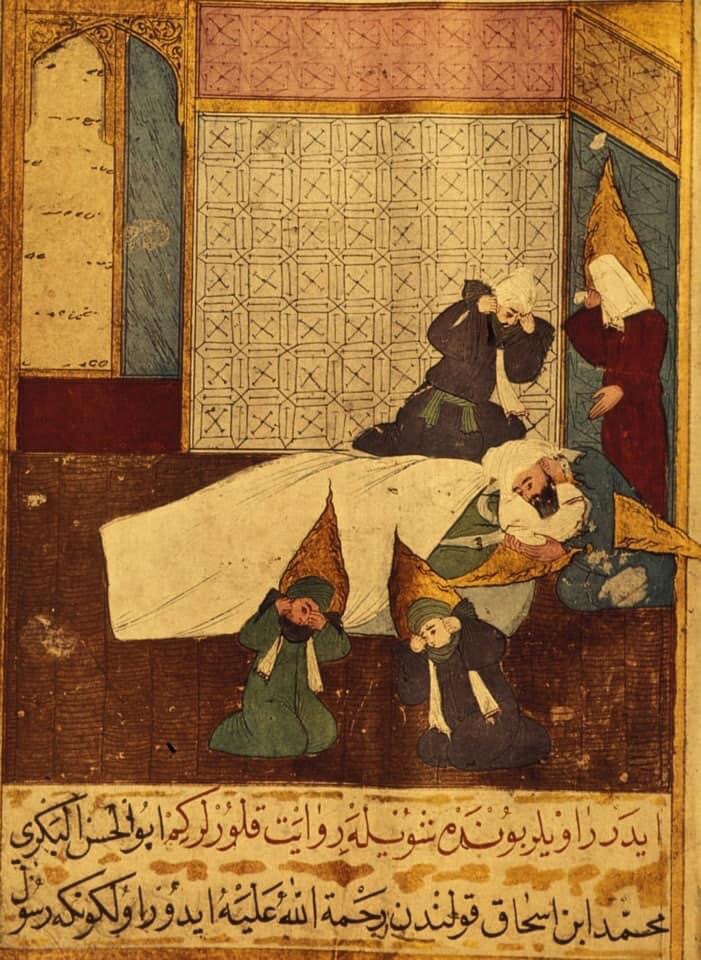
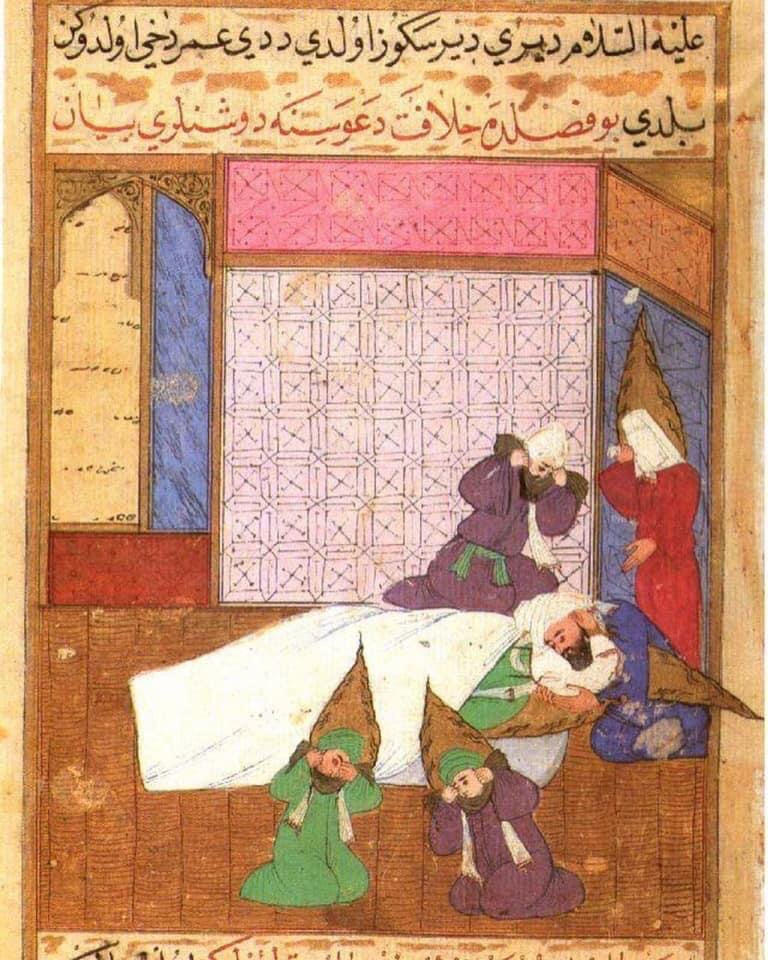
The death of the Prophet Mohammed. Ottoman miniature painting from the Siyer-i Nebi, kept at the Topkapı Sarayı Müzesi, Istanbul (Hazine 1222, folio 414a) . circa 1595. Ottoman miniature painter 492 Siyer-i Nebi 414a

Although there is a consensus between the Shia and Sunni scholars that the Holy Prophet (S) passed away on a in 11 year of Hijri, a Monday, there is much confusion regarding the exact date of this incident. Most Shia scholars believe that it was the 28th of Safar, and the majority of the Sunnis say that it was 12th Rabiul Awwal, ten years after Hijri. There are also reports, both from Sunni and Shi’i sources that however suggest that the actual date of death was 2 Rabi ul Awwal. Why the Muslims never reached a consensus as far as the death of their Prophet is concerned, is so is a tragedy! They seem to remember everything else.

Incidentally according to popular belief prevalent amongst the Sunnis, the Prophet was born and died on the same day! Thus the day is known as Bāra Wafāt: the culmination of 12 days in any of which the death of the Prophet occurred. Recently since a few years it has been nomenclated as Mīlādun Nabi, and celebrated as the date of the birth of the Prophet.

What do the sources tell us in this regard?

In Sahih Muslim, there is a famous tradition narrated by Ibn ‘Abbas saying:

“Three days before the Prophet’s death, ‘Umar ibn al­-Khattab and other companions were present by his side. The Prophet said, “Now let me write something for you whereby you shall not go astray after me.” ‘Umar said, “The Prophet is overcome by illness; you have the Qur’an, the Book of Allah, which is sufficient for us.”

“’Umar’s statement caused a furor among those present. Some were saying that the Prophet’s command should be obeyed so that he might write whatever he desired to write for their guidance. Others sided with’Umar. When the tension and uproar intensified, the Prophet said, “Get away from me!” Therefore, Ibn ‘Abbas used to say, “It was a miserable, absolutely miserable, occurrence that the conflict of opinion and noise made by the people came in the way of the Prophet’s writing a will and, because of it, the Prophet could not leave behind what he wanted to put on paper.”

Sa’eed ibn Jubayr’s narrative is thus recorded in Sahih Bukhari:

“Ibn ‘Abbas said, “What a miserable day it was that Thursday!,” and he wept so bitterly that the pebbles lying there became wet with his tears. Then he continued, When on a Thursday, the Prophet’s sickness intensified, he said, ‘Get me the things to write with so that I may write something by which you may never be misguided after me.’ People differed and quarreled over the matter, although quarreling in the presence of the Prophet was unseemly. People said that the Prophet was talking in delirium. The Prophet cried out, ‘Go away from me! I am more sound than you are.”‘

It is stated in Rawdatul-ahbab that the Prophet said to Fatimah, “Bring your sons to me.” Fatimah brought Hasan and Husain to the Prophet. Both of them greeted the Prophet, sat by his side and wept at witnessing the agony of the Prophet in such a manner that the people who saw them weeping could not hold their tears. Hasan rested his face upon the Prophet’s face and Husain rested his head upon the Prophet’s chest.

The Prophet opened his eyes and kissed his grandsons lovingly, enjoining the people to love and respect them. In another tradition, it is stated that the companions who were present there, having seen Hasan and Husain weep, wept so loudly that the Prophet himself could not hold his tears at their grief. Then he said, “Call my beloved brother ‘Ali to me.” ‘Ali came in and sat near the head of the Prophet. When the Prophet lifted his head, ‘Ali moved to the side and, holding the Prophet’s head, he rested it, on his own lap. The Prophet then said:

“O ‘Ali! I have taken a certain amount from so and so Jew for the expenditure on Usamah’s army. See that you repay it. And, O ‘Ali! You will be the first person to reach me at the heavenly reservoir of al-Kawthar. You will also be given a lot of trouble after my death. You should bear it patiently and when you see that the people prefer the lust of this world, you should prefer the hereafter.”

The following is quoted in Khasa’ is of Nasa’ i from Ummu Salamah:

“By Allah, the closest person [to the Prophet] at the time of the Prophet’s death was ‘Ali. Early on the morning of the day when he was going to die, the Prophet called ‘Ali who had been sent out on some errand. He asked for ‘Ali three times before his return. However, ‘Ali came before sunrise. So, thinking that the Prophet needed some privacy with ‘Ali, we came out. I was the last to be out; therefore, I sat closer to the door than the other women. I saw that ‘Ali lowered his head towards the Prophet and the Prophet kept whispering into his ears (for sometime). Therefore, ‘Ali is the only person who was near the Prophet till the last.”

Al-Hakim, moreover, remarks in his Mustadrak that:

“the Prophet kept confiding in ‘Ali till the time of his death. Then he breathed his last.”

On getting the news Umar, who was so stunned that he almost lost consciousness and stood before people addressing them:

“Some of the hypocrites claim that the Messenger of Allah sallallahu ‘alayhi wa sallam died. The Messenger of Allah did not die, but went to his Lord in the same way as Moses ibn ‘Imran did. He stayed away for forty nights, but finally came back though they said he had been dead. By Allah, the Messenger of Allah will come back and he will cut of the hands and legs of those who claim his death.” [Ibn Hisham, 2/655]

Abu Bakr on hearing this said: “‘Umar, be seated.” ‘Umar refused to do so. People parted ‘Umar and came towards Abu Bakr, who started a speech saying:

“And now, he who worships Muhammad, sallallahu ‘alayhi wa sallam, Muhammad is dead now. But he who worships Allah, He is Ever Living and He never dies. Allah says: ‘Muhammad is no more than a Messenger, and indeed (many) Messengers have passed away before him. If he dies or is killed, will you then turn back on your heels (as disbelievers)? And he who turns back on his heels, not the least harm will he do to Allah, and Allah will give reward to those who are grateful.’ [Al-Qur’an 3:144]”

Ibn al-Musayyab said that ‘Umar had said: “By Allah as soon as I heard Abu Bakr say it, I fell down to the ground. I felt as if my legs had been unable to carry me so I collapsed when I heard him say it. Only then did I realize that Muhammad sallallahu ‘alayhi wa sallam had really died.” [Sahih al-Bukhari, 2/640,641]

Dispute about who would succeed him broke out even before having the Messenger of Allah’s body prepared for burial. Lots of arguments, discussions, dialogues took place between the Helpers and Emigrants in the roofed passage (Saqīfa / portico) of Banu Sa’ida. Finally they acknowledged Abu Bakr as a Caliph. They spent the whole Monday there till it was night. People were so busy with their arguments that it was late night — just about dawn of Tuesday — yet his blessed body was still lying on his bed covered with an inked-garment. He was locked in the room.

The burial process took Tuesday long and Wednesday night (i.e. the night which precedes Wednesday morning). ‘A’ishah said: “We did not know that the Prophet sallallahu ‘alayhi wa sallam was being buried till we heard the sound of tools digging the ground at the depth of Wednesday night.” [Mukhtasar Sirat ar-Rasul, p.471; Ibn Hisham, 2/649-665; Talqih Fuhum Ahlul-Athar, p. 38, 39; Rahmatul li’l-Alamin 1/277-286]

The Ottoman Miniature depicts the Ahle Bayt as they mourn the Prophet:

The death of the Prophet Mohammed has been depicted in an Ottoman miniature painting from the Siyer-i Nebi, kept at the Topkapı Sarayı Müzesi, Istanbul (Hazine 1222, folio 414a) . circa 1595. Ottoman miniature painter 492 Siyer-i Nebi 414a One can see Hasan and Husain crying, as Ali holds the head of the Prophet. A veiled lady, probably Fatima and another personage is shown standing.

Syed Ali Nadeem Rezavi

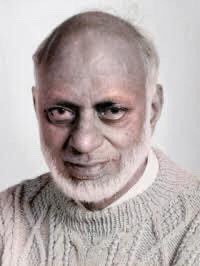
Professor Saiyid Athar Abbās Rizvi: The Historian Par Excellence (1921-94)

Professor Saiyid Athar Abbās Rizvi

Saiyid Athar Abbās Rizvi was a prolific writer and scholar. He started his career, if I am not wrong, from Aligarh. When my father got an appointment at AMU and shifted to Aligarh in 1954, he stayed for a few months in the old rambling Nili Kothi of Dr Rizvi near Kela Nagar. So he must have been here from before 1954.

Rizvi was one of the favourite students (research scholar?) of Professor Mohammad Habib, and like him, started his academic career by writing on Sufism. Initially an agnostic, he would pass his time sitting in the Manuscript Section. Another person who would also be sometimes there was another Athar: M Athar Ali. At leisure time they would not only discuss the various manuscripts and the information there but also indulge in light banter! Once a scholar reading a manuscript detailing Babur’s conquest read a statement in Persian “ba afwāj i qāhira humlā namūd”! On reading it the scholar exclaimed “Oh! Babur came to India with the contingents from Cairo!” [afwāj i qāhira only meant “ferocious army”!] Till the very end of his life, the scholar was made a butt of this joke by Rizvi Sahib and he would narrate this incident to everyone with much aplomb! This was actually repeated me by a well known French scholar who came to meet me in Paris when he came to know my relations with Professor Rizvi! He would also those days make fun of my father for his religious ways! To Athar Abbās Rizvi of those days, religion was nothing but a dangerous opium!

About him, Mohammad Habib however once predicted in writing in one of Rizvi’s works on Sufis that “If he continued in this way, he would end up one day as a great mystic one day”! And what a keen understanding that was of a student of his!

Rizvi wrote extensively on mysticism. His two volumes on Indian Sufism is a testimony of that! He also wrote on Shāh Waliullah. Another of his books was on Shāh Abdul Aziz Dehlavi and a third on Muslim Revivalist Movement in India. He has six volumes on Freedom Struggle in UP. Another of his projects was the translation of Persian sources into Hindu. It is a counterbalance to the colonial translation project of Elliot & Dawson. He wrote much more: from Iranian Revolution to Fatehpur Sikri! His first book on Sikri is still being published by the ASI as an ideal tourist guide and remarkable insights. The second book on Fathpur Sikri, done along with his research student VJA Flynn, is the first source based project on that capital city of Akbar which is still unparalleled and classic. Similarly his two volumes on the history of Shias in India is a masterpiece in spite of many of its drawbacks.

When I started work on Fathpur Sikri, one of my first paper to be presented was in his presence in the audience. He was an old man and Irfan Habib had told me that if Athar Sahib does not tear it down and maul you for writing it (it was very critical to some of his views), then you carry on with the topic, else forget it. When I made the presentation, Athar Sahib shuffled up from his seat, resting himself on his stick, cleared his voice and said: “I wish a day comes when you are an old man, and a young man tears you down!” My face went pale, there was a pin drop silence. Then he chuckled and continued “But more seriously young man, your criticism is valid: I was writing of Fathpur Sikri, sitting in Canberra and with most of my references back home in Aligarh! You are correct in your analysis and I congratulate you for it!” My supervisor smiled, and decades later I completed my book Fathpur Sikri Revisited!

However to me his best work was Religious and Intellectual History of the Muslims in Akbar’s Reign 1556-1605 published in 1975. Unfortunately out print and out of mind, this is so far one of the best works to understand Abu’l Fazl, as well as the debates which took place in Akbar’s Ibādatkhāna. A very good account of what was Sulh i kul, is also given there. I don’t know why Aligarh, as well as other centres which teach Medieval India have neglected it? This book needs to be reprinted and made available to the students and teachers alike!

True to the predictions of Mohammad Habib, Athar Abbās Rizvi soon transformed from an agnostic into a godfearing mystic. He grew a beard, established a library and an Imāmbada in his Aligarh house, where he would return each Muharram during the last decades of his life. I very well remember Athar Sahib coming to my house for the majlis with a bundle of books wrapped in a red cloth. And till the start of majlis he would sit on a sofa with that bundle of papers, busy in making corrections. I once asked what was it? He said proofs of a book on the Indian Shias. He would also sometimes after the majlis go to where my father’s books were kept in our home library and sit there for hours.

He would fast every thursday, recite ‘āmāl i Āshūr every week. He ultimately died in Mashhad, Iran and is now buried within the precincts of the Shrine of Imām i Reza, from whom he traced his descent.

May his soul rest in Peace!

Syed Ali Nadeem Rezavi

Mughal Architecture: Organisation of Building Construction

Construction of Fathpur Sikri, Akbarnāma, V&A Museum, London

Syed Ali Nadeem Rezavi

The question to be taken up here is: who were the real ‘builders’ and how were they organized?

Though buildings – mosques, tombs, residences etc – came to be constructed from the reign of Babur himself (1526-30), the Mughal school of architecture was really established only in the period of Akbar (1556-1605).

Quite often when our Persian chroniclers narrate the building of various forts, bridges, havelis or gardens, instead of providing the names of the architects or master-masons, and other precise details, they confine themselves to just praising their skill (as architects) – mi’mārān-i jādu asar and najjārān-i āzarkār or muhandisān-i firdaus barīn, high flown adjectives that hardly advance our knowledge.[1]

When Khwānd Amir discusses the division of society into three classes, he fails to mention the architects who must have formed an important group during his time. Even Abu’l Faẓl who devoted a full section on the building establishment and provides the names of men of standing, intellectuals and artists, fails to name the architects of his time, which he in fact does in respect of physicians. The same appears to be the case with Badāūni and the author of the Ṭabaqāt-i Akbarī. In Medieval India the inscriptions which have so far been noticed mention architects, or calligraphers, but seldom the masons or brick-layers. Thus in the case of the Tāj Mahal, the only name which comes to us – and that too only from inscriptions – is  that of Amānat Khān who has left his signature on one of the panels. The Persian sources are also silent as far as the personnel of the building construction are concerned.[2] They only mention the chief architects and engineers like Ustād Qāsim Khān, the architect of Agra Fort[3] and Ustād Ahmad and Hāmid of the Red Fort of Delhi.[4] As far as the palaces and structures at Fathpur-Sīkri are concerned, the sources are entirely silent about their actual builders. We are only informed that craftsmen from regions like Gujarat and Rajasthan were employed in the enterprise. From our sources it also appears that like other professions, the architects were largely hereditary in nature.[5]

While dealing with the expertise of stone-cutters in India, Babur tells us that in his buildings at Fathpur Sīkri, Bayāna, Dholpūr, Gwālior and Kol (modern Aligarh), “as many as 1491 stone-cutters worked daily”.[6] Abu’l Fazl tells us that three to four thousand masons and other craftsmen were employed in the construction of Agra Fort, while ‘Ārif Qandhāri says that two thousand stone-cutters and two thousand skilled masons were employed for the construction work, while eight thousand labourers assisted them.[7] Though the Persian sources are silent as far as the work force employed in the Sikandara, the tomb of I’timād ud Daulah and the Tāj Mahal are concerned, William Finch gives the figure of three thousand for Sikandara.[8] Irfan Habib, basing himself on the information available in the Persian sources, hazards a figure of 5,000 to 8,000 building craftsmen employed in the construction at Fathpur Sīkri.[9]

Our Persian sources refer to some designations of officers or professional men without naming them personally, e.g. the mīr-i ‘imārat  and dārogha-i ‘imārat who appear to have headed the building establishment. Other categories of overseers and workers mentioned in our sources are the mi’mār (architect/mason), muḥandiṣ (architect), naqsha-navīs(plan drawer), naqqāsh (carver), sangtarāsh (stone-cutter), gul tarāsh (floral designer), parchīnkār (inlayer/engraver) and the najjār (carpenter), apart from the generality of artisans and labourers.

The mīr-i ‘imārat was an official who supervised the construction of a building or an edifice. It was he who apart from supervising the construction was also responsible for the recruitment of the various masons, artisans and labourers.  While dealing with details of various bureaucratic offices and positions under the Mughals, the author of the Hidāyat-ul Qāwa‘id (c. 1700) gives the qualifications that were deemed necessary for an efficient mīr-i ‘imārat.He was required to be aware of the art of construction and also possessed a sound knowledge of arithmetic (ḥisāb).[10] If he himself was not well versed in ḥisāb, he was to hire a person who was a master in it. The mīr-i ‘imārat was also required to have some technical knowledge as well. Thus he was supposed to know the number of bricks that were needed to construct a house of a certain size, the method of preparing the mortar and the relative quantities of its ingredients.[11] Apart from this, he was required to be aware of the prevailing wages of the masons, artisans and labourers. Hidayatullah cautions that the mīr-i ‘imārat should also be aware of the prices of the lime, bricks, wood and other building material so that the person for whom the edifice is being built remains satisfied. His dealings with the subordinates were also supposed to be such that the work could be carried out in a congenial atmosphere and at a rapid pace.[12]  We are further told that if the chief architect (sardār-i mi‘mārān) were to be rewarded with a robe of honour or some other gift from the court, the mīr-i ‘imārat should himself make gifts to the other workers in a similar manner from his own account so that they may not be disheartened.[13]

Once the building was fully constructed it was put under the supervision of the dārogha-i ‘imārat, the Incharge of the buildings, who was responsible for its upkeep and repairs as the need arose.[14] To help him discharge his duties, a number of aḥadīs (royal troopers),[15] bandūqchis (musketeers)[16] and a host of ‘shovel-wielders’ (beldārs)[17] were placed under his charge.

Before the actual construction could start, it appears that certain experts were asked to submit a plan. Our sources, however, have very few references as to how these plans were made. It is only in the nineteenth century, when books of tourist interest for the Tāj were prepared that we find a detailed mention of naqsha navīs.[18] Interestingly enough in these works, the naqsha navīs is mentioned as the chief architect. The mere absence of a mention of naqsha navīs does not necessarily mean the non-existence of this profession. The sheer magnitude of the Imperial buildings and their symmetrical appearance hints towards the existence of expert plan- drawers. We find Babar lamenting at the asymmetrical and un-planned buildings which he found on coming to India.[19] One of the surviving Akbarnāmapaintings preserved at Victoria and Albert Museum shows Bābur overseeing the laying out of the Bāgh-i Wafa Garden. The painting contains a depiction of a man supervising the work with the help of a plan on a rectangular sheet of graph-paper. The men to whom instructions are being given are shown holding a long rope with which they are measuring the garden-beds. In all probability the same method was used in carrying out construction of buildings according to plan set out on a graph. For only then can one appreciate the Emperor’s indignation at the un-planned buildings of India.[20] An interesting passage in Manucci’s account very lucidly brings out the detailed manner in which the plans of houses were drawn by architects before the actual construction. Discussing the whimsical nature of a Mughal noble, Ja’far Khān, he writes:

“…But it was a stranger thing he [Ja’far Khān] did when the architect brought him the plans of a fine palace that he intended to build. For after asking as to various sections of the plan, he ended by inquiring about a certain place, where were depicted the privy retreats. The architect said it was the necessary place, whereupon he held his nostrils with his right hand, and puckering up his face, made a sign with his left to take the plan away, as if it smelt merely through having this painting on it.”[21]

Our sources generally use the term taraḥ for the plan drawing as for any pattern. Abul Qāsim Namakīn in his Munsh’āt includes taraḥi or plan-drawing, as one of the essential functions of the mi‘mār.[22] Further, we are informed that the fort of Shāhjahānabad was constructed according to the taraḥ ratified by the emperor himself.[23] Sālih Kanboh says that even the covered bāzār (bāzār-i musaqqaf) at the fort was constructed after Shāhjahān, having seen a taraḥ of a similar market at Baghdād, ordered that it be sent to Mukarramat Khān, the supervisor of the Red Fort.[24] Asaf Khān, we are informed was an expert in taraḥī and it was he who placed a number of plans for the proposed khwābgāh (bed-chamber) at Lahore Fort made by certain ‘expert architects’ (ustādān) before Shāhjahān, who then, chose one plan which was ultimately executed by the engineers (muhandisān).[25] The making of the taraḥ is also mentioned in some of the surviving Mughal documents. For example, the Nigārnāma-i Munshī, a collection of administrative documents, contains a reference to the preparation of a taraḥ of a damaged building at Peshāwar.[26] Similarly another document of Aurangzeb’s reign refers to Jawāharmal, a mi‘mār, who prepared a taraḥ of a haveli of a deceased noble.[27]  

Sometimes the term naqsha was also used to refer to a plan: Salih Kanboh uses both terms, the taraḥ and the naqsha.[28] Shahnawaz Khān in his Ma’āsirul Umara informs us that the Mughal court possessed the naqshās of both Baghdad and Isfahan.[29]

The official histories have also recorded the details of many major monuments of their period. These details include even minor intricacies like the thickness of the plinth, the height of the various portions, their length and breadth, the curvature of the dome etc. For a person like Lāhori it would not have .been possible to discuss the details of a building of such dimensions as the Tāj, unless he was provided these details by a plan or map placed before him.[30]The manner in which he describes the bulbous dome of the mausoleum also indicates the use of a plan or drawing.

We also find that the builders under the Mughals had certain rules based on which the plan might have been drawn. Thus the author of Bayāẓ-i Khwushbūī writing in the reign of Shāhjahān gives examples of details of certain mansions and gardens in order to stress how the houses, baths and gardens should be ideally constructed.[31] Dealing with arched-gates of buildings, the author says:

“The breadth of the gate of the building should be 1 dira, the height 2 dira and its chaukhaṭ should be one foot high. If the dimensions are less than this, it (the gate) would look ugly.”[32]

The actual construction work was carried out under the mi‘mār. The term normally denoted a mason, but was also used for the chief of works or supervisor. The chief architect under whose supervision the other architects constructed the Agra Fort under Akbar is called a mi‘mār by Gulbadan in her Memoirs.[33] Similarly the Fort of Delhi was completed under the directions of Ustad Ahmad and Ustad Hamid, both being ‘expert mi‘mārs’.[34] We are also told that the Tāj Mahal was constructed by the architect of the Delhi Fort Ustād Ahmad mi‘mār and his son claimed that he himself and his brothers were all expert mi‘mārs.[35] Abdur Rahim Khān-i Khānan too had in his service a ‘mi‘mār’ who had no parallel.[36] These master-masons had under their control a number of ordinary mi‘mārs (masons) whose job appears to have been mainly brick-laying. They in fact, were the real masons. Their expertise extended to estimating prices of buildings and lands: witness the task assigned officially to Lachhmi mi‘mār at Mathura to estimate the price of a private house early in Aurangzeb’s reign.[37] The mi‘mārs of supervisory levels enjoyed both importance and affluence can be deduced from their portrayal in Mughal miniatures, where, while directing building work, they are depicted fully clad from head to foot.[38]

Another category of experts who worked hand in hand with the mi‘mār were the muhandis or the mathematicians. They appear to be expert in the art of arithmetic and geometry, which they applied to calculate the proportions of the foundations and. heights.[39] The term muhandis was also generally applied to the architects. Lutfullah, the architect had the title ‘Muhandis’. He was well-versed in the science of mathematics, which he says, he applied whi1e constructing buildings.[40] In fact he has left behind works on mathematics.[41] ‘Atāullah Rashīdī, the brother of Lutfullah Muhandis, was a master of arithmetic and architecture.[42] In fact, throughout his Dīwān, Lutfullah uses the term muhandis for architect.[43] We are also told that Ustād Ahmad, the architect of Delhi Fort had no parallel as far as his knowledge of mathematics is concerned.[44]

Next in importance to the mi‘mār was the sangtarāsh (stone-cutter) or the najjār (carpenter). While dealing with the positive aspects of Indian society, Shaikh Zain while summarising the Bāburnāma says:

“They are far more numerous and exceed in number than those of any other country… in the royal edifices at Agra 680 stone- cutters who are the natives of the city, have been at work every day in special departments of the governments, and in laying in the foundations of the buildings of Fathpur Sīkri, Biāna, Dholpūr, Gwālior, Kol, and, in carrying out the imperial command, as many as 1491 stone-cutters worked daily. Moreover, every one of the pillars of the government (grandees) who erect buildings of stones, employ a. large number of the stone-cutters in the same way.”[45]

Bābur himself alludes to the large number of sangtarāsh in India giving the numbers that Shaikh Zain has reproduced. He also writes that these stone cutters were also sent to other countries.[46] Abu’l Faẓl in his chapter on a’in-i imārat mentions two categories of sangtarāsh viz. the naqqāsh who was the tracer or carver and the sādahkār or the plain stone-cutter.[47] The naqqāsh enjoyed a superior position relative to the sādahkār: the Akbarnāma paintings show the carvers better dressed than the sādahkār.[48] The stone was first handed over to the sādahkār who would cut the stone into the required shape. It was then handed over to the naqqāsh who would trace the required floral or geometrical design before handing it over to the parchīnkār (engraver) or mambatkār (embosser) as per the need. For carving out the more intricate designs, the stone marble was handed over to the gultarāsh.[49]

After the various categories of the stone- cutters and carvers accomplished their work, these stone pieces were ready to be fixed in the building. We may assume that due to a large number of stones adorned with various floral and geometrical designs, they were also numbered to enable them to be placed in proper order.[50] Quite often the stone cutters themselves had the job of joining the stone-pieces together. Shaikh Zain informs us at the stone cutters so closely and expertly joined the stones in the buildings that ‘even the sagacity of the acute and subtle critics fell in state of amazement.’ He further states that the stone cutters accomplished this task of joining without use of any plastering material or iron.[51] The title of ustād (master) was also bestowed on such expert sang tarāsh. Thus Babur mentions one Ustād Shāh Muḥammad who was entrusted with the construction of a building at Dholpūr.[52]

A close study of Mughal monuments suggests a very interesting practice. The stones adorning the plinths, stairs, pavements etc. of the various monuments at Delhi, Agra and Fathpur Sīkri have certain marks carved on them. R.Nath designates them as the masons’ marks.[53] But they are surely stone-cutters’ marks. Whether each mark denoted a family of stone cutters or their respective guilds, we do not know.

Yet another craftsman who was important was the khwushnawīs or the calligrapher who was responsible for designing and executing inscriptions to be fixed on the building. Whether like a modern calligrapher he would execute his art on paper later to be transferred on stone by the naqqāsh and parchīnkār, we do not know. But from what we know, it seems, he was held in good esteem. It is only his name that time and again we find inscribed along with his work on the building. Thus one of the slabs on the main portal of the Tāj gives the name of Amānat Khān, the khwush-navīs.[54]

Yet another class of master-craftsmen and artisans was that of najjār  or durūdgar (carpenter).[55] Carpenters had the responsibility of constructing the doors and the windows. Some of the European accounts mention wooden houses,[56] and Abu’l Faẓl mentions wooden structures.[57] In his chapter on buildings, Abu’l Faẓl mentions the carpenters just after the stone-cutters. According to him, the carpenters were divided into two groups. The first group of durūdgar appear to be those who shaped and chiselled the wood. These he sub-divides into five categories. The second group, which he calls sādahkār or plain job-workers, who probably just shaped the planks etc, are divided into three categories. The man responsible for sawing the logs of wood was called ārah-kash (‘saw-driver’).[58] The need for carpenters in making windows would also have been considerably high due to the high cost of glass for the panes.[59]Abu’l Faẓl thus speaks of pinjarasāz who were the lattice and wicker workers who probably decorated the windows etc.[60] Whenever glass was used the services of tābdān tarāsh were required.[61]

The building under construction cannot be completed without the presence of artisans who have the expertise in digging and brick-laying. Thus our Persian sources have innumerable references to beldārs or ‘shovel wielders’.[62] A lofty building being constructed with the use of stone and bricks needed the service of the beldārs to dig its strong foundations. Then again, the mason busy in his work was in need of help of certain artisans to prepare the bricks and bring them to him. Thus, Abu’l Faẓl divides the beldārs into two categories. The first were those who helped in the construction, of walls and the second were ordinary diggers.[63] When the bricks were being cemented with the help of lime mortar, the services of a gilkār were required, a kind of lime-mixer or mortar-maker.[64] Another cementing material which was in vogue at that time was prepared with the help of surkhī or pounded bricks. This work of pounding the brick and mixing it with lime mortar was performed by surkhīkob or the brick-pounder.[65] The, tiles which were used in roofing the houses of the middle-income group were prepared by the khisht-tarāsh.[66] From the Mughal paintings it appears that most of these workers were ill-clad and went about – as in the present age – in a semi-clad condition with only a loin-cloth and c1oth-piece used to help in carrying load; the women carrying bricks are, on the other hand shown with blouses and short sarees.

Abu’l Faẓl also mentions a number of artisans who were required in the construction of thatched-houses and huts which were used as dwellings by the common people in the towns and countryside.[67] They included the chhappar-band (thatchers), bāns-tarāsh (bamboo-cutters) pātāl-band (reed-binders) and lakhīra (varnishers of reeds).[68]

The water needed for the construction work was supplied from the wells (chāh) which were dug by chāh-kan(well diggers) and frequently cleaned by yet another set of experts called ghoṭa-khor.[69] A worker was also needed to carry this water to the place where the mortar was being prepared. He was known as the ābkash (water-carrier).[70]

The practice of constructing water tanks and fountains near palaces and tombs was quite common. The water to these fountains was supplied through underground water channels and pipes. Our sources are silent as to their builders. In Persia, Afghanistan and other Central Asia, the experts who constructed these underground water pipes were known as mukhānis, chāhkhu, qumūsh or qārizkan.[71] Whether under the Mughals they were known by any of these names, we do not know.

Thus we see that the building establishment under the Mughals generally consisted of numerous categories of craftsmen each expert in his field, working under the command of a supervisor.

As far as the construction of Imperial buildings was concerned, there appears to have been some sort of a ‘contract’ system. Gopāl Rāi Surdaj includes in his work an istighāsa regarding the construction of two sarais between Narwar and Sironj, which mentions an amount set aside for the construction. It was from this amount that the salaries were to be paid and material bought by the building supervisor.[72]

Once the supervisor for the construction was chosen and an architect appointed the next step was to draw the plan. The actual work would start with the bēldār s digging the foundations. The masons would then raise the plinth over this foundation and then construct the walls. Mughal paintings abound in depictions of spades, hammers and other instruments which were used for these purposes. Some workers would busy themselves in preparing and mixing the mortar. Others would carry the bricks and the mortar to the masons. For the mortar, barrows carried by two workers, one on each side were utilized. For bricks, baskets were used. Wheel-barrows, not depicted, were presumably not in use. It also appears that the bricks needed for the building were and baked in kilns quite near the site of the building under the eyes of the Supervisor.[73] The paintings also depict the work of each category of worker being supervised by a person with a guiding stick in his hand. The use of ramp made of wood was also known along with the ladder, with the help of which the labourers could climb up to the level where the bricks were to be laid.

The embossers and carvers used iron chisels and hammers. Probably the ābkash used leather bucket (mashk) like the saqqas (water- carriers).

The practice of repairs of the old buildings is also referred to, despite Pelsaert’s statement that this was entirely neglected.[74] Thus we find Jahāngīr ordering ‘Abdul Karīm Mā’mūri, an architect, to repair ‘the buildings of the old kings’ at Māndu.[75] An iron plate inscription on the gate of the mausoleum of Sultān Hoshang Ghori (d. 838 A.H. / 1434-5 A.D.) at Māndu mentions a host of architects who went there for inspection.[76] In a very interesting letter to Shāhjahān, Prince Aurangzeb mentions the repair works being carried out at the Tāj Mahal whose ceiling had started leaking during the rains. He urged that there was greater need to pay attention to the repairs in order to safe-guard the ground structure.[77] Dealing with the repair-works going on at the Tāj, he writes:

“The architects (mi‘mār) are of the opinion that if the roof of the second floor is opened up and treated afresh with lime mortar over which half a gaz (yard) layer of mortar grout is laid (tehkāri) then probably the semi-domed portals, galleries and the small domes may be made water tight.”[78]

Aurangzeb then goes on to remark that the architects ‘confess their inability to fully repair the bigger Dome’.

Extract from the Sectional Presidential Address of Professor Syed Ali Nadeem Rezavi to Medieval India Section of the Indian History Congress, JNU session, 2014

_____________________________

Notes:

[1] See for example Lahori, Pādshāhnāma, Bib. Ind. ed., Calcutta, 1866-72, Vol. I, pt.i, p. 22l; Muhammad Salih Kambo, Amal-i Salih ed. G Yazdani, Calcutta. 1923, Vol. II, p. 294.

[2]  For the various categories of craftsmen involved in constructional.activity and their wages, see my “Organization of Building Construction in Mughal India”, paper presented at the Indian History Congress, Dharwar, 1988; see also A.J. Qaisar, Building Construction in Mughal India – The Evidence from PĀ’inting, Delhi, 1988.

[3] Gulbadan, Humayun Nama Tashkent, 1959, p. 17 Abu’l Faẓl, Akbar Nama, ed. Molvi Abdur Rahim, Calcutta, 1879, Vol. II, p. 247.

[4] Waris, Badshahnama, MS. Raza Library, Rampur, (transcript in the Department of History Research Library, AMU, Aligarh), Vol.I, p.38

[5] See for example the family of Lutfullah, Dīwān-i Muhandis, reproduced in Sayyid Sulaiman Nadwi, “The Family of the Engineers who built the Taj Mahal and the Delhi Forts”, The Journal of Bihar Research Society, Vol. XXXIV, Pts I & II, 1948, pp. 75-110 and M. Abdullah Chaghtai, “A Family of Great Mughal Architects”, Islamic Culture, Vol. XI, no. 2, April, 1937, 200-209

[6] Bāburnāma, ‘Abdur Rahīm’s Transl., Br. Lib. MS Or. 3714, ff. 412 B – 413 a; transl. A.S. Beveridge, London, 1921, vol. II, p. 520; See also Shaikh ZĀ’in Khawāfi, Ṭabaqāt-i Bāburi, tr. Hasan Askari, Delhi, 1982, p.134.

[7] Abu’l Fazl, Akbarnāma, ed. Abdur Rahim, Calcutta, 1886, Vol.II, p.247; Ārif Qandhārī, Tārīkh-i Akbarī, Rampur, 1962, p.145.

[8] Finch’s account in Early Travels in India, 1583-1619, ed. Foster, Oxford, p.121.

[9] Irfan Habib, “The Economic and Social Setting”, Marg, vol. XXXVIII, no.2 (special on Akbar and Fatehpur-Sikri), pp.79-80.

[10] Hidāyatullah Bihārī, Hidāyat ul Qawā‘id, Ms., University Collection, Azad Library, AMU,  f. 40(a).

[11] Ibid, f 40(b)

[12] Ibid.

[13] Ibid. For his responsibilities also see Gopāl Rāi Surdaj, Durrul ‘Ulūmf. 60(a) (Rotograph in the Research Library of the Department of History, Aligarh).

[14] Similar supervisory distinction can be seen in the canal construction work. The actual digging of the canal, building of dykes, the control and disbursement of wages to masons and artisans was the job of mir-i ab. See for example, Akbar’s sanad of 978 (1570-71) in Lieut., Yule, ‘A canal Act of the Emperor Akbar with some notes and remarks on the History of Western Jumna Canal’, JASB, l846, vol.XV, Calcutta, pp.213-23; also Memorandum on Chitung River (1635) contĀ’ined in Letters of Shaikh Jalāl Hisāri and Bālkrishan Braḥman, MS (Rotograph Deptt. of History). Badāūnī informs us that Nūruddin Muhammad Tarkhān, who was an expert in the science of ḥindsa, riyāzī and nujūm (arithmetic, geometry and astronomy) was appointed as mīr-i āb to dig Shah Nahr by Akbar (Badauni, Muntakhab-u Tawārīkh, ed. Molvi Ahmad Ali, Calcutta, 1869, Vol. IV, p. 197). After a canal was completed, it was placed under the charge of dārogha-i nahr who with the help of his gumāshtas and mutaṣaddis looked after its upkeep and collected the canal cess (nahrāna). He was also entitled to recruit labourers for the repair work. See, for example, B.N Goswami and J.S. Grewal, The Mughal & Sikh Rulers and the Vaishnavas of Pindori, IIAS, Simla, 1969, Document No. III, pp. 94-95; also J.S. Grewal, ‘Some Persian Documents from Nurpur’,  Historians Punjab: Miscellaneous Articles, Amritsar, 1974, pp. 79-80.

[15] Mughal Documents, Catalogue Of Aurangzeb’s Reign, ed. M.A. Naeem, Vol.1, Pt.I, document Nos. 1/204 arid 1/1468.

[16] Ibid., Document No. 1/96.

[17] Ibid., Document nos. 1/131, 1/151, 1/735.

[18] For example, Dīwān-iAfridiTarikh-i Taj MahalAhwal-i Taj Mahal etc. For their references and date of compilation see R. Nath, The Tal Mahal and its Incarnation, Jaipur, 1985; S.M. Latif, Agra: Historical and Descriptive, Calcutta, 1896 (new ed. pub. 1981), pp. 116-7; S.C. Mukherji, “Architecture of the Taj and its Architect”, Indian Historical Quarterly, Vol., I,1933, Calcutta, pp. 872-9, etc.

[19] Shaikh ZĀ’in Khawafi, Tabaqat-i Baburi, tr. Hasan Askari, Delhi, 1982, p.108.

[20] A plan of the houses of Santidas Sahu which were gifted by him survives in a hibanama, see M.A. Chaghtai’s article in JASP, op.cit.

[21] Manucci, II, p.146.

[22] Abul Qasim Namakin, Munshat-i Namakin, Aligarh Collection, Maulana Azad Library, AMU, no. farsiya 26, f. 133 (b)

[23] Wāris, Pādshāhnāma, Ms. (transcript Research Library, Department of History, AMU, Aligarh), p.39; see also Shāhnawāz Khān, Ma’āsir ul Umara, ed. Abdur Rahim & Ashraf Ali, Bib.Ind., Calcutta, 1881-91, III, p.463.

[24] Amal-i Sālih, op.cit., II, pp.471-72.

[25] Lāhori, II,op.cit., p.224; Amal-i Sālih, op.cit., II, p. 8

[26]  Munshi Malikzāda, Nigārnāma-i Munshi, Ms. No. 36, Research Library, Department of History, AMU, Aligarh, ff. 157 (a)-(b).

[27] Akhbār dated 43rd RY of Aurangzeb, Akhbār- darbār mu’alla, Royal Asiatic Society, London (microfilm Research Library, Department of History, AMU, Aligarh, no. 30)

[28] Amal-i Salih, op.cit., III, p.28.

[29] Ma’āsir ul Umara, op.cit., II, p.469; For the naqsha of a Deccan Fort sought to be captured by Aurangzeb, see, Kalimāt-i Taiyabāt, ed. Ināyatullah Khān, Ms., Aligarh Collection, Maulana Azad Library, AMU, Aligarh, farsiya,39, no. 278.

[30] Lahori, op.cit., Vol. II, pp. 323-31.

[31] Bayāẓ-i Khwushbūī, Ms. IOL Ethe 2784 (I.O.828); Rotograph copy in the Research Library, Department of History, AMU, ff. 108(a) – 111 (a).

[32] Bayaz-i Khushbuif. 108 (b). Suggestions are made for construction of tombs, minarets and garden-beds. For similar directions as to dimensions for buildings being built at Jaipur in 1720’s under the supervision of Vidhyadhar., the architect of Raja Jai Singh, see A.K. Roy, History of the Jaipur City, New Delhi, 1978, pp.41-42, 52.

[33] Gulbadari, Humayun Nama Tashkent, 1959, p.17; See also Abul Fazl, ed. Molvi Abdul Rahim, Calcutta, 1879, Vol. II, p. 247.

[34] Waris, Badshah Nama, Ms. Raza Library. Rampur (transcript copy in Research Library, Deptt. of History, AMU), vol., I, p. 38.

[35] Lutfullah Muhandis, Dīwān-i Muhandis, reproduced in Sayyid Sulaiman Nadwi, “The Family of the Engineers who built the Taj Mahal and the Delhi Forts”, The Journal of Bihar Research Society, Vol. XXXIV, Pts I & II, 1948, pp. 75-110 and M. Abdullah Chaghtai, “A Family of Great Mughal Architects”, Islamic Culture, Vol. XI, no. 2, April, 1937, 200-209.

[36] Mulla Abdul .Baqi Nahawandi, Ma’asir-i Rahimi, ed. M. Hidayat HusĀ’in, Calcutta, Vol. II, pp.610-11.

[37] Mathura Documents, dated 10 Jamadi I, 5th R.Y of Aurangzeb (,Xeroxed)

[38] See for example Akbarnāma pĀ’intings depicting the construction of Fathpur Sikri and Agra Fort preserved in Victoria and Albert Museum.

[39] See for example Lahori, Vol. I., Pt.i, p, 223.

[40] Dīwān-i Muhandis, op.cit.

[41] Some of his books which survive include (i) Risala-i Khawās-i a’dad, MS. BM 16744 / 3; (b) Sharh-i Khulāstul Hiṣāb, MS. Azad Library, AMU, Aligarh (2 copies).

[42] Dīwān-i Muhandis, op.cit.

[43] Ibid. In modern Persian also the term muhandis stands for an architect.

[44] Ahmad Ali Sandelvi, Makhazan-ul Gharāib, MS. Shibli Academy, p. 153.

[45] Tabaqāt-i Bāburi, op.cit., p. 134.

[46] Baburnāmah, ed. A.S. Beveridge, London, 1971, f. 291(b)

[47] Abul Fazl, A’in-i Akbari, Nawal Kishore, Vol.1, n.d. p. 117.

[48] Akbarnāma PĀ’intings, op.cit.

[49] For their separate skills see Lāhori, II, p.324; Ahwāl-i Tāj Mahal, Mirza Beg, (MS. Research Library, Deptt. of History, AMU); R. Nath, The Taj and its Incarnation, op.cit., pp. 40-41.

[50] Even today one can see the practice of numbering the stones at the Dayāl Bāgh Mandir at Agra which is under construction. As per the design, the stones are numbered before being handed over to the mason who has the job fixing them on the brick walls of the temple.

[51] Tabaqāt-i Bāburi, op.cit., p. 157.

[52] Babur Nama, op.cit., f. 339(b).

[53] R. Nath, The Taj Mahal and Incarnation , op.cit., p. 44; For the marks of professionals, including the stone cutters see Infra.

[54] See also Latif, Agra: Historical And Descriptive, op.cit., description of the Taj; . R.Nath, op.cit. pp. 41-2. Abdul Bāqi also mentions quite a few khushnawis and naqqāsh (calligraphist) see for example Ma’āsir-i Rahīmī, ed. Hidayat Hossein, 1925, Vol. III, p.1682.

[55] Abul Fazl used the term durūdgar for them. A’in, I, p. 117.

[56] Pelsaert, op.cit., p. 34; Bernier, op.cit., p.398.

[57] A’in, Vol. I, op.cit., p. 562; For the use of wood in houses an its importance see Hidāyat-ul Qawā’idop.cit., f. 40(b). For the expert carpenters of Calicut, see Pyrard, The Voyage of Francois Pyrard of Laval, tr. ed. Alfert Gray, Vol. I, n.d., London, p. 403.

[58] Ā’in. Vol.I, op.cit., pp. 117

[59] Fryer, op.cit., p. 92.

[60] Ā’in, op.cit., Vol. I, p. 117.

[61] Ā’in, op.cit., Vol. I, p.118

[62] See for example Bāburnāma, op.cit., f. 291(b); Tabaqāt-i Bāburi, op.cit., p.115; Lahori, I, op.cit.,p.323 Ali Muhammad Khan, Mīrāt-i Aḥmadi ed. Nawab Ali, Baroda, 1928, Vol.1, p. 276; M.A. Naeem, Mughal Document, Catalogue of Aurangzeb’s Reign, vol. I (1658-63), Hyderabad, 1980 

[63] Ā’in., op.cit., Vol. I, p. 117.

[64] Ibid. Interestingly he is placed the first in the list of artisans employed in the Building establishment.

[65] Ibid

[66] Ā’in., op.cit., Vol. I,  p. 118. For the use of tiles in mercantile houses at Ahmadabad see Jawaid Akhtar, ‘Merchants and Urban Property: A Study of Cambay Documents of the 17th-18th centuries: Professor R.N. Mehta Felicitation Volume, Jaipur, 1999

[67] For thatched huts of common people, see for example, Fr. J. Xavier’s Letter, JASB, n.s. no. XXIII, 1927, p. 125; Finch, Early Travels, p. 185; Tavernier, I, op.cit., pp.122,128. See also Badauni, op.cit., p.398 etc.

[68] A’in., op.cit., Vol. I,., pp. 117-8.

[69] Ibid

[70] Ibid

[71] See Iskandar Beg, ‘Ālam Ārā-i ‘Abbāsi, Isfahan, l956, Vol.I. p. 473 also The Encyclopaedia of Islam, (new edition), Vol. IV, Leiden, 1978, s.v. kanat.

[72] Durrul ‘U1ūmop.cit., ff. 60(a)-(b); See also Tuzuk-i Jahāngīrī ed. S.Ahmad Khan, Ghazipur, 1863, Vol. II, p. 347 where there is a mention of Jahangir giving Rs. 30, 000 to Haidar Malik to construct a canal. The amount was to be utilized for material and labour.

[73] Ibid., f. 60(b).

[74] Francisco Pelsaert, Jahangir’s India The Remonstratie, transl., W.H. Moreland & P.Geyl, Delhi, 2009, p. 56

[75] Lahori, Vol. I, op.cit., pp. 137,182.

[76] Epigraphia Indo-Moslemica, 1909-10, p. 23 cf. M.A Chaghtai, ‘A Family of Great Mughal Architects’ Islamic Cultureop.cit., p. 200.

[77] Abul Fath Qabil Khan, Ādāb-i ‘Ālamgīrī, ed. Abdul Ghafur Chaudhuri, Lahore (Pakistan), 1971, Vol. I, pp. 111-13.

[78] Ibid. Vol. I, p. 112.

An Illustration of Defiance?: Depicting The Tomb of Qutbuddin & the Minār at Mehrauli in a 16th Century Miniature

I am really thankful to Rana Safvi for posting an almost an unknown miniature from the illustrated manuscript of Wāqi’āt-i Bāburi, preserved at the State Museum, Alwar in Rajasthan.

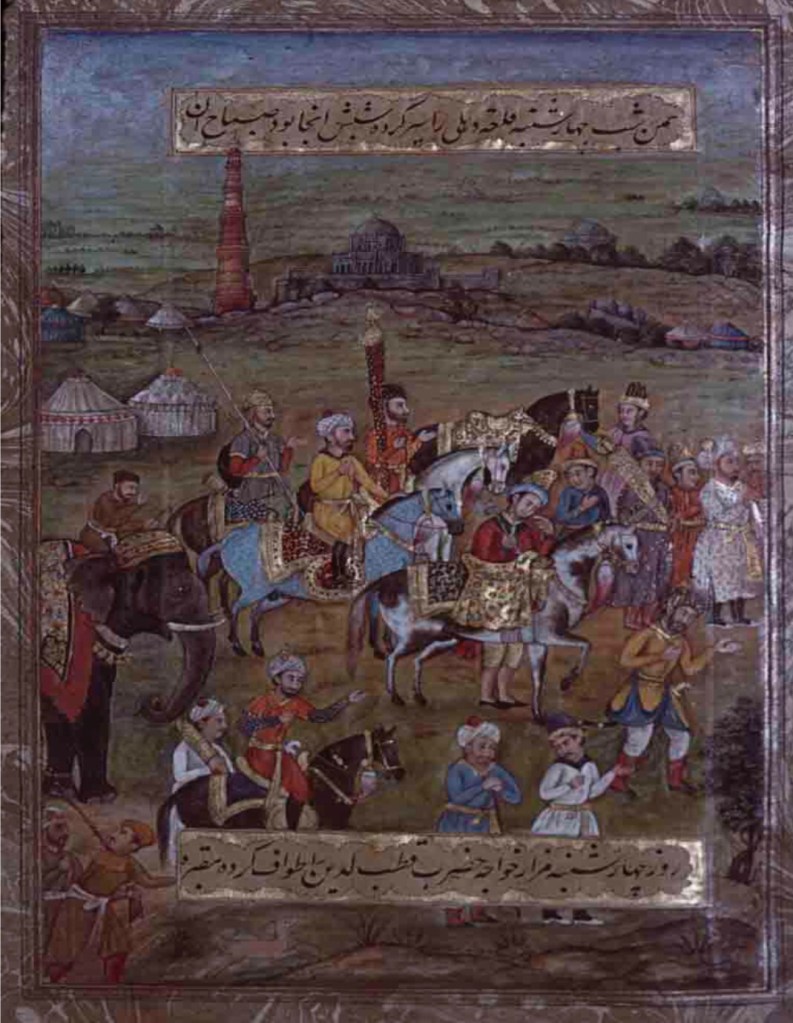
Babur Circumambulating the Tomb of Khwaja Qutbuddin Bakhtiyar Kaki

The miniature is interestingly inscribed in two lines in naskh using black ink within a golden band, one above, and the other below. The text is as follows:

“…hamīn shab i chahār shambah, qal’a i Dehli rā sair kardah. Shabash īnjā būd wa subāh i ān
Roz i chahār shambah, mazār i Khwāja Hazrat Qutbuddin tawāf kardah maqbara …”

[..on the night (preceding) Wednesday, went for site seeing the Fort of Dehli. Stayed there for the night. The next day morning, that is, Wednesday, went to circumambulate the sacred tomb of Hazrat Qutbuddin…]

We know that these texts were illustrated during the reign of Akbar, who had ordered a large number of histories and other manuscripts to be illustrated.

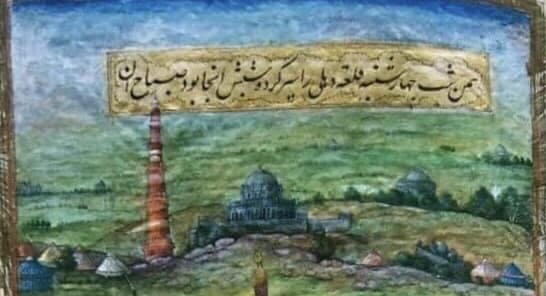
The miniature is extremely important due to the fact that amongst the genre known as “Mughal miniatures” perhaps it is the first visual record of the area of Qila Rai Pithora where the earlier Sultans built the city, the city which in sources of Delhi Sultanate is known as ‘Dehli-i Kuhna’. The miniature records at least three tombs, at a distance from each other. The most prominent of them being an octagonal one. To any observer of this miniature who has not visited the site, the above mentioned text would make him conclude that the prominent octagonal structure depicted almost in the centre of the frame would be the Tomb of the saint, Qutbuddin Bakhtiyār Kāki.

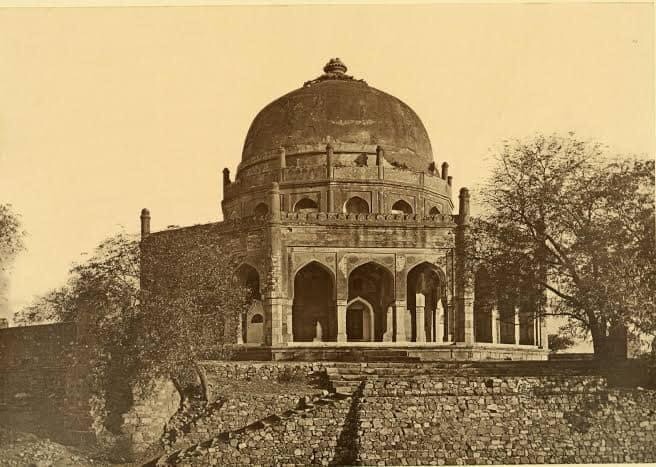
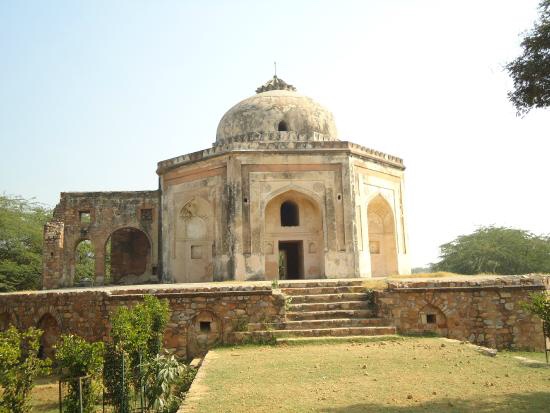
However, as righty pointed out by Rana Safavi, the octagonal tomb is actually the tomb of Adham Khan, the son of Akbar’s foster nurse, Maham Anaga, who was thrown twice from the ramparts by Akbar in 1562 after he had stabbed Shamsuddin Muhammad Atka, whom the emperor revered as his father!

Tomb of Adham Khan

We know that Adham Khan was actually punished with the death penalty by Akbar. After his execution, Maham Anaga withdrew from politics and ultimately died. From 1562 to 1567 the reign of Akbar saw a number of revolts by the senior nobles, many of whom were Turanis.

This whole incident is discussed in detail by Abul Fazl in his Akbarnāma. A very beautiful and poignant illustration of this punishment to the unfortunate rebel has also been included in the Akbarnāma manuscript at Victoria & Albert Museum, London.

After this particular incident nothing is mentioned by any of the sources regarding Adham Khan or his mother.

It is interesting to note that the painter who was assign the task to illustrate this copy of the Waqi’āt i Bāburi manuscript places this rebel’s tomb in the centre of his composition. If so, then was this an allusion to a silent and symbolic defiance? An illustration of sympathy towards a lost cause? We know that Akbar had ordered manuscripts and texts to be illustrated around 1580’s. A serious revolt had once again erupted in 1581, centred in Bengal and Bihar, against certain economic and religious matters. But is this illustration one of those which were illustrated under Akbar at all? Or is it a later composition?

The artist is placing the tomb of Adham Khan in the centre of his composition, on a page where Babur’s visit to the tomb of Khwāja Qutbuddin is being mentioned.

Rana Safvi rightly mentions that the domed structure now covering the tomb of the saint is of quite modern origins. The present structure was built only in 1940’s.

The present Tomb of Qutbuddin Bakhtiyar Kaki

According to her, Sir Syed in his Athār us Sanānādīd says that this dargah is not a permanent structure and the saint’s grave is just a mound of mud. Similarly Monuments of Delhi of Maulvi Zafar Hasan describes it as ‘a mound of earth and kept covered by a sheet, made by his disciple and successor Baba Farid Ganj Shakkar of Pakpattan.’

Illustration of this shrine in Athār us Sanādīd

Also seen (perhaps again for the first and only time) in the miniature under discussion is the Qutb Minār built initially by Qutbuddin Aibek and then added upon by Sultan Iltutmish. The tapering minaret with its actual flutings and honeycomb balconies is depicted along with its original chhatri.

Towards the left of the minaret are placed a number of camps. Some camps can also be seen near a domed mosque-like structure placed on the right hand. Between Adham Khan’s tomb and the Qutb Minār are certain other structures. This is the place where ideally the Qubbatul Islām mosque should have been placed. But it is remarkably absent. Two domed structures are drawn at some distances behind Adham Khan’s tomb. Both are silhouetted with green trees. Is one of these tombs that of Muhammad Quli Khan, the brother of Adham Khan as opined by Rana Safvi?

Detail of the miniature

It’s just a guess. If so, and if one believes the miniature to be made under Akbar, then the defiant nature of the artist gets confirmed. The tomb of Muhammad Quli Khan, however in real life is much smaller than the dome depicted in this painting: though the artist’s licence can never be ruled out!

Tomb of Muhammad Quli Khan

The painting is a very interesting composition. In the foreground is depicted the party of the emperor with his standards and other royal paraphernalia. Babur is shown wearing a bright yellow tunic sitting atop a horse and accompanied with three other horsemen and a number of piyādas. A mahout atop an elephant follows him.

In a warning note on my post on this miniature by the art historian Dr Kavita Singh, a professor of Art History at JNU opined that artistically this painting can not be dated to the period of Akbar but to 19th Century. And then Professor Rochelle Kessler posted the link of American Institute of Indian Studies which lists this miniature from Waqi’āt i Bāburi as being dated c. 1775 AD! So it turns out that the painting is late 18th Century. The artist thus can in no way be labelled as a person registering his defiance or subversion! Probably the poor guy was not even aware of who Adham Khan was, or what the incident involving him was!

But then, it is quite possible, that the artist was closely following some other more contemporary depiction which he might have seen?

Must however thank my senior Rana Safvi for making this miniature known to the public through her posts. And thanks to Kavita Singh and Rochelle Kessler for helping us understand it!

The link to the website is:

Link

• Syed Ali Nadeem Rezavi

PROFESSOR R.C. GAUR (1929-2001)

Professor R C Gaur

Ram Chandra Gaur, archaeologist and historian, was born on 4 July 1929 at Faizabad, U.P. Losing his father when he was 14 and being the eldest among his brothers, he pursued his higher studies under difficult circumstances. Gold medallist at his B.A. examination, Allahabad University, he passed his M.A. in Ancient Indian History and Greater India, in 1952. He worked as Assistant Archaeologist, and Curator at the State Museum, Lucknow, 1955-58, during which he made a survey of the medieval site of Kara.

He joined the Department of History, Aligarh Muslim University, as Lecturer in 1958, and became involved in the archaeological work that Professor S. Nurul Hasan, Head of the Department, wished to develop.


However the excavations which emblazoned Professor Gaur’s name as an archaeologist of international fame was that of the ancient site of Atranjikhera in District Etah, U.P. During these excavations he scrupulously followed all the prescribed canons of excavations. The excavations began in 1962 and Gaur published his monumental report, Excavations at Atranjikhera: Early Civilization of the Upper Ganga Basin , in 1983.


Even before the time the report was published, Professor Gaur’s papers in various journals had already changed the perception of the Painted Grey ware culture from a copper to an iron- age culture. Despite the very important finds that he brought to public notice, he remained very careful always, so that even when the technical report suggested that a piece of glass found in the PGW strata was part of a bottle, he himself refrained from endorsing the claim. This excavation of Atranji Khera helped bring Aligarh on the world map of Indian archaeology.


Professor Gaur directed excavations at another site, Lai Qila (Dist. Bulandshahr), which was subsequently destroyed. He thought the site to be very significant for a possible link between the OCP and PGW phases.
In 1978 Professor Gaur became Director of the Aligarh team engaged in excavations at Fatehpur Sikri, as part of a national project, which was initiated by Professor Nurul Hasan as the Union Education Minister. During the course of various seasons of diggings, he unearthed the presence of a long avenue of shops leading to the palace complex, the Khushbu Khana (royal perfumery), which had temporarily been converted into a Jesuit chapel during the reign of Akbar, the royal stables (cheetah khana, shutar khana and horse stables) as well as a number of nobles’ houses. The site which had been identified as “Ibādatkhana” by Mahrahrawi and S Athar Abbas Rizvi was also cleared.


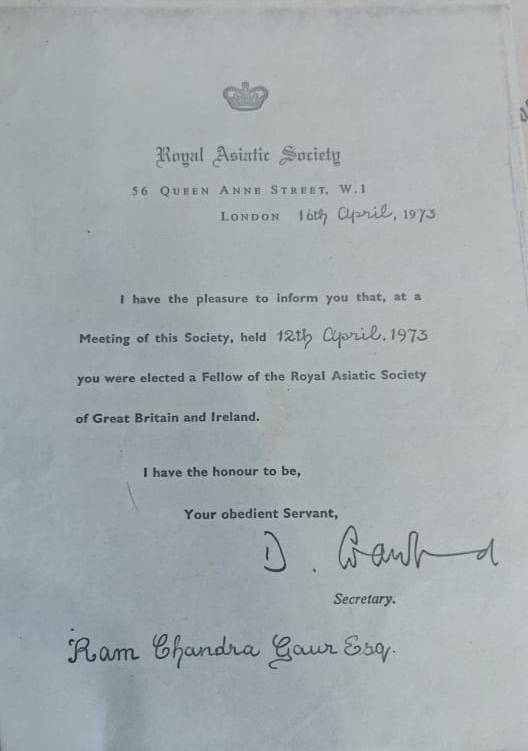
Many honours came his way. The Aligarh Muslim University appointed him Reader in 1967 and Professor of Archaeology and Ancient Indian History in 1978. When he retired on 31 July 1989, he was the Dean, Faculty of Social Sciences, and Chairman, Department of History. He was Visiting Fellow of the Institute of Archaeology University of London, 1971-72. While at London he not only had attended a number of International conferences in London and Paris but had also the honour of being made a Fellow of the Royal Asiatic Society of Great Britain and Ireland in 1973.

He was also appointed as the General President of Indian Archaeological Society in 1988.


Professor Gaur’s last ten years were quite tragic as a consequence of a cerebral infection which kept him in a coma for a long period of time. Yet his strength of will seemed to triumph over everything. With the full support of his family he went on working to the last. His reports on Lal Qila and Fatehpur Sikri excavations appeared during the years that he was so disabled and could speak and move only with difficulty. And yet he also compiled and published during the same time his catalogue of the major items of statuary and sculpture at the Aligarh University’s Archaeological Museum, which he had so assiduously assembled, and to which he gave the name “Sir Syed Collection” in honour of the AMU’s founder.
To honour his memory and in recognition to his immense contribution to the field of Indian Archaeology, a special gallery at Musa Dakri Museum was dedicated to his name in 2018. The gallery was formally inaugurated by the Dr Tariq Mansoor, the Vice Chancellor, AMU on 27th August 2019. It houses the archaeological material and artefacts from various excavations conducted by him and others at the Department of History, AMU

Syed Ali Nadeem Rezavi