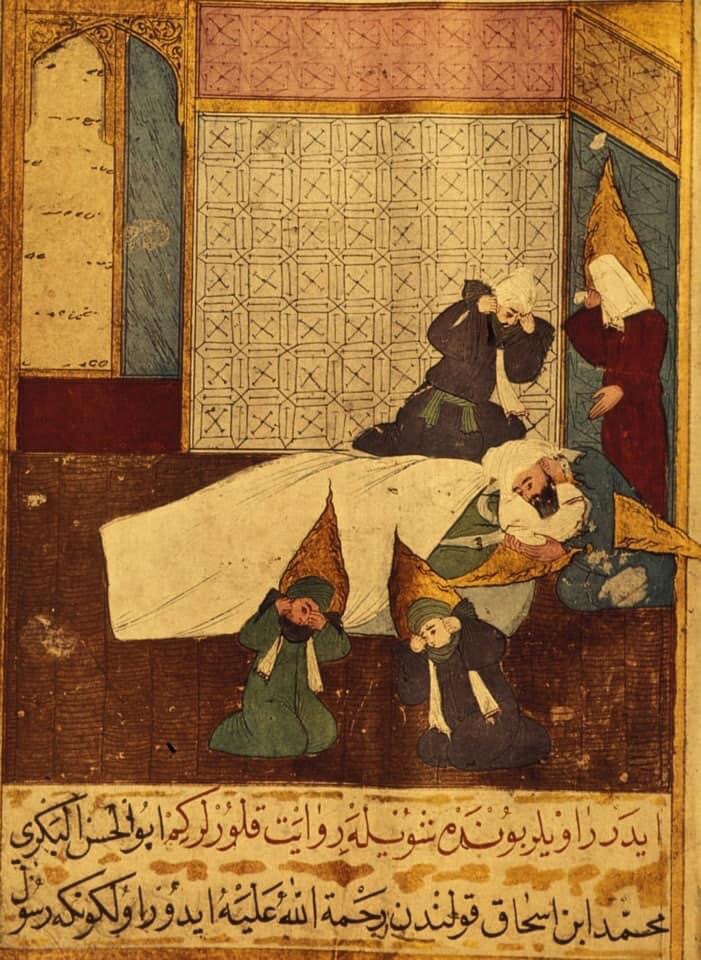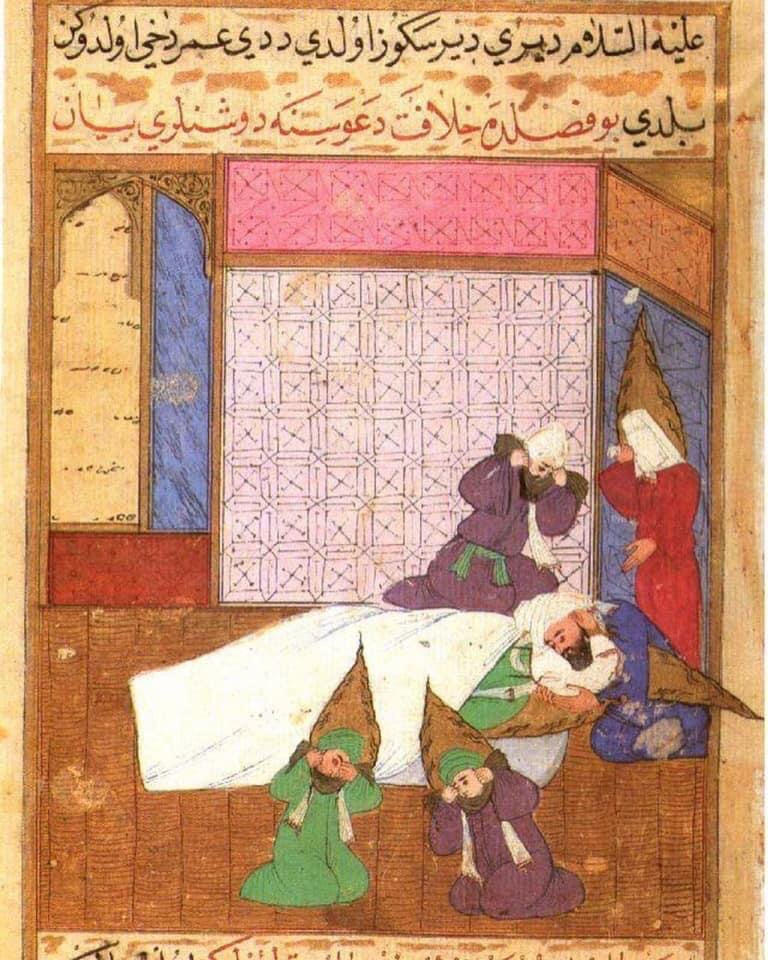
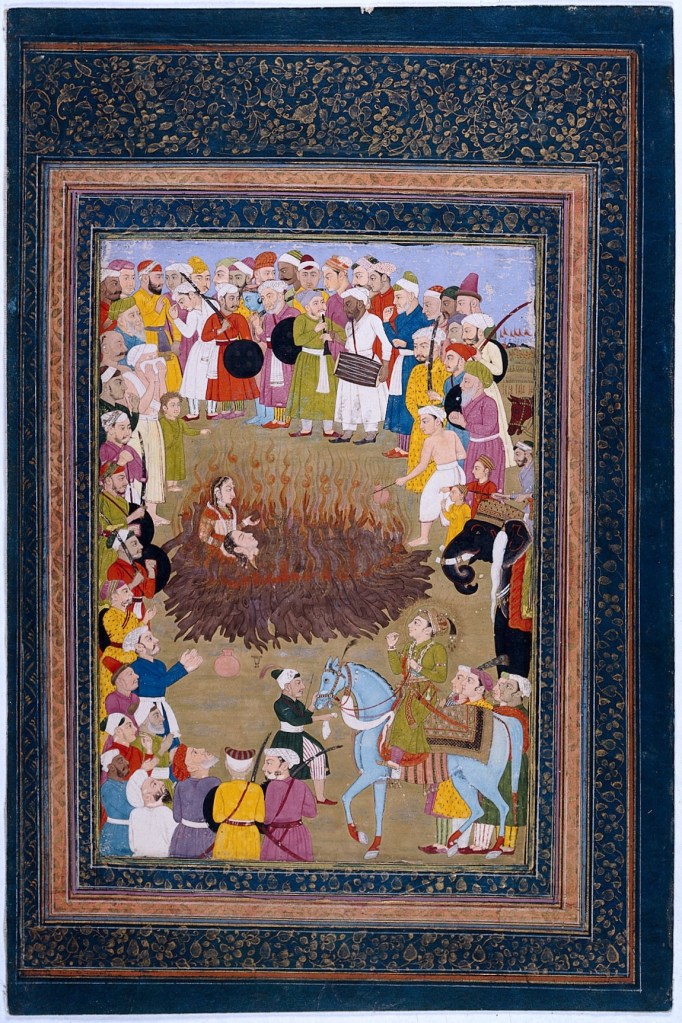
A Hindu princess committing sati against the wishes of the Emperor Akbar but with his reluctant consent
Description
Depicts a scene in the work Sūz u gudāz (“Burning and melting”) by Muhammad Rizā Nau’ī of Khasbushan (d. 1610). In the right foreground, on horseback, is Prince Dāniyāl, Akbar’s third son, from whom Nau’ī received the story. 18th Century
Raja Rammohan Roy is one of the most outstanding personalities of the 19th Century India who is known for his religious, social, literary, educational and political activism which was backed by a robust intellect and a high degree of rationalism. His endeavours backed by reason included a crusade against multiplicity of gods and image worship in the field of religion; a movement against social evils like sati, child-marriage and man’s ill-treatment of women; an advocacy for introduction of ‘modern’ learning in place of classical subjects, as well as a strong plea for liberty for the entire humankind. Much has been written on his thought; many have analysed him as a social and religious reformer. He has also been analysed as a political activist who stood for the freedom of the press and improvement of the system of trial by Jury. My object, however, is to analyse the source which might have gone to shape his early views and thinking.
Rammohan Roy’s first major work, Tuhfatu ‘ul Muwahhidin (Gift of Monotheists), written in Persian around 1804, brings out the central themes of his developing thought.[1] In this work, which addresses both Hindus and Muslims, he tried to argue that Hinduism in its pristine form does not allow image-worship. In its rejection of image worship and its case for proximity between monotheistic Hindus and Muslims, this book clearly drew upon a tradition, to which Akbar, Abu’l Fazl and Dara Shukoh had already greatly contributed.
Thus at one place he writes:
“…some people having a firm belief in the sayings of their leaders, think some stones and vegetables or animals to be the real objects of their worship; and in opposing those who may attempt to destroy those objects of their worship or to insult them, they think shedding the blood of others or sacrificing their own lives, an object of pride in this world, and a cause of salvation in the next. It is more strange that the mujtahids or religious expounders of them also after the examples of their leaders of other religions, putting aside justice and honesty, try to invent passages in the form of reasonable arguments in support of these articles of faith, which are evidently nonsensical and absurd, and thereby try to give strength to the faith of the common people, who are deprived of insight and discretion.”[2]
Rammohan Roy tried to argue the centrality of the concepts of tauhid (monotheism) and ‘aql (reason / rationalism). In the Introduction to his pamphlet he says:
“I travelled in the remotest parts of the world, in plains as well as in hilly lands, and found the inhabitants thereof agreeing generally in believing in the personality of One Being Who is the source of all that exists and its governor, and disagreeing in giving peculiar attributes to that Being and in holding different creeds consisting of doctrines of religion and precepts of haram (forbidden) and halal (lawful). From this Induction it has been known to me that turning generally towards One Eternal Being, is like a natural tendency in human beings and is common to all individuals of mankind equally. And the inclination of each sect of mankind to a particular God or Gods, holding certain especial attributes, and to some peculiar forms of worship or devotion, is an excrescent quality grown (in mankind) by habit and training.”[3]
It was the blind following (taqlid) in the precepts of the crafty ‘leaders’, the mujtahids or religious expounders, which led the followers (muqallids) astray:
“…a mujtahid or religious expounder girds up his loins to invent traditional and rational arguments in order to give strength to the doctrines of his faith. The muqallids [or common people following that religion by blind imitation] who are always anxious at heart to give preference to their faith to other religions according to the proverb that “A ‘Hoo’ is sufficient for (exciting) a mad fellow”, making those invented and gilded arguments the grounds of their dissensions pride in their own faith, and decry the faith of others.”[4]
Rammohan Roy asserted that ‘aql (reason) should be the instrument to reach the truth and a safeguard against fallacy:
“O God! Notwithstanding implicit faith in the orders of the mujtahids or the doctors of religion, there is always such an innate faculty existing in the nature of mankind that in case any person of sound mind, before or after assuming the doctrines of any religion, makes an impartial and just enquiry into the nature of the principles of religious doctrines, of different nations, there is a strong hope that he will be able to distinguish the truth from untruth and true propositions from fallacious ones, and also he, becoming free from the useless restraints of religion, which sometimes become sources of prejudice of one against another and causes of physical and mental troubles, will turn to One Being who is the fountain of the harmonious organization of the universe, and will pay attention to the good of society.”[5]
He argued that both Hinduism and Islam as practiced were false:
“…it may not be improper if it be said that all of them are either right or wrong. In the former case, two contradictories come together [ijma’ al naqizain] (which is logically inadmissible). In the latter case, it may not be improper if it be said that either falsehood is to be attributed to some religions particularly or commonly to all; in the first case tarjih bila murajjeh, i.e. giving preference without there being any reason for it (which is logically inadmissible) follows. Hence falsehood is common to all religions without distinction.”[6]
Yet again there is a long passage in which Rammohan Roy argues the falsehood of all the religions. While contesting the view that one religion supersedes the other in the same fashion as one government replaces the other, he gives the examples of the contradictory position of the Hindus and Muslims and then concludes:
“Now, are these contradictory precepts or orders consistent with the wisdom and mercy of the great, generous and disinterested Creator or are these the fabrications of the followers of religion? I think a sound mind will not hesitate to prefer the latter alternative.”[7]
However, he argued that both Hinduism and Islam interact as both had a core of tauhid and their practitioners were muwahhids (monotheists):
“…belief only in one Almighty God is the fundamental principle of every religion.”[8]
The position of Raja Rammohan Roy as far as the concept of muwahhids is concerned appears to have been from non Sufistic traditions. It appears to be similar to the one which we find reflected in the khatima of Akhbar ul Akhyar where Abdul Haqq Muhaddis Dehlavi (a divine of Akbar’s period) mentions that as a child when he enquired from his grandfather regarding Kabir’s faith, whether a Muslim or a non-Muslim, he was informed he was a muwahhid. When Abdul Haqq further enquired what it meant, he was answered that he was too young to grasp the meaning. Incidentally the same thought is reflected in one of the famous couplets of the 19th Century Urdu poet, Mirza Ghalib:
“Ham muwahhid hain hamara kesh hai tark-i rusum
Millatein jab mit gaeen, ajza-i iman ho gaeen!”
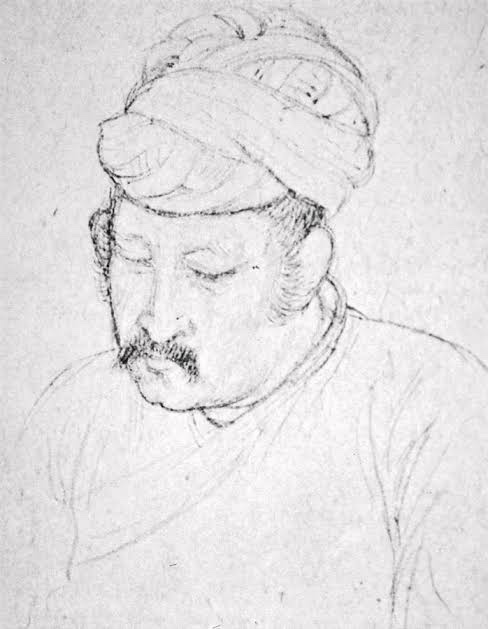
The emphasis on rationalism, rejection of taqlid and an attempt to address both Hinduism and Islam seems to have started during the 16th and 17th Century. With Akbar (1556-1605), the great Mughal emperor, the perception of India as home to different traditions interacting and adjusting with each other, had received a fresh reinforcement, notably under the dual impetus of pantheism and a revived rationalism. The officially organised translations of Sanskrit works into Persian were followed by a detailed account of the society and culture of India (inclusive of its Muslim component) in Abu’l Fazl’s official record of Akbar’s empire, the A’in-i Akbari. Akbar’s attitude towards this cultural heritage is not, however, one of uncritical sympathy. He could not accept the inequities that he felt were built into the traditions of Hinduism and Islam, notably in the treatment of women (child marriage, sati, unequal inheritance) and slaves (especially, slave trade). Moreover, the influence of tradition (taqlid) was too strong, and this he thoroughly disapproved of. He therefore even tried to frame a secular and scientific syllabus for education in both Persian and Sanskrit. Such groping towards a combination of patriotism with reform seems to anticipate strikingly the core of the 19th- century Renaissance that was to spread out from Bengal with the writngs of Raja Rammohan Roy.
It appears that by 16th Century the ishraqi (Illuminationistic) philosophy of Shihabuddin Suhrawardi was knocking at the doors of India. Its basic premise was that knowledge is available to man not through ratiocination alone but also, and above all, through illumination resulting from the purification of one’s inner being. Suhrawardi founded a school of philosophy which some have called theosophy in its original sense, that is, mystical philosophy through and through but without being against logic or the use of reason. He criticized Aristotle and the Muslim Peripatetics on logical grounds before setting about expounding the doctrine of ishraq.[9] This doctrine was based not on the refutation of logic, but of transcending its categories through an illuminationist knowledge based on immediacy and presence, or what Suhrawardi himself called ‘knowledge by presence’ (al-‘ilm al-huzuri), in contrast to conceptual knowledge (al-‘ilm al-husuli) which is the ordinary method of knowing based on concepts.[10]
Abul Fazl and his father, Shaikh Mubarak had both come under the influence of this ishraqi philosophy. They had also imbibed the pantheistic thought of ibn ‘Arabi,[11] who was primarily a mystic who believed that he possessed superior divinely-bestowed knowledge. He held that whereas the divine Essence is absolutely unknowable, the cosmos as a whole is the locus of manifestation of all God’s attributes. Moreover, since these attributes require the creation for their expression, the One is continually driven to transform itself into Many. The goal of spiritual realization is therefore to penetrate beyond the exterior multiplicity of phenomena to a consciousness of what subsequent writers have termed the ‘unity of existence’. This entails the abolition of the ego or ‘passing away from self’ (fana‘) in which one becomes aware of absolute unity, followed by ‘perpetuation’ (baqa’) in which one sees the world as at once One and Many, and one is able to see God in the creature and the creature in God.
Support for Reason in Akbar and Abul Fazl was from a pantheistic position. It followed that Religious and other differences are illusory and so must be tolerated. It further meant that Reason must be tolerated and indeed placed on a high position.
Describing Akbar’s spiritual views, Abul Fazl writes:
“When world-ornamenting wisdom-giving God desires that the essence (gauhar) of humankind should come into existence, and from that diversity in the degree of (spiritual) capacity, the cloud of Duality (do-rangi) rises and fashions Religion (din) and World (dunya), every creature begins to have a distinct leader (kargiya), and these become engaged in mutual denunciation. As lack of vision and unwisdom become the touchstone, the knowledge of (true) worth and acquisition of love become scarce. Otherwise, what is religion, what is world?”[12]
This passage, according to Irfan Habib marks the starting point of Abul Fazl’s thought where he invokes reason (‘aql) and both religion and secular sphere are placed at par.[13] As a result we come across the policy of sulh-i kul, the tolerance of all diversity. From 1578-79 onwards as a result of this policy Akbar opened a discourse with leading men of all religions and appointed men of different faiths to high offices.[14] It is interesting to note that Fr.Monserrate, the Jesuite missionary to the court of Akbar in 1581 disgustingly remarked that Akbar “cared little that in allowing everyone to follow his own religion, he was in reality violating all religions.”[15]
Emphasizing Reason Abul Fazl at one place writes that the true, the just sovereign ‘shall not seek popular acclaim through opposing reason (‘aql).’[16] In fact Abul Fazl quotes a ‘happy saying’ of Akbar that:
“The case for pursuing reason and rejection of traditionalism (taqlid) is so clear that it does not need any argument from me. If tradition is to be held excellent, all prophets would have just followed their ancestral customes.”[17]
In fact Abul Fazl anticipates Raja Rammohan Roy in the spirited condemnation of blind following (taqlid) when he writes why Indian beliefs and culture had not been more closely studied by Muslims:
“The fifth [reason], the blowing of the heavy wind of taqlid, and the dimming of the lamp of khirad (reason, wisdom). Of old, the door of ‘how and why’ has been closed; and questioning and enquiry have been deemed fruitless and the act of a pagan (kufr). Whatever one received from one’s father, teacher, kinsman, friend and neighbour was considered the wherewithal of Divine favour; and the holder of a contrary opinion was accused of heresy and impiety. Though some of the enlightened have tried to pursue a different path, yet they have followed the path of (correct) conduct no more than half-way.”[18]
While the name of Akbar and Dara Shukoh are often linked together in discussions of religious policies of the Mughal court, however, there are certain important distinctions to be made. Akbar and his circle were unaware of Shankaracharya and his version of the Vedanta; Abu’l Fazl’s detailed account of Hinduism in the A’in-i Akbari has no reference to that seer. But when Jahangir met Jadrup (Chitrupa), a yogic follower of Shankaracharya, he propounded a crucial equation, identifying Vedanta with Sufism. The equation could only be valid if Sufism was interpreted in the light of Ibn Arabi’s philosophy of Unity of Existence, and Shankararacharya’s pantheism.
Dara Shukoh’s major achievement was to underline and prove this equation. Unlike Akbar, he was deeply mystical and had little or no interest in nationalism. It was the mystic path that led him to Majmu ‘al Bahrain, seeking an identity between Sufic and Brahmanical concepts. This was followed by his translation of over 100 Upanishads, the Sirr-i Akbar, completed in 1657. Here we suddenly find a meeting ground between not Akbar and Rammohan Roy, but between Dara and Rammohan Roy, for the latter followed Dara in translating Upanishads and underlining their importance. While this convergence between the two is important, it is equally important to remember that Rammohan Roy went to Upanishads seeking essentially monotheism while Dara, submerged in mysticism, was seeking pantheism. It is, however, impossible to believe that Rammohan Roy had not read, or at least heard of, Dara Shukoh’s great Persian translation.
The social reforms espoused by Raja Rammohan Roy also appear to have been anticipated under the Mughals. The social evils like sati, child-marriage, man’s ill-treatment of women and slave trade seem to have troubled Akbar’s conscience during the 16th Century as they did Rammohan Roy during the 19th Century. Abu’l Fazl records the views of Akbar on Sati when he writes that Akbar once scornfully remarked that:
One marvels at the magnanimity of men who seek their own salvation through the instrumentality (i.e. self-sacrifice) of the women.[19]
As early as 1578, we find Akbar mildly censuring the husbands who contrived to get their women immolating themselves by spreading false reports of their own death.[20] At least till 1580 the ritual of Sati appears to have been tolerated.[21] However in 1583 we find the emperor personally going to stop such a ceremony. Abu’l Fazl says that the hapless widow was rescued and the “misguided ones” were imprisoned on the imperial orders.[22] Abu’l Fazl then goes on to inform that the emperor ordered the appointment of ‘truthful observers’ in every town to ensure that no forcible Sati took place.[23] An injunction to the kotwal to the same effect is recorded in the Ai’n-i Akbari.[24] Badauni also mentions the prohibition of Sati in the case of “Hindu child-widows who had not enjoyed conjugal relations”.[25]
Akbar did not leave the matters only at suppressing the ritual of Sati. In 1587 he took the step of permitting widows to remarry “in the manner that the people of India do not prohibit”.[26]
Akbar also appears to have been for monogamy. Badauni mentions that in 1587 Akbar in fact issued a decree that no one should marry more than one wife, unless she was barren, on the principle of “one God, one wife”.[27]
A discussion in the Ibadatkhana on 3 October 1578, reported in the first version of the Akbarnama reveals that Akbar during the discussions had himself touched upon the principle of monogamy:
“Under the principle of attachment to one another, which is the foundation of the arrangement of the universe it would be eminently preferable that one should not marry more than one wife in a lifetime…”[28]
The reason given by Akbar as a justification for monogamy was purely based on the concept of mutual devotion between man and woman, an early index of his later tendency to stress the necessity of protecting women against men’s unjust treatment of them.
Another step in the same direction was the rejection of child-marriages. It appears that by 1582 Akbar in response to a petition had passed a law against a marriage between girls and boys of less than twelve years of age.[29] Badauni referring to this order gives the minimum age as 16 years for boys and 14 years for girls.[30] Akbar also believed that marriages were best made between those who were not related, or atleast, closely related.[31]
Abu’l Fazl also records Akbar’s dissatisfaction over the share of women’s inheritance. He felt that the Muslim law in allowing a smaller share to the daughter in inheritance lacked justification since “the weakness of the woman calls for a larger share.”[32] He objected to yet another aspect of the Muslim law of inheritance: if a person died leaving only daughters, his nephew would get the larger individual shares in place of sons.[33] Both these objections show an anxiety to protect and enlarge women’s rights.
Akbar also seems to have been dis-inclined towards slavery. As early as 1562-63, he passed orders prohibiting the imperial soldiers from “making captive the women, children and kinsmen” of the opposing soldiery, and then selling them or keeping them as slaves.[34] In 1582 he liberated his own slaves and ordained that they be now styled as chelas (disciples) who would be free to go anywhere then want.[35] Badauni, however, appears to be sceptic and says that this was nothing but a mere change of nomenclature.[36] Even if we accept Badauni, this view of slavery as an unjust institution is however explicit in this act of the emperor.
Thus we see that almost all the issues which were to be taken up by Raja Rammohan Roy were taken into consideration by Akbar. It is beyond doubt that if there was a single founder of Modern India, it could only be Rammohan Roy. But some of his building blocks had been shaped in an earlier epoch, since many of the questions that troubled him had also troubled others. As I have shown, there are many points in which Akbar and Abu’l Fazl can be treated as Rammohan Roy’s precursors; and in Dara Shukoh he had an earlier admirer and translator of the Upanishads. These convergences could not all have been accidental; for when Rammohan Roy wrote his first work Tuhfatu’l Muwahhidin he shows himself immersed in Persian and Arabic learning; and he had, of course, a family background of Mughal bureaucratic tradition. The connection between Mughal court tradition and Rammohan Roy’s ideas is, therefore, a fertile field one needs to explore.
• Professor Syed Ali Nadeem Rezavi
Bibliography:
Abul Fazl, Ain-i Akbari, ed.H.Blochmann, Bib.Ind., Calcutta, 1867-77 (in two volumes)
Abul Fazl, Akbarnama, ed.Agha Ahmad Ali and Abdur Rahim, Bib.Ind., Calcutta, 1837-87 (in three volumes)
Badauni, ‘Abdul Qadir, Muntakhab ut Tawarikh, ed. Ahmad Ali & Lees, Bib.Ind.,Calcutta, 1864-69 (in three volumes)
Cooper, John, “al-Shihab al-din Yahya al-Suhrawardi”, Routledge Encyclopaedia of Philosophy, ed. Edward Craig & O.Leaman, 1998, vol.9; For online version visit http://www.muslimphilosophy.com/ip/rep/H031.htm;
Habib, Irfan, “A Political Theory for the Mughal Empire: A Study of the ideas of Abul Fazl”, Proceedings of the Indian History Congress, Patiala, 1998
Habib, Irfan, “Akbar and Social Inequities- A Study of the Evolution of his Ideas”, PIHC, Warangal, 1993
Jogendra Chander Ghose (ed.), The English Works of Raja Rammohan Roy, Delhi, 1906 (in four volumes)
Monserrate, Commentary of Father Monserrate, ed. and trans. SN Banerjee and JS Hoyland, Cuttack, 1922
Nasr, S.Hosein, “Mystical Philosophy of Islam”, Routledge Encyclopaedia of Philosophy, ed. Edward Craig & O.Leaman, 1998, vol.6, pp.616-20; For online version visit http://www.muslimphilosophy.com/ip/rep/H004.htm
Rezavi, Syed Ali Nadeem,“The philosophy of Mulla Sadra and its Influence in India”, in Religion in Indian History, ed. Irfan Habib, Tulika, New Delhi, 2007
Yazdi, Muhammad Ha’iri, The Principles of Epistemology in Islamic Philosophy – Knowledge by Presence, Albany, NY, 1992.
Notes:
[1] For an English translation of the text see Jogendra Chander Ghose (ed.), The English Works of Raja Rammohan Roy, Delhi, 1906, vol.IV, pp.941-58.
[2] Ibid. p.946.
[3] Ibid. p.943
[4] Ibid. p.946
[5] Ibid. p.947.
[6] Ibid.
[7] Ibid. pp.954-55
[8] Ibid. p.957.
[9] S.Hosein Nasr, “Mystical Philosophy of Islam”, Routledge Encyclopaedia of Philosophy, ed. Edward Craig & O.Leaman, 1998, vol.6, pp.616-20; For online version visit http://www.muslimphilosophy.com/ip/rep/H004.htm
[10] Muhammad Ha’iri Yazdi, The Principles of Epistemology in Islamic Philosophy – Knowledge by Presence, Albany, NY, 1992. For Suhrawardi and his philosophy see John Cooper, “al-Shihab al-din Yahya al-Suhrawardi”, Routledge Encyclopaedia of Philosophy, op.cit, vol.9, pp219-224; For online version visit http://www.muslimphilosophy.com/ip/rep/H031.htm; For a detailed discussion of these views see my paper “The philosophy of Mulla Sadra and its Influence in India”, Religion in Indian History, ed. Irfan Habib, Tulika, New Delhi, 2007
[11] Abul Fazl, Ain-i Akbari, ed.H.Blochmann, Bib.Ind., Calcutta, 1867-77, II,pp260,276.
[12] Ibid., I, p.158.
[13] Irfan Habib, “A Political Theory for the Mughal Empire: A Study of the ideas of Abul Fazl”, Proceedings of the Indian History Congress, Patiala, 1998, p.331
[14] Akbarnama, ed.Agha Ahmad Ali and Abdur Rahim, Bib.Ind., Calcutta, 1837-87, III, pp271-73.
[15] Commentary of Father Monserrate, ed. and trans. SN Banerjee and JS Hoyland, Cuttack, 1922, p.142.
[16] Ain-i akbari, I, p.3.
[17] Ibid. II, p.229
[18] Ibid., II, p.3
[19] Ain-i Akbari, op.cit., II, p.243
[20] Akbarnama, op.cit., III, p.256
[21] Fr.Monserrate informs that in this particular year Akbar personally witnessed such a ceremony. See, Commentary, op.cit., p.61
[22] Akbarnama, op.cit.,III, pp.402-3
[23] Ibid., p.402; see also Badauni, Muntakhab ut Tawarikh, ed. Ahmad Ali & Lees, Bib.Ind.,Calcutta, 1864-69, II, p.376
[24] Ain-i Akbari, op.cit., I, p.284
[25] Badauni, op.cit., II, p355
[26] Ibid., II, p.356
[27] Ibid.
[28] Akbarnama, Add.26,247,f.296 (a) cf. Irfan Habib, “Akbar and Social Inequities- A Study of the Evolution of his Ideas”, PIHC, Warangal, 1993, pp.300-10
[29] Akbarnama, op.cit, III, p.380
[30] Badauni, op.cit., II, pp.306, 338
[31] Ain-i Akbari, op.cit., p.242; Badauni, II, p.306
[32] Ain-i Akbari, II, p.235
[33] Ibid, II, p.240
[34] Akbarnama, op.cit., II, p.159
[35] Ibid.,III, pp.379-80
[36] Badauni, op.cit., II, p.325
• Professor Syed Ali Nadeem Rezavi