The study of technological developments in India between 800 and 1200 CE has been closely tied to broader historiographical debates about the character of early medieval Indian society and economy. Historians such as D. D. Kosambi, R. S. Sharma, B. D. Chattopadhyaya, Burton Stein, and Irfan Habib have approached the period from different perspectives, but they broadly agree that technological change must be examined within the larger processes of agrarian expansion, regional state formation, and the growth of artisanal production. Unlike the dramatic technological revolutions associated with early modern Europe, technological change in early medieval India was largely incremental and cumulative. Yet these gradual transformations played a significant role in expanding the productive capacity of the economy and integrating regional societies into wider networks of trade and exchange.
One of the most important technological foundations of early medieval economic change was the widespread use and refinement of iron technology, particularly in agricultural implements. The significance of iron in the agrarian expansion of the subcontinent had already been highlighted by D. D. Kosambi, who argued that the diffusion of iron tools facilitated the clearing of forests and the extension of cultivation into new regions. R. S. Sharma later developed this insight further in his influential work Indian Feudalism, where he linked the spread of iron ploughshares and axes to the establishment of new agrarian settlements, particularly in eastern India and the Deccan. According to Sharma, the proliferation of land grants to Brahmanas and religious institutions often led to the colonisation of forested areas, a process that depended materially upon the availability of iron tools for clearing land and cultivating heavy soils. The increasing use of iron ploughshares enabled cultivators to work dense alluvial soils more effectively, thereby expanding the agricultural frontier and increasing the production of surplus.
While Sharma interpreted these developments within a broader framework of feudalization and ruralisation, later historians such as B. D. Chattopadhyaya have emphasized the regional diversity of these processes. Chattopadhyaya has argued that the expansion of agrarian settlements was not simply a result of top-down land grants but also involved complex interactions between local communities, political authorities, and ecological conditions. Technological change—particularly the use of iron tools and improved cultivation techniques—played a crucial role in enabling these transformations. The spread of agriculture into forested and marginal regions fundamentally altered the landscape of early medieval India, contributing to the emergence of new villages, local markets, and regional political centres.
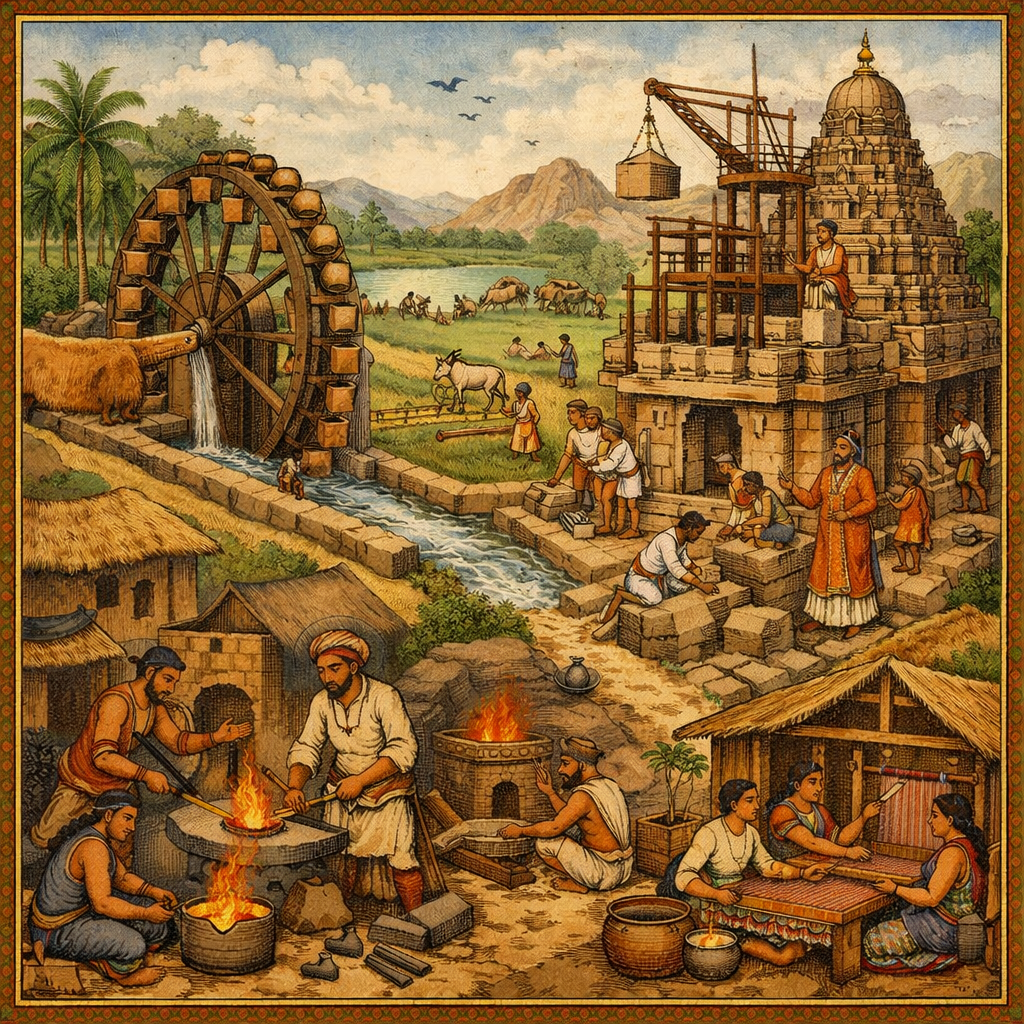
Closely connected with agrarian expansion were developments in irrigation technology, which allowed cultivators to stabilise agricultural production in environments subject to seasonal rainfall variability. Early medieval inscriptions and literary sources refer to several devices used for lifting water from wells and rivers. Among these was the araghatta, a mechanical water-lifting device consisting of a rotating wheel fitted with a chain of earthen pots that raised water from wells through continuous motion. The araghatta appears in both textual descriptions and iconographic representations and seems to have been widely used in northern India. Other water-lifting devices included the shaduf, a counterbalanced lever mechanism, and the charasa, a leather bucket raised by animal power. Such devices enabled irrigation from wells and small reservoirs and were particularly important in semi-arid regions where rainfall was unreliable.
In South India, irrigation technology reached a particularly sophisticated level during the period of the Chola dynasty. Large artificial tanks and reservoirs were constructed to collect monsoon water and distribute it to agricultural fields through canals and sluice systems. These irrigation works were often managed collectively by village assemblies, which organized the maintenance of embankments and the regulation of water distribution. Burton Stein has emphasized that such irrigation systems were central to the functioning of the Chola state and to the prosperity of the Kaveri delta. The technological complexity of these hydraulic systems illustrates the close relationship between engineering knowledge, local institutional organization, and agricultural production.
Metallurgical technology also reached notable levels of sophistication during the early medieval period. India had long possessed an advanced tradition of iron and steel production, and this expertise continued to flourish between the ninth and twelfth centuries. One of the most remarkable products of Indian metallurgy was crucible steel, commonly known as wootz steel. This high-carbon steel was produced by heating iron with carbonaceous materials in sealed crucibles, allowing the metal to absorb carbon and acquire exceptional hardness and flexibility. Wootz steel was widely exported to West Asia, where it became famous for its use in the manufacture of high-quality blades. Medieval Arabic writers frequently praised Indian steel for its superior quality, and the material eventually became associated with the celebrated Damascus swords of the Islamic world.
The production of such steel required considerable technical knowledge, including control over furnace temperatures, fuel composition, and cooling processes. As Irfan Habib has emphasized in his studies of medieval Indian technology, the manufacture of wootz steel demonstrates the existence of highly specialized metallurgical skills among Indian craftsmen. These techniques were transmitted through artisanal traditions and often remained confined to particular regions or communities.
Metalworking extended beyond iron and steel to include the production of copper and bronze objects. The casting of bronze sculptures in South India reached extraordinary levels of technical and artistic excellence during the Chola period. Using the lost-wax casting method, artisans produced bronze icons of remarkable elegance and precision. The creation of such sculptures required detailed knowledge of mould preparation, alloy composition, and casting techniques. These bronzes not only served religious purposes but also testify to the sophisticated metallurgical practices of early medieval India.
Another area in which technological skill was prominently displayed was architecture and construction, particularly in temple building. The early medieval centuries witnessed a remarkable proliferation of monumental temples across the subcontinent. Builders developed advanced techniques for quarrying, transporting, and shaping large stone blocks, as well as for constructing complex superstructures. The temples of Khajuraho, Bhubaneswar, and Thanjavur represent some of the most impressive examples of early medieval architecture.
The Brihadisvara temple at Thanjavur, constructed in the early eleventh century under Rajaraja I, stands as a striking example of engineering skill and architectural planning. Built largely of granite—a material not readily available in the immediate vicinity—the temple required the transport and assembly of massive stone blocks. Scholars have suggested that long earthen ramps may have been constructed to raise these blocks to the upper levels of the temple tower. Such projects required not only technical expertise but also the mobilization of large numbers of skilled artisans and labourers.
Technological developments were equally important in the sphere of textile production, which remained one of the most important sectors of the Indian economy. India had long been renowned for its cotton textiles, and early medieval artisans continued to refine the techniques of spinning, weaving, and dyeing. Vijaya Ramaswamy has shown that textile production relied upon highly specialized craft communities whose skills were transmitted through hereditary training. Indian artisans developed sophisticated dyeing techniques using vegetable dyes to produce textiles of vivid colours and intricate patterns. Techniques such as resist dyeing and block printing were widely practiced in western India, while weaving centres in Gujarat, Bengal, and the Deccan supplied both domestic markets and overseas trade.
Maritime technology also played an important role in sustaining long-distance trade during the early medieval centuries. Indian shipbuilders constructed large ocean-going vessels capable of navigating the monsoon routes of the Indian Ocean. Many of these ships were built using the technique of sewn-plank construction, in which wooden planks were stitched together with coir ropes rather than fastened with metal nails. This technique allowed ships to remain flexible and resilient during long voyages. Knowledge of monsoon wind patterns enabled merchants to undertake regular voyages linking Indian ports with those of Southeast Asia, China, and the Middle East. Such maritime connections contributed significantly to the circulation of goods, technologies, and cultural influences across the Indian Ocean world.
Despite these achievements, historians have debated the broader implications of technological change during this period. R. S. Sharma once argued that the early medieval economy exhibited signs of decline in long-distance trade and urban activity, partly due to the rise of feudal structures. In contrast, scholars such as B. D. Chattopadhyaya and Irfan Habib have suggested that while certain regions may have experienced economic contraction, others witnessed significant growth and technological development. Habib has emphasized that technological innovations in medieval India were often gradual refinements within established craft traditions rather than sudden breakthroughs. The absence of large-scale mechanization should therefore not be interpreted as technological stagnation; rather, it reflects the specific social and economic conditions under which technology developed.
In conclusion, the centuries between 800 and 1200 CE witnessed significant technological developments in agriculture, irrigation, metallurgy, architecture, textiles, and maritime activity. These developments were closely connected to the expansion of agrarian production, the growth of craft industries, and the increasing integration of India into wider networks of trade and exchange. As historians such as Kosambi, Sharma, Chattopadhyaya, Stein, and Habib have demonstrated, technological change in early medieval India cannot be understood in isolation from the social structures and economic processes that shaped it. Instead, technology formed an integral part of the evolving relationship between society, environment, and production in early medieval South Asia.
References
Chattopadhyaya, B. D. The Making of Early Medieval India. Delhi: Oxford University Press, 1994.
Habib, Irfan. Technology in Medieval India c. 650–1750. New Delhi: Tulika Books, 2008.
Habib, Irfan. Medieval India: The Study of a Civilization. New Delhi: National Book Trust, 2007.
Kosambi, D. D. An Introduction to the Study of Indian History. Bombay: Popular Prakashan, 1956.
Ramaswamy, Vijaya. Textiles and Weavers in Medieval South India. Delhi: Oxford University Press, 1985.
Sharma, R. S. Indian Feudalism. New Delhi: Macmillan, 1980.
Stein, Burton. Peasant State and Society in Medieval South India. Delhi: Oxford University Press, 1980.
Chaudhuri, K. N. Trade and Civilisation in the Indian Ocean. Cambridge: Cambridge University Press, 1985.
• Syed Ali Nadeem Rezavi

 ASHA: Blast From The Past