Muhammad taught humanity the path of justice;
Husain ensured that path would never perish.
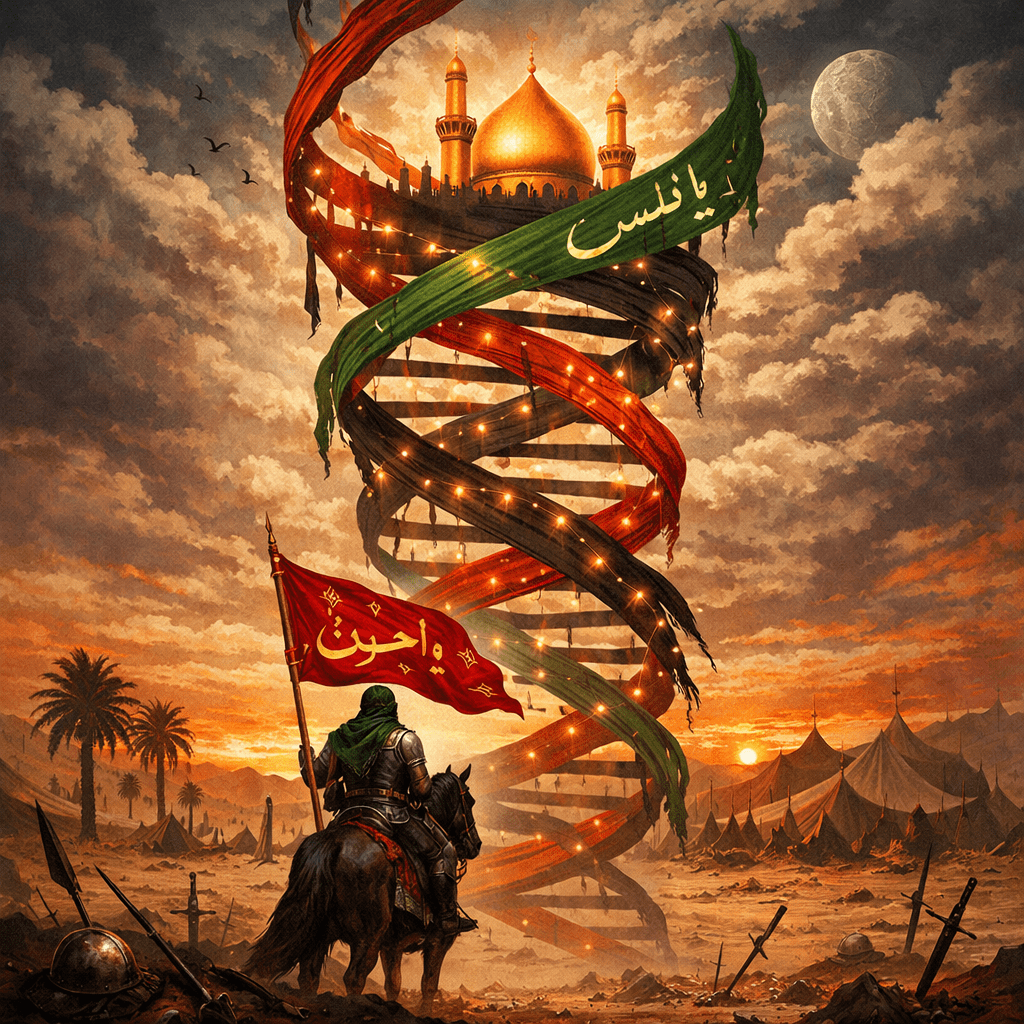
Karbala as the DNA of Shiʿi Identity
Among the many historical events that have shaped the religious and emotional universe of Islam, few have exercised the enduring influence of the tragedy of Karbala. For the Shiʿa, Karbala is not merely an episode in early Islamic history; it is the central moral drama that defines their worldview, their ritual life, and their collective memory. To say that Karbala is the DNA of the Shias is therefore not merely a metaphorical flourish. It reflects the profound manner in which the narrative, symbolism, and ethical message of Karbala permeate Shiʿi theology, ritual practice, historical consciousness, and political imagination.
The Historical Moment
The event of Karbala occurred in 680 CE (61 AH) when Imam Ḥusayn ibn ʿAlī, the grandson of the Prophet Muḥammad, refused to acknowledge the legitimacy of the Umayyad ruler Yazid ibn Muʿāwiya. Ḥusain’s refusal was not a mere political rebellion but a moral protest against what he perceived as the corruption of the Islamic polity. Accompanied by a small group of family members and companions, he was surrounded by the forces of the Umayyad governor of Kufa on the plains of Karbala in present-day Iraq. On the tenth day of Muḥarram—ʿĀshūrāʾ—Ḥusain and his companions were killed after days of thirst and siege, while the surviving women and children were taken captive.
While the immediate historical significance of Karbala was limited in military or political terms, its symbolic power proved immense. The death of the Prophet’s grandson under such circumstances was perceived by many as a moral catastrophe for the Muslim community. Among the Shiʿa, however, the event came to represent the eternal struggle between justice and tyranny.
Karbala as Moral Archetype
For the Shiʿa, Karbala functions as a moral template that transcends time and place. Imam Ḥusayn is not remembered merely as a historical figure but as the embodiment of resistance against injustice. His stand is interpreted as a conscious act of martyrdom intended to preserve the ethical integrity of Islam. In Shiʿi devotional literature, this moment becomes the paradigmatic example of the Qurʾanic injunction to “enjoin good and forbid evil.”
Thus Karbala is not simply remembered, it is constantly reinterpreted. Every generation is invited to ask: who is the Ḥusain of our time, and who is the Yazid? The story becomes a moral grammar through which contemporary events are understood. This interpretive flexibility explains why the symbolism of Karbala has been invoked in various historical struggles, from medieval sectarian conflicts to modern political movements.
Ritual Memory and Collective Identity
If Karbala is the genetic code of Shiʿi identity, its rituals are the mechanisms through which that code is transmitted from generation to generation. The annual commemoration of Muḥarram, culminating in the rituals of ʿĀshūrāʾ and Arbaʿīn, constitutes one of the most elaborate cycles of religious mourning in the world.
Majālis (mourning assemblies), mars̱iya poetry, noha recitations, taʿziya passion plays, and processions serve not merely as acts of remembrance but as reenactments of the tragedy. Through these rituals, believers are emotionally and spiritually transported to Karbala. The participants become witnesses to the suffering of Ḥusain and his companions, and in doing so they renew their allegiance to his cause.
This ritualized memory creates a powerful sense of community. The Shiʿa across different cultures, whether in Iran, Iraq, South Asia, Lebanon, or the diaspora, share a common emotional vocabulary rooted in Karbala. The lamentations of Muḥarram thus function as a cultural and religious adhesive binding together disparate communities.
Karbala in Shiʿi Theology
The theological significance of Karbala lies in its connection to the doctrine of Imamate. In Shiʿi belief, the Imams are not merely political leaders but divinely guided authorities who safeguard the true interpretation of Islam. The martyrdom of Imam Ḥusain therefore represents the suffering of legitimate authority at the hands of illegitimate power.
Over centuries, Shiʿi scholars developed a rich theology of martyrdom centred on Karbala. The martyrdom of Ḥusain is understood as redemptive in a spiritual sense: his sacrifice awakened the conscience of the Muslim community and ensured that tyranny would never go unchallenged. This idea is captured in the famous maxim often attributed to Shiʿi devotional tradition: “Every day is ʿĀshūrāʾ and every land is Karbala.”
Cultural and Literary Expressions
The narrative of Karbala has generated an immense literary and artistic tradition. Persian, Arabic, and Urdu literatures are replete with elegiac poetry commemorating the tragedy. The mars̱iya tradition of Lucknow, perfected by poets such as Mir Anis and Mirza Dabeer, elevated the story of Karbala into one of the most sophisticated forms of classical Urdu poetry.
Similarly, the dramatic performances of taʿziya in Iran and South Asia transformed the narrative into a form of sacred theatre. Visual arts, calligraphy, and shrine architecture, especially at Karbala and Najaf, have also been profoundly shaped by this tradition. Through these mediums, the story of Ḥusayn has been woven into the cultural fabric of Shiʿi societies.
Karbala and Political Consciousness
Karbala has also played a significant role in shaping Shiʿi political thought. The symbolism of resistance embodied in Imam Ḥusain has frequently been invoked during periods of oppression. In modern times, the Iranian Revolution of 1979 famously mobilized the imagery of Karbala, portraying the struggle against tyranny as a reenactment of Ḥusain’s stand against Yazid.
Yet the political interpretation of Karbala is not uniform. For many believers, the lesson of Karbala lies not in revolutionary activism but in moral steadfastness and spiritual resistance. The event thus accommodates a spectrum of interpretations ranging from quietist piety to militant opposition.
Conclusion
To describe Karbala as the DNA of the Shiʿa is to recognize that it functions as the foundational code from which Shiʿi identity derives its meaning. It shapes theology through the doctrine of martyrdom, ritual through the commemorations of Muḥarram, literature through elegiac poetry, and politics through the symbolism of resistance.
More than a historical memory, Karbala is a living narrative. It provides a moral compass that continues to guide the ethical and spiritual life of Shiʿi communities across the world. Through centuries of repetition in ritual, poetry, and collective memory, the message of Imam Husain: resistance to injustice and fidelity to truth, remains embedded in the very cultural and spiritual genome of the Shiʿa.
“Muharram is the month in which justice rose up against oppression, and truth confronted falsehood.”
• Ayatollah Khomeini
• Syed Ali Nadeem Rezavi

 ASHA: Blast From The Past