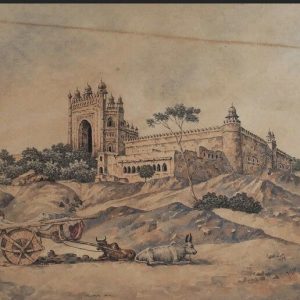

Tarikh-i-Khandan-i-Timuriya (dated between ca.1570–1590)
Khuda Bakhsh Oriental Public Library in Patna, India
Farid was born in 1485-90 at Narnaul at a time when his father Hasan Khan was serving as a petty officer under Umar Khan Sarwani, Hasan Khan made a beginning as a petty officer of 40 horsemen under a Sur officer in 1452-85, after which he had shifted to Narnaul. From Narnaul he had been shifted to the east under Ahmad Khan Lodi, the commandant of Jaunpur who appointed Hasan Khan as a sub-assignment holder of Sahsaram in 1499.
Thus as a child, Farid was educated at Sasaram and then at Jaunpur. In 1510 when he returned to Sahsaram after completing his education he was given the charge of his father’s jagir which he administered for a few years.
His administrative measures, including revenue administration, at pargana Sahsaram are recorded in detail by Abbas Khan Sarwani. As a result of his measures, we are informed he considerably improved the financial position of his pargana. This also enabled him to study in detail the nature of the land-revenue structure in the Sultanate administration. It also gave him an opportunity to establish close contacts with the local zamindars of eastern Bihar. These contacts proved helpful to him in his subsequent career. He used the same area as his base.
It was, again during this period that Farid, began the process of replacing the local chiefs of Sahsaram belonging to the Cheru tribe by a Rajput clan, who called themselves as ‘Ujjainiyas’. But there came a break in his career around 1523 when he developed differences with his father and was obliged to leave Sahsaram.
Subsequently he remained for some time he remained with the Mughal commandant of Jaunpur, Junaid Barlas. It was in Junaid’s company that Farid visited Babur’s court. Abbas Khan Sarwani says observing him Babur remarked “Keep an eye on this person, he seems dangerous”.
On his return, he came to Sahsaram once again and was living as a bandit. He raised a small band and made plundering raids in different directions and raised resources and sustained himself between 1523-28. His father died during this period and Farid got the opportunity to establish himself as his father’s succession at Sahsaram.
Sometime around 1528 he took up service under the Nauhani chief of Bihar, Jalal Khan who had declared himself as an independent king after the overthrow of Lodis. In this period, Farid was able to secure his position in Sahsaram against any immediate pressure of the Nauhani’s. He also utilized this opportunity to consolidate his hold on the region by overcoming or subduing other petty Sur officials who were controlling a number of adjoining parganas. Amongst them the most noteworthy was Muhammad Khan Sur.
By 1532 Farid, who had in the meanwhile earned the title of Sher Khan from Jalal Khan Nauhani, who also picked up quarrel with the dominant section of the Nauhani nobility. He used his newly gained resources and military power to establish an upper hand inside the Nauhani principality. So much so that in 1532, the senior Nauhani chiefs thought that their position in Bihar had become untenable and escaped to Bengal with Jalal Khan. Therefore by the end of 1532, Sher Khan was controlling the whole territory of Bihar south of Ganges up to Talaiya Garhi.
But then the Nauhanis sheltering in Bengal succeeded in persuading the ruler of Bengal to give them military assistance for re-establishing their authority in Bihar.
Thus a number of conflicts between Sher Khan and the Bengalis took place. However, the exact date of these battles is difficult to establish. But a decisive battle took place at Surajgarh, near Talaiyagarhi sometime during 1533, in which the Bengalis were defeated and thus the Nauhanis were totally eliminated from Bihar. Sher Khan became the master of the whole territory from Sahsaram to Talaiyagarhi.
But still in Northern Bihar, at Hajipur ans Saran, there were a large number of Afghan chiefs who belonged to influential and reputed families who had risen to prominence during the Lodi period. There were also a large section of Afghan populace who regarded them as their natural leaders. These groups had added prestige due to the presence of Sultan Mahmud Lodi in their midst. Therefore even after Sher Khan succeeded in establishing his say over Bihar, he was still far from the position of the undisputed leader of the Afghans.
This problem was resolved, though accidentally, by the outcome of the Battle of Dadra.
Then came another significant phase during 1533-36. On account of Bahadur Shah’s mounting pressure on the Mughals on their western and southern flanks, Humayun was prevented from taking any action or measure against Sher Khan. Sher Khan got this respite from 1533 to the end of 1536 to augment his forces. During this period, Sher Khan invaded Bengal and forced its ruler to conclude a treaty with him which stipulated that the ruler of Bengal would not put any claim on any territory in Bihar to the east of Talaiyagarhi. Secondly, that he would be paying an annual tribute to Sher Khan.
During the same period he also succeeded in making an appeal to th national sentiments of the Afghan chiefs in the east and succeeded in rallying them around him.
And thus in 1540 after the battle of Kannauj, Sher Khan was able to capture power. He reigned up till his accidental death at Kalinjar in May 1545.
• Syed Ali Nadeem Rezavi

 ASHA: Blast From The Past