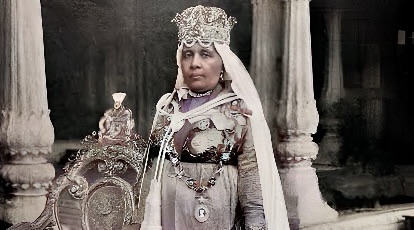
The Sultania Historical Study has been functioning as a part of the Department of History since the very early years of its existence. Named originally as Historical Society, it was renamed after Nawab Sultan Jahan Begum subsequent to MAO Collage being upgraded as a University in 1920. Begum Sultan Jahan, after whom the Sultania Historical Society was renamed, was the Begum of Bhopal who contributed immensely towards the establishment of the MAO College and was ultimately the founding Chancellor of the Aligarh Muslim University between 17 December 1920 to 12 May 1930.
The revival of the earlier Historical Society as Sultania Historical Society was done by the efforts of Prof. A.B.A. Haleem, the then Chairman of Department of History and Politics, Prof. Mohammad Habib and Mr. S. Naushey Ali. At a time when the society was revived in 1923, it emerged as one of the most active societies in the University. Some inkling of its aims and objectives, as well as functioning can be got from a notice to this society recorded in the pages of the Aligarh Magazine dated 1934-35.
From the date of its re-emergence in 1923 the society had well laid out dual objectives, viz., (a) to encourage and popularise the study of History; and (b) to foster research work in History. In order to fulfil these aims, it functioned at three levels. One, it organised excursions of students to various historical sites under the guidance of the faculty members. Thus for example Professors Mohammad Habib and S. Moinul Haq accompanied a tour to Afghanistan which also visited Ghazni in 1932. The same year, another set of teachers accompanied another group of students to historical places in Southern India. We are informed that in order to acquaint the students with historical sites, tours were organized to places like Taxila, Peshawar, Bijapur, Chittor, Ajmer, Sanchi as well as Delhi and Agra. This helped the students to obtain “firsthand knowledge of the actual working of the administrative machinery of, and the general conditions prevailing in the country”.
At the second level, the society organized and arranged lectures and seminars of eminent historians. Thus Fr. Heras, Rushbrooke Williams, Stella Kramrisch, Srinivas Iyengar and Sulaiman Nadvi, amongst others, delivered stimulating and thought provoking lectures, igniting lively discussions and debates.
The third level at which the Sultania Historical Society functioned was the work of bringing out publications. The Publications Programme of the Department in fact was an important work of the society. Important early publications of the Department of History, like Khazainul Futuh of Hazrat Amir Khusrau, edited by S. Moinul Haq, and Sultan Mohmud of Ghazna of Mohammad Habib, are some of the important publications of this Sultania Historical Society.
How and in which circumstances the Sultania Historical Society transformed into a defunct society responsible for organizing only a ‘Farewell Party’ of the M.A. Students is not properly recorded or known. However at least since the 1970’s the Society has only functioned as such. A gold medal, the ‘Sultanjahan Gold Medal’ is also given to the student securing the highest marks at the post-graduate level. The tradition of “appointing” a Secretary of the Sultania Historical Society has however survived the ravages of time. A student securing the highest aggregate marks is usually declared ‘Secretary’ a few days before the ‘Function’ and his/her only duty is to occupy a chair besides the Chairman and the Guest of Honour at the time of the Group Photo-session.
In the past few decades, two “awards” have been added to the Farewell Party which is given the name of the Sultania Historical Society Function: the Razmi Memorial Award (given to a person securing highest marks in the first year with Medieval India) and the Sohail Ahmad Award (to the recipient of highest marks in first year in Ancient India).
Razmi Rizwan Husain was a promising scholar who passed his M.A. (Medieval India) in 1980. He met with a tragic road accident in Delhi in December 1981. At the time of his passing away, he had completed his M.Phil. from JNU under the supervision of Professor Bipan Chandra, and had been appointed as a faculty at Jamia Millia Islamia. The Board of Studies, Department of History, AMU unanimously passed a resolution instituting the Razmi Memorial Award which is a token of appreciation for the aspiring and budding scholars of Medieval India. [Incidentally in Razmi’s memory there is a fellowship each in JMI and JNU. An Annual Memorial lecture is also organised at 11C, New Delhi since the last six years].
Sohail Ahmad, like Razmi Rizwan, was also a student of our Department. He did his M.A. in Ancient India History. He expired in 1992 and his classmates instituted an Award in his name which is given at the Annual Sultania Historical Society function. Both the awards are in the form of a book.
Between 2017-19 during the Chairmanship of Professor Syed Ali Nadeem Rezavi, the Society held weekly seminars and symposiums in which not only the faculty from outside, but research scholars and students were invited to make presentations. Selections from these were included in an online journal Bulletin of the Sultania Historical Society [BOSHS] which was not only uploaded on the department website, but was also made available on the internet archive from where it can still be downloaded.

Unfortunately with the onset of the Pandemic all this ended abruptly. The annual function is still held, but all the academic activities have mostly ceased.

 ASHA: Blast From The Past