
Today it is generally considered that the Muslims have three ‘major’ festivals: Eid, Baqrid and Muharram. However the fact is that amongst them ‘Baqrid’ is the only real occasion which can be labelled as a traditional festival. The first, to be exact, is only a thanksgiving day, the Eid al-Fitr, when after a month long fasting, the devout are required to give charity in the name of God and offer special prayers. The Muharram, on the other hand, is not a “festival” but a commemoration of a tragedy: its a mourning of a martyrdom- that of Prophet’s grandson by a tyrant.
Baqrid or Eid-i Azhā, on the other hand is a commemorative festival: it celebrates the victory of Divinity over self. It is the festival of sacrifice and total submission to the will of God: a feast through which we remember the pure confidence of Abraham in God! It is the day when the great Biblical Prophet through a series of dreams was asked by God to sacrifice his son. He readily agreed, albeit that he tied his eyes with a piece of cloth (in Islamic traditions) so that he may not see his son die. As he attempted to make the sacrifice, as per the Biblical tradition, God replaced his son with a ram! The Holy Quran only says that God proclaimed that He has replaced this sacrifice of Abraham with “The Zibhin Azeem“: the Supreme Sacrifice, which the Shi’i believe is the Sacrifice of Imam Husain of his entire family and friends at Karbala! The Quran, unlike the Bible, makes no mention of the ram. It asks us to remember the Great Sacrifice by offering a sacrifice ourselves.
Following the established Biblical traditions the Muslims started commemorating the event with animal sacrifice: thus the popular name in the Indian subcontinent, ‘Baqr Eid’.
Today the festival has been reduced to a ritual and an occasion of showing off power and wealth, a total negation of its original spirit. Today most do not sacrifice self for God, but celebrate it as an occasion of pelf and show off: whose sacrificial animal is costlier! It has been turned into a festival of self-projection and brutality rather than piety and self negation! In fact the spirit has been totally subverted and the festival is directly reverse of what it was intended to be: occasion of sacrifice and submission to the will of God!
Baqr Eid or Eid-i Azhā is, as pointed out, a commemorative festival which celebrates the victory of Divinity over self. Let us see what does the Qura actually says:
وَفَدَيْنَاهُ بِذِبْحٍ عَظِيمٍ
‘And We ransomed him with a momentous sacrifice’
[Quran, 37:107]
The next verse more revealing:
وَتَرَكْنَا عَلَيْهِ فِي الْآخِرِينَ
‘And We left (this test) for him to the last generations’
In fact there is a very well known saying of Imām Raza, as quoted by Shaikh Sudūq, that the “momentous sacrifice” which replaced the sacrifice of Abraham was that which was offered at Karbala in 61 AH
Biblical Tradition:
One day when Isaac was a boy, God came to Abraham and told him to sacrifice Isaac on Mt. Moriah. Though he loved his son dearly, he did not hesitate to obey the Lord. The very next day, Abraham saddled his donkey and began the journey, with Isaac, two servants, and wood for the sacrifice. As they neared the mountain, Abraham instructed the servants to stay behind, while he and Isaac ascended. Genesis 22:7-8 describes the conversation between father and son as they climbed the mountain:
Isaac spoke to his father Abraham. “Father!” he said. “Here I am,” he replied. Isaac continued, “Here are the fire and the wood, but where is the sheep for the burnt offering?”
“My son,” Abraham answered, “God will provide the sheep for the burnt offering.” Then the two walked on together.
Genesis 22:7-8
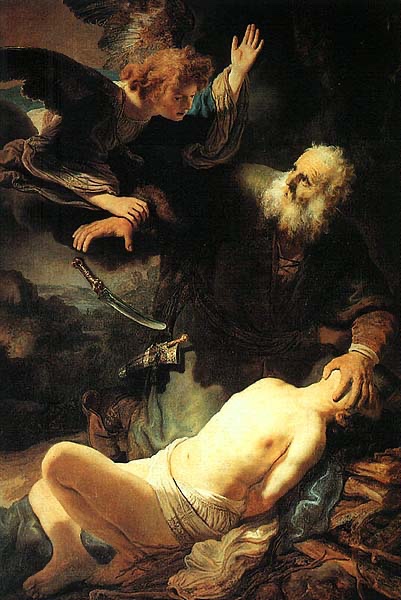
They came to the place where God had told him to go and built an altar. Abraham bound Isaac, arranged the wood on the altar, and drew his knife. But at that moment, an angel stopped him. Genesis 22:11-12 describes:
But the angel of the Lord called to him from heaven, “Abraham, Abraham!” “Here I am,” he answered. “Do not lay your hand on the boy,” said the angel. “Do not do the least thing to him. For now I know that you fear God, since you did not withhold from me your son, your only one.”
Genesis 22:11-12
Abraham noticed a ram caught by his horns in the thicket nearby and offered it to the Lord instead. He called the place “Yahweh-yireh” meaning “the Lord will provide.” After the sacrifice, the angel spoke again to him, saying that he would be blessed for being willing to give all that he had to the Lord, as Genesis 22:16-18 relates:
“I swear by my very self—oracle of the Lord—that because you acted as you did in not withholding from me your son, your only one, I will bless you and make your descendants as countless as the stars of the sky and the sands of the seashore; your descendants will take possession of the gates of their enemies, and in your descendants all the nations of the earth will find blessing, because you obeyed my command.”
Genesis 22:16-18
Quranic Injunction:
The Quran, unlike the Bible, makes no mention of the ram. It asks us to remember the Great Sacrifice by offering a sacrifice of our Self. It was the sacrifice of his personal “self”, in lieu of which God granted him His Will: those who sacrifice and set aside their own ‘nafs’, for the wish of God, are in fact the chosen!
It is however surprising that the Muslims, believe what is not directly said in the Quran and hold dear what had been mentioned in the Bible. Surprisingly, though mentioned in the Biblical text and tradition, the sacrificing of a ram/ lamb on this occasion is neither practiced by the Jews nor the Christians.
Following the established Biblical traditions however, the Muslims started commemorating the event with animal sacrifice, a tradition which was quite popular since remote past all over the world. Being considered as an occasion of sacrifice, in the Indian subcontinent it became popular as ‘Baqr Eid’. As this day is the one when the believers perform Hajj, the circumambulation of the “House of God”, Kaaba, said to have been built by Prophet Abraham, and the pelting of stones at the three Satans and offering sacrifice to Allah, a tradition continued from pre-Islamic days, those who are unable to visit Kaaba also take part in the ritual of sacrifice. Directly the Quran makes no mention of a ram or a lamb, or any quadruped, including cows or camels, the name Baqr Eid stuck. Remember that it is only while performing the ritual of Hajj that sacrificing an animal is compulsory.
Baqr Eid is known by different names. Its actual name is Eid al-Adha (also pronounced as Eid uz Zuha): the Celebration of Sacrifice. It is also called as Eid-i Kabir, the Great Celebration. The popular name, however, in the sub-continent remains Baqrid, derived either from Arabic word “Baqar” (Cow) or “Bakr” (a youthful camel), two animals (and ram/sheep) which were traditionally sacrificed in Arabia. In India, the usual sacrifice is of goats (bakri) or sometimes, buffaloes. Thus many in India call it “Bakri-eid“, mistaking it to be a festival of sacrificing goats!

Today the festival has been reduced to a mere ritual and an occasion of showing off power and wealth, a total negation of its original spirit. Today most do not sacrifice self for God, but celebrate it as an occasion of pelf and show off: whose sacrificial animal is costlier! It has been turned into a festival of self-projection and brutality rather than piety and self negation! In fact the spirit has been totally subverted and the festival is directly reverse of what it was intended to be: occasion of sacrifice and submission to the will of God!
• Syed Ali Nadeem Rezavi

 ASHA: Blast From The Past